
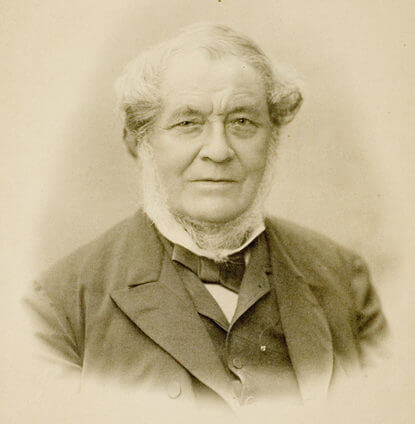
 If you close your eyes and picture a typical chemistry lab, what do you see? Beakers, test tubes, flasks suspended over small, bright-burning flames? The Bunsen burner has become a symbol of chemistry labs around the world, but very few know about the man who helped invent it.
Robert Bunsen (1811-1899) was a German chemist. Like other chemists at the time, he was frustrated by the burners used in laboratory work because the flames were hard to control and produced a lot of soot. Bunsen knew that the soot was a result of incomplete combustion, which occurs when there isn’t enough oxygen available to completely burn the fuel. The solution therefore lay in mixing the combustible gas with just the right amount of air to create a stable, clean flame.
With the help of his lab assistant, Peter Desaga, Bunsen created a metal tube that had holes drilled into the sides at certain intervals through which air could enter and mix with the combustible gas fuel inside the tube. By adjusting the number of open holes with a sliding metal cover, a chemist could control the characteristics of the flame. The result was a very hot and clean-burning flame.

Why did Bunsen care so much about a clean flame? One of his passions was studying the colors produced by adding different substances to a flame, and the soot from older burners skewed the results of his tests. This new burner made it possible to conduct a systematic analysis of the unique colors produced by known elements. Bunsen worked with physicist Gustav Kirchoff to build an instrument called a spectroscope; with it, they were able to identify the characteristic colors of sodium (orange-yellow), potassium (lilac), and lithium (fuchsia pink). Bunsen also discovered the existence of elements cesium and rubidium solely through the colors they produced (sky-blue and dark red, respectively).

Bunsen never took out a patent for his invention, believing science should be done for its own sake and not for profit. Though Bunsen and Kirchoff were not the only scientists studying the relationship between chemistry and the physics of light and color, the Bunsen-Desaga burner—now known as the Bunsen burner—revolutionized the way scientists could conduct new experiments. So the next time you see an image of a Bunsen burner, say thanks to Robert Bunsen and his fiery passion for colors!
Subjects