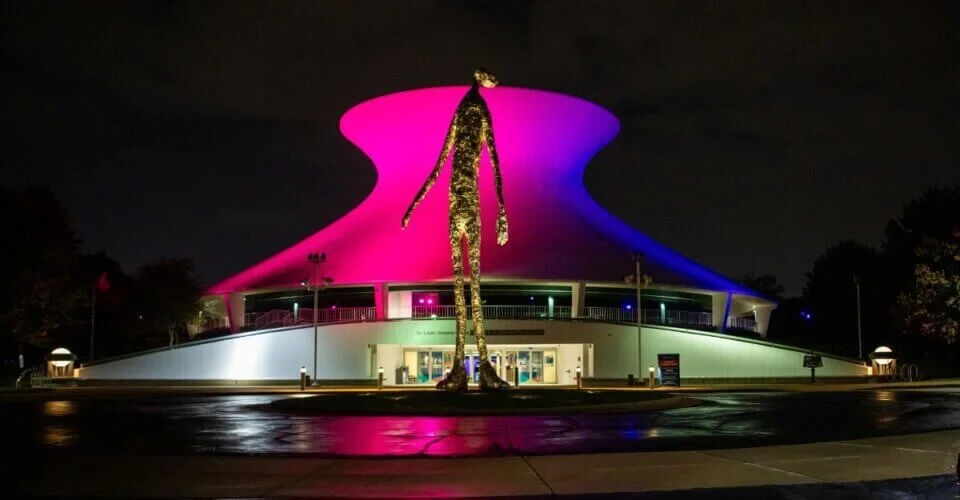
The installation of our new GOTO Chiron III Hybrid with Cosm Digistar projection system, made possible by the St. Louis-based Centene Foundation, will make the James S. McDonnell Planetarium the largest and most advanced hybrid planetarium in the United States.
BUT WHAT IS A HYBRID PLANETARIUM?
Best of Both Worlds
HYBRID PLANETARIUMS feature the best of both worlds by combining an optomechanical star projector for the most realistic night sky with a digital data visualization system to take audiences to the stars and beyond. These two systems work in perfect harmony to create a seamless and immersive world-class experience.
For over 100 years, planetariums have strived to recreate the vastness of space, but the technology utilized has progressed with time.
The earliest planetariums utilized massive optomechanical projectors consisting of highly specialized gearwork and lenses to project a realistic view of the night sky. As the decades passed, optomechanical star projectors have gained new features, shrunk in size, and evolved from using energy- intensive incandescent lamps to LED technology.


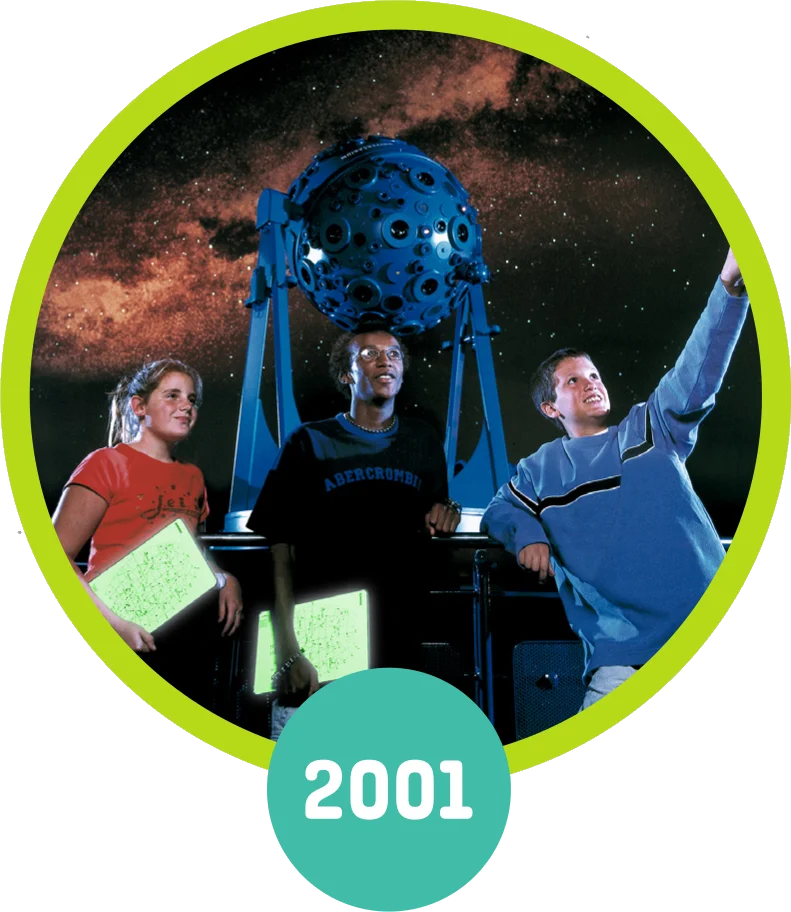
By the 1980s, computers and digital projectors entered planetariums with the ability to display content far beyond the night sky viewed from Earth. Utilizing an array of modern laser-powered projectors or even LED screen technology, digital planetariums now serve as data visualization tools limited in what they can display only by our imaginations.
Modern digital planetariums excel in their flexibility and ability to immerse audiences in content, but the technology is not without drawbacks. Digital systems are limited in resolution, rendering them currently incapable of producing the pinpoint stars necessary to create an accurate and realistic night sky. Digital projectors often struggle with contrast, leading to washed-out projections and further reducing the realism of the planetarium experience.
Heart and Brains
The GOTO Chiron III is the heart of the new hybrid planetarium, and the
Cosm Digistar is the brains. Together, these two technologies will combine to take audiences to the stars and beyond!
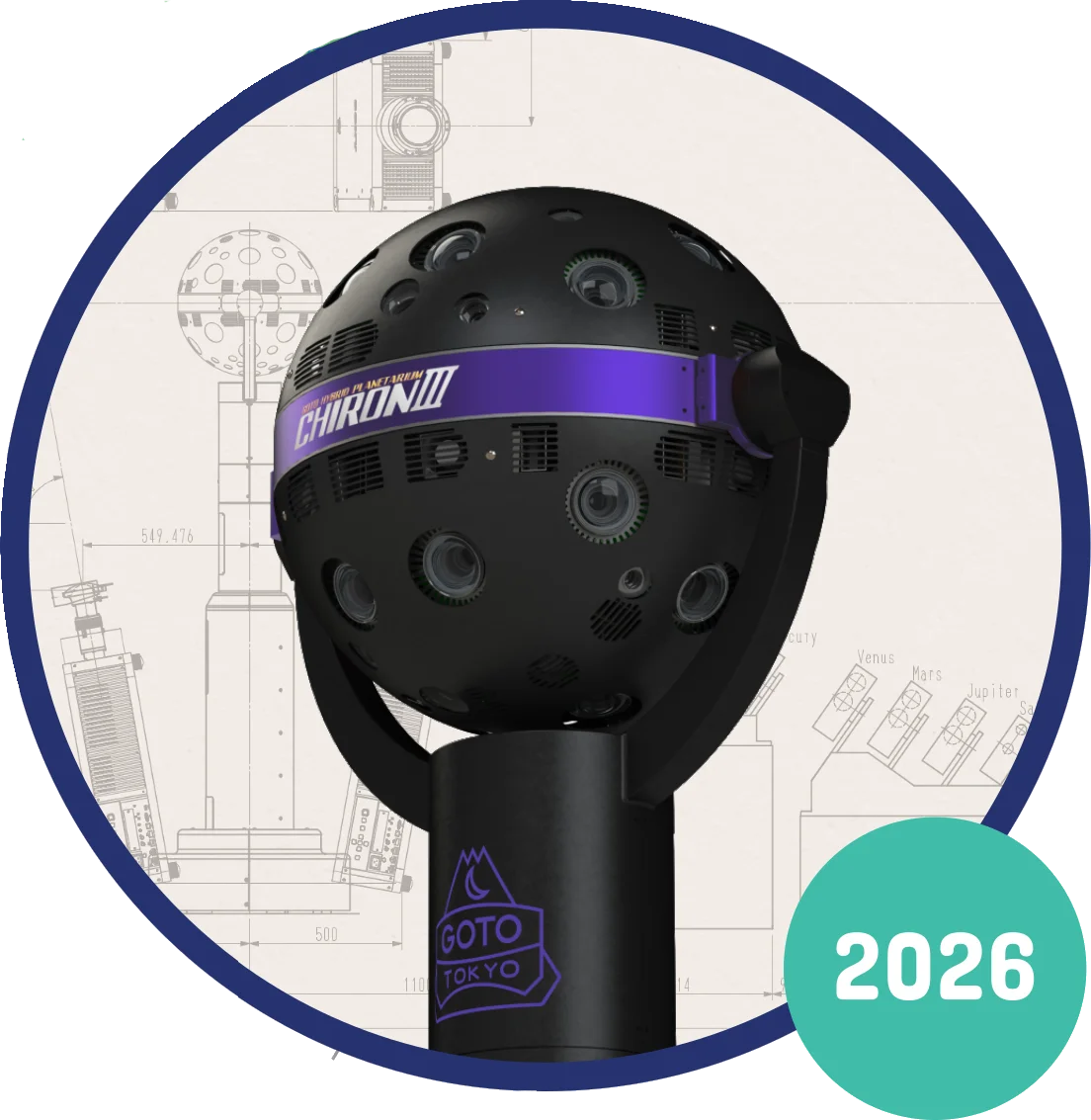
GOTO Chiron III
The GOTO Chiron Ill star projector in our new hybrid planetarium system is a marvel of modern optomechanical technology. In a projector only 18 inches in diameter, high powered LEDs shine their light through proprietary optical fiber light guides to faithfully recreate the night sky viewed from anywhere on Earth.
The optical design of the Chiron Ill uses custom ground lenses utilizing low dispersion and anomalous dispersion glass. The high refractive index of these lenses minimizes chromatic aberration and other optical distortions to create crisp, pinpoint star images less than 4 arc minutes in diameter. This allows the Chiron Ill to produce a sky at a resolution equivalent to nearly 70k.
Further increasing the realism of the Chiron Ill’s projection is its high dynamic range and ability to adjust the brightness of all stars. Previous optomechanical projectors struggled with the brightest stars lacking contrast to the dimmest stars, creating an unnatural and artificial appearance. The dynamic range of the Chiron Ill allows the shapes of constellations to emerge realistically compared to fainter stars and increases the accuracy of the projection.
High- precision gears and motors allow the Chiron Ill to move in all three axes and transport audiences to any location on Earth, 10,000 years into the future or 10,000 years into the past – all within ten seconds or fewer.
Cosm Digistar
The Cosm Digistar component of our hybrid planetarium system utilizes four laser- powered digital projectors to create a 360-degree immersive experience. These projectors are powered by a rack of high- performance computers capable of recreating the entirety of the observable universe and displaying 3D scientific data visualizations.
Preserving a dark night sky is vital for a hybrid planetarium. The Digistar’s already impressive 16,000.1 contrast ratio is further improved by utilizing custom lenses with built- in iris mechanisms. These irises adjust the amount of light the projectors emit, dimming the digital images down when a dark night sky is displayed and allowing them to display their full brightness for vivid images.
The Digistar’s power is provided by real-time access to hundreds of sky surveys and scientific databases. Data from the European Space Agency’s Gaia mission provides the most comprehensive and precise three- dimensional map of the Milky Way galaxy. Additional astronomical and geospatial datasets from NASA, the European Southern Observatory, the National Oceanic and Atmospheric Administration, and a host of observatories and satellites supply new discoveries streamed into the planetarium each day.
On Earth, an advanced terrain engine supports flying into valleys and through mountain ranges with beautiful volumetric clouds and photorealistic tiles. Terrain datasets and detailed elevation data are combined with high resolution up- to- date satellite imagery to give in- context views of scientific data, including changing weather patterns, animal migrations, active satellites, and more, or simply provide beautiful views of the landscape.
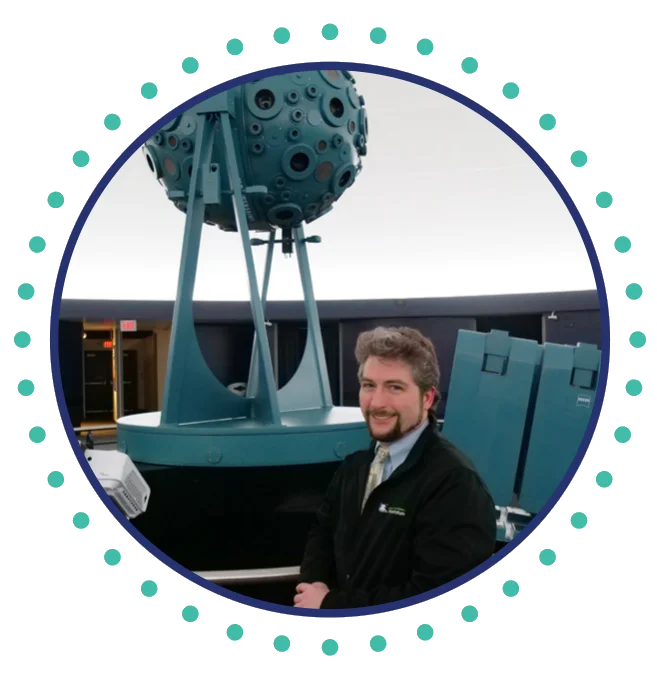
Will Snyder, our own expert on hybrid planetariums, has been Manager of the James S. McDonnell Planetarium since 2019 and has a degree in astrophysics from Clarion University of Pennsylvania. Prior to coming to the Saint Louis Science Center, he was Director of the James H. Lynn Planetarium at the Schiele Museum of Natural History outside of Charlotte, NC and was Director of the Ingram Planetarium in Sunset Beach, NC. Will’s first job working in a planetarium was as a laserist at the historic Buhl Planetarium and Carnegie Science Center in his hometown of Pittsburgh, PA.
Subjects