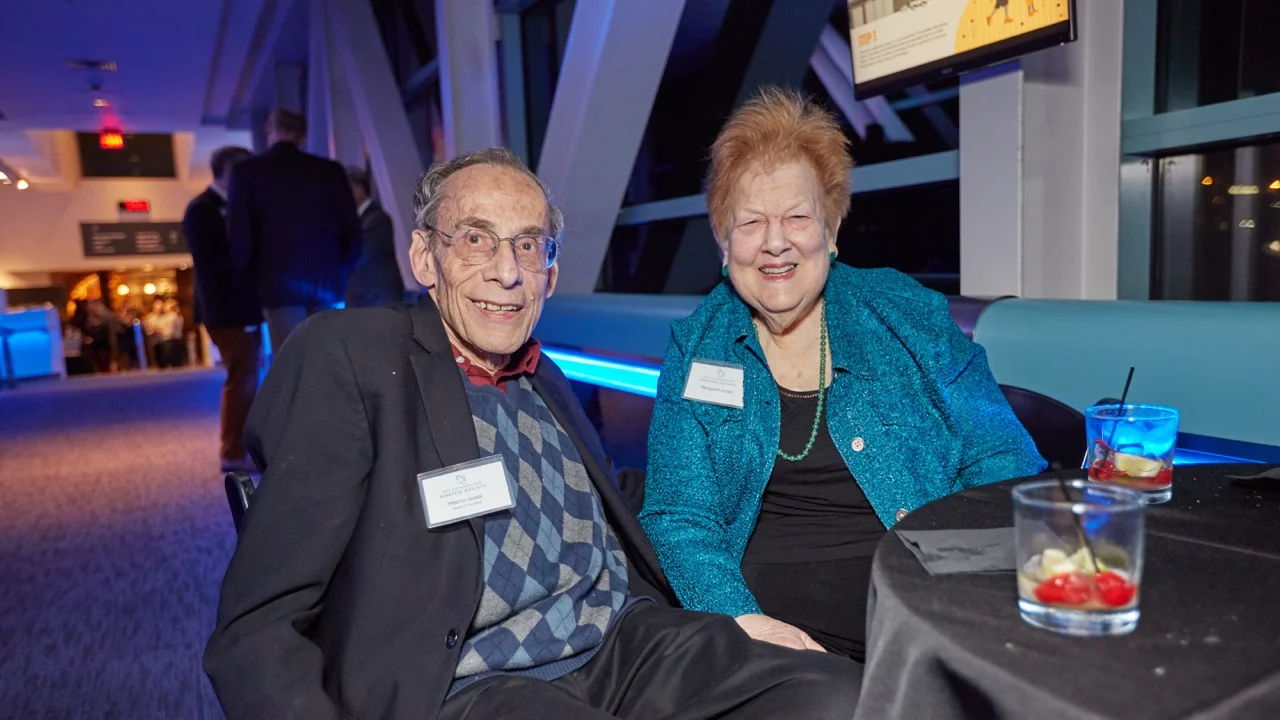
Science has been at the center of life for Margaret and Martin Israel for as far back as they can remember. This includes more than 35 years of commitment to the mission and impact of the Saint Louis Science Center.
The couple—who recently celebrated their 61st wedding anniversary—met at a mixer while Margaret was studying Italian language and literature at the University of California, Los Angeles, and Martin was working on his Ph.D. degree in physics at the California Institute of Technology. Both were serious students who loved to learn, and although Margaret didn’t have a formal academic background in science, just like Martin, she had enjoyed it ever since her childhood.
“I remember visits to the La Brea Tar Pits and the Museum of Natural History, where I was awestruck by saber-tooth tiger bones and dinosaur skeletons,” she says.
After graduating, Margaret and Martin pursued academic careers, first in California before coming to Washington University in St. Louis in 1968. There, they each took positions in Arts and Sciences with Margaret teaching Italian Language and Literature in the Department of Romance Languages and Martin teaching physics in the Department of Physics, instructing courses in Physics and Astronomy as well as conducting basic scientific research.
Martin’s main research focus has been cosmic rays carrying samples of materials from elsewhere in the galaxy. He was a co-investigator on the Trans-Iron Galactic Element Recorder (TIGER) experiment, and one experiment, known as SuperTIGER, involved sending collection instruments on a record-breaking, 55-day high-altitude balloon flight over Antarctica. He has also worked with co-investigators from Caltech, the Jet Propulsion Laboratory, and NASA’s Goddard Space Flight Center to analyze data from the Cosmic Ray Isotope Spectrometer (CRIS) on the Advanced Composition Explorer (ACE) spacecraft.
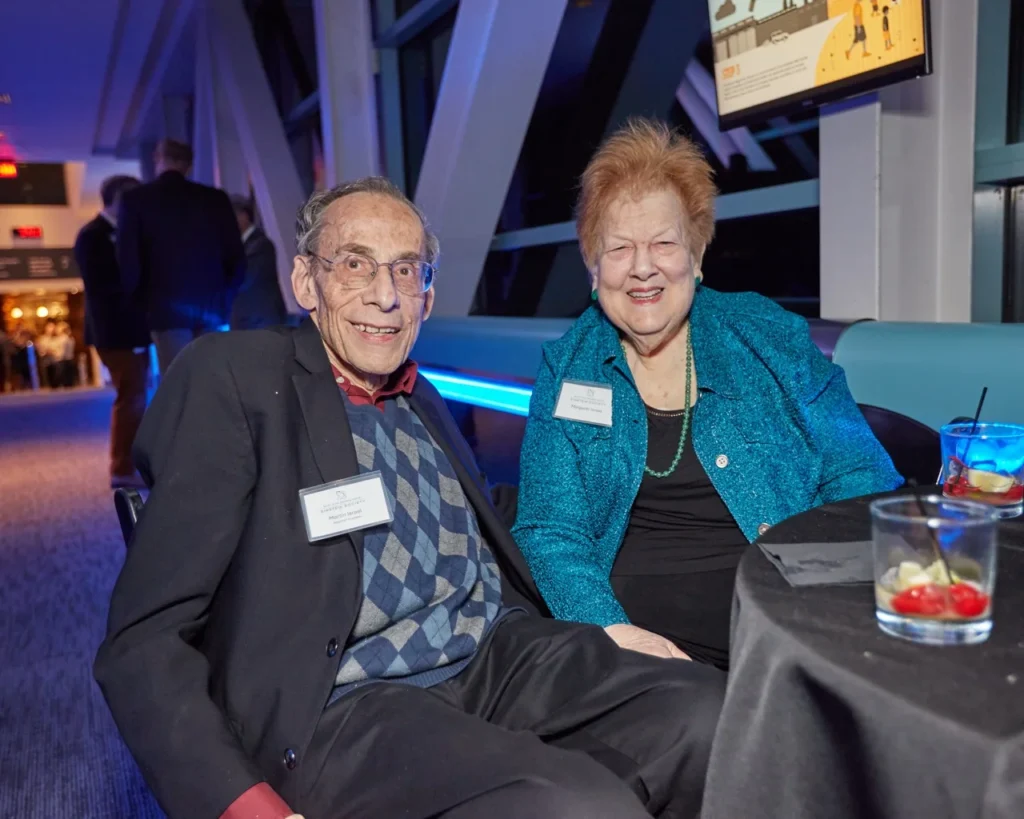
In between his research, Martin spent seven years as Dean of Washington University’s Faculty of Arts & Sciences. When it came to teaching, he most enjoyed introducing astronomy to non-science majors. “It reminded me of my own sense of childhood wonder, looking up at the night sky with an innate curiosity for how things work,” he says. “Those students would ask the best questions after class.”
Both Martin and Margaret encouraged the spirit of curiosity in their own family, bringing their children to places like the Science Center. Elisa, their daughter (who now serves as the Science Center’s Director of Research and Evaluation), loved coming to the museum as a young girl and even into her high school and college years. “We were buoyed by her enthusiasm,” Margaret says, “and it kept us going to things there.”
But the Israels did more than just visit.
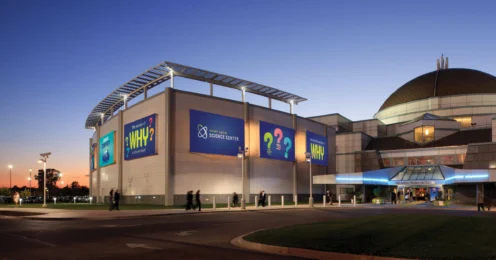
While the Science Center’s expansion was being planned at the Oakland Avenue site, Martin’s astrophysics background and interest in education made him an excellent candidate for the Board of Trustees. This began a tenure of service that extended into 2026, when he decided it was time to step down. Martin was involved in planning major museum renovations, the expansion of educational programming, and visitation growth during this period, guided by a strong moral compass (recusing himself to avoid any conflicts of interest when Elisa was first hired as a gallery assistant).
In 1988, the Israels began supporting the Science Center as members. In 2003, they stepped up to join the Einstein Society because, Margaret says, “science is important to how we function as a community, and we want everybody to feel the importance of what you do at the Science Center.” They love attending Einstein Society events as a meaningful way to connect with others who are passionate about science.
The Israels also contribute to the community through their work with the National Fragile X Foundation. As founders of the Fragile X Resource Center of Missouri, they have helped support families across the nation facing Fragile X, a genetic disorder that their son Sam lives with. They received the National Fragile X Foundation’s Lifetime Achievement Award in 2017 but are most proud of organizing a special night at the Science Center for the entire group when its international convention was in St. Louis.
In 2025, Margaret and Martin helped lead the way as early members of the host committee and donors for WONDER: A Quantum Blast, contributing to the success of the Science Center’s first fundraising event since the Covid-19 pandemic. The reason why was simple. “We wanted to help make a big impression,” they say. “Exploration and looking to the future are critical to discovery, and the Science Center excels at reaching out to the entire community.”
For Margaret, the Science Center is a place for sparking new ideas and unlocking possibilities, helping people of all ages appreciate not just what humanity has learned but also to dream about what we can achieve. “There are always new things to discover,” she says, “And it’s so much easier for a family to enjoy an outing together if they don’t have to worry about an admission fee. We are happy to support that.”
“The value of our Science Center with free admission,” Martin adds, “is to encourage people to explore and try things. Dinosaurs might draw you in the doors, but then you could find yourself immersed in a Planetarium star show or curious about physics after watching an educator dropping something from a balcony to see how fast it falls. Having a place that’s wide open for that type of discovery is wonderful.”