Monday, December 1, 2025
On this date in 2013, China launched the robotic lunar exploration lander Chang’e 3, with China’s first lunar rover, Yutu-hao (‘jade rabbit’). Rover Yutu explored its landing area in Mare Imbrium and sent back pictures of the surface of the Moon for several weeks.
Tuesday, December 2, 2025
On this date in 2013, China launched the lunar lander Chang’e 3 and the lunar rover named the Jade Rabbit. Chang’e 3 successfully landed on the Moon on December 14, 2013 and became the first successful soft landing on the Moon since 1976.
Wednesday, December 3, 2025
On this date in 1910, neon lighting, developed by French physicist Georges Claude, made its public debut at the Paris Motor Show. The colored light is produced by passing electrical current through inert gases in a vacuum tube. Neon gas glows a fiery orange-red; argon is soft lavender; argon gas enhanced with mercury is brilliant blue. More than 150 colors can be achieved by combining different gases and phosphors that coat the inside of the glass tube.
Thursday, December 4, 2025
This morning, Mercury reaches dichotomy. Dichotomy describes when of the face of Mercury is half illuminated when viewed through a telescope. Mercury is halfway through its November 2025 – January 2026 morning apparition and can be viewed above the southeastern horizon before sunrise. It will reach a peak altitude of about 17 degrees.
Friday, December 5, 2025
On this date in 1935, the first large hydroponicum was established in Montebello, California. The word hydroponics was coined in the early 1930s, by Professor Gericke at U.C.L.A. to describe the growing of plants with their roots suspended in water containing mineral nutrients. Hydroponics is used to grow plants on the International Space Station and could be used to support future human deep space missions.
Saturday, December 6, 2025
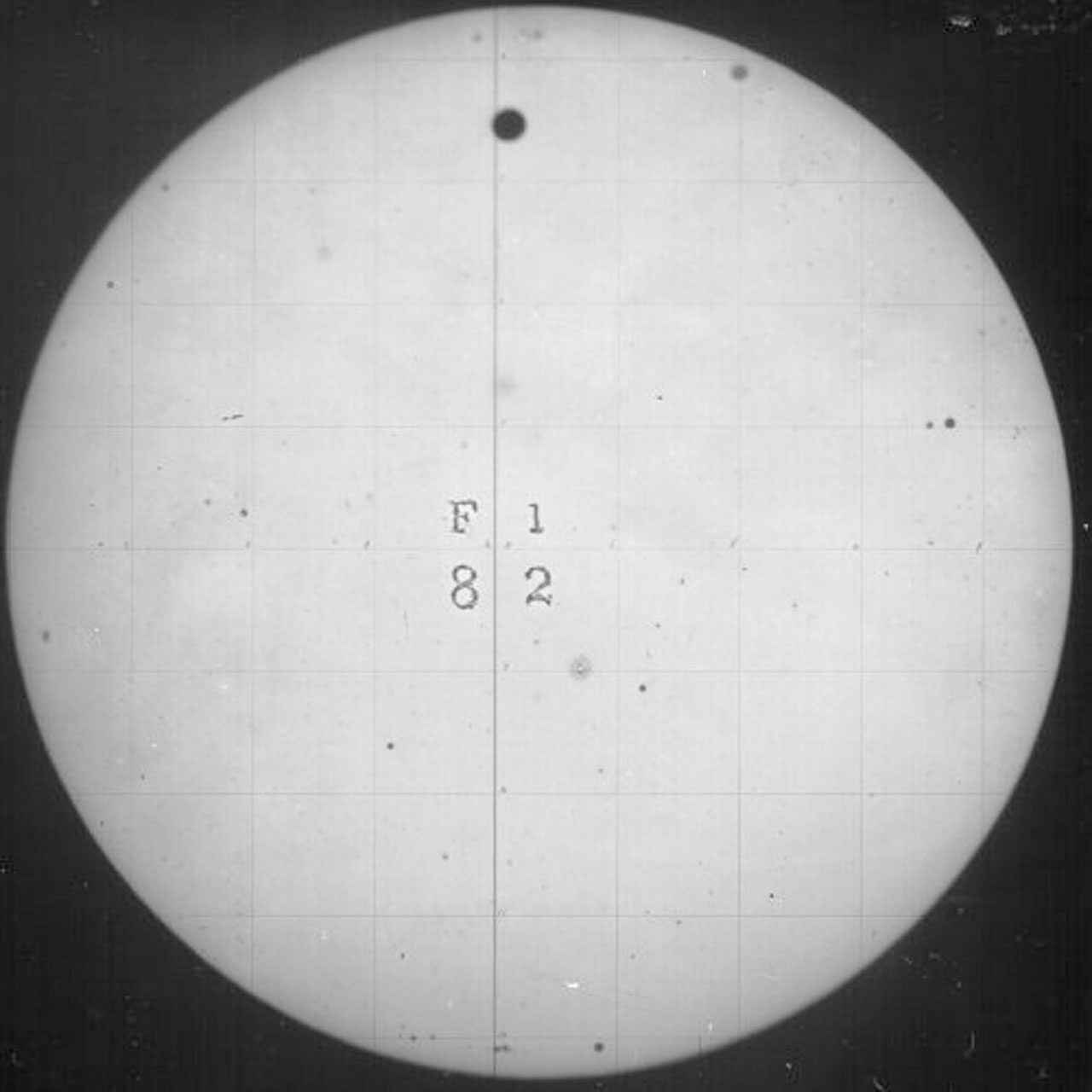
On this date in 1882, the second and final transit of Venus visible during the 19th century occurred. Numerous scientific expeditions were organized around the world to observe the event, and the transit received much public attention. The famous march composer John Philip Sousa would write the “Transit of Venus March” to celebrate the event.
Sunday, December 7, 2025
On this date in 1995, the Galileo spacecraft arrived at Jupiter and entered orbit after 6 years of travel including a flyby of Venus and two asteroids, Gaspra and Ida. Galileo spent a further 8 years examining Jupiter and its moons Io and Europa. In 1994, the Galileo orbiter was present to watch the fragments of comet Shoemaker-Levy 9 crash into Jupiter. Its mission was concluded in 2003 by sending the orbiter into Jupiter’s atmosphere at a speed of nearly 50 km/sec, destroying it to avoid any chance of it contaminating local moons with bacteria from Earth.
Subjects