World-renowned Exhibition Presents New Experiences, nearly 150 Authentic Artifacts, 4-D Simulation & More for Deep Look into City Buried for Centuries
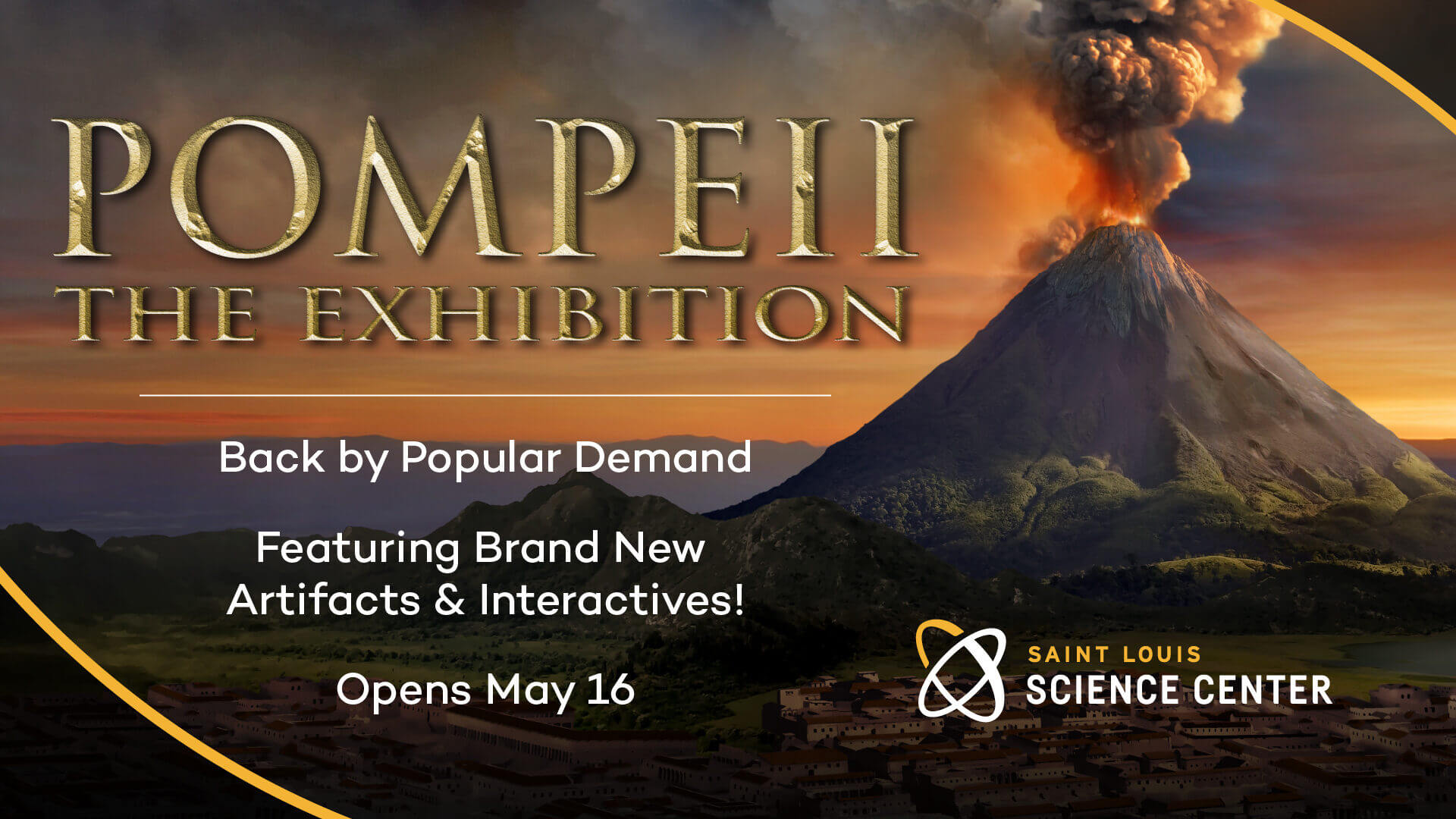
ST. LOUIS, MO – April 23, 2025 – Nearly 2,000 years ago, the eruption of Mount Vesuvius buried the Roman city of Pompeii and its residents under 15 feet of ash and volcanic debris. Archaeologist Giuseppe Fiorelli rediscovered the perfectly preserved city about 250 years ago and found what nature destroyed, it also preserved. Back in St. Louis by popular demand, POMPEII: THE EXHIBITION tells the tale of a city hidden from view and forgotten for centuries through nearly 150 authentic artifacts that examine the lives of Pompeii’s residents before the eruption in August 79 A.D.
“The story of Mount Vesuvius and the destruction of Pompeii is well-recognized around the globe, but the opportunity to connect with the people and the amazing artifacts that have been uncovered from this site like you can in POMPEII: THE EXHIBITION is unparalleled,” Science Center President and CEO Dr. Ray Vandiver notes. “We were fortunate to host the exhibition at the Science Center in 2019, and it quickly became one of our most successful exhibitions because it enables guests to explore life in this ancient city through archaeology, geology, earth science, art history, culture and more. We are thrilled to bring POMPEII — now featuring updates and new artifacts — to our guests this year, as we strive to encourage everyone to be curious and engaged in science.”
Presenting a media-rich, artifact-intensive experience, the 12,000-square-foot exhibition in the Science Center’s Boeing Hall will introduce guests to the people of Pompeii — sharing their customs, their way of life, what they treasured and what they believed. Among the exhibition highlights are:
- Artifacts excavated from the site, including mosaics, frescoes, statuary and other priceless art; jewelry; medical instruments, restaurant pots and other professional tools; household items; and more. Included in this are several artifacts on their first-ever tour amid any exhibition in the United States, such as:
- A first century bronze gladiator helmet and additional armor/weaponry.
- A bronze statue of Apollo that dates to 50 A.D.
- Several fresco paintings — including one of Dionysus and Silenus — and mosaics featuring pigments preserved by the ash layers.
- Intricate glass artwork that survived the eruption.
- Re-creations of an atrium inside a Roman villa, a religious temple, a communal bath and the village market.
- A spectacular display featuring holographic gladiatorial combat and the armor and weaponry used in these battles. (This video display is new to the exhibition and was not part of the previous visit to St. Louis.)
- A 4-D multi-media simulation, allowing guests the opportunity to experience the stages of Mount Vesuvius’ two-day eruption and its monumental impact through sights, sounds, smells and more. (This video display is new to the exhibition and was not part of the previous visit to St. Louis.)
- The aftermath of the eruption, including body casts from several of the region’s 20,000 citizens who were left forever frozen in time by the extreme heat, noxious gases and hardened ash.
Prior to the eruption, Pompeii bustled as a commercial port, a strategic military and trading city, and a resort getaway for Roman nobility. Featuring more than 150 artifacts on loan from the National Archaeological Museum of Naples in Italy and the Archaeological Park of Pompeii, the exhibition provides a picture of life at the height of the Roman Empire, from the perspectives of both elite and everyday Pompeiian citizens. For tickets and more information on what to expect from POMPEII: THE EXHIBITION, visit slsc.org/pompeii.
John Norman, President of NEON’s Artifact Division, producer of POMPEII: THE EXHIBITION, spoke to the exhibition’s fusion of history and technology saying, “The blend of scientific discovery and media-rich retelling of history allows visitors to experience the awe of nature and human ingenuity. We’re thrilled to bring this innovative exhibition back to St. Louis to provide guests with the ability to travel through time and immerse themselves in the beauty of Ancient Pompeii once more. For our return, we’ve added numerous new artifacts to the exhibition, such as emotive theatrical masks, even more gladiatorial helmets and armor, and a stunning statue of Aphrodite, which is the focal point of our Atrium Gallery. These new additions draw guests even further into Pompeii as it once was with breathtaking, real-life examples of archeology, geology, earth-science, art history, culture, and more.”
POMPEII: THE EXHIBITION opens on May 16 and continues through the summer. While admission to the Science Center is free, tickets for a specific timed entry are required to enter this exhibition. Tickets start at $15 for current or new Science Center members of all ages and are now on sale at slsc.org/pompeii or through the Science Center box office.
The Saint Louis Science Center offers free admission to all guests and is open to the public Thursdays through Mondays. For more information about the Science Center, please visit slsc.org or call 314-289-4400.
Contact:
Doug Bolnick, Public Relations Manager
Email or call 314.289.4461
About the Saint Louis Science Center
The mission of the Saint Louis Science Center is to inspire everyone to be curious and engaged in science. Named a Smithsonian Institution Affiliate in 2016, the award-winning Science Center engages guests through on-site experiences, including hundreds of hands-on exhibits, the OMNIMAX® Theater, which is one of just nine IMAX® Dome with Laser theaters in the world, and the James S. McDonnell Planetarium, which was recently named America’s Best Planetarium by the USA Today Readers’ Choice Awards. For more information about the Saint Louis Science Center, please visit slsc.org.
About World Heritage Exhibitions
World Heritage Exhibitions (WHE) is renowned for producing, promoting, and designing the finest quality museum content on the globe. Their exhibitions have captivated, educated, and inspired visitors in virtually every major market on the planet. With a combined 150 years of exhibition experience, the WHE executive team has been responsible for touring many of the world’s most valuable treasures, including objects from King Tutankhamun’s tomb, relics from Cleopatra’s Royal Palace, artifacts from the Titanic, items from the discovery of Pompeii, and more. Their exhibitions have now been enjoyed by over 30 million people spanning six continents, and their collective expertise has come together in one of the industry’s most influential touring exhibition companies.
In 2021, World Heritage Exhibitions became a part of NEON, a global leader in immersive experiences that is responsible for the touring phenomena “Jurassic World: The Experience,” “Harry Potter: Visions of Magic,” “AVATAR: The Experience,” and more. WHE and NEON have brought their expertise together to launch the awe-inspiring, artifact-based exhibitions “Ramses the Great and the Gold of the Pharaohs” and “Machu Picchu and the Golden Empires of Peru,” coupled with some of the most successful artifact exhibitions on tour: “Mummies of the World: The Exhibition;” “Pompeii: The Exhibition;” and “Auschwitz. Not long ago. Not far away.” With decades of expertise in events, exhibitions and logistics, NEON is positioned to support billion-dollar studio IPs and government organizations in the creation of epic experiences for fans & families across the globe.
About the National Archaeology Museum of Naples
A world-class museum located in the heart of the city, the National Archaeological Museum of Naples (MANN) houses one of the most important collections of classical archaeology in the world. Set in the massive 16th century palace, Palazzo degli Studi, the museum was founded by Ferdinand IV in 1777. Formed from the discoveries from the Vesuvian Excavations, which were at the time exhibited in Museo Herculanese in the Royal Palace at Portici, and his family’s extensive collection of art and Roman antiquities (the Farnese collection), the museum holds over three million objects of archaeological and historic importance today.
MANN is certainly the essence of Pompeii, and its important and vast collection of Vesuvian antiquities shows it. It is the museum of the capital of the kingdom of the Bourbons, the place where all the attention to western values of classical culture begins. The Museum includes an incredible patrimony: the world’s most important collection of classical sculpture, brought to Naples by the Farnese family and representing the evolution of western sculpture. Furthermore, MANN is the gate of the Italian culture and of Ancient Greece thanks to discoveries made in the Kingdom of Two Sicilies; it has the second largest Egyptian section — after the one in Turin — with the peculiarity of having a lot of objects that appeared in Italy before the Napoleonic expedition, where you can discover the taste of the pre-Napoleon’s Egyptian culture, and owns a collection of nearly 2,500 documents written in Latin, Greek and dialects of the Italic peoples.
MANN boasts the richest and most valuable collection of artworks and artifacts of archaeological interest in Italy and is considered one of the most important archaeological museums in the world, if not the most important concerning Pompeii’s history.