Day Sky Update April 2026
This is the Saint Louis Science Center’s DAY SKY UPDATE for the Month of April 2026.
Information updated monthly or as needed.
Times given as local St. Louis time which is Central Daylight Time (CDT). For definitions of terminology used in the night sky update, click the highlighted text. If relying on times posted in Universal Time (UT), St. Louis is -5 hours when CDT. Additionally, times will be posted in a 24-hour format.
Join us for our next solar telescope viewing, Sunday, April 19, held in association with the St. Louis Astronomical Society. These viewing sessions are weather dependent. For details, see the information at the bottom of this page or visit https://www.slsc.org/explore/mcdonnell-planetarium/public-telescope-viewings/
Daytime Astronomy Primer
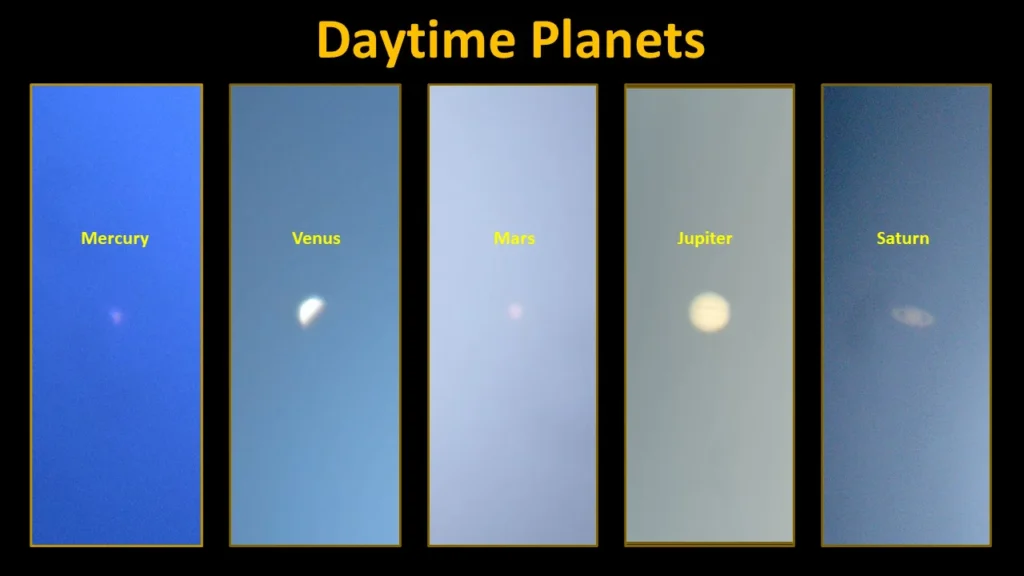
Image shows daytime telescope view of the five naked eye planets. Image credit: Eric Gustafson
For most, astronomy is a hobby that is left to the darkness of night. While most astronomical objects are only visible at night, the day sky can offer a careful observer several astronomical targets along with a multitude of atmospheric phenomena to enjoy. When posted, the DAY SKY UPDATE will explore these possibilities which may include a highlight of the month, cloud observing, sun rise/set times, daytime Moon information, daytime planets and other topics. As always, when viewing during daytime, you must use caution as the Sun is always near.
Aside from solar filters, there are other safety steps that you should consider. Sunscreen, hats and sunglasses are always advisable. Visible light is how we observe the world around us, however, there is light we cannot see such as ultraviolet (UV) and infrared (IR) lights. While both are an issue if you are using an optical system, UV light is an issue through exposure. This can be mitigated by using sunscreen, sunglasses and limiting exposed skin. While sunglasses are not safe instruments to view the Sun with, they do protect your eyes from exposure to ultraviolet light that we are susceptible to during the day.
Observing Highlight
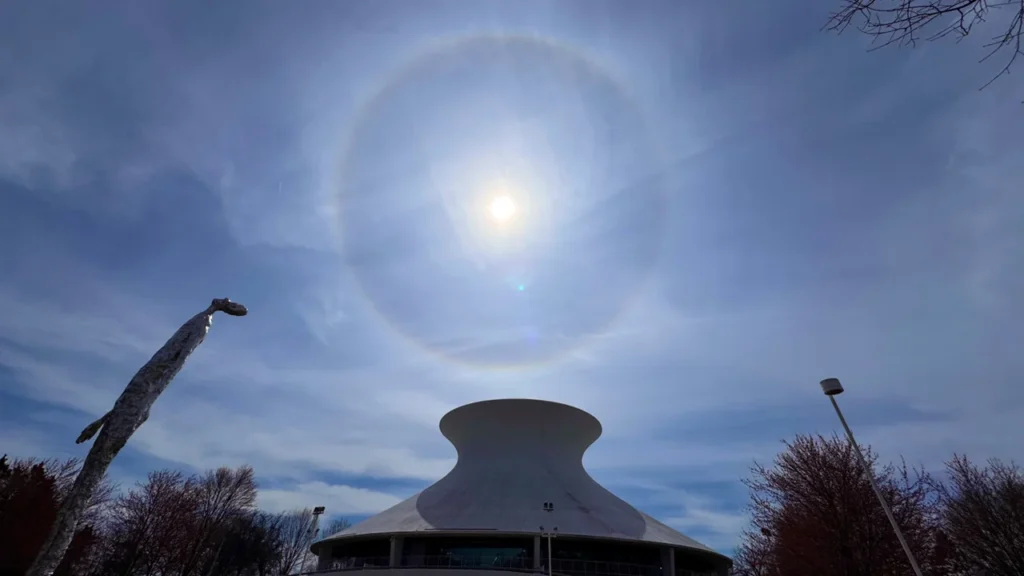
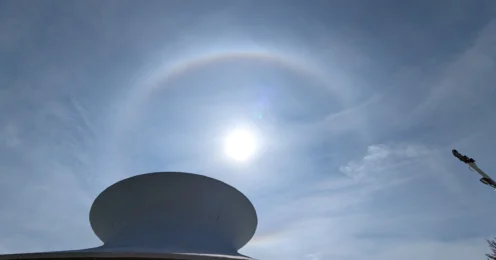
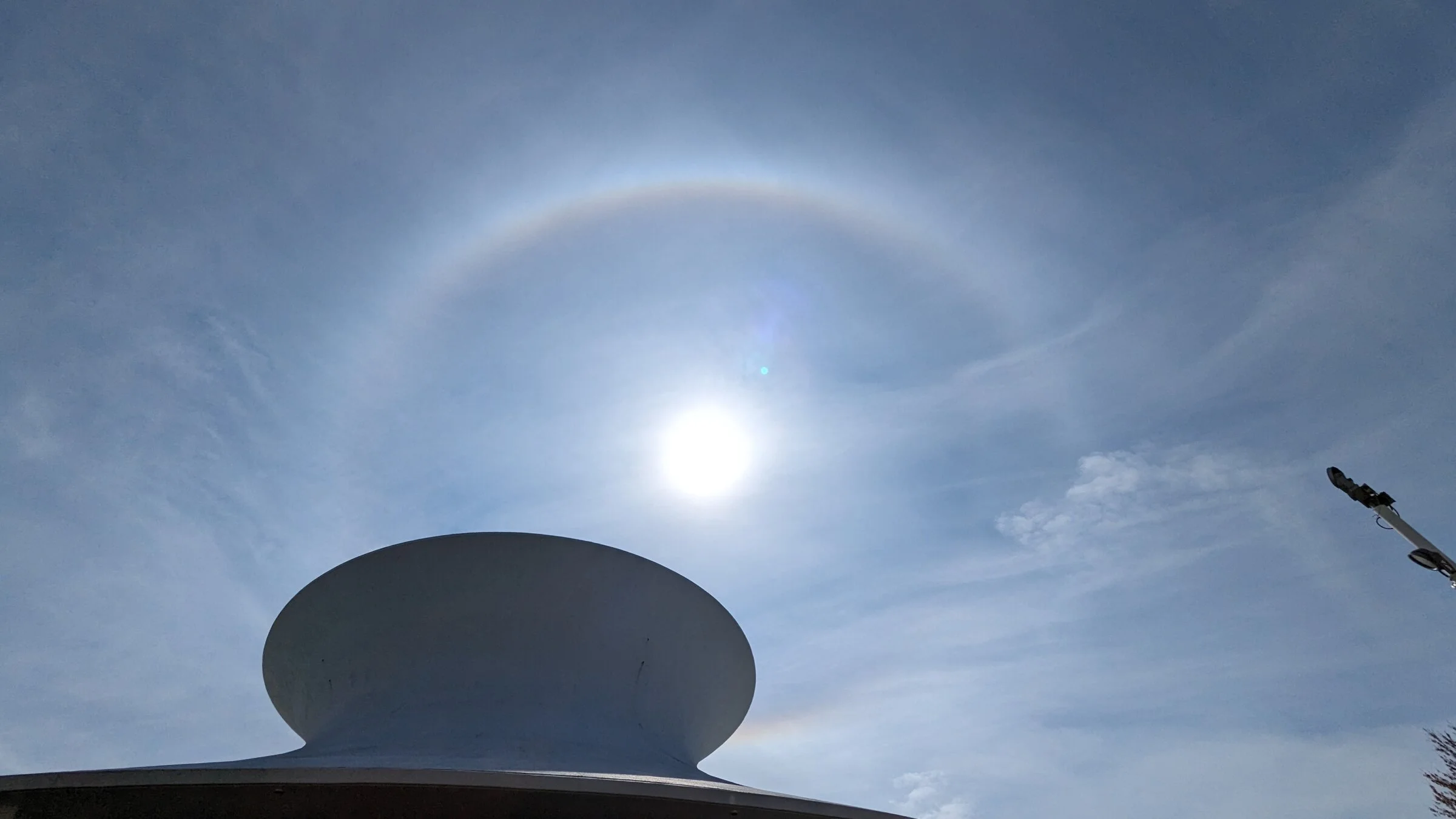
Image showing 22°above the James S. McDonnell Planetarium. Image credit: Jessica Amann
Have you ever noticed a large ring around the sun? This is called an ice halo. The most common type is known as a 22º halo. They are often seen around the Sun or the Moon when there are high altitude cirrus and cirrostratus clouds in the sky. To safely look at a halo, make Sure the Sun is fully shielded; you can use a building, a tree, a book, or whatever you have on hand. The halo is large and is almost always the same diameter. If you stretch out your fingers and hold your hand at arm’s length, the distance from the Sun to the halo will be about the same from your thumb to the tip of your pinky finger.
The halo is formed by the refraction of sunlight through millions of hexagonal ice crystals in the clouds. The crystals behave like jewels. The hexagon shape of these ice crystals, as well as their orientation, causes the sunlight to bend at a consistent angle, creating the circular ring. Halos can be seen all year round and they are more frequent than rainbows. If the Sun is low on the horizon, the halo may be accompanied by sun dogs on the left and right. Sun dogs are at their brightest when the Sun is low. There are a lot of infrequent halos and halo features to look out for too: tangent arcs, parry arcs, circumscribed halos, etc.
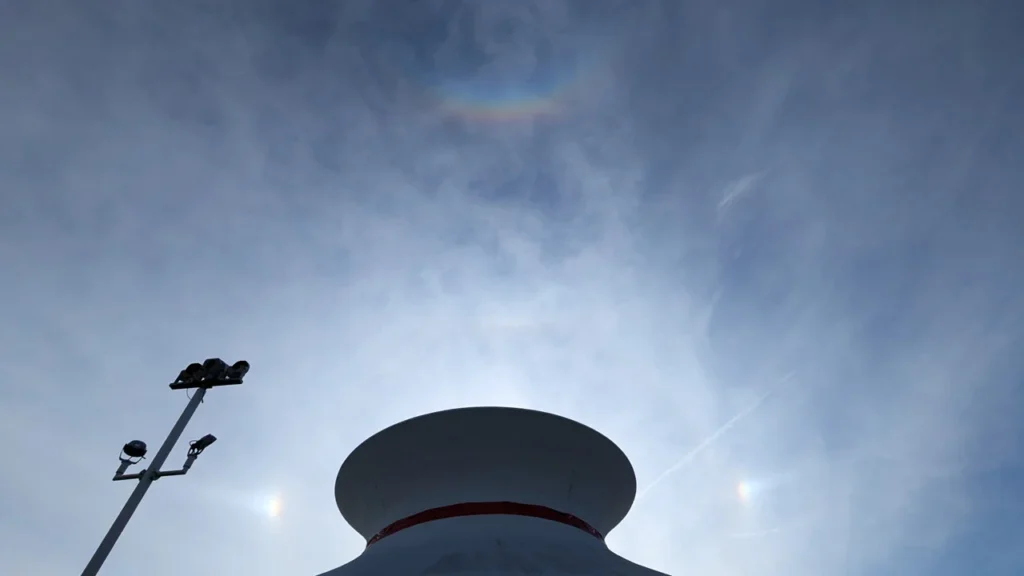
Image showing sundogs and a circumzenithal arc at the James S. McDonnell Planetarium. Image credit: Eric Gustafson
Cloud of the Month
It is officially spring! It’s also the start of severe weather season. Being able to enjoy the outdoors more and dealing with spring’s temperature and weather fluctuations, means we get the opportunity to observe interesting cloud formations often.
Early in March this year, St Louis experienced a line of thunderstorms attached to a passing cold front. That gave us a very unique and often rare cloud, known as the roll cloud.
A roll cloud is a low level, tube-shaped cloud, that spins on a horizontal axis. They form along the leading edge of an approaching storm system (the gust front). A gust front is when cool, dense air gets pushed down and out from a thunderstorm’s downdraft. Think of this as cold air racing out ahead of the storm. The passage of a gust front can often resemble a cold front since winds become gusty and rapidly change in speed and direction. Temperatures will also drop sharply.
As the gust front is pushing the cold air out, warm moist air (that is feeding the storm) is going over and up above the cold air. This is known as a temperature inversion (warm air over cold air). As the warm and humid air continues to rise, it cools and condenses. With the mixture of wind shear (change is wind speed and/or direction) from the gust front, and the temperature inversion, the roll cloud starts to form.
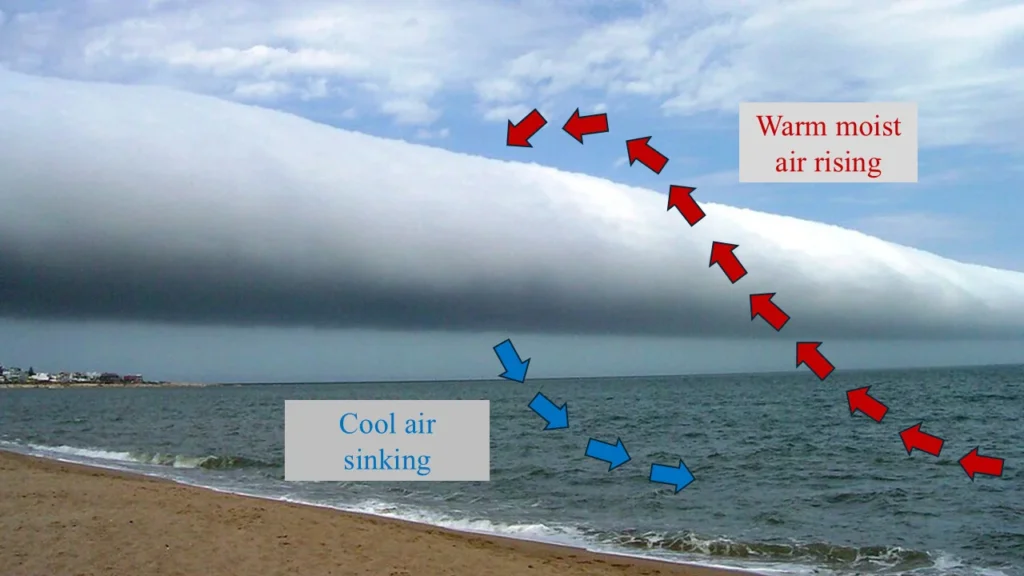
Image showing air dynamics of a roll cloud over Las Olas Beach taken January 25, 2009. Image credit: Daniela Mirner Eberl. Image additions: Alex Guajardo
The roll cloud actually rotates against the direction its traveling. The leading edge rises upwards while the back ends sinks down, creating that horizontal motion and “rolling” effect. For the most part, they tend to have a smooth silky appearance but will sometimes look rough and bumpy, acting as a precursor for severe weather. Roll clouds can look very ominous, making the sky appear darker at times but they are essentially harmless, aside from the possibility of straight-line winds (strong winds exceeding 60 mph).
It’s important to remember that roll clouds are completely detached from any cloud system. Because of this, they can stretch for miles and travel for hours. Often times the roll cloud can be confused with a shelf cloud. Am ominous low hanging, wedge shaped cloud that appears on the leading edge of a storm. But shelf clouds are attached to the parent thunderstorm cloud. Roll clouds can also be confused with funnel clouds because of the clear rotation. Funnel clouds rotate vertically and can indicate tornadic activity. If you see a funnel cloud, you should seek shelter. And if you can’t determine if it’s a roll cloud or a funnel cloud, it’s best to seek shelter anyway. Roll clouds can act as a warning for severe weather being on the way but it is not a guarantee.
Roll clouds are a rare and unique feature that one can look for during the springtime. It’s relevant to remember that they spin horizontally and do not form any immediate threat. While they mostly form ahead of storm systems, under the right conditions they can also form from sea breezes or near mountainous regions. Make sure to always stay weather aware and have a plan during sever weather season.
The Sun and the Moon
Sun Information
The month of April sees the Sun continue to head towards its northern standstill later this year in June. When viewed from St. Louis, the Sun’s maximum altitude will shift from 56.1° on April 1, 2026, to 66.3° on April 30, 2026. The next major position of the Sun occurs on June 21, 2026, as the Sun reaches the June solstice.
For us in the northern hemisphere, the world is springing back to life. Early season plants are starting to sprout or bloom which will bring the return of familiar garden insects. Severe weather season is also upon us, so it is time to prepare and be aware. Local news stations and the National Weather Service will have an abundance of resources regarding sever weather.
Local St. Louis News Resources
| June Solstice | June 21, 2026 |
| Sept. Equinox | Sept. 22, 2026 |
| Dec. Solstice | Feb. 21, 2026 |
| March Equinox | March 20, 2027 |
Sunrise and Sunset Times for St. Louis Missouri
The sunrise and sunset times below were calculated by the Earth Systems Research Laboratories for NOAA. These times are calculated using equations for Jean Meeus’s Astronomical Algorithms. The atmosphere complicates these calculations due to the refraction of sunlight as it passes through the atmosphere. For the times listed below, the amount of atmospheric refraction is assumed to be 0.833°. Variations in the atmosphere can change the amount of refraction so the times posted are accurate to within a minute for latitudes between +/- 72°.
| Day | Sunrise (CDT) | Sunset (CDT) |
| 26-Apr | 6:09 | 19:48 |
| 27-Apr | 6:08 | 19:49 |
| 28-Apr | 6:07 | 19:50 |
| 29-Apr | 6:06 | 19:51 |
| 30-Apr | 6:04 | 19:52 |
Moon (daytime views)
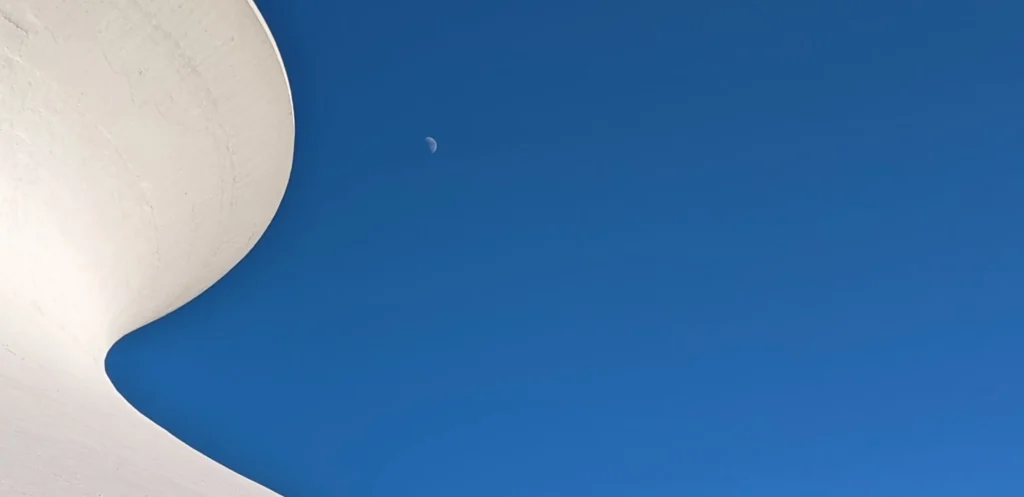
Last quarter moon occurs on April 9, 2026, and first quarter moon occurs on April 24, 2026. The best daytime views of the Moon are always near the quarter phases. Look for the Moon in the morning at the beginning of March. When we are near first quarter phase, look for the Moon in the afternoon.
The Moon crosses the ecliptic at its ascending node this month on April 11, 2026, and then at its descending node on April 26, 2026. This behavior occurs because the Moon’s orbit around Earth is tilted about 5.1° with respect to Earth’s ecliptic. This nodal cycle of the Moon is called a draconic month which 27.2 days long. Being aware of these crossing nodes helps observers know if the Moon will appear south or north of the ecliptic.
| Phase | Date | Time (CDT) |
| Full Moon | April 1, 2026 | 21:12 |
| Last Quarter | April 09, 2026 | 23:52 |
| New Moon | April 17, 2026 | 06:52 |
| First Quarter | April 24, 2026 | 21:32 |
| Full Moon | May 31, 2026 | 12:23 |
Solar Sunday is now held every 3rd Sunday of the month from 11:00 a.m. until 3:00 p.m. (Weather Dependent)
On the 3rd Sunday each month, the St. Louis Astronomical Society and the Saint Louis Science Center will set up a number of safe solar telescopes outdoors and be on hand to answer your questions. Telescope viewing begins at 11:00 a.m.
The St. Louis Astronomical Society helps host the monthly Star Parties at the Saint Louis Science Center. In addition to our daytime viewings, they also help facilitate our nighttime Public Telescope Viewing. These nighttime viewing sessions occur on the 1st Friday each month. Visit SLAS’s website linked above to learn about other telescope events SLAS hosts around the St. Louis area.
Subjects