This is the Saint Louis Science Center’s NIGHT SKY UPDATE for the week of Friday, May 8, 2026
Information updated weekly or as needed.
Times given as local St. Louis time this week will be in Central Daylight Time (CDT). For definitions of terminology used in the night sky update, click the highlighted text. If relying on times posted in Universal Time (UT), St. Louis is -5 hours when CDT. Times posted in the Night Sky Update are in the 24-hour format.
Join us for our next star party, Friday, June 5, 2026, held in association with the St. Louis Astronomical Society. For details, see the information at the bottom of this page or visit https://www.slsc.org/explore/mcdonnell-planetarium/public-telescope-viewings/
Observing Highlight
On April 22, 2026, reports of the discovery of a new supernova in the galaxy NGC 5907 were reported. Follow up observations confirmed that the supernova now called SN 2026kid, is a type II supernova in a galaxy that is roughly 46.56 million light years away. At the time of discovery, SN 2026kid was a 16.62 magnitude object which has brightened a bit into 15th magnitude. At these magnitudes, SN 2026kid will require imaging to see for most observers.
Type II supernova are the result of a single massive star’s core collapsing once its nuclear fuel has run out. As mass flows into the core through the production of iron from fusion, its own mass increases enough that it starts to implode. The implosion eventually stalls out until a sudden release of neutrinos occurs powering the explosion associated with supernovae. These are truly awesome events that release an enormous amount of energy. Scientists Stan Woosley and Thomas Janka state in their paper “The Physics of Core-Collapse Supernovae,” that the power released as neutrinos from these events is comparable “to all the rest of the luminous, visible Universe combined.”
For those with a telescope, the galaxy that hosts SN 2026kid is found in the constellation Draco. The galaxy is known as NGC 5907 or the Splinter Galaxy. At 11.80 magnitude, you will want to get to darker skies to have a chance to spot it. NGC 5907 can be found just shy of 3° east of the 3.25 magnitude star Edasich (12 Dra).
Extragalactic supernovae are not rare events. In 2025, 26,627 extragalactic supernovae were reported to the Transient Name Server hosted by the IAU Supernova Working Group. It is, however, quite rare to see a supernova in our galaxy. It is estimated that 1-3 supernova occur in the Milky Way each century with the last one observed in 1604.
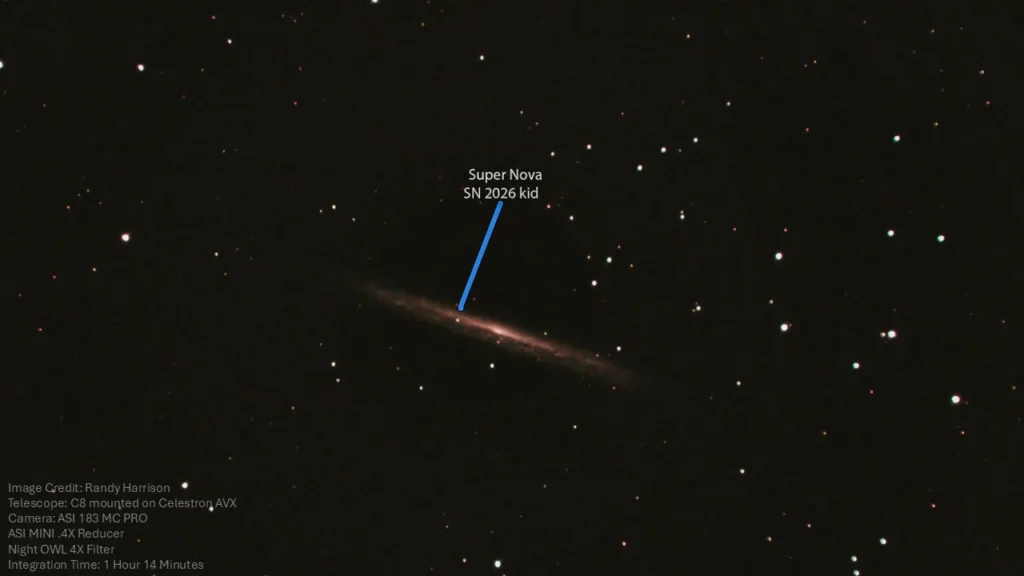
The image above was recorded by local astrophotographer Randy Harrison on May 2, 2026. The image shows the supernova SN 2026kid in the galaxy NGC 5907.
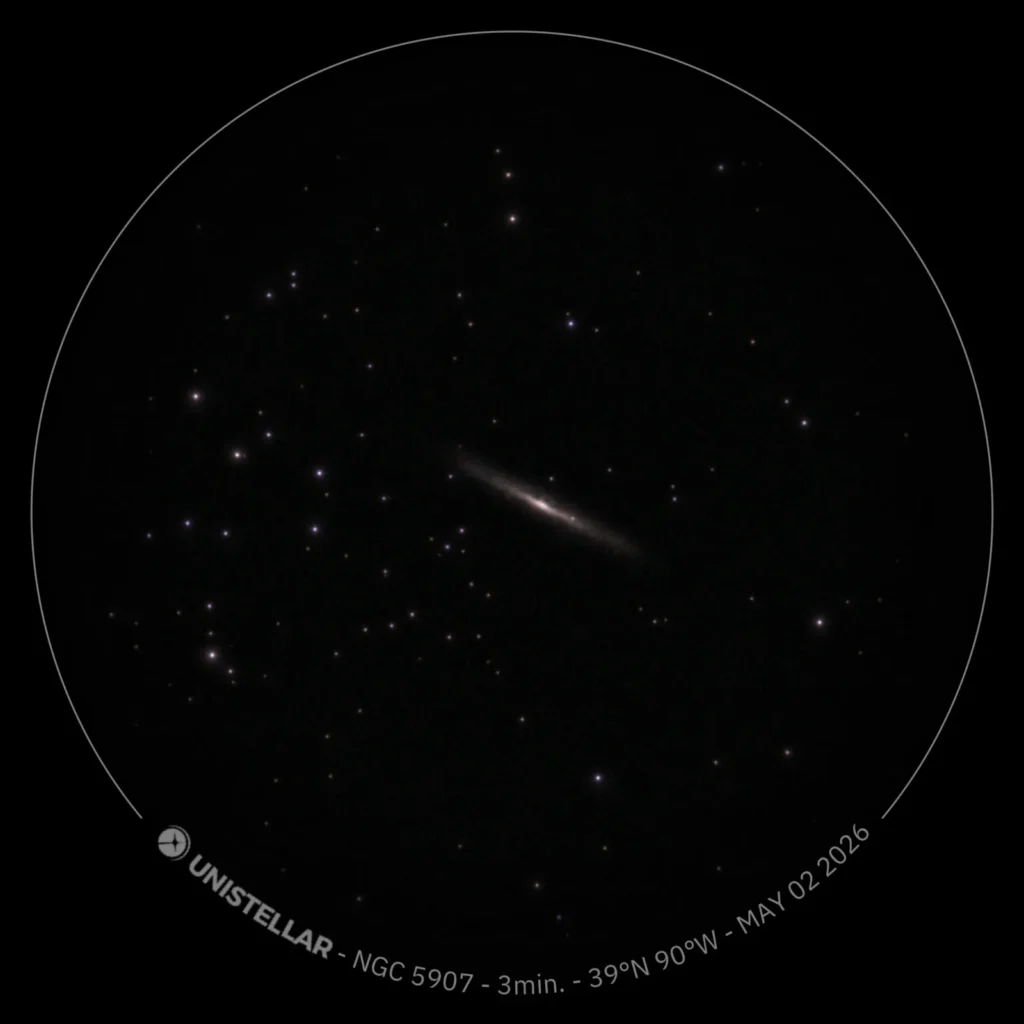
The image above of NGC 5907 and SN 2026kid was recorded by local astrophotographer Jessica Amann using the Unistellar Odyssey evscope..
T CrB Nova Update 5/8/2026
If you are still interested in seeing the recurrent nova T Coronae Borealis, there is still hope. The nova has not yet occurred meaning we are in a waiting game. If you are still interested, the part of the sky the nova will appear in is found rising in the east by the time it is dark. The star system T Coronae Borealis is found in the constellation Corona Borealis which looks like a small U-shape of stars next to the constellation Boötes. By 1 am the location of T CrB will be overhead. If you cannot observe the sky directly, you can track the behavior of T CrB by checking current magnitude estimates posted at AAVSO here or by visiting spaceweather.com. Current magnitude estimates of the system show it at 10th magnitude.
The Sun and Moon
Sun
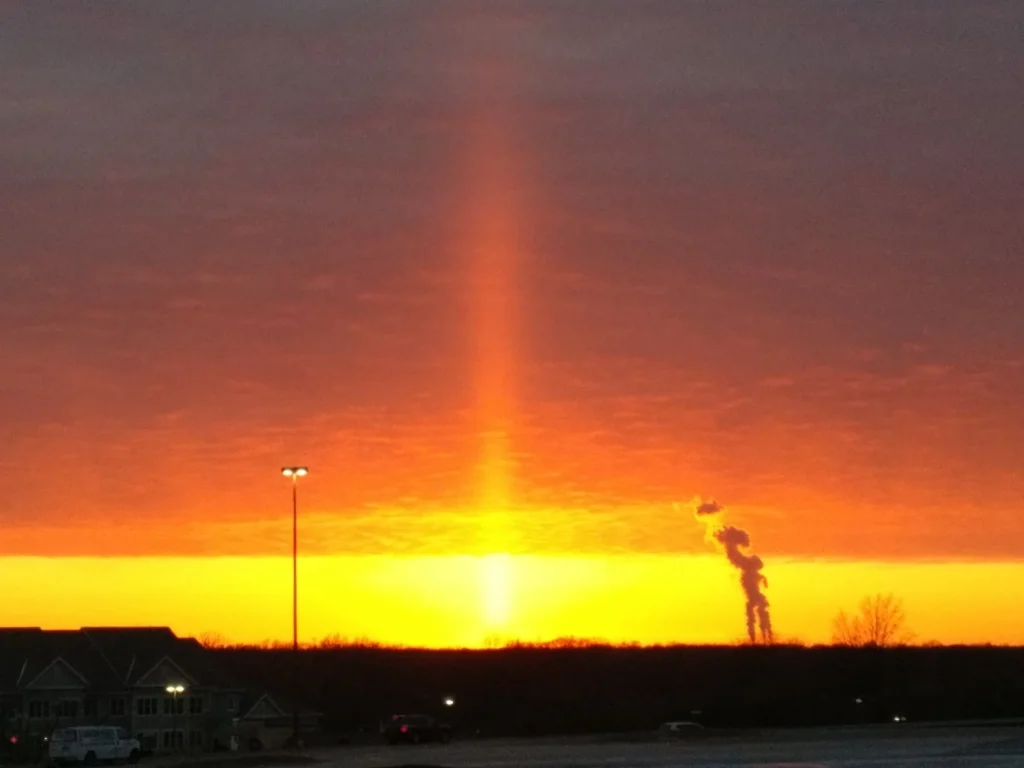
Sunrise on Friday, May 8 is at 05:55 and sunset is at 19:59 providing over 14 hours of daylight. Even after sunset, light from the Sun will dimly illuminate our sky for about 1 hour and 45 minutes. This period is called twilight, which ends around 21:44 this week. For those with a sundial, local noon occurs around 12:58 on May 8, 2026.
| Day | Sunrise (CDT) | Sunset (CDT) |
| 08-May | 5:55 | 19:59 |
| 09-May | 5:54 | 20:00 |
| 10-May | 5:53 | 20:01 |
| 11-May | 5:52 | 20:02 |
| 12-May | 5:51 | 20:03 |
| 13-May | 5:51 | 20:04 |
| 14-May | 5:50 | 20:05 |
| 15-May | 5:49 | 20:06 |
| 16-May | 5:48 | 20:07 |
Moon
Moonrise for Friday, May 8, is at 20:18 and moonset occurs at 06:08 the following morning. On May 8, 2026, the Moon will exhibit a waning gibbous phase with 61% disk illumination. By May 16, 2026, the Moon will exhibit a new moon phase with 0% disk illumination. Last quarter moon occurs on May 9, 2026, at 16:11.
International Space Station (ISS) Observing
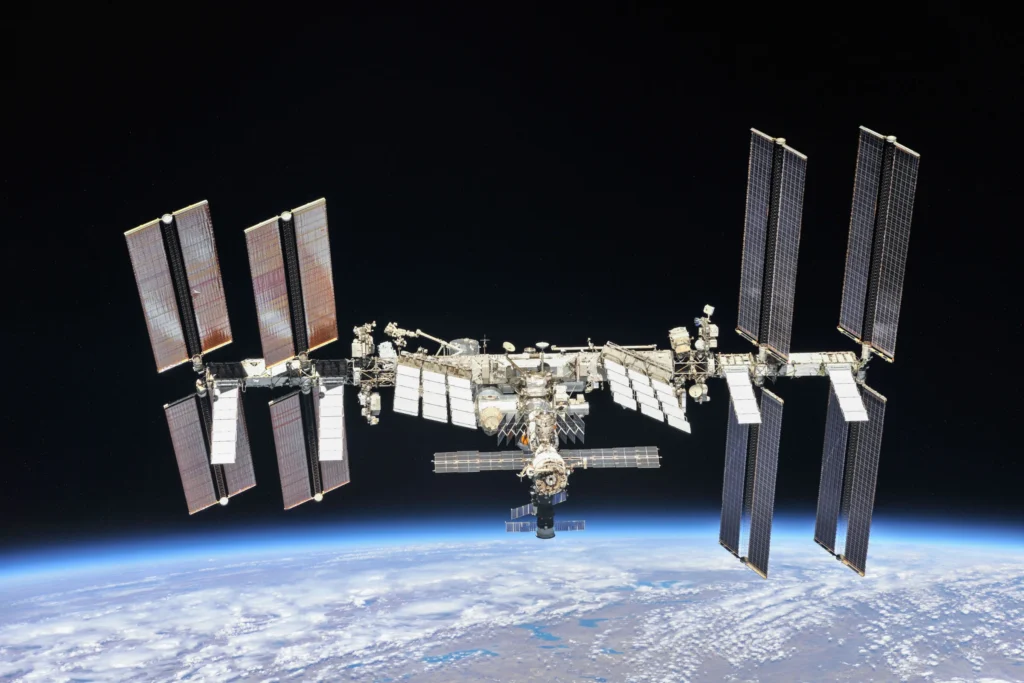
Visible passes of ISS from St. Louis for the week of May 8 occur during evening hours with the best passes occurring on May 11 and 13. You can find information about these and other satellite pass at https://heavens-above.com. If you are not viewing from the St. Louis area, make sure to change your viewing location for your local times.
Visible Planets
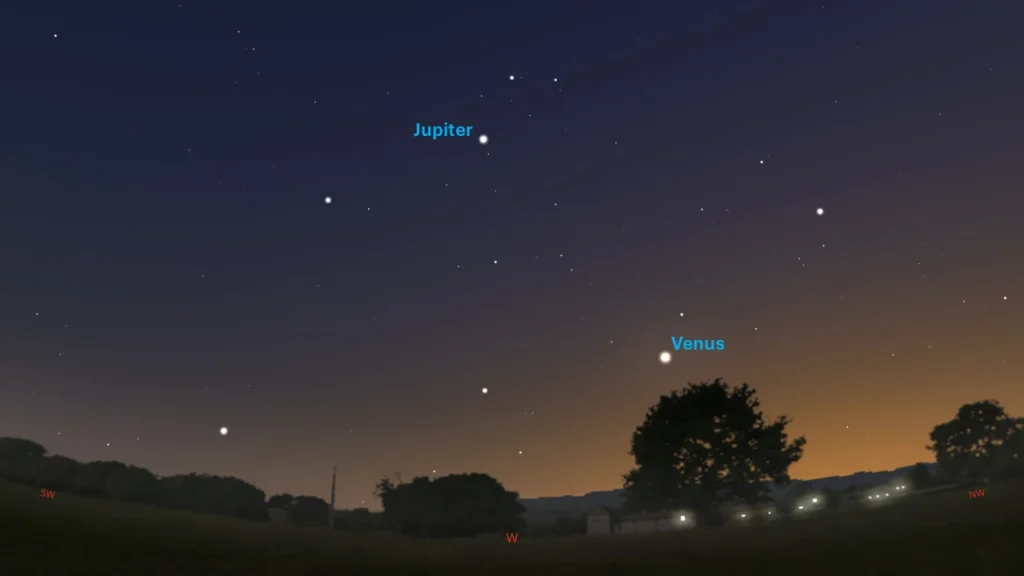
View looking southwest on May 10,2026, at 20:45. Image created using Stellarium
Two naked eye planets will be visible this week. Jupiter will be found in the west and Venus low in the west after sunset. Mars and Saturn are starting to climb out of the glare of the Sun before sunrise. By May, we should start seeing them in the east before sunrise.
Venus
Venus can now be seen low in the west after sunset. Its current evening apparition will continue until October as it approach inferior conjunction on October 23, 2026. Venus sets by 22:23.
Jupiter
Jupiter will be visible in the west about 30 minutes after sunset, Jupiter remains visible until 23:30. Much later than this, Jupiter will appear too low in altitude making it difficult for some observers to find. Jupiter’s current apparition continues through June and some of July as it heads towards superior conjunction on July 29, 2026. Jupiter set around 00:30 this week.
Our next Star Party will be held on Friday, June 5, 2026 from 6:30 pm to 10:00 pm.
On the first Friday of each month, the St. Louis Astronomical Society and the Saint Louis Science Center will set up a number of telescopes outdoors and be on hand to answer your questions. Telescope viewing begins once it is dark.
The St. Louis Astronomical Society helps host the monthly Star Parties at the Saint Louis Science Center. In addition to our nighttime viewings, they also help facilitate our daytime event called Solar Sundays. These daytime viewing sessions occur every Sunday through Labor Day. After Labor Day they occur on the 3rd Sunday each month. Visit SLAS’s website linked above to learn about other telescope events SLAS hosts around the St. Louis area.
James S. McDonnell Planetarium
Night Sky Update for May 8, 2026
Subjects