This is the Saint Louis Science Center’s NIGHT SKY UPDATE for the week of Friday, May 29, 2026
Information updated weekly or as needed.
Times given as local St. Louis time this week will be in Central Daylight Time (CDT). For definitions of terminology used in the night sky update, click the highlighted text. If relying on times posted in Universal Time (UT), St. Louis is -5 hours when CDT. Times posted in the Night Sky Update are in the 24-hour format.
Join us for our next star party, Friday, June 5, 2026, held in association with the St. Louis Astronomical Society. For details, see the information at the bottom of this page or visit https://www.slsc.org/explore/mcdonnell-planetarium/public-telescope-viewings/
Observing Highlight
This week the Moon visits the star Antares as it approaches the 2nd full moon in May. As you may know, anytime there are two full moons in one month, the second is called a blue moon. Additionally, Jupiter and Venus continue their march towards one another as they approach conjunction later in June.
Full moon occurs as the Moon is fully illuminated when viewed from Earth. This happens every 29.5 days when the Moon appears opposite the Sun in the sky. This 29.5 day cycle is known as the Moon’s synodic cycle. It is possible to have two full moons in a month because the average calendar month is 30 days.
The Moon reaches full moon at 03:45 CDT on May 31, 2026. Unfortunately, the Moon will be found only 12° above the southwestern horizon making it a difficult target for some. In St. Louis, the best time to view the Moon comes around 00:45 CDT when the Moon can be found due south appearing 24° above the horizon. At this time the Moon will be about 99.7% full.
You will also find the Moon next to a bright star called Antares. Antares is a 1st magnitude star and is the 16th brightest star in the night sky. Antares is a red supergiant star with a spectral classification of M1.5. When viewed from Earth, Antares looks more orange than red. This is mostly due to how the star’s light is affected by our atmosphere. Because Antares is found near the ecliptic, the Moon will appear near this star each month. On May 31, around 00:45, they will appear about 2° apart.
You might also note how low to the south the Moon appears this week. In 2024, the Moon reached a moment called lunar major standstill. Lunar standstills are a product of a few things. First the Moon’s orbit is tilted about 5.1° with respect to Earth’s ecliptic. The ecliptic is Earth’s orbital plane projected onto the celestial sphere which is tilted about 23.5° with respect to the celestial equator.
Secondly, gravitational and tidal forces from the Sun and Earth cause nodal precession of the Moons orbit. Over a cycle of 27.2 days, the Moon appears to cross Earth’s ecliptic twice. These crossing points are called the ascending and descending nodes. Due to nodal precession, the crossing nodes shift along Earth’s ecliptic completing a cycle every 18.6 years.
During this 18.6 year period, there is a major and minor standstill. During a minor standstill, the Moon’s maximum and minimum declination shifts between +18.5° and -18.5°. During a major standstill, it shifts between +28.5° and -28.5°. Depending on the season, this difference will have a major influence on how far north or the south the Moon appears. When a standstill occurs, its impact lasts about two years with the last major lunar standstill occurring over 2024 and 2025. One year later, while the impact is lesser, we are still seeing an impact on where the Moon appears.
For those tracking Venus and Jupiter, the pair starts the week separated by about 10°. By June 6, 2026, they will only be 3° apart. After June 9, 2026, Jupiter will be closer to the horizon the Venus is. Observing behaviors like these were key steps towards understanding the nature of our solar system.
T CrB Nova Update 5/29/2026
If you are still interested in seeing the recurrent nova T Coronae Borealis, there is still hope. The nova has not yet occurred meaning we are in a waiting game. If you are still interested, the part of the sky the nova will appear overhead by the time it is dark. The star system T Coronae Borealis is found in the constellation Corona Borealis which looks like a small U-shape of stars next to the constellation Boötes. If you cannot observe the sky directly, you can track the behavior of T CrB by checking current magnitude estimates posted at AAVSO here or by visiting spaceweather.com. Current magnitude estimates of the system show it at 10th magnitude.
The Sun and Moon
Sun
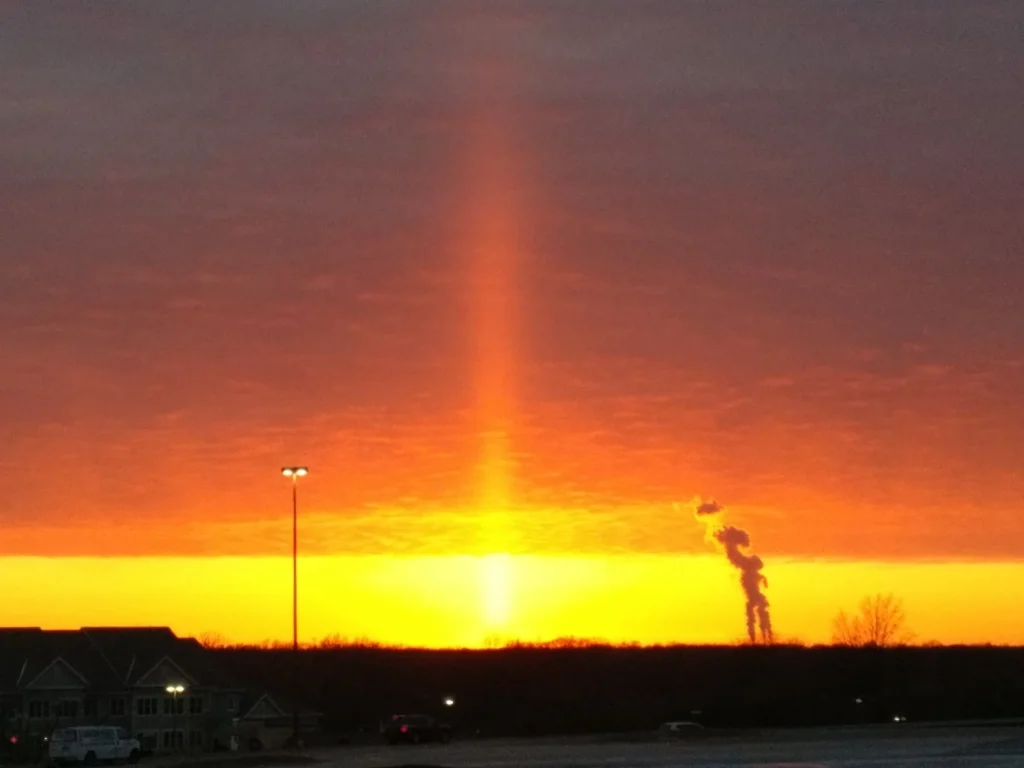
Sunrise on Friday, May 29 is at 05:39 and sunset is at 20:17 providing over 14.5 hours of daylight. Even after sunset, light from the Sun will dimly illuminate our sky for about 2 hours. This period is called twilight, which ends around 22:11 this week. For those with a sundial, local noon occurs around 12:59 on May 29, 2026.
| Day | Sunrise (CDT) | Sunset (CDT) |
| 29-May | 5:39 | 20:17 |
| 30-May | 5:39 | 20:18 |
| 31-May | 5:38 | 20:19 |
| 01-June | 5:38 | 20:20 |
| 02-June | 5:38 | 20:20 |
| 03-June | 5:37 | 20:21 |
| 04-June | 5:37 | 20:21 |
| 05-June | 5:37 | 20:22 |
| 06-June | 5:36 | 20:23 |
Moon
Moonrise for Friday, May 29, is at 19:13 and moonset occurs at 04:43 the following morning. On May 29, 2026, the Moon will exhibit a waxing gibbous phase with 98% disk illumination. By June 6, 2026, the Moon will exhibit a waning gibbous phase with 66% disk illumination. Full moon occurs on May 31, 2026, at 03:45. This is the 2nd full moon in May making it a blue moon.
International Space Station (ISS) Observing
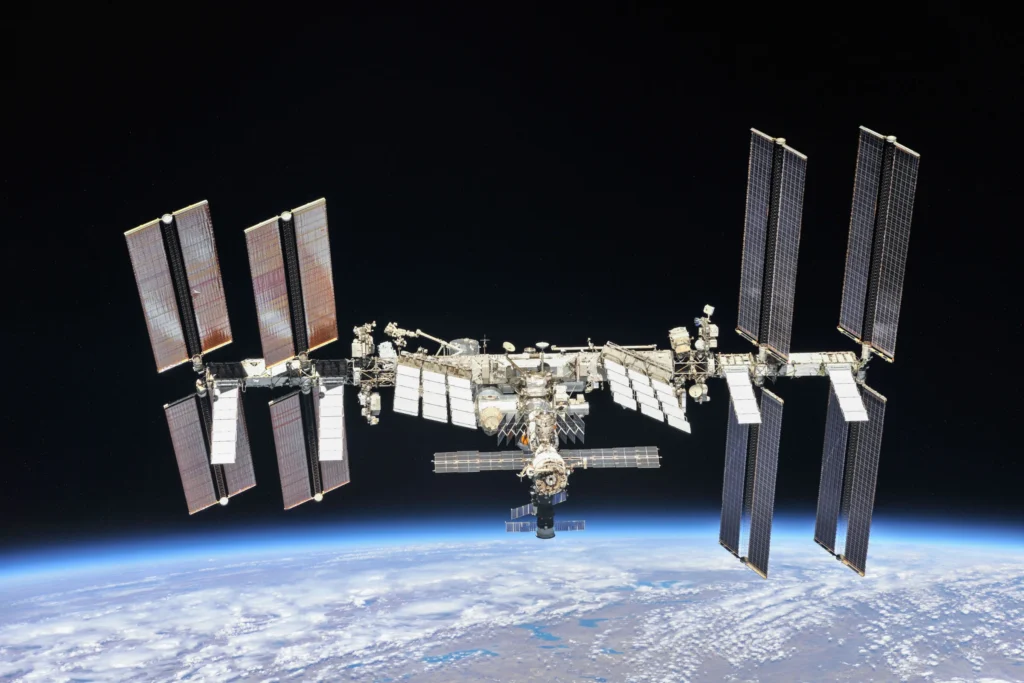
Visible passes of ISS from St. Louis for the week of May 29 occur during evening hours with the only pass this week occurring on May 29. ISS returns to St. Louis skies in the morning by June 18, 2026. You can find information about these and other satellite pass at https://heavens-above.com. If you are not viewing from the St. Louis area, make sure to change your viewing location for your local times.
Visible Planets
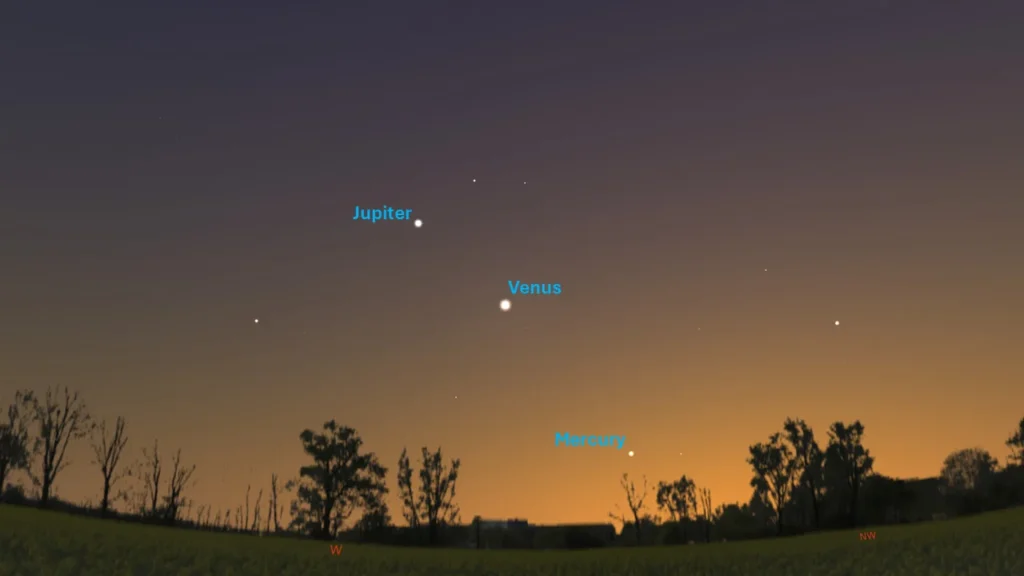
View looking west on May 29, 2026, at 20:45. Image created using Stellarium
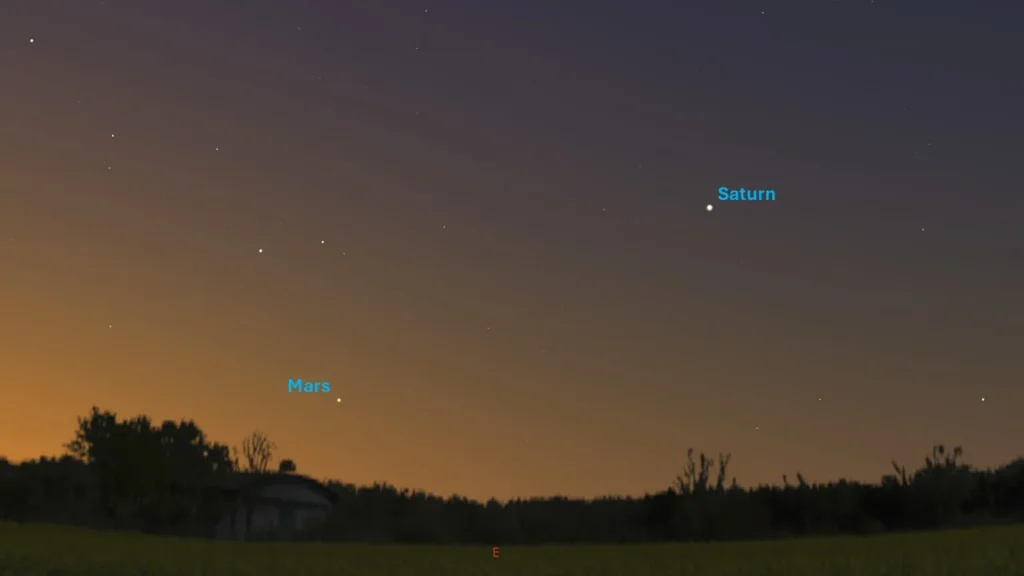
View looking east on May 30, 2026, at 05:00. Image created using Stellarium
Four naked eye planets will be visible this week. Venus, Jupiter and Mercury will be found in the west about 30 minutes after sunset. Saturn is visible in the east before sunrise. Viewers with clear views to the East might catch a glimpse of Mars in the east before sunrise.
Mercury
Mercury has started another evening apparition becoming visible in the west about 30 minutes after sunset. On May 29, 2026, Mercury will appear about 8.5° above the western horizon at the end of civil twilight. It reaches greatest eastern elongation on June 15, 2026, appear roughly 12° above the western horizon at 21:00.
Venus
Venus is visible in the west after sunset. Its current evening apparition will continue until October as it approach inferior conjunction on October 23, 2026. Venus sets by 22:53.
Mars
Those with a clear view to the east might be able to spot Mars around 05:00. It will be found just shy of 10° above the horizon.
Jupiter
Jupiter will be visible in the west about 30 minutes after sunset, Jupiter remains visible until 22:30. Much later than this, Jupiter will appear too low in altitude making it difficult for some to find. Jupiter’s current apparition continues through June and some of July as it heads towards superior conjunction on July 29, 2026. Jupiter set around 23:26 this week.
Saturn
Saturn can be found rising in the east around 04:00. By the start of civil twilight, Saturn can be found about 20° above the horizon.
Our next Star Party will be held on Friday, June 5, 2026 from 6:30 pm to 10:00 pm.
On the first Friday of each month, the St. Louis Astronomical Society and the Saint Louis Science Center will set up a number of telescopes outdoors and be on hand to answer your questions. Telescope viewing begins once it is dark.
The St. Louis Astronomical Society helps host the monthly Star Parties at the Saint Louis Science Center. In addition to our nighttime viewings, they also help facilitate our daytime event called Solar Sundays. These daytime viewing sessions occur every Sunday through Labor Day. After Labor Day they occur on the 3rd Sunday each month. Visit SLAS’s website linked above to learn about other telescope events SLAS hosts around the St. Louis area.
James S. McDonnell Planetarium
Night Sky Update for May 29, 2026
Subjects