The Saint Louis Science Center envisions an equitable and inclusive society where people are passionate about science and use it to improve lives, transform communities and empower future generations. Through exposure to STEM concepts and recognition of contributions made by members of various communities, we hope that individuals from all backgrounds can find their place in STEM.
As we celebrate Deaf History Month, we’re recognizing a few STEM-sational individuals who’ve inspired us all to make an impact:
Dr. Tilak Ratnanather
American educator who was the world’s first congenitally deaf person to earn a Ph.D. in mathematics and has pioneered research into brain structure and its implications in neuropsychiatric and neurodevelopmental disorders (1964-Present).
Inspirational Quote:
“I want to show deaf students that there are no barriers in science. The only barriers are those we create in our minds.”
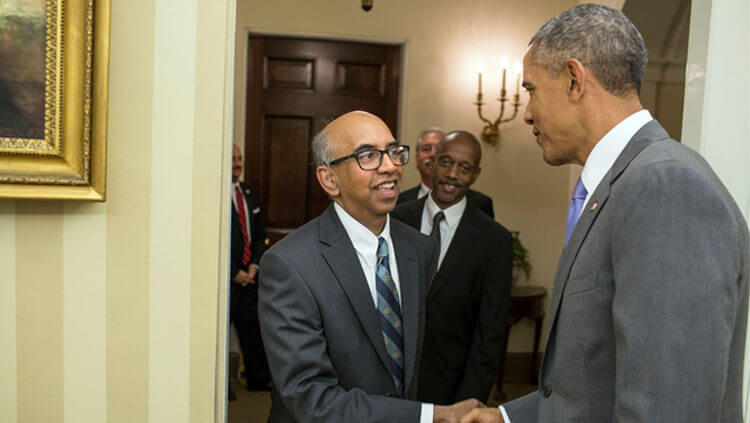
Dr. Tilak Ratnanather was born in Sri Lanka and became deaf from meningitis when he was only a few months old. At age five, his family moved to England, where he attended both mainstream and schools for the deaf. Defying expectations, Ratnanather went on to become the first congenitally deaf person to earn a faculty position at the Johns Hopkins University School of Medicine and has championed mentorship for deaf and hard-of-hearing students entering STEM fields.
After receiving a bachelor’s degree in mathematics from University College London, Dr. Ratnanather became the world’s first congenitally deaf person to earn a Ph.D. in mathematics after graduating from Oxford University with a focus on fluid mechanics. He then pursued postdoctoral studies on the faculty at Johns Hopkins, where he redirected his research toward computational neuroscience and auditory neuroimaging.
As an Associate Research Professor of Biomedical Engineering at Johns Hopkins, Dr. Ratnanather has pioneered groundbreaking research in brain imaging and hearing loss. His work involves developing computational models that help understand the neural basis of hearing loss and psychiatric disorders. He has published numerous papers on the structural differences in the brains of people with hearing loss compared to those with normal hearing.
Beyond his research, Dr. Ratnanather is known for his exceptional mentorship of deaf and hard-of-hearing students in STEM fields. Through his program “Hearing and Speech Sciences,” he has mentored more than 50 deaf and hard-of-hearing students, many of whom have gone on to pursue advanced degrees and careers in STEM. He also launched the STEM-HEAR initiative (STEM for students with Hearing loss to Engage in Auditory Research), pointing out that students with hearing loss must do three things to succeed in academia: recognize that support is available, understand what to do with that support and find the motivation to keep going despite obstacles. This mentorship effort has significantly increased the representation of deaf individuals in biomedical sciences.
In 2015, Dr. Ratnanather was recognized at the White House as a “Champion of Change” for his extraordinary work in mentoring and supporting deaf individuals in STEM careers. During that ceremony, President Barack Obama awarded him the Presidential Award for Excellence in Science, Mathematics, and Engineering Mentoring (PAESMEM).
For more information:
Dr. Kathleen Arnos
Introduced groundbreaking research focused on identifying and understanding the genetic causes of hereditary deafness (1948-Present).
Inspirational Quote:
“Understanding our genetic diversity helps us appreciate how different sensory experiences shape our interaction with the world. There is no ‘standard’ human experience.”
Dr. Kathleen Arnos is a leading geneticist whose groundbreaking research has focused on identifying and understanding the genetic causes of hereditary deafness. Born with normal hearing to a family with a history of genetic hearing loss, Dr. Arnos developed an early interest in genetics that would shape her career.
After earning her Ph.D. in Human Genetics from Virginia Commonwealth University in 1984, Dr. Arnos joined the faculty at Gallaudet University (the world’s only institution of higher education in which all programs are designed to accommodate deaf and hard-of-hearing students), where she would eventually become the Chair of the Biology Department and Director of the Genetics Program. Throughout her distinguished career, she has published over 100 scientific papers and book chapters on the genetics of hearing loss.
Dr. Arnos’s research has been instrumental in identifying several genes responsible for syndromic and non-syndromic hearing loss. Her work has particularly focused on GJB2 (Connexin 26) mutations, the most common genetic cause of hearing loss in many populations. This research has significantly advanced genetic counseling for families with hereditary hearing loss, providing them with crucial information about inheritance patterns and recurrence risks.
In collaboration with the National Human Genome Research Institute at NIH, Dr. Arnos developed educational materials about genetics for the Deaf community, ensuring that complex genetic information is accessible in American Sign Language. This work has helped bridge the gap between cutting-edge genetic research and the Deaf community.
Dr. Arnos received numerous awards for her contributions to genetic research and education, including the Distinguished Faculty Award from Gallaudet University and the Award of Merit from the American Society of Human Genetics for her work in community genetics education.
For More Information:
Dr. Dimitri Kanevsky
Has been awarded more than 200 patents for improvements in the accuracy of speech-to-text technology (1952-Present).
Inspirational Quote:
“Technology should adapt to humans, not the other way around. The best innovations come from addressing real needs from diverse perspectives.”
Dr. Dimitri Kanevsky, born in Russia and deaf since early childhood, has emerged as one of the most innovative forces in speech recognition technology and accessibility computing. After earning his Ph.D. in Mathematics from Moscow State University, Kanevsky emigrated to the United States, where his career has combined pure mathematics with practical technological solutions for accessibility.
Kanevsky began his U.S. career at IBM’s Thomas J. Watson Research Center, where he worked for over 25 years developing groundbreaking speech recognition systems. His mathematical background proved crucial in developing algorithms that dramatically improved the accuracy of speech-to-text technologies. One of his most significant contributions was the creation of the “Voice Recognition with Context Method,” which uses contextual information to improve speech recognition accuracy—a technique now standard in all modern speech recognition systems.
In 2014, Kanevsky joined Google as a Research Scientist, where he has continued to pioneer accessibility technologies. At Google, he has been instrumental in developing Live Transcribe, a real-time transcription app that helps deaf and hard-of-hearing people participate in conversations. He also contributed to the development of Sound Amplifier and other Google accessibility initiatives.
Throughout his career, Kanevsky has been awarded over 200 patents for his innovations in speech recognition, machine learning, and accessibility technologies. His work spans pure mathematics (particularly in algebraic geometry and number theory) to highly practical applications that have improved the lives of millions of deaf and hard-of-hearing people worldwide.
In 2012, Kanevsky was honored at the White House as a “Champion of Change” for his work in STEM accessibility. He has also received the Technology for Humanity Award from the Bakken Foundation and the Research Division Award from IBM for his contributions to accessible technology.
For More Information:
Subjects