The Saint Louis Science Center envisions an equitable and inclusive society where people are passionate about science and use it to improve lives, transform communities and empower future generations. Through exposure to STEM concepts and recognition of contributions made by members of various communities, we aim to inspire and empower individuals from all backgrounds to pursue and thrive in STEM fields.
This July, as we celebrate Disability Pride Month, we’re recognizing a few STEM-sational individuals who’ve inspired us all to make an impact. Highlighted this month are Dr. Stephen Hawking, Dr. Wanda Diaz-Merced and Dr. Florence Seibert.
Dr. Stephen Hawking – Considered one of the world’s most brilliant minds, he helped explain complex ideas in a simple means for the general public (1942-2018)
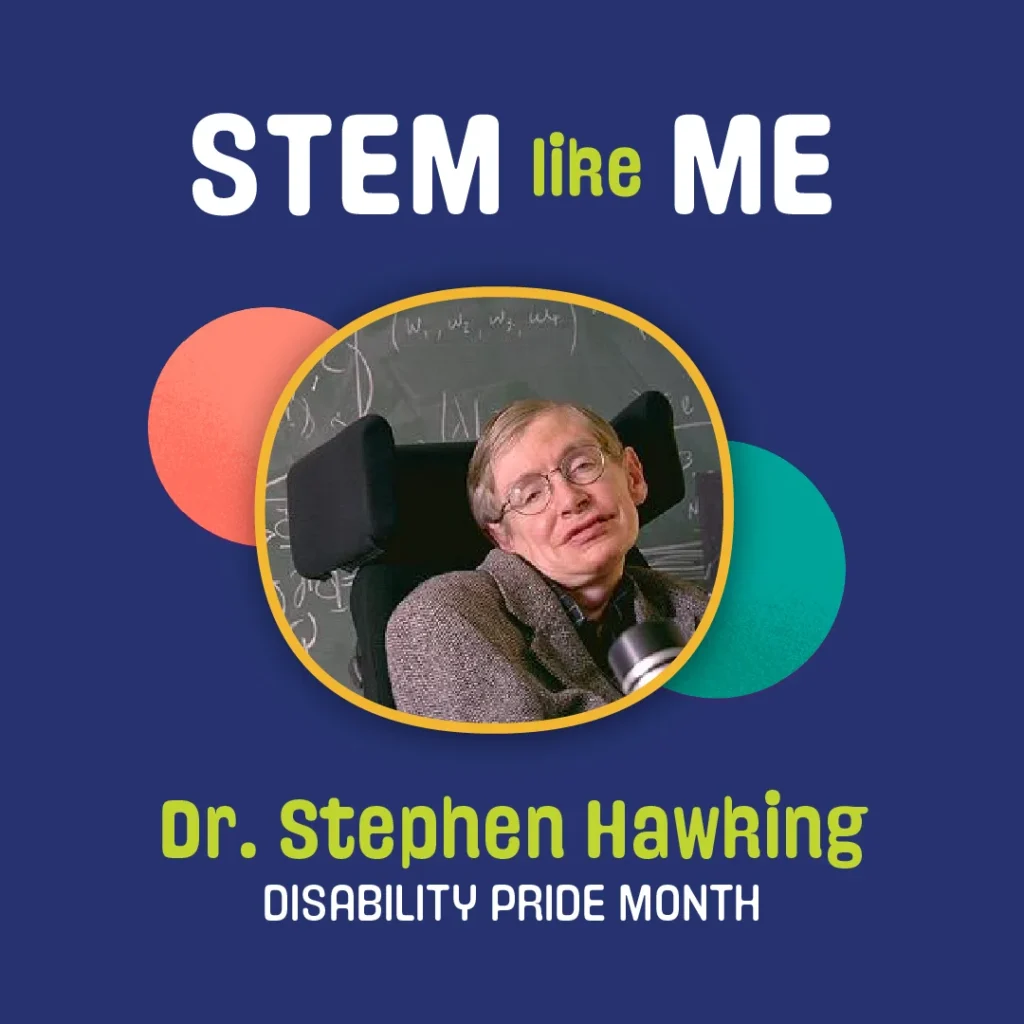
Considered one of the world’s most brilliant minds, Dr. Stephen Hawking overcame a diagnosis of amyotrophic lateral sclerosis (ALS) to share complex scientific concepts with the general public. A mathematics professor at the University of Cambridge, Hawking was a theoretical astrophysicist, cosmologist, mathematician, author, actor, lecturer and more who researched and challenged conventional wisdom on the universe, including: black holes, Albert Einstein’s Theory of Relativity, the Big Bang and more.
Born in Oxford, England, Dr. Hawking modeled his life after his father, a medical researcher. His family placed a high value on education, and he developed a fondness for mathematics and physics as a teenager, earning a scholarship to University College, Oxford. He found the studies to be “ridiculously easy” and was a lazy student but discovered more enjoyment by joining the university’s rowing crew and becoming “one of the boys.” He earned a first-class bachelor’s degree in natural sciences, which allowed him to enter doctoral studies at the University of Cambridge. He completed his Ph. D. in 1965 and remained with the school throughout his career, rising to the prestigious title of Lucasian Professor of Mathematics — one of the most celebrated academic positions in the world and a former position held by Sir Isaac Newton, Charles Babbage and other eminent scientists.
During his time at Cambridge, Dr. Hawking began noticing difficulty in his movement and became clumsy. At age 21 in 1963, he was diagnosed with an incurable motor neuron disease, ALS, which would progressively limit his abilities to move. Doctors predicted that the disease would take his life within two years, but the symptoms would slow. He began using crutches, lost the ability to write and speak and required the use of a power wheelchair by the end of the 1960s. However, he continued to share his studies with others — both students and the public — for years to come, first using eye movement to choose letters on a spelling card and then a computer program to select words and phrases using brain patterns and facial expressions. This program gave Dr. Hawking his signature computer “voice.”
Hawking’s work primarily focused on how the universe began. He sought to prove that black holes are not simply giant vacuums, but that they have a temperature and produce radiation (a theory known as “Hawking radiation”). This changed the belief that nothing could ever leave a black hole and that they could eventually disappear as their energy dissipates. He also sought to connect the laws of physis to the universe, explaining how both the really big things and extremely tiny things work together to make up all existence. This research furthered the belief that all mysteries can be explored by asking the right questions and using evidence to discover the answers.
In recognition for his contribution, Dr. Hawking has received numerous honors and been celebrated in a wide variety of means. He was appointed a Commander of the Order of the British Empire, the United States’ Presidential Medal of Freedom and Russia’s Special Fundamental Physics Prize. He was awarded the Copley Medal of the Royal Society, the Albert Einstein Award and the Gold Medal of the Royal Astronomy Society. Writing numerous books for a variety of audiences, Dr. Hawking’s “A Brief History of Time” is a best-selling book (and included in Time’s list of the best 100 nonfiction books) that explains the structure, origin, development and fate of the universe in non-technical terms for all audiences. He also portrayed himself on several television programs and was the focus of the 2014 movie “The Theory of Everything.”
Given only two years to live when diagnosed in 1963, Dr. Hawking died at age 71 from ALS in 2018.
For more information:
Dr. Wanda Diaz-Merced – discovered a method for studying stars using audio data patterns after losing her sight (1982-Present)
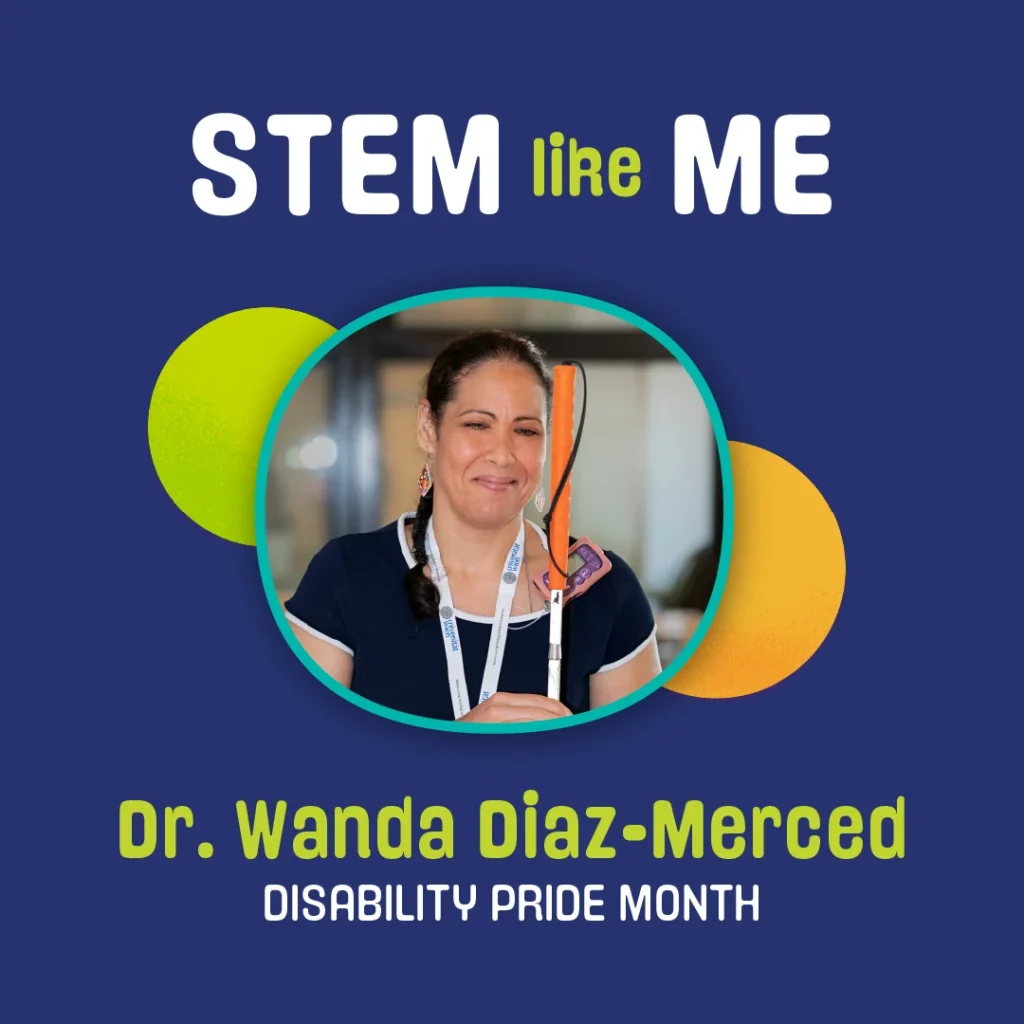
Overcoming blindness in her early 20s, Dr. Wanda Diaz-Merced discovered a method for studying stellar radiation using audio data. This method enables astronomers to track and study objects that are obscured from vision. It also brought recognition to the importance of equal access to the field for individuals of all abilities and backgrounds.
Born in Puerto Rico, Dr. Diaz-Merced and her sister pretended they could fly aboard spacecraft to explore the universe. She credits winning second place in a science fair as a middle schooler with her belief that a science-focused career was an option. She took that momentum to study physics at the University of Puerto Rico and an internship at the NASA Goddard Space Flight Center after graduation. She then earned a doctorate in computer science from the University of Glasgow, studying space data analysis. Her post-doctoral work included time at the Center for Astrophysics Harvard & Smithsonian, the National Astronomical Observatory Japan (NAOJ) and the South African Astronomical Observatory.
Suffering from degenerative diabetic retinopathy, Dr. Diaz-Merced lost her sight during her undergraduate studies. One of her classmates at the University of Puerto Rico introduced her to a NASA project that played the audio of a sunburst – the ejection of energy from the sun tracked by audio detectors on Earth. At the Goddard Center, she joined a team creating technology to analyze astronomical data that had been converted to audio waves (a technique called sonification that was first developed in the 1930s but not actively used toward the end of the century). She tested its reliability by comparing research by scientists as sound only, as visual only and combined, and discovered that sonification allowed astronomers to detect more subtle signals than visuals alone.
Dr. Diaz-Merced now promotes equal access to astronomy for individuals of all abilities. She was the co-chair for NAOJ’s conference Astronomy for Equity, Diversity and Inclusion and collaborated to develop a “LightSound” device that translates the changing light intensity into musical tones so that blind individuals could experience a solar eclipse. She also leads AstroSense, a project by the Office of Astronomy for Development in South Africa that strives to include all individuals interested in astronomy and space science careers.
Beyond enhancing a new method for studying the universe, Dr. Diaz-Merced has received several honors. She earned Google’s first European Scholarship for Students with Disabilities and was awarded the Estrella Luike prize, given in recognition for outstanding achievement and innovation across multiple industries. In 2017, she was recognized by the BBC 100 Women campaign as one of “Seven Trailblazing Women in Science.” Additionally, she collaborated on an album, “X-Ray Hydra,” that puts to music the sound data collected by NASA’s Chandra X-Ray Observatory.
For more information:
Dr. Florence Seibert – invented the PPD test to diagnose tuberculosis infection (1897-1991)
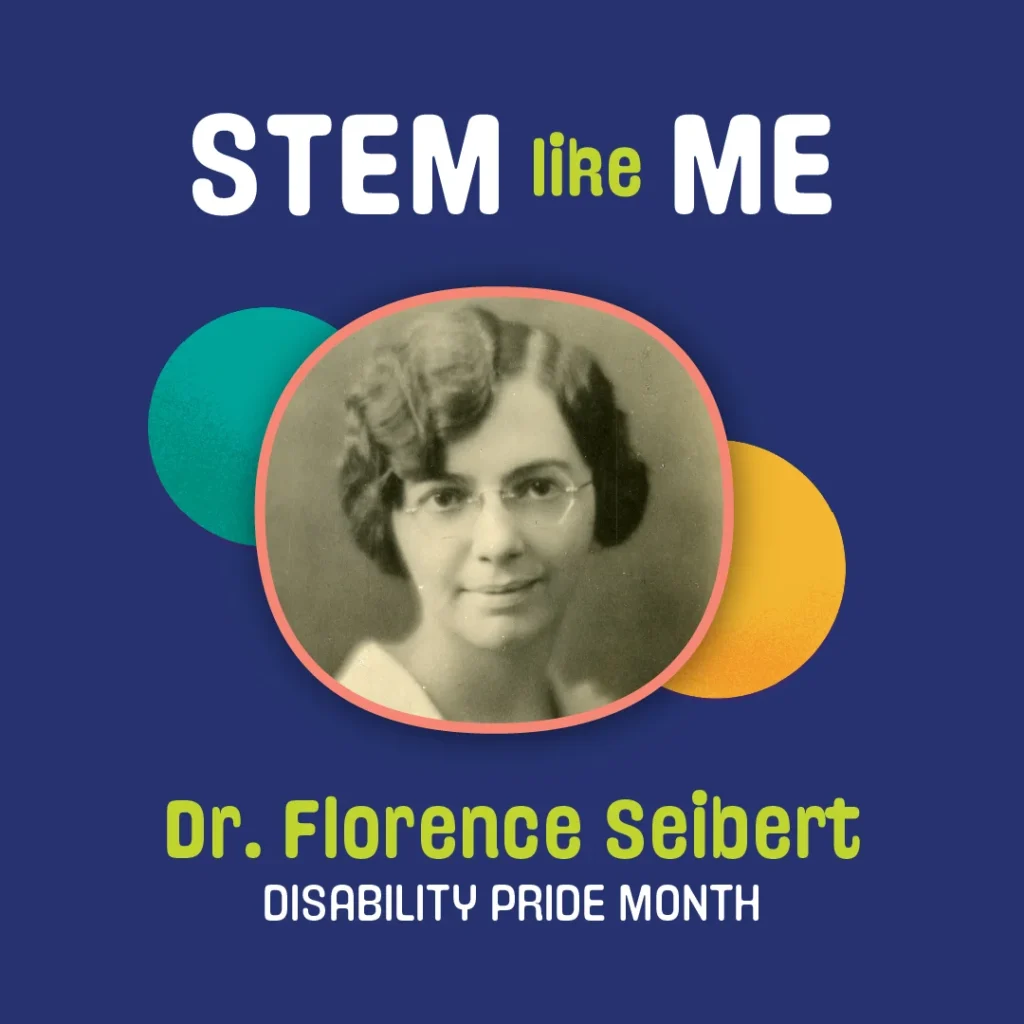
When eliminating bacterial contamination in vaccinations, injections and blood transfusions is the second most groundbreaking discovery of your career, you earn a place in the Hall of Fame. Dr. Florence Seibert created a process to eliminate that contamination during her graduate degree studies and later identified the protein in Mycobacterium tuberculosis that enabled the creation of the PPD test that identifies the infectious and deadly disease tuberculosis.
Born in Pennsylvania, Dr. Seibert contracted polio at age three and had to wear leg braces throughout her life as a result. Reading about famous scientists inspired her career in medicine. After graduating high school as the valedictorian, she studied chemistry at Goucher College in Maryland, graduating with Phi Beta Kappa honors. She then earned a Ph. D. in biochemistry from Yale University, where she invented the water distiller that prevented the contamination in vaccinations and other products. After that, she became a Porter Fellow at the University of Chicago, an assistant professor at Chicago and an assistant professor at the University of Pennsylvania, where she would work the rest of her professional career. Following retirement as a full professor in 1959, she volunteered for various organizations seeking to uncover the origins for various cancers.
At Penn, she worked with Dr. Esmond Long to discover a reliable method for testing tuberculosis — a disease that was one of the world’s leading causes of death at the time. Before Dr. Seibert identified the PPD test, the previous test would produce a high number of false negative results because of impurities in the system. She published her findings in the late 1930s and was awarded the Trudeau Medal from the National Tuberculosis Association in 1938. By the 1940s, her test became the international standard for assessing the infection and is still used today.
Dr. Seibert wrote an autobiography, “Pebbles on the Hill of a Scientist,” to highlight the challenges she overcame and was inducted into the National Women’s Hall of Fame in 1990. She passed away from long-term complications from her polio infection in 1991.
For more information:
Subjects