Day Sky Update July 2026
This is the Saint Louis Science Center’s DAY SKY UPDATE for the Month of July 2026.
Information updated monthly or as needed.
Times given as local St. Louis time which is Central Daylight Time (CDT). For definitions of terminology used in the night sky update, click the highlighted text. If relying on times posted in Universal Time (UT), St. Louis is -5 hours when CDT. Additionally, times will be posted in a 24-hour format.
Join us for our next solar telescope viewing each Sunday through Labor Day, held in association with the St. Louis Astronomical Society. These viewing sessions are weather dependent. For details, see the information at the bottom of this page or visit https://www.slsc.org/explore/mcdonnell-planetarium/public-telescope-viewings/
Daytime Astronomy Primer
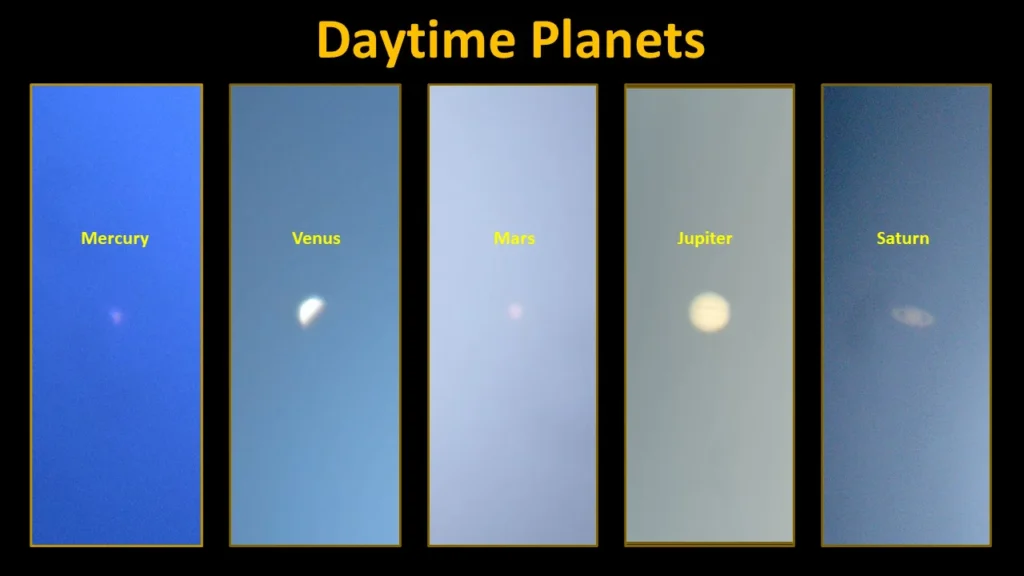
Image shows daytime telescope view of the five naked eye planets. Image credit: Eric Gustafson
For most, astronomy is a hobby that is left to the darkness of night. While most astronomical objects are only visible at night, the day sky can offer a careful observer several astronomical targets along with a multitude of atmospheric phenomena to enjoy. When posted, the DAY SKY UPDATE will explore these possibilities which may include a highlight of the month, cloud observing, sun rise/set times, daytime Moon information, daytime planets and other topics. As always, when viewing during daytime, you must use caution as the Sun is always near.
Aside from solar filters, there are other safety steps that you should consider. Sunscreen, hats and sunglasses are always advisable. Visible light is how we observe the world around us, however, there is light we cannot see such as ultraviolet (UV) and infrared (IR) lights. While both are an issue if you are using an optical system, UV light is an issue through exposure. This can be mitigated by using sunscreen, sunglasses and limiting exposed skin. While sunglasses are not safe instruments to view the Sun with, they do protect your eyes from exposure to ultraviolet light that we are susceptible to during the day.
Observing Highlight
It is finally Summer! Just because we are leaving Spring behind us does not mean we stop experiencing severe weather. Pop-up thunderstorms become more common with the rise of temperatures and humidity during the summer months. It is time to talk all about lightning! What is it? What different types of lightning are there? What are the dangers and how can we protect ourselves from injury?
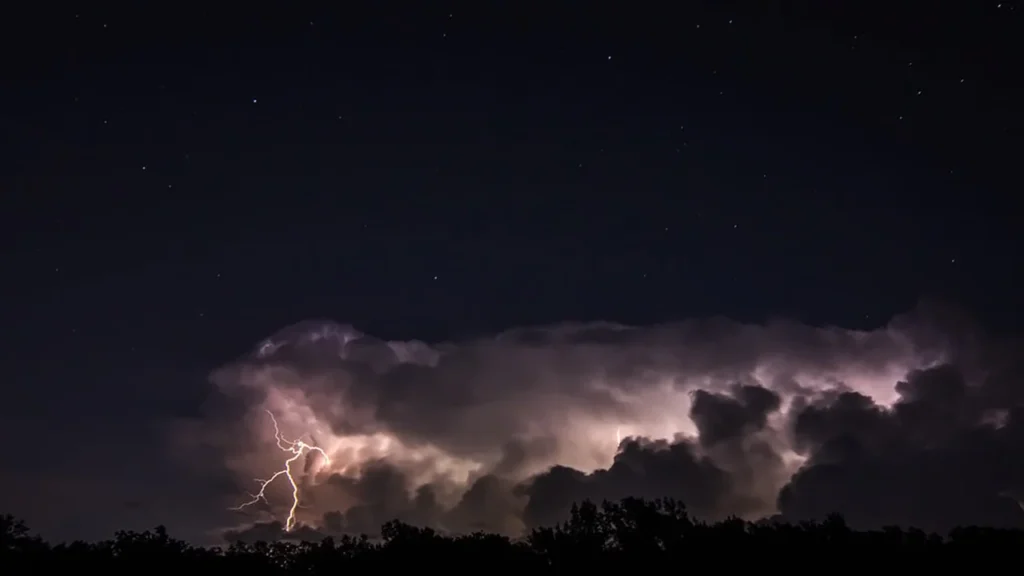
Image showing lightning strike during nighttime thunderstorm in Missouri taken August 19, 2017. Image credit: Sue Corbisez
Lightning Environment
Lightning is defined as an electrical discharge in the atmosphere. You can think of this as the same form of static electricity from the spark created by rubbing your shoes on carpet and touching something metal, but on a much larger scale! Just because it is raining, does not guarantee that we will experience lightning. Common rain clouds such as nimbostratus are not able to produce lightning because they lack the proper conditions for the static charge to build. Cumulonimbus clouds are known as thunderstorm clouds but that also doesn’t guarantee lightning activity. It all comes down to having certain atmospheric conditions.
On a day with no clouds, Earth has what is called a fair weather electrical field, meaning there is an excess number of positively charged ions in the atmosphere and an excess of negatively charged ions on the surface. Now let’s set the scene by starting with a large, towering cumulonimbus cloud. A well-developed thunderstorm cloud contains ice crystals in its upper levels and liquid water in its lower levels. Water droplets get caught in the updraft and are lifted higher altitudes where they start to freeze. The downdrafts bring down ice particles and hail towards the bottom on the cloud. The water and ice crystals collide with each other, causing electrons to detach from the water droplets and start collecting on the ice crystals. This creates a strong electrical field inside the storm with the upper part positively charged and the lower part negatively charged. This scenario results in the ground underneath the main part of the storm to be positively charged and the ground underneath the anvil to be negatively charged.
Lightning types
When the electrical charge difference becomes too great, the surrounding air no longer acts as an insulator, electrons start to move freely, and we get the lightning strike. There are many types of lightning, but the three main types are known as cloud to ground, cloud to cloud (and cloud to air), and intra cloud lightning.
Intra cloud is the most common type, which occurs due to a discharge between positively and negatively charged regions in the cloud. Many know this as sheet lightning because you normally do not see a lightning bolt, but instead the cloud lights up from within. Cloud to cloud lightning occurs when the discharge happens between separate clouds. Cloud to air lightning occurs when there is a discharge between the positively charged portion of the cloud and the negatively charged surrounding air.
Lastly, we have cloud to ground lightning. This starts with a channel of electrons that rush from the cloud base to the ground in a series of steps called the stepped ladder. The charges can take several paths, which eventually leads to the typical forked look to lightning. As the branches of the stepped ladder reach closer to the surface, the electrical field between the surface object (buildings, tress, etc.) and the stepped ladder becomes so great that positive charges jump upward off the object to meet the stepped ladder. This is all occurring faster than the blink of an eye (1/100,000 of a second) and completely invisible to the human eye. Once the positive streamer and ladder connect, the electrical current starts flowing, called the return stroke, and the flash occurs. The return stroke travels about 60,000 miles per second back to the cloud. So even though it looks like lightning comes down from the cloud to the ground, it technically begins at the ground and travels up!
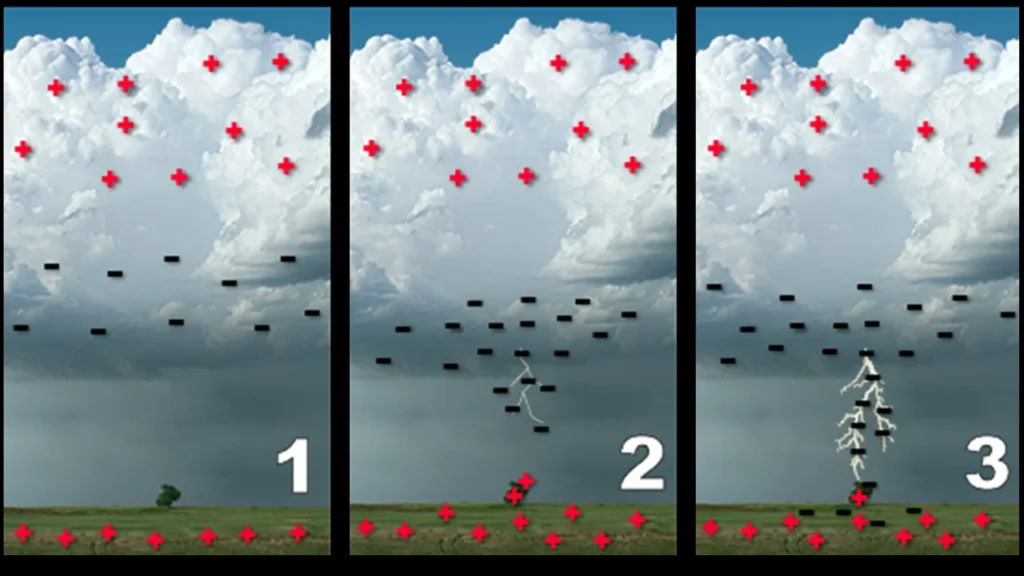
Image showing the stages of cloud to ground lightning. Step 1 shows the normal charge distribution environment between the cumulonimbus cloud and the ground. Step 2 shows the negative stepped ladder coming down and the positive streamer coming up to meet it. Step 3 shows the return stroke. Image credit: NOAA
Thunder
When lightning strikes, the air is heated to 54,000 degrees F° (that’s five times hotter than the surface of the sun!). This extreme heating causes the air to expand rapidly, compressing the air out in front of it creating a shock wave. The air then contracts as it starts to cool and creates the sound wave we hear as thunder.
The frequency of the sound changes with distance from the lightning channel and will reach you at different times. Close to the stroke you experience the high frequencies which means thunder will have a tearing sound. A few seconds later you’ll hear a loud crack from the lightning channels a little farther out. Lastly, you hear the low rumbles from the most distant part of the channel.
We see lightning before we hear the thunder and that’s because the speed of light is faster than the speed of sound. We can roughly estimate how far the lightning stroke is from our location by counting the number of seconds between the flash and the first sound of thunder. It takes about 5 seconds for sound to travel one mile. So, if you see lightning and count ten seconds until you hear thunder, the lightning strike occurred two miles away. One can hear thunder from a stroke of lightning up to 25 miles away. Sometimes you can even see lightning but never hear the thunder, this is because at this point the sound has propagated away from your location. If you experience lightning and thunder simultaneously, the stroke is in your vicinity, and you need to seek shelter. The sound of thunder and the sight of lightning should serve as a warning that you are within striking distance and should seek shelter immediately.
Lightning safety
Lightning is an extremely fascinating phenomenon and can be breathtaking to admire, but it needs to be taken very seriously. People tend to focus on the dangers of hail, wind, and tornadoes, but lightning can be the first hazard you experience from a thunderstorm and can be the last hazard to leave. Lightning is unpredictable and protection cannot always be guaranteed, but knowing certain safety guidelines can reduce the risk of injury or even death.
No place can ensure 100% safety, but some places are safer than others. The safest place to seek shelter during a thunderstorm is inside a large, enclosed structure (specifically with plumbing and wiring), including private residences, schools, office buildings, and shopping centers. If these are not available, seek shelter in an enclosed vehicle such as an automobile, van, or school bus as an alternative. Once inside, it is recommended you stay in the most interior room and to limit interactions with electrical appliances and plumbing fixtures. If inside one of the listed vehicles, make sure the windows are rolled up and try to avoid contact with radios and the ignition. Unfortunately, not all buildings and vehicles provide safety during a lightning storm. Specifically, those that have exposed elements including carports, sheds, pavilions, convertible vehicles, golf carts, and tractors.
There are many misconceptions about lightning, but it is not something to take lightly. Summer is the most dangerous season for lightning injuries, with the most fatalities occurring during the months of June, July, and August. Avoid open areas and stay away from trees, utility poles, and stay away from metal conductors. Although metal doesn’t necessarily attract lightning, it does travel through it. Each year in the United States, about 300 people get struck by lightning. Ten percent of those struck are killed, while other suffer with lifelong disabilities.
The Nation Weather Service collects data to learn how to better prevent these tragedies. They state that many lightning victims waited too long to seek shelter or they went back outside too soon. It is recommended to wait at least 30 minutes after hearing the last crack of thunder to resume normal activities. Just because it stopped raining doesn’t mean you are in the clear. Lightning has the ability to strike as far as ten miles away from the parent storm. If you know that there is a chance of severe weather, try to have a safety plan. Remember the saying, when thunder roars, go indoors!
The Sun and the Moon
Sun Information
The month of July sees the Sun decreasing its altitude each day after its standstill in June. When viewed from St. Louis, the Sun’s maximum altitude will shift from 74.4° on July 1, 2026, to 69.5° on July 31, 2026. The next major position of the Sun occurs on September 22, 2026, as the Sun reaches the September equinox. This day sees the beginning of fall in the northern hemisphere and spring in the southern hemisphere.
With summer fully underway, you can expect to see increasing temperatures and continued chances for sever weather. Dragonflies and damselflies are beginning to appear as are lightning bugs. While lightning bugs can be found in the daytime, they are better seen during twilight hours or at night. I have also started to notice the discarded exoskeletons of emerging annual cicadas.
Earth reaches aphelion this year on July 6, 2026. This is when Earth is at its greatest distance from the Sun for the current orbit. At aphelion, Earth is roughly 94.5 million miles from the Sun. At perihelion, which is Earth’s closest point to the Sun, they are separated by 91.4 million miles. Earth’s average distance from the Sun is 92,955,807 miles which is known as an astronomical unit.
| Sept. Equinox | Sept. 22, 2026 |
| Dec. Solstice | Feb. 21, 2026 |
| March Equinox | March 20, 2027 |
| June Solstice | June 21, 2027 |
Sunrise and Sunset Times for St. Louis Missouri
The sunrise and sunset times below were calculated by the Earth Systems Research Laboratories for NOAA. These times are calculated using equations for Jean Meeus’s Astronomical Algorithms. The atmosphere complicates these calculations due to the refraction of sunlight as it passes through the atmosphere. For the times listed below, the amount of atmospheric refraction is assumed to be 0.833°. Variations in the atmosphere can change the amount of refraction so the times posted are accurate to within a minute for latitudes between +/- 72°.
| Day | Sunrise (CDT) | Sunset (CDT) |
| 1-July | 5:40 | 20:29 |
| 2-July | 5:40 | 20:29 |
| 3-July | 5:41 | 20:29 |
| 4-July | 5:42 | 20:29 |
| 5-July | 5:42 | 20:28 |
| 6-July | 5:43 | 20:28 |
| 7-July | 5:43 | 20:28 |
| 8-July | 5:44 | 20:28 |
| 9-July | 5:44 | 20:27 |
| 10-July | 5:45 | 20:27 |
| 11-July | 5:46 | 20:26 |
| 12-July | 5:46 | 20:26 |
| 13-July | 5:47 | 20:26 |
| 14-July | 5:48 | 20:25 |
| 15-July | 5:49 | 20:25 |
| 16-July | 5:49 | 20:24 |
| 17-July | 5:50 | 20:23 |
| 18-July | 5:51 | 20:23 |
| 19-July | 5:52 | 20:22 |
| 20-July | 5:52 | 20:21 |
| 21-July | 5:53 | 20:21 |
| 22-July | 5:54 | 20:20 |
| 23-July | 5:55 | 20:19 |
| 24-July | 5:56 | 20:18 |
| 25-July | 5:56 | 20:18 |
| 26-July | 5:57 | 20:17 |
| 27-July | 5:58 | 20:16 |
| 28-July | 5:59 | 20:15 |
| 29-July | 6:00 | 20:14 |
| 30-July | 6:01 | 20:13 |
| 31-July | 6:02 | 20:12 |
Moon (daytime views)
Last quarter moon occurs on July 7, 2026, and first quarter moon occurs on July 21, 2026. The best daytime views of the Moon are always near the quarter phases. Look for the Moon in the morning at the beginning of July. When we are near first quarter phase, look for the Moon in the afternoon.
The Moon crosses the ecliptic at its ascending node this month on July 4, 2026, and then at its descending node on July 17, 2026. This behavior occurs because the Moon’s orbit around Earth is tilted about 5.1° with respect to Earth’s ecliptic. This nodal cycle of the Moon is called a draconic month which is 27.2 days long. During each nodal cycle, the Moon crosses Earth’s ecliptic twice at what are called the ascending and descending nodes. Being aware of these crossing nodes helps observers know if the Moon will appear south or north of the ecliptic.
| Phase | Date | Time (CDT) |
| Full Moon | June 29, 2026 | 18:57 |
| Last Quarter | July 07, 2026 | 14:29 |
| New Moon | July 14, 2026 | 04:44 |
| First Quarter | July 21, 2026 | 06:06 |
| Full Moon | July 29, 2026 | 09:36 |
Solar Sunday is now held every Sunday from 11:00 a.m. until 3:00 p.m. (Weather Dependent). This will continue until Labor day.
Every Sunday through Labor Day, the St. Louis Astronomical Society and the Saint Louis Science Center will set up a number of safe solar telescopes outdoors and be on hand to answer your questions. Telescope viewing begins at 11:00 a.m. weather permitting.
The St. Louis Astronomical Society helps host the monthly Star Parties at the Saint Louis Science Center. In addition to our daytime viewings, they also help facilitate our nighttime Public Telescope Viewing. These nighttime viewing sessions occur on the 1st Friday each month. Visit SLAS’s website linked above to learn about other telescope events SLAS hosts around the St. Louis area.
Subjects