The Saint Louis Science Center envisions an equitable and inclusive society where people are passionate about science and use it to improve lives, transform communities and empower future generations. Through exposure to STEM concepts and recognition of contributions made by members of various communities, we aim to inspire and empower individuals from all backgrounds to pursue and thrive in STEM fields.
This month, as we celebrate Hispanic Heritage Month, we’re recognizing a few STEM-sational individuals who’ve inspired us all to make an impact.
Dr. Mario Molina
First Mexican-born scientist to receive a Nobel Prize in Chemistry, discovered the threat to Earth’s ozone layer (1943 – 2020).

While studying the effect of chlorofluorocarbons (gases used in refrigerants, aerosol sprays and some plastics), Dr. Mario Molina and his partner, Professor F. Sherwood Rowland, discovered a threat to the ozone layer that prevents cancer-causing ultraviolet B light from entering Earth’s atmosphere. This discovery led to bans on the production of those materials and the ongoing recovery of holes in the ozone layer found above Antarctica.
Born in Mexico City, Molina knew he wanted to become a chemist at an early age thanks to guidance from his aunt Ester, a chemist herself. He completed elementary and primary school in Mexico but entered a Swiss boarding school at age 11 to further his interest in science. After graduating, he earned a bachelor’s degree in chemical engineering from the Universidad Nacional Autónoma de México in Mexico City and studied at the Albert Ludwig University in West Germany before entering graduate school at the University of California – Berkeley, from which he earned a PhD in physical chemistry. His post-doctoral research led to his focus on chlorofluorocarbons (CFCs).
Molina entered a research program led by Rowland in 1973. At the time, CFCs were believed to be harmless because they were inert at lower levels in the atmosphere. However, Molina’s research discovered that these gases did not decay, and that they rise to higher altitudes. At these higher levels, the sun’s ultraviolet light does break down these gases and releases chlorine atoms that react with one of ozone’s three oxygen atoms to destroy that protective layer – a process that perpetuates. Observation in the early 1980s by Joseph Farman discovered that this oxygen depletion caused a large decrease in the ozone layer along Earth’s polar areas and was most pronounced above Antarctica (a phenomenon they termed the Antarctic hole). These discoveries led to the Montreal Protocol in 1987, an international treaty ratified by nearly 200 countries to eliminate the production of substances responsible for ozone depletion, the Paris Agreement in 2015 that aims to reduce the emission of harmful chemicals, and an ongoing improvement to the ozone layers that is expected to return to pre-1980 levels by 2040.
Beyond that 1995 Nobel Prize, Molina has earned numerous awards and honors. Among them, he was elected to the U.S. National Academy of Sciences in 1993 and the Mexican Academy of Sciences and received the Presidential Medal of Freedom from President Barack Obama in 2013.
For more information:
Dr. Antonia Novello
The first woman and first Hispanic individual to serve as the Surgeon General of the United States in 1990 (1944 – Present).
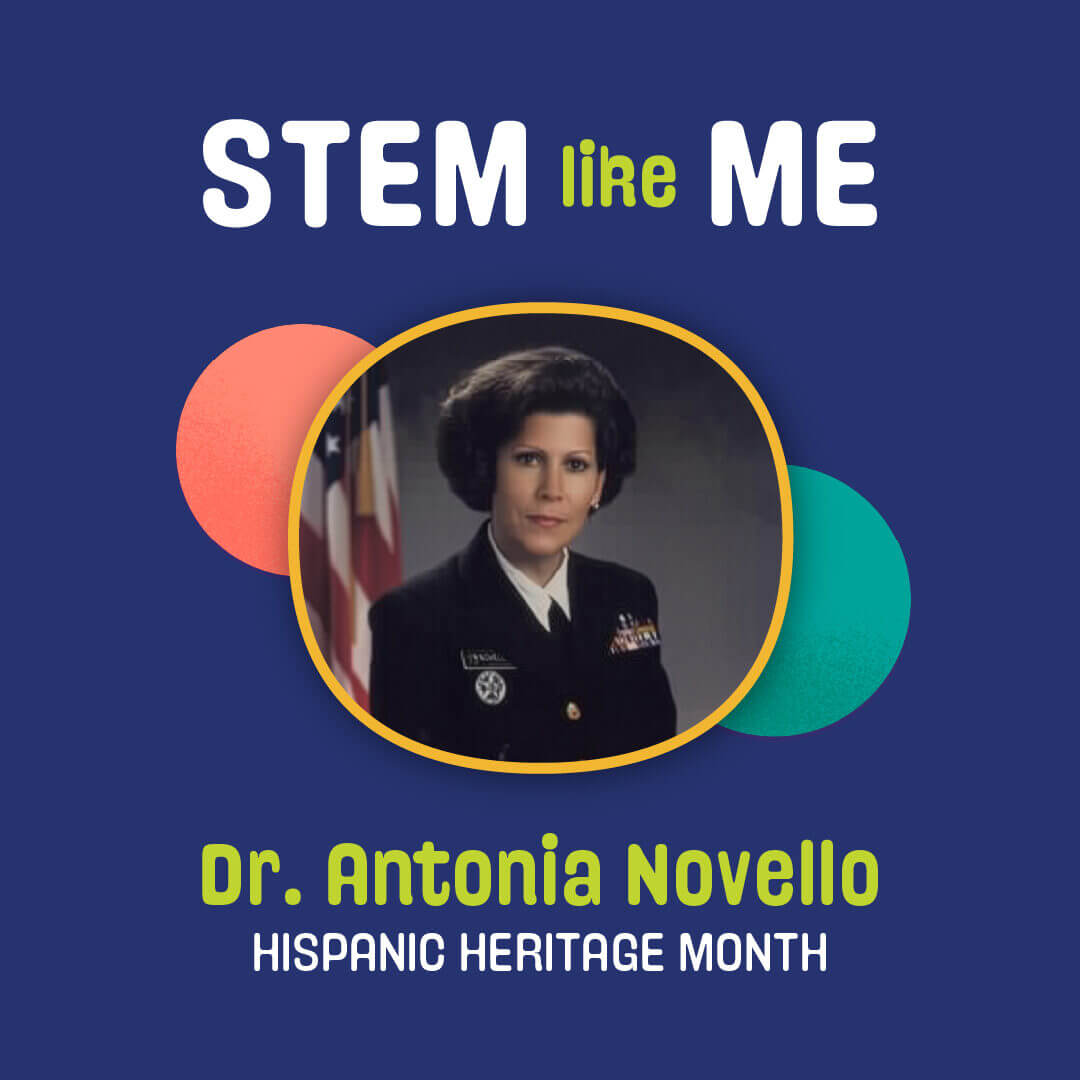
A pediatric nephrologist who became a doctor because of a congenital disease that was left untreated for 18 years, Dr. Antonia Novello worked to help children. She rose through public health service because of this devotion and was appointed U.S. Surgeon General – the first woman and first Hispanic person to hold this position — by President George H.W. Bush in 1990.
Born in Puerto Rico to a single mother who stressed the importance of education, Novello graduated high school at age 15 and attended college on the island. After earning a Bachelor of Science from the University of Puerto Rico in Rio Piedras, she earned a Doctor of Medicine from the University of Puerto Rico School of Medicine in San Juan. After graduating and marrying Joseph Novello, they moved to Michigan, where she became the first woman to receive the University of Michigan Pediatrics Department Intern of the Year. The couple then moved to Washington D.C., where she earned master’s and doctorate degrees in public health from Johns Hopkins University.
With her education complete, Novello first opened a pediatric practice but then joined the United States Public Health Service to improve the welfare of children, women and minorities. She performed various positions for the National Institutes of Health (NIH) and was appointed to Assistant Surgeon General in 1986. In this position, she focused on pediatric AIDS patients and the enactment of the Organ Transplant Procurement Act of 1984.
President Bush appointed Novello as Surgeon General in March 1990. She worked to promote immunization of children and the prevention of childhood injuries, reduce underage drinking and smoking, and enhance research on the prevention and treatment of AIDS.
She left the Surgeon General post in 1993 but remained committed to the Public Health Service. She was assigned to UNICEF as the Special Representative for Health and Nutrition. After that, she was named Commissioner of the New York State Department of Health from 1999-2006. She then served as the Vice President of Women and Children’s Health and Policy Affairs at Disney Children’s Hospital in Orlando, Florida before retiring from the hospital in 2014.
In addition to numerous awards and recognition for her role with the Public Health Service and Surgeon General’s office, Novello was inducted into the National Women’s Hall of Fame in 1994 and the National Academy of Medicine in 2000. In 2020, USA Today named her to its list of the “100 Women of the Century.”
For more information:
Dr. Franklin Chang Diaz
Astronaut and leading proponent of plasma rocket propulsion technology (1950 – Present).

A veteran of seven Space Shuttle missions (among the most space flights for any astronaut), Dr. Franklin Chang-Diaz is dedicated to the development of plasma rocket propulsion technology through his Ad Astra Rocket Company. Once perfected, this technology allows space vehicles to achieve extremely high exhaust speeds that enable them to travel longer distances more efficiently.
Born in Costa Rica, Chang-Diaz moved to the United States to finish his high school career and expand his opportunities to explore space. He graduated from the University of Connecticut with a degree in mechanical engineering and earned a PhD from the Massachusetts Institution of Technology in 1977.
Following college, he was selected as a NASA astronaut candidate in 1980. He flew his first of the seven space missions in 1986 and continued on missions through 2002, logging more than 1,600 hours in space and more than 19 hours in three spacewalks. During this time, he also served as the Director for the Advanced Space Propulsion Laboratory at the Johnson Space Center in Houston, Texas. For his work, he was inducted into NASA’s Astronaut Hall of Fame in 2012 and earned two NASA Distinguished Service Medals, three NASA Exceptional Service Medals and the Liberty Medal, presented by President Ronald Reagan. He retired from NASA in 2005.
Following his departure from NASA, he formed Ad Astra Rocket Company, which is dedicated to advancing plasma rocket propulsion technology. The company has extended the development of the Variable Specific Impulse Magnetoplasma Rocket (VASIMR), which is an electrical device used for space propulsion. This technology ionizes a propellent to create a heated plasma that uses magnetic fields to generate thrust. The technology is intended to allow space travel to become faster, more efficient and longer in duration – allowing for future exploration of the moon, Mars and other planetary objects.
For more information:
Subjects