July 14, 2025
On this date in 2005, the Cassini spacecraft conducted a flyby of Saturn’s moon Enceladus. The surface of Enceladus is covered in a layer of ice approximately 13 miles (20 km) deep. Beneath the ice is a liquid water ocean that spans the entire moon and is about 25 miles (40 km) deep. The deepest part of Earth’s oceans is called Challenger Deep, which is in the western Pacific Ocean, and is 6.8 miles (10.9 km) deep – much shallower than Enceladus’ global ocean.
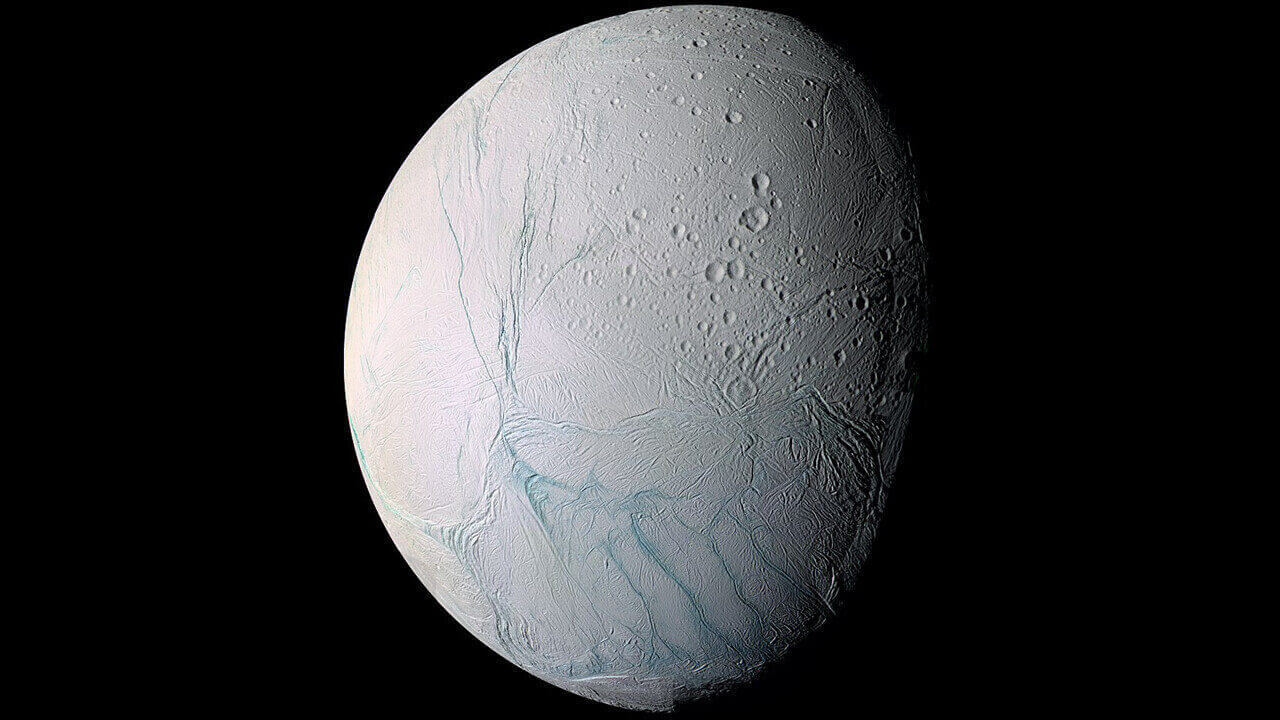
This image of Enceladus was taken during Cassini’s flyby in 2005. This is a false-color image, meaning some of the color has been enhanced. For example, the blue lines are long fracture lines on the icy surface of the moon.
Image courtesy of NASA/JPL.
Subjects