This is the Saint Louis Science Center’s NIGHT SKY UPDATE for the week of Sunday, April 19, 2026
Information updated weekly or as needed.
Times given as local St. Louis time this week will be in Central Daylight Time (CDT). For definitions of terminology used in the night sky update, click the highlighted text. If relying on times posted in Universal Time (UT), St. Louis is -5 hours when CDT. Times posted in the Night Sky Update are in the 24-hour format.
Join us for our next star party, Friday, May 1, 2026, held in association with the St. Louis Astronomical Society. For details, see the information at the bottom of this page or visit https://www.slsc.org/explore/mcdonnell-planetarium/public-telescope-viewings/
Observing Highlight: Lyrid Meteor Shower
This week the Lyrid meteor shower peaks on April 21/22, 2026. The Lyrids are a moderate strength meteor shower that can produce between 10-20 meteors per hour during peak activity. On rare occasions, the Lyrids have exhibited an outburst of activity producing upwards of 100 meteors per hour, but this is not expected this year. The American Meteor Society lists the Lyrids as producing 18 meteors per hour this year if viewing from a dark location.
The Lyrid meteor shower is produced by Comet Thatcher (C/1861 G1). This long period comet orbits the Sun on a period of 422 years which will reach perihelion again in 2276. Each time Comet Thatcher returns to the inner solar system it leaves behind a fresh stream of debris that eventually intersects Earth’s orbit. Every year in April, Earth passes through past debris streams of the comet, producing the annual Lyrid meteor shower. Comet Thatcher was discovered by A.E. Thatcher in 1861 and was later confirmed as the source of the Lyrids in 1867 when Johann Gottfried Galle confirmed the comet and meteor shower shared the same orbit.
Meteor showers were not linked to comets until the 19th century. Many scientists believed that meteor showers were localized atmospheric phenomena. In 1794, physicist Ernst Chaldani suggested meteors originated from outer space. Eventually, astronomer Giovanni Schiaparelli suggested that meteors came from comets after he found that Comet Temple and the Leonid meteor stream had similar orbits. While most meteor showers appear to be caused by comets, there are a few that are caused by objects that appear to be asteroids. These meteor showers are the Geminids in December and the Quadrantids in January.
Observations of the Lyrid meteor shower date back to the year 687 BCE making it the oldest known observed meteor shower. Every year from mid-April to the end of the month, Earth encounters debris from Comet Thatcher which produce the Lyrid meteor shower. The outburst behavior of the Lyrids appears to be on a 60-year cycle. Scientists theorize that this might be caused by a crumbling fragment of Comet Thatcher that broke off the comet during a previous orbit. If the 60 year cycle is correct, the next outburst should happen around 2040 or 2041.
To view meteor showers, you only need clear skies and knowledge of the meteor shower radiant. The radiant of a meteor shower is the place in the sky meteors appear to emanate from. For the Lyrids, its radiant is near the bright star Vega. You can find Vega rising in the northeast by 10 pm. The Lyrid radiant is about 9° south of this bright star.
While it might be above the horizon by 10 pm, this is not the best time to look for meteors. Meteors will emanate from this location in all directions. When it is low to the horizon you limiting your view. The higher the radiant appears, the better your chance to see meteors will be.
Higher meteor activity for the Lyrid shower occurs over a few days centered around the date of peak activity. With the Lyrid peak expected to be best in the predawn hours of April 22, views from April 21 to April 23 should be decent.
T CrB Nova Update 4/19/2026
f you are still interested in seeing the recurrent nova T Coronae Borealis, there is still hope. The nova has not yet occurred meaning we are in a waiting game. If you are still interested, the part of the sky the nova will appear in is found rising in the east by 10 pm. The star system T Coronae Borealis is found in the constellation Corona Borealis which looks like a small U-shape of stars next to the constellation Boötes.
By 3 am the location of T CrB will be nearly overhead. Besides observing the sky directly, you can track the behavior of T CrB by checking current magnitude estimates posted at AAVSO here or by visiting spaceweather.com. Current magnitude estimates of the system show it at 10th magnitude.
The Sun and Moon
Sun
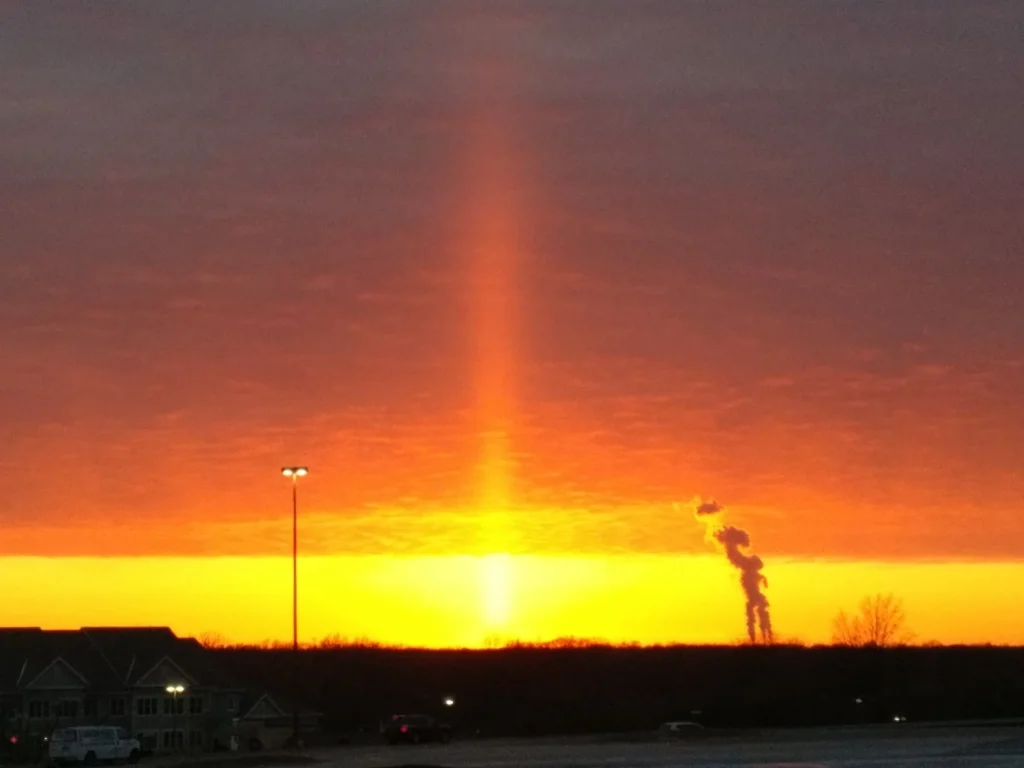
Sunrise on Sunday, April 19 is at 06:19 and sunset is at 19:41 providing about 13.5 hours of daylight. Even after sunset, light from the Sun will dimly illuminate our sky for about 1 hour and 40 minutes. This period is called twilight, which ends around 21:18 this week. For those with a sundial, local noon occurs around 13:00 on April 19, 2026.
| Day | Sunrise (CDT) | Sunset (CDT) |
| 19-Apr | 6:19 | 19:41 |
| 20-Apr | 6:17 | 19:42 |
| 21-Apr | 6:16 | 19:43 |
| 22-Apr | 6:15 | 19:44 |
| 23-Apr | 6:13 | 19:45 |
| 24-Apr | 6:12 | 19:46 |
| 25-Apr | 6:11 | 19:47 |
| 26-Apr | 6:09 | 19:48 |
| 27-Apr | 6:08 | 19:49 |
Moon
Moonrise for Sunday, April 19, is at 07:22 and moonset occurs at 22:59. On April 19, 2026, the Moon will exhibit a waxing crescent phase with 9% disk illumination. By April 27, 2026, the Moon will exhibit a waxing gibbous phase with 87% disk illumination. First quarter moon occurs on April 23, 2026, at 21:32.
International Space Station (ISS) Observing
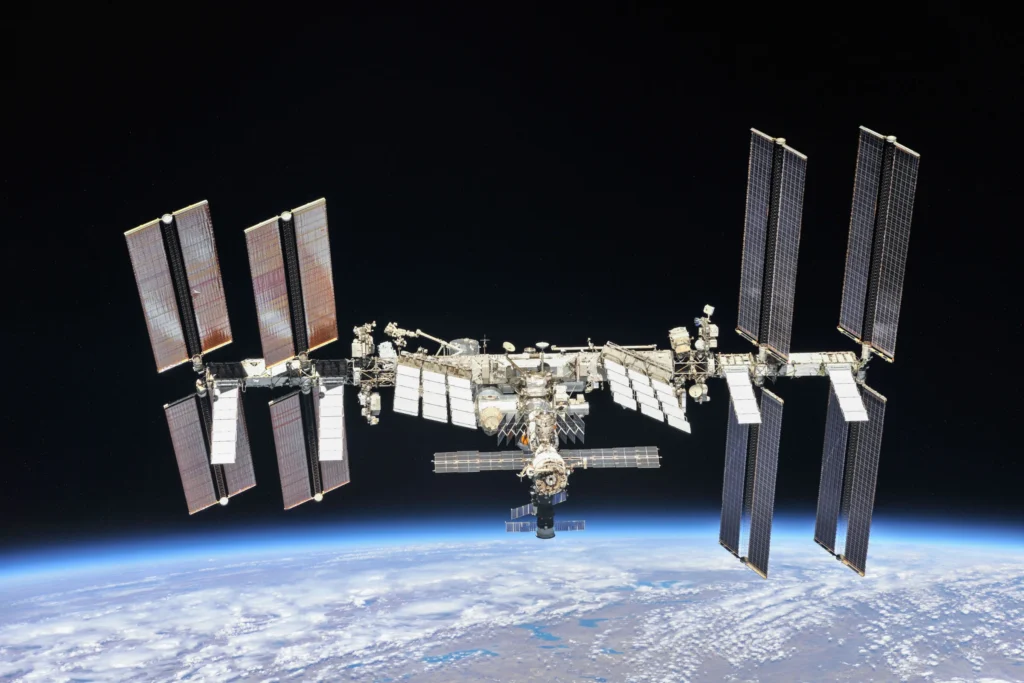
Visible passes of ISS from St. Louis for the week of April 19 occur during morning hours with the best passes occurring on April 20, 22 and 23. You can find information about these and other satellite pass at https://heavens-above.com. If you are not viewing from the St. Louis area, make sure to change your viewing location for your local times.
Visible Planets
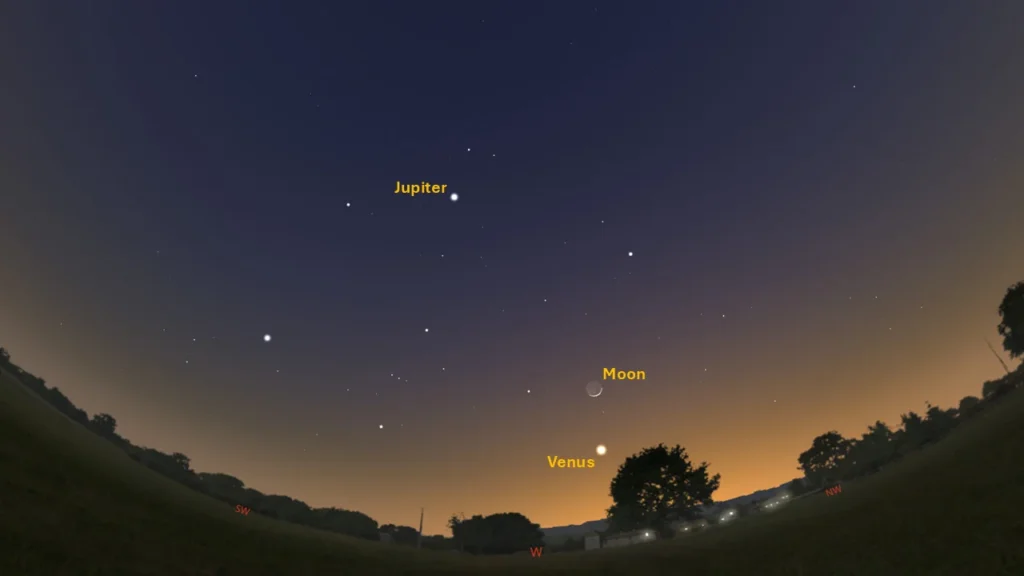
View looking west on April 19,2026, at 20:15. Image created using Stellarium
Two naked eye planets will be visible this week. Jupiter will be found in the west and Venus low in the west after sunset. Mars and Saturn are starting to climb out of the glare of the Sun before sunrise. By May, we should start seeing them in the east before sunrise.
Venus
Venus can now be seen low in the west after sunset. Its current evening apparition will continue until October as it approach inferior conjunction on October 23, 2026. Venus sets by 21:42.
Jupiter
Jupiter will be visible in the west about 30 minutes after sunset, Jupiter remains visible until 1 am at which time its low altitude will make it difficult to find for some viewers. Jupiter’s current apparition continues through June and some of July as it heads towards superior conjunction on July 29, 2026.
Our next Star Party will be held on Friday, May 1, 2026.
On the first Friday of each month, the St. Louis Astronomical Society and the Saint Louis Science Center will set up a number of telescopes outdoors and be on hand to answer your questions. Telescope viewing begins once it is dark.
The St. Louis Astronomical Society helps host the monthly Star Parties at the Saint Louis Science Center. In addition to our nighttime viewings, they also help facilitate our daytime event called Solar Sundays. These daytime viewing sessions occur every Sunday through Labor Day. After Labor Day they occur on the 3rd Sunday each month. Visit SLAS’s website linked above to learn about other telescope events SLAS hosts around the St. Louis area.
James S. McDonnell Planetarium
Night Sky Update for April 19, 2026
Subjects