The Saint Louis Science Center envisions an equitable and inclusive society where people are passionate about science and use it to improve lives, transform communities and empower future generations. Through exposure to STEM concepts and recognition of contributions made by members of various communities, we aim to inspire and empower individuals from all backgrounds to pursue and thrive in STEM fields.
This March, as we celebrate Asian American/Pacific Islander Heritage Month, we’re recognizing a few STEM-sational individuals who’ve inspired us all to make an impact.
Dr. Steven Chu – received the 1997 Nobel Prize for Physics and became the 12th U.S. Secretary of Energy (1948-Present)
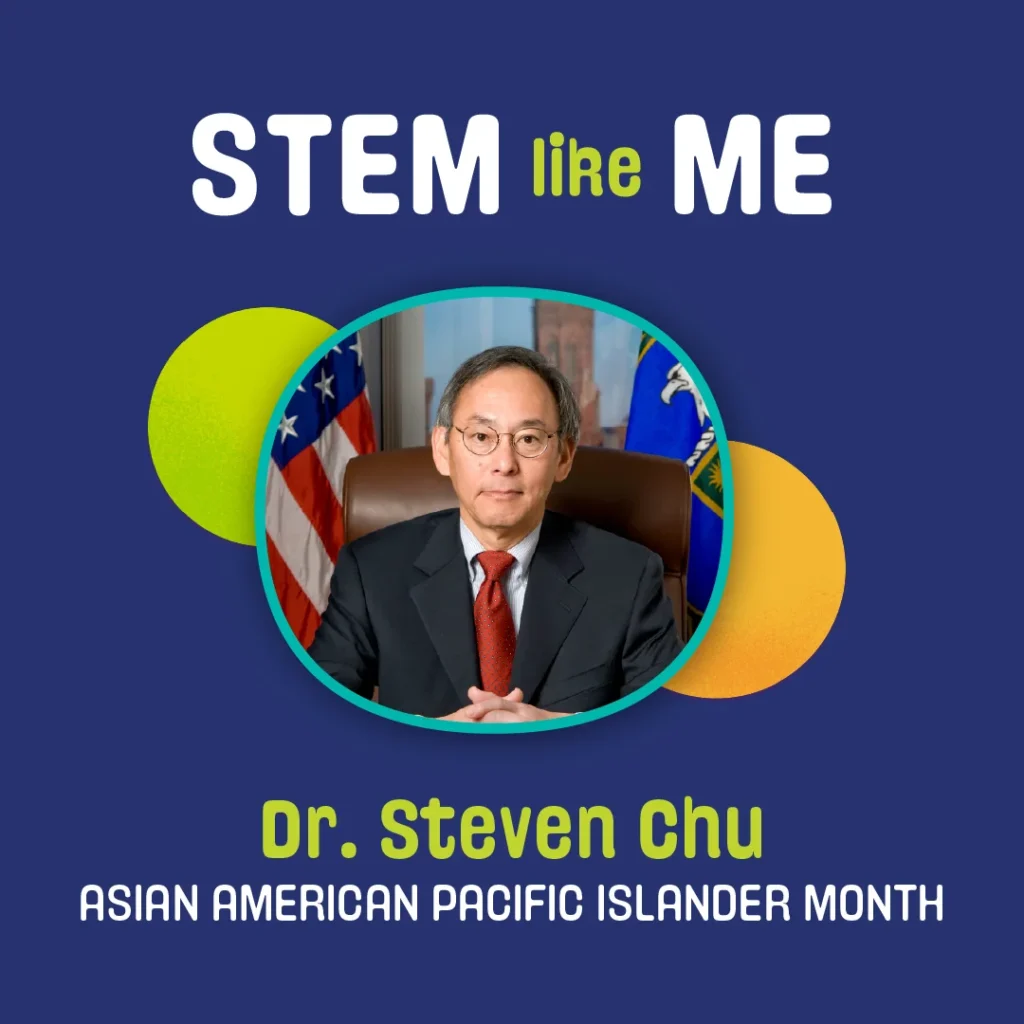
Born in St. Louis, Dr. Steven Chu served as the 12th U.S. Secretary of Energy and received the 1997 Nobel Prize in Physics for his research into the cooling of atoms using laser light. Now a university professor, he’s also recognized for advocating renewable energy sources as a means for combating climate change.
The importance of education played a significant role in Dr. Chu’s development. His father, Dr. Ju-Chin Chu taught at Washington University in St. Louis, and his grandfather, Dr. Shu-tian Li was a professor and school president at Tianjin University in China. After leaving St. Louis for the New York City area and attending Garden City High School, Steven Chu earned bachelor’s degrees in mathematics and physics from the University of Rochester and a PhD in physics from the University of California, Berkeley. He proudly shares that he, his brothers and cousins collectively earned five PhDs, three medical doctorates and a law degree.
After completing his education and two years of postdoctoral research at Cal in the 1970s, he joined Bell Labs in 1978, where he began studying the benefits of laser cooling — along with colleagues such as those with whom he shared the Nobel Prize, Claude Cohen-Tannoudji and William D. Phillips. Using lasers to cool and trap atoms reduces vibration inside mechanical systems and allows for higher precision measurement and longer operational periods. Dr. Chu coined a term for this process, “optical molasses,” as the laser beams “trap” atoms in a way that slows their movement and allows their properties to be studied in greater detail.
Following Bell Labs, Dr. Chu entered academia. He joined Stanford University in 1987 as a physics professor and twice chaired the physics department. During this time, he initiated the Bio-X program which combines physical and biological sciences with engineering and medicine. He returned to Cal from 2004-2009 as director of the Lawrence Berkeley National Laboratory researching biofuels and renewable energy sources that could drive transportation.
In 2009, President Barack Omana nominated Dr. Chu as Secretary of Energy, and he was unanimously confirmed, becoming the first Nobel Prize winner to serve in the U.S. Cabinet and the second Chinese American to serve a Cabinet Secretary position. His focus during his term was to grow renewable energy resources, control greenhouse gas emissions and strengthen America’s energy supplies. He also oversaw the effort to cap the Deepwater Horizon oil spill and assisted the disaster responses to the Fukushima nuclear event in Japan and Superstorm Sandy along the U.S. East Coast. He resigned as Secretary of Energy in 2013 and returned to Stanford as a professor and founder of the The Chu Group that is part of the Physics, Molecular and Cellular Physiology, and Energy Science and Engineering departments.
Along with the Nobel Prize, Dr. Chu has received many accolades. He is a member of the U.S. National Academy of Sciences and the American Academy of Arts and Sciences. He was presented the William F. Meggers Award by The Optical Society, the Humboldt Prize by the Alexander von Humboldt Foundation and the Karl Compton Medal from the American Institute of Physics.
For more information:
Patsy Mink – the first woman of color and first Asian-American woman elected to U.S. Congress, co-authored the Title IX amendment (1927-2002)
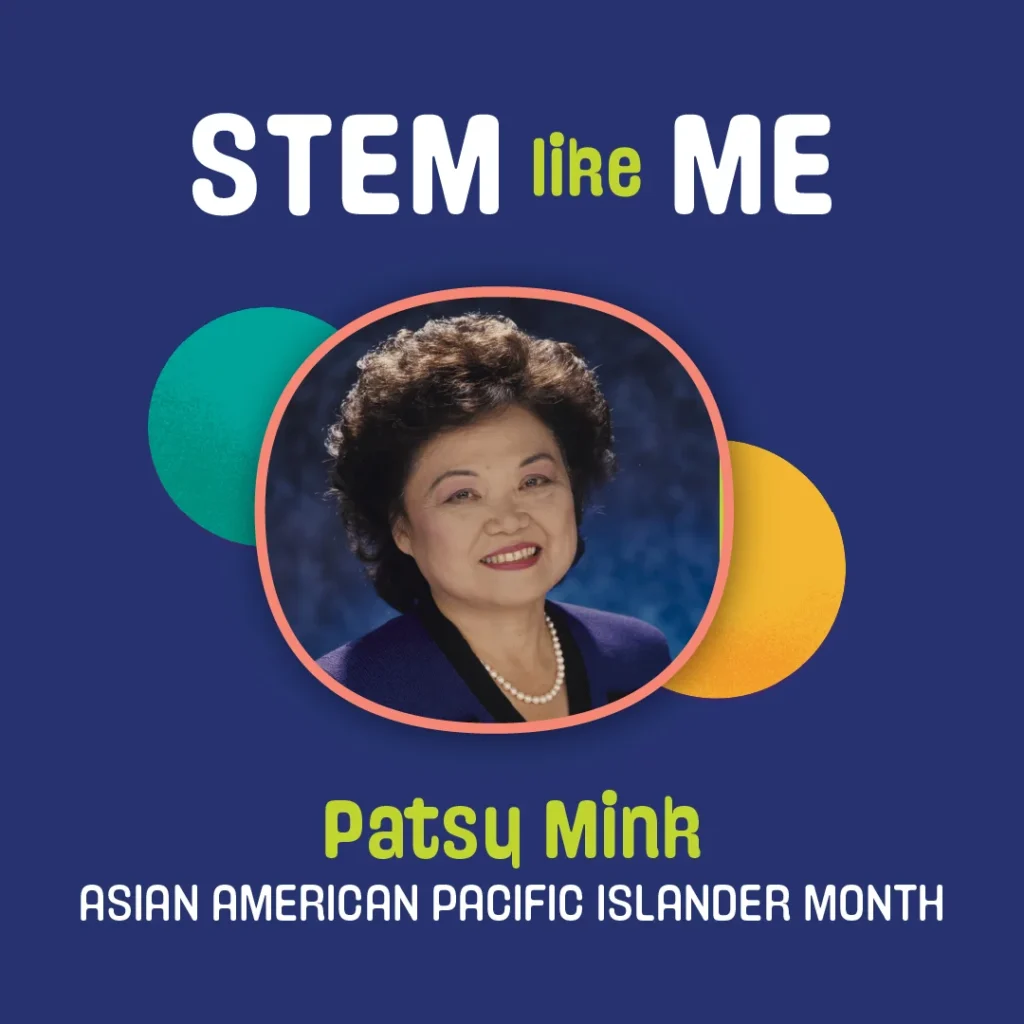
An attorney and politician from Hawaii, Patsy Mink was elected as the first woman of color and the first Asian-American woman in the U.S. House of Representatives. During her 24-year term, she is recognized for efforts to advance women’s rights and for co-authoring the Title IX amendment to the Higher Education Act, which prohibits discrimination based on gender by higher education institutions that receive federal funding.
A third-generation Japanese American, Mink was born and raised on Maui. She graduated as valedictorian from Maui High School in 1944 and earned a bachelor’s degree in zoology and chemistry from the University of Hawai’i at Manoa, with hopes of a career in medicine. Despite this degree and her skill, she received only rejections from the numerous medical schools to which she applied – in part because she was a woman and those institutions had received large numbers of applications from male veterans returning from World War II. She changed her intended career path and became one of two women in her law school class at the University of Chicago, overcoming many barriers to earn a Juris Doctor degree from the school.
She met her husband, John, during their time in Chicago, and the couple moved to Hawaii in 1952. After passing the bar in 1953, she became the first Japanese-American woman licensed to practice law in the state but could not find employment due to discrimination. She then established her own practice and taught law at the University of Hawaii. She also became active in politics during this period, being elected chairman of the territory-wide Young Democrats organization.
Mink began her political career by working as an attorney in Hawaii’s 1955 legislature session and then being elected to the Hawaiian Territorial Legislature before it gained statehood. In 1959, after Hawaii became a state, she ran for its seat in the U.S. Congress but lost to Senator Daniel Inouye, so she served in the state Senate for two years. In 1964, she ran for national office again and won one of Hawaii’s seats in the U.S. House of Representatives, becoming the first Japanese-American woman member of Congress. Among the bills she introduced during her 24 years of service was the Early Childhood Education Act, which included bilingual education, Head Start, school lunch, special education, student loan and other initiatives. In 1970, she became the first Democratic woman to deliver the State of the Union response and, in 1971, became the first Asian-American woman to run for President.
An advocate for women’s issues, Mink co-authored the Title IX Amendment to the Higher Education Act in 1972, which prohibits gender discrimination by federally funded institutions of higher education. Building upon the Civil Rights Act of 1964 that did not address educational institutions, the Act (now named the Patsy T. Mink Equal Opportunity in Education Act) was signed into law by President Richard Nixon in 1972 and remains in place today.
For more information:
I. M. Pei – world-renowned architect, designed many of the world’s most iconic buildings (1917-2019)
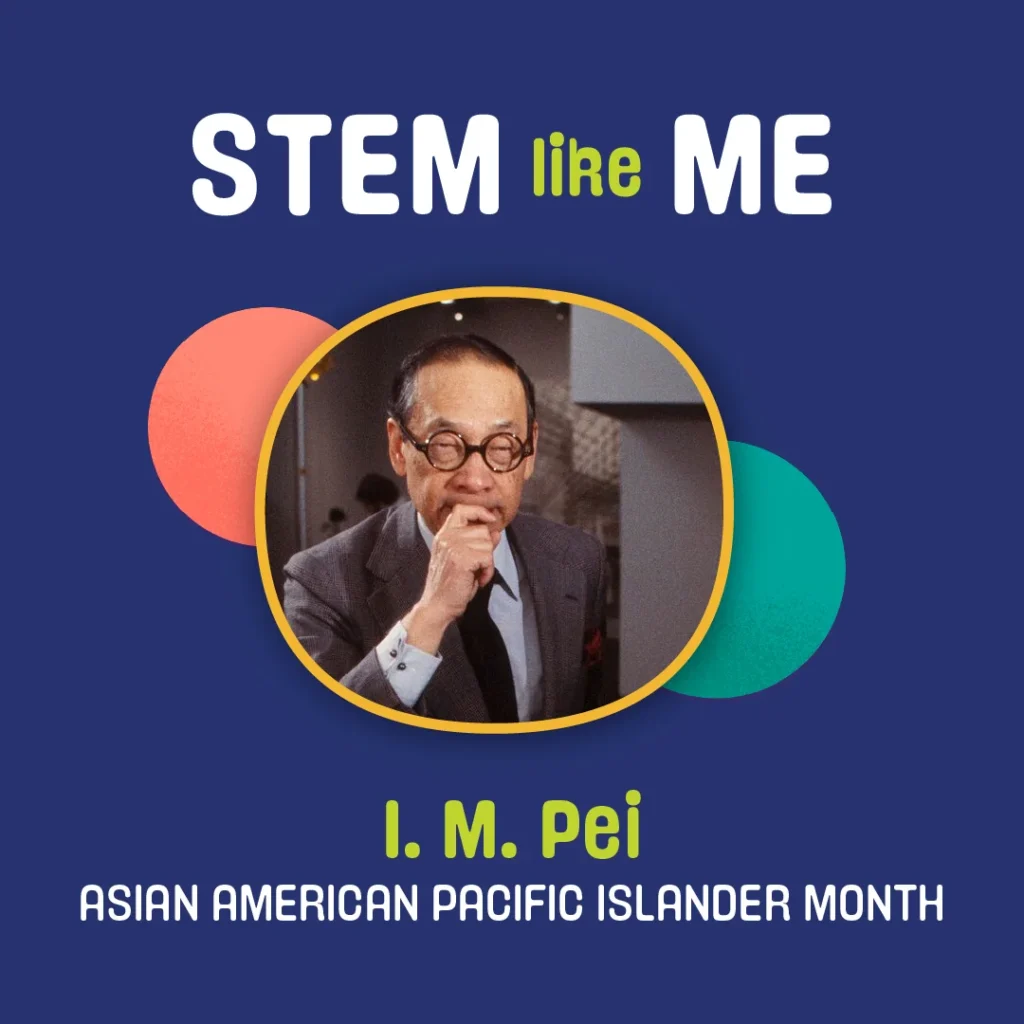
With a style that combined traditional principles with geometric patterns, Ieoh Ming (I. M.) Pei was a world-renowned architect who won “every award of consequence in his art,” according to his biographer Carter Wiseman. Among his noted designs are several of the world’s most iconic buildings, including the Grand Louvre Pyramid entrance, the John F. Kennedy Presidential Library, the East Building of the National Gallery of Art, the Museum of Islamic Art in Qatar, the Rock and Roll Hall of Fame in Cleveland and more. For his contributions, he was awarded the Pritzker Prize, considered the “Nobel Prize for architecture” in 1983.
With an ancestry that traces to the Ming dynasty, Pei was born in Guanghzhou, China, and moved to Hong Kong as an infant before relocating to Shanghai at age 10. Shanghai’s fantastic design work, both the architecture of its buildings and impressive gardens, influenced Pei’s love for art. After finishing secondary education in China, he enrolled in the architecture program at the University of Pennsylvania in 1935 to experience life in the United States. As he was more interested in modern architectural design, as opposed to the Beaux-Arts style taught at Penn, he chose to transfer to the Massachusetts Institute of Technology (MIT) and study engineering – but was convinced to return to architecture by the school’s architecture dean and earned a Bachelor of Architecture degree from the university. He later earned a master’s degree in architecture from Harvard University’s Graduate School of Design (GSD).
At MIT, he was influenced by the modernist work of French-Swiss architect Le Corbusier and American architect Frank Lloyd Wright. While studying at Harvard, he further moved on from the Beaux-Arts philosophy toward the modernist movement professed by those icons and by those from the European Bauhaus School movement. Pei worked with two leaders of the Bauhaus, who had fled Nazi Germany during the war period, Walter Gropius and Marcel Breuer. One of his projects while at GSD was a plan for an art museum in Shanghai, a piece Gropius called “the best thing done in my master class.”
After teaching at Harvard for two years after graduation, Pei joined the New York-based architecture firm Webb and Knapp, which designed buildings around the United States for its founder, a real-estate developer named William Zeckendorff. His first project with the firm was an apartment complex based on a circular tower with concentric rings, but the project was never completed because the cost of this design was too high to meet the funding provided by the Housing Act of 1949. However, he designed his first building in 1949, the corporate headquarters for Gulf Oil in Atlanta, Georgia, which earned him praise from Architectural Forum. After that, he received many requests for additional projects around the nation, including the Mile High Center and Courthouse Square in Denver and L’Enfant Plaza in Washington D.C.
In 1955, Pei established his own firm (I. M. Pei & Associates, later becoming Pei Cobb Freed & Partners). Their initial projects developed residential and commercial complexes in New York City, Philadelphia, Montreal, Boston and Taiwan, as well as numerous other projects in the early 1960s. Following the assassination of President John F. Kennedy, Pei was commissioned to design the JFK Presidential Library by the widowed Jaqueline Kennedy, and this building was dedicated in October 1979. Also in the late 1970s, he completed the design for the East Building of the National Gallery of Art in D.C., a project called the “Masterpiece of the Mall” by Time magazine. In the 1980s, he joined a team renovating The Louvre in Paris and presented its now iconic Pyramid entrance to rave reviews. He completed his last major project, designing the Rock and Roll Hall of Fame in 1995.
Along with the Pritzker Prize, Pei earned numerous awards and high praise for his design of more than 50 buildings across the globe. He was awarded the Gold Medal for Architecture from the American Academy of Arts and Letters in 1979, the Praemium Imperiale for Architecture from the Japan Art Association, the Lifetime Achievement Award from the Smithsonian Institution’s Cooper-Hewitt, National Design Museum, and the Royal Gold Medal from the Royal Institute of British Architects. He was awarded the Presidential Medal of Freedom by President George H. W. Bush in 1992, the Medal of Liberty from President Ronald Reagan in 1986 and the Medal of Arts from the National Endowment for the Arts.
For more information:
Subjects