Monday, October 13, 2025
On this date in 1959, NASA launched Explorer 7 to measure solar X-ray and Lyman-alpha flux, trapped energetic particles, and heavy primary cosmic rays. Secondary objectives included collecting data on micrometeoroid penetration and molecular sputtering and studying the Earth-atmosphere heat balance.
Tuesday, October 14, 2025
The Triangulum Galaxy (M33) is well placed for observation this evening. M33 will be visible all night and will reach its highest altitude in the sky around midnight. This spiral galaxy is located approximately 2.7 million light-years away from Earth and is the third-largest member of the Local Group of galaxies, containing the Milky Way and Andromeda galaxies. Under ideal observing conditions far from light pollution, it is possible to see the Triangulum Galaxy with the unaided eye.
Wednesday, October 15, 2025
On this date in 1997, NASA’s Cassini-Huygens mission began a seven-year journey to the ringed planet Saturn. For more than a decade, the Cassini spacecraft shared the wonders of Saturn and its icy moons, while the Huygens probe became the first mission to land on a moon in the outer solar system.
Thursday, October 16, 2025
On this date in 1982, famed Halley’s Comet was observed at the Mount Palomar Observatory on its 30th recorded visit to Earth. Halley’s Comet orbits the Sun roughly every 76 years and will next make a close approach to Earth in 2061.
Friday, October 17, 2025
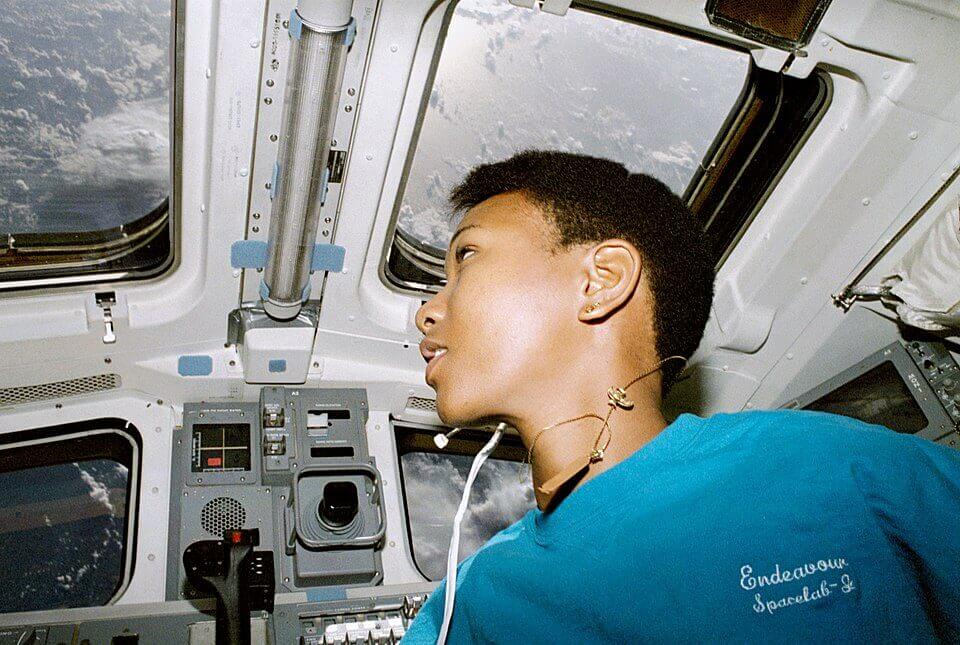
On this date in 1956, Dr. Mae Carol Jemison, the first African American woman to fly in space, was born. Jemison holds a degree in chemical engineering and a Doctor of Medicine. She also became the first real-life astronaut to appear in an episode of Star Trek.
Saturday, October 18, 2025
On this date in 1989, the Galileo Jupiter Atmospheric Probe was released from the space shuttle Atlantis during STS-34. Over its six-year journey to Jupiter, Galileo collected data on the solar system, including fly-bys of the asteroids Gaspra and Ida. The probe spent two years studying Jupiter and its moons before intentionally diving into the Jovian atmosphere on December 7, 1995.
Sunday, October 19, 2025
On this date in 2008, NASA’s Interstellar Boundary Explorer (IBEX) launched to map the boundary of our solar system. IBEX produced the first all-sky map of the heliosphere. The heliosphere is a giant bubble around the solar system produced by a constant flow of charged particles from the Sun.
Subjects