Day Sky Update September 2026
This is the Saint Louis Science Center’s DAY SKY UPDATE for the Month of September 2026.
Information updated monthly or as needed.
Times given as local St. Louis time which is Central Daylight Time (CDT). For definitions of terminology used in the night sky update, click the highlighted text. If relying on times posted in Universal Time (UT), St. Louis is -5 hours when CDT. Additionally, times will be posted in a 24-hour format.
Join us for our next solar telescope viewing each month on the third Sunday, held in association with the St. Louis Astronomical Society. These viewing sessions are weather dependent. For details, see the information at the bottom of this page or visit https://www.slsc.org/explore/mcdonnell-planetarium/public-telescope-viewings/
Daytime Astronomy Primer
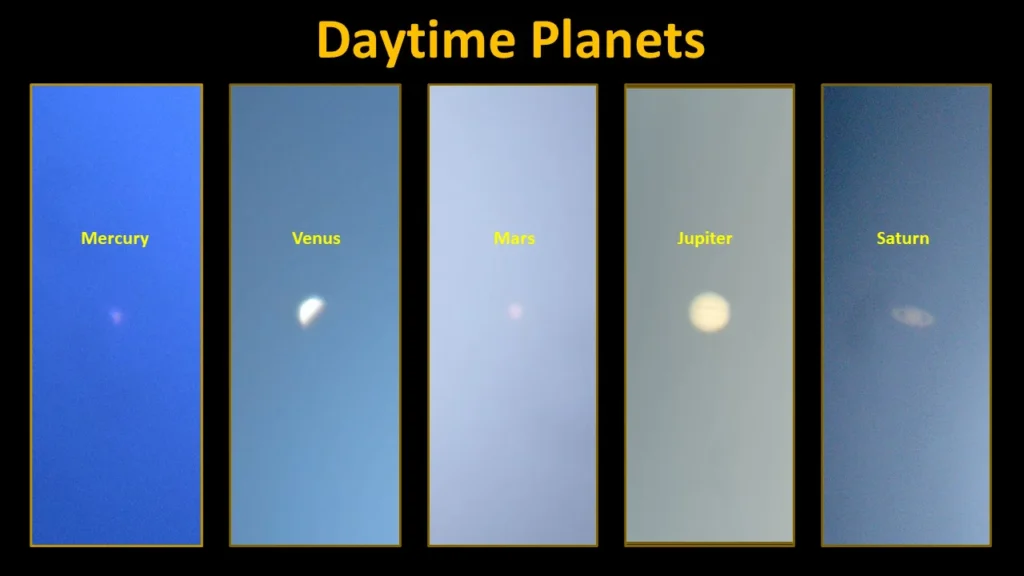
Image shows daytime telescope view of the five naked eye planets. Image credit: Eric Gustafson
For most, astronomy is a hobby that is left to the darkness of night. While most astronomical objects are only visible at night, the day sky can offer a careful observer several astronomical targets along with a multitude of atmospheric phenomena to enjoy. When posted, the DAY SKY UPDATE will explore these possibilities which may include a highlight of the month, cloud observing, sun rise/set times, daytime Moon information, daytime planets and other topics. As always, when viewing during daytime, you must use caution as the Sun is always near.
Aside from solar filters, there are other safety steps that you should consider. Sunscreen, hats and sunglasses are always advisable. Visible light is how we observe the world around us, however, there is light we cannot see such as ultraviolet (UV) and infrared (IR) lights. While both are an issue if you are using an optical system, UV light is an issue through exposure. This can be mitigated by using sunscreen, sunglasses and limiting exposed skin. While sunglasses are not safe instruments to view the Sun with, they do protect your eyes from exposure to ultraviolet light that we are susceptible to during the day.
Observing Highlight
During the summer months, you tend to hear about severe storms that have large hail, and straight line winds that can cause heavy flooding and severe structural damage. But some of those storms did not produce a tornado at all. Many of these storms produce a phenomenon known as a downburst which can cause damage similar to tornadoes.
A downburst is a severe localized downdraft that causes an outflow of damaging winds that hit the ground, spreading out rapidly in all directions, much like a stream of water from a faucet hitting the sink. If the downburst is less than 4km (2.5mi) wide it is known as a microburst, and if it is greater than 4km it is known as the macroburst. We will just reference them as downbursts for simplicity.
For a downburst to form, we first need an average thunderstorm. The storms updraft is the key driver for the longevity of the storm. The updraft pulls warm moist air upward, feeding the storm its energy and allowing the clouds to continue growing, and for raindrops and hailstones to form. In most scenarios, as the storm matures, the updraft will continue feeding the storm with moist unstable air, at the same time the raindrops and hailstones become large enough they start to fall. However, if a storm has a very strong updraft, it can keep large amounts of raindrops and hail suspended in the middle of the storm, allowing them to continue to grow and get heavier. This leads to a weakening of the updraft and that’s when downdrafts come into play.
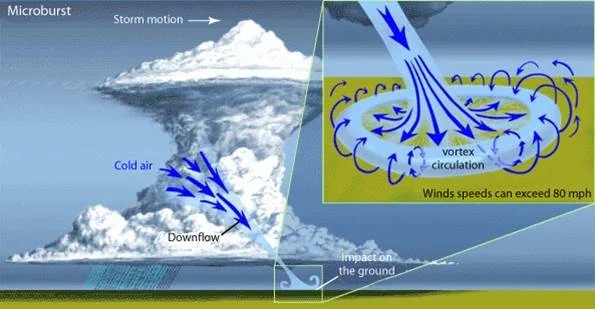
Image showing thunderstorm anatomy including a microburst. Image credit: NWS
The updraft is no longer capable of holding the droplets and hail, so they start falling and drag air down with them. This is the start of what can trigger a downburst. What accelerates the production of a downburst is something called evaporative cooling. If dry winds aloft encounter the storm, it can rapidly evaporate raindrops as well as melt the hailstones. This cools the surrounding air making it more dense, so it starts to sink and rush to the surface. As the rain and hail make its way towards the surface, it can then come into contact with even more dry air below the cloud base, causing more evaporation and cooling, further strengthening the downburst.
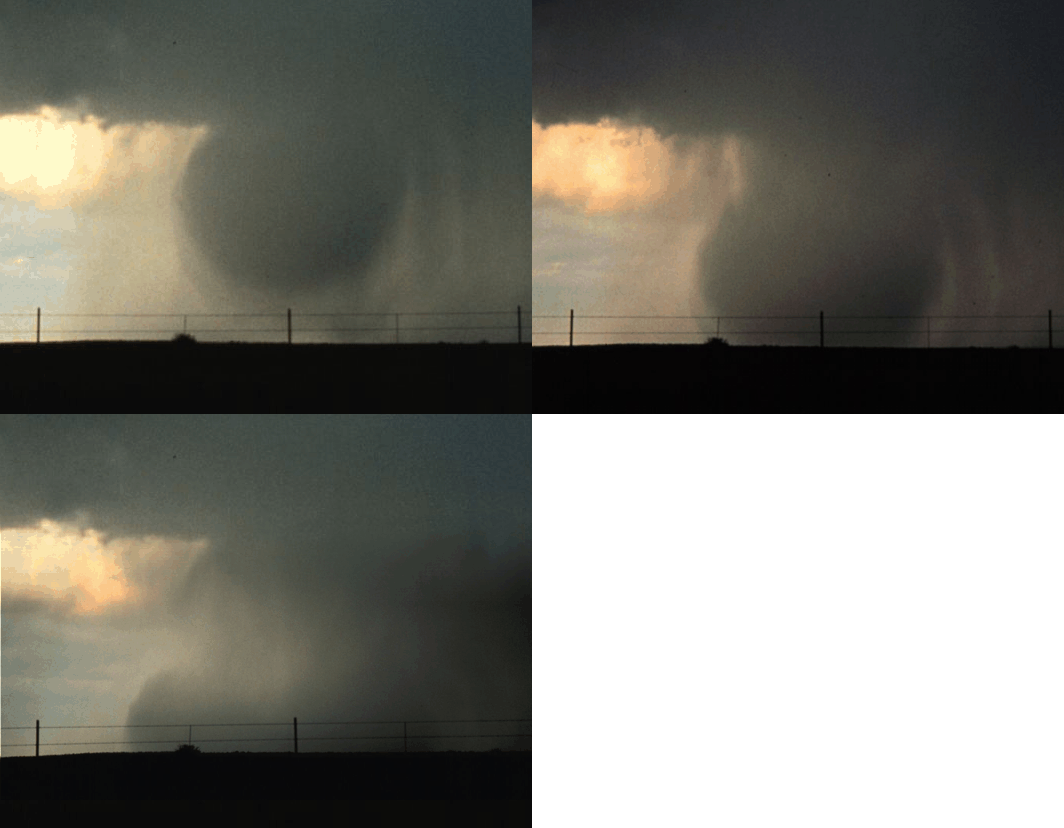
Series of photos showing the evolution of a downburst making its way to the surface. Image credit: NWS
Downburst winds can reach well over 100mph, which is equivalent to an EF-1 tornado. What makes it so dangerous is the rapid increase of wind speed. Winds that jump from 15mph to 50mph can produce a lot more damage than a sustained 50mph wind. These winds can cause damage to homes and businesses and take down dozens of trees. If forecasters can identify certain atmospheric parameters, they will issue a severe thunderstorm warning. It is very important to take these warnings just as seriously as tornado warnings. Just a reminder to always stay weather aware.
The Sun and the Moon
Sun Information
The month of September sees the Sun decreasing its altitude each day as it continues towards the September equinox. When viewed from St. Louis, the Sun’s maximum altitude will shift from 59.4° on September 1, 2026, to 48.5° on September 30, 2026. The next major position of the Sun occurs on September 22, 2026, as the Sun reaches the September equinox. This day sees the beginning of fall in the northern hemisphere and spring in the southern hemisphere.
Summer heat looks to return for much of September reminding us it is not done with us yet. Bird migratory season is underway which is a good time to learn how we can assist in conservation efforts to mitigate our impact on migratory birds. You can learn more about this at Lights Out Heartland.
| Sept. Equinox | Sept. 22, 2026 |
| Dec. Solstice | Feb. 21, 2026 |
| March Equinox | March 20, 2027 |
| June Solstice | June 21, 2027 |
Sunrise and Sunset Times for St. Louis Missouri
The sunrise and sunset times below were calculated by the Earth Systems Research Laboratories for NOAA. These times are calculated using equations for Jean Meeus’s Astronomical Algorithms. The atmosphere complicates these calculations due to the refraction of sunlight as it passes through the atmosphere. For the times listed below, the amount of atmospheric refraction is assumed to be 0.833°. Variations in the atmosphere can change the amount of refraction so the times posted are accurate to within a minute for latitudes between +/- 72°.
| Day | Sunrise (CDT) | Sunset (CDT) |
| 1-Sep | 6:30 | 19:31 |
| 2-Sep | 6:31 | 19:29 |
| 3-Sep | 6:32 | 19:28 |
| 4-Sep | 6:33 | 19:26 |
| 5-Sep | 6:34 | 19:24 |
| 6-Sep | 6:34 | 19:23 |
| 7-Sep | 6:35 | 19:21 |
| 8-Sep | 6:36 | 19:20 |
| 9-Sep | 6:37 | 19:18 |
| 10-Sep | 6:38 | 19:17 |
| 11-Sep | 6:39 | 19:15 |
| 12-Sep | 6:40 | 19:13 |
| 13-Sep | 6:41 | 19:12 |
| 14-Sep | 6:41 | 19:10 |
| 15-Sep | 6:42 | 19:09 |
| 16-Sep | 6:43 | 19:07 |
| 17-Sep | 6:44 | 19:06 |
| 18-Sep | 6:45 | 19:04 |
| 19-Sep | 6:46 | 19:02 |
| 20-Sep | 6:47 | 19:01 |
| 21-Sep | 6:48 | 18:59 |
| 22-Sep | 6:49 | 18:58 |
| 23-Sep | 6:49 | 18:56 |
| 24-Sep | 6:50 | 18:54 |
| 25-Sep | 6:51 | 18:53 |
| 26-Sep | 6:52 | 18:51 |
| 27-Sep | 6:53 | 18:50 |
| 28-Sep | 6:54 | 18:48 |
| 29-Sep | 6:55 | 18:46 |
| 30-Sep | 6:56 | 18:45 |
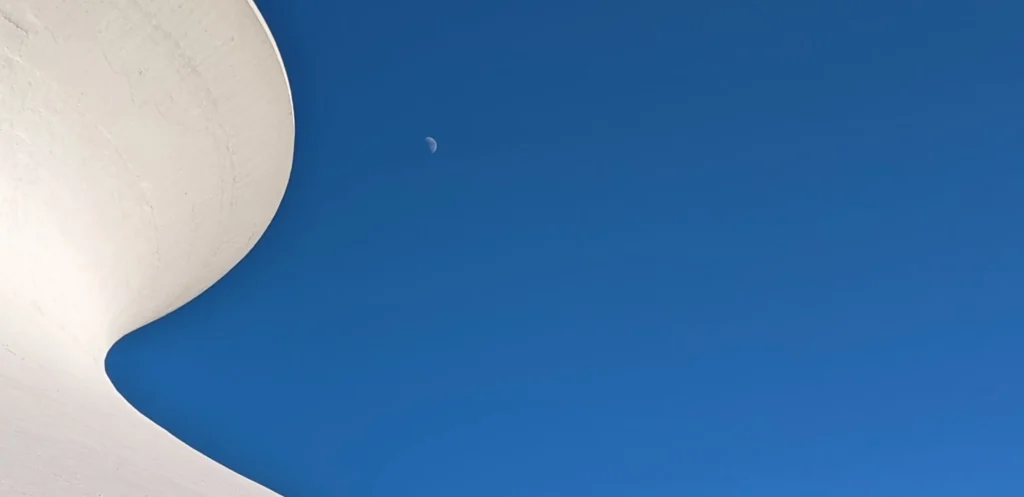
Moon (daytime views)
Last quarter moon occurs on September 4, 2026, and first quarter moon occurs on September 18, 2026. The best daytime views of the Moon are always near the quarter phases. Look for the Moon in the morning at the beginning of September. When we are near first quarter phase, look for the Moon in the afternoon.
The Moon crosses the ecliptic at its descending node this month on September 9, 2026, and then at its ascending node on September 24, 2026. This behavior occurs because the Moon’s orbit around Earth is tilted about 5.1° with respect to Earth’s ecliptic. This nodal cycle of the Moon is called a draconic month which is 27.2 days long. During each nodal cycle, the Moon crosses Earth’s ecliptic twice at what are called the ascending and descending nodes. Being aware of these crossing nodes helps observers know if the Moon will appear south or north of the ecliptic.
| Phase | Date | Time (CDT) |
| Full Moon | August 27, 2026 | 23:19 |
| Last Quarter | September 04, 2026 | 02:51 |
| New Moon | September 10, 2026 | 22:27 |
| First Quarter | September 18, 2026 | 15:44 |
| Full Moon | September 26, 2026 | 11:49 |
Solar Sunday occurs on the third Sunday of the month from 11:00 a.m. until 3:00 p.m. (Weather Dependent). There is one additional Solar Sunday this month on September 6, 2026.
Each month on the third Sunday, the St. Louis Astronomical Society and the Saint Louis Science Center will set up a number of safe solar telescopes outdoors and be on hand to answer your questions. Telescope viewing begins at 11:00 a.m. and is weather dependent.
The St. Louis Astronomical Society helps host the monthly Star Parties at the Saint Louis Science Center. In addition to our daytime viewings, they also help facilitate our nighttime Public Telescope Viewing. These nighttime viewing sessions occur on the 1st Friday each month. Visit SLAS’s website linked above to learn about other telescope events SLAS hosts around the St. Louis area.
Subjects