This is the Saint Louis Science Center’s NIGHT SKY UPDATE for the week of Tuesday, December 16, 2025.
Information updated weekly or as needed.
Times given as local St. Louis time this week will be in Central Standard Time (CST). For definitions of terminology used in the night sky update, click the highlighted text. If relying on times posted in Universal Time (UT), St. Louis is -6 hours when CST. Times posted in the Night Sky Update are in the 24-hour format.
Join us for our next star party, Friday, February 6, 2026, held in association with the St. Louis Astronomical Society. For details, see the information at the bottom of this page or use the button below.
Learn more about Public Telescope Viewings
Observing Highlight
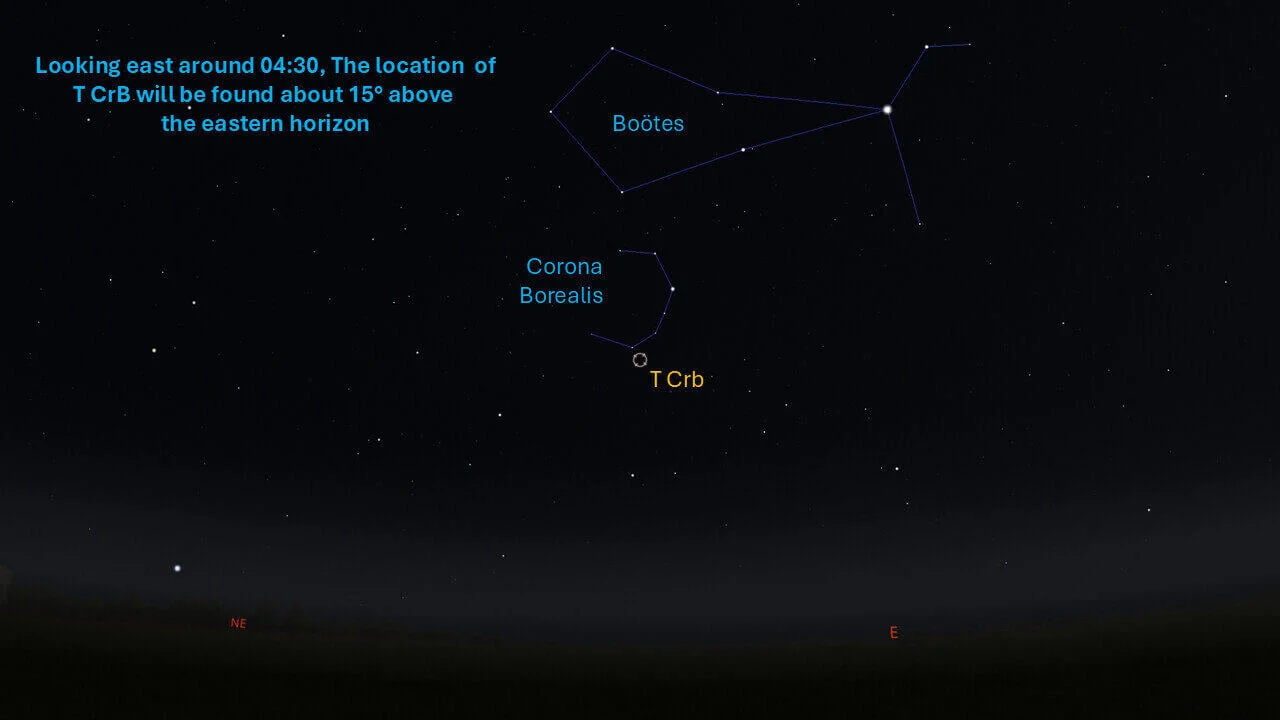
The location of the recurrent nova T CrB can be found rising in the east after 4 am. Image created using Stellarium.
Back in 2024, a variable star called T Coronae Borealis (T CrB) caught people’s attention because observers had reported changes in the system that were also observed in the prior eruption. It seemed the system was showing signs that the nova was on the verge of occurring. T CrB is a rare recurrent nova which is a type of variable star that suddenly brightens from a much dimmer quiescent state.
Novae occur in binary systems when mass from a companion star falls onto a white dwarf star creating an accretion disk that becomes unstable. Mass from the accretion disk transfers to the surface of the white dwarf becoming super-heated. This leads to a runaway thermonuclear event in which the accumulated mass is blown off the star causing to surge in brightness. Most nova events occur once. Recurrent novae like the T CrB system, occur multiple times on a cycle. Less than a dozen of these have been found in the Milky Way galaxy.
The T CrB system exhibits a period of 80 years. The last time the system went nova was in 1946. Observations of T CrB in 2023 showed changes in the star that were observed before the 1946 eruption. Once this was announced astronomers predicted this T CrB would likely go nova in 2024. Well, that year went by with no nova occurring. After all the hype that built around this once in a lifetime event, it failing to occur caused many to lose interest.
In February of 2025, another change in T CrB’s spectrum signaled the nova could be on the verge of occurring. A sharp increase in certain emission lines of the star’s spectrum occurred bringing new hopes that the nova would soon occur. Unfortunately, with 2025 about to end, it seems like yet again predictions are not coming to fruition.
With another prediction falling short, I would expect many to be frustrated. However, the delay in the system going nova only stresses the importance of continued observations of the T CrB system. Each opportunity to observe the 80-year cycle of T CrB, offers scientists the opportunity to learn new things about T CrB and other recurrent nova.
2026 will be 80 years since the last eruption of T CrB. Hopefully, next year we will finally see the nova occur. If it has been a while since you have looked for T CrB, it has shifted to early morning visibility. If you look east around 4 am, you will spot a bright orange star called Arcturus. Extending north of this star is a kite shaped group of stars which is the constellation Boötes. The widest point of the kite shape is marked by the bright stars γ Boo and δ Boo. If you follow a line between them pointing east, you will find a U-shape of stars which is the constellation Corona Borealis. The area T CrB will appear in is about 1° from the star ε CrB. Binoculars will help you learn the dimmer stars in the area making it easier to know when the nova has occurred.
The Sun and Moon
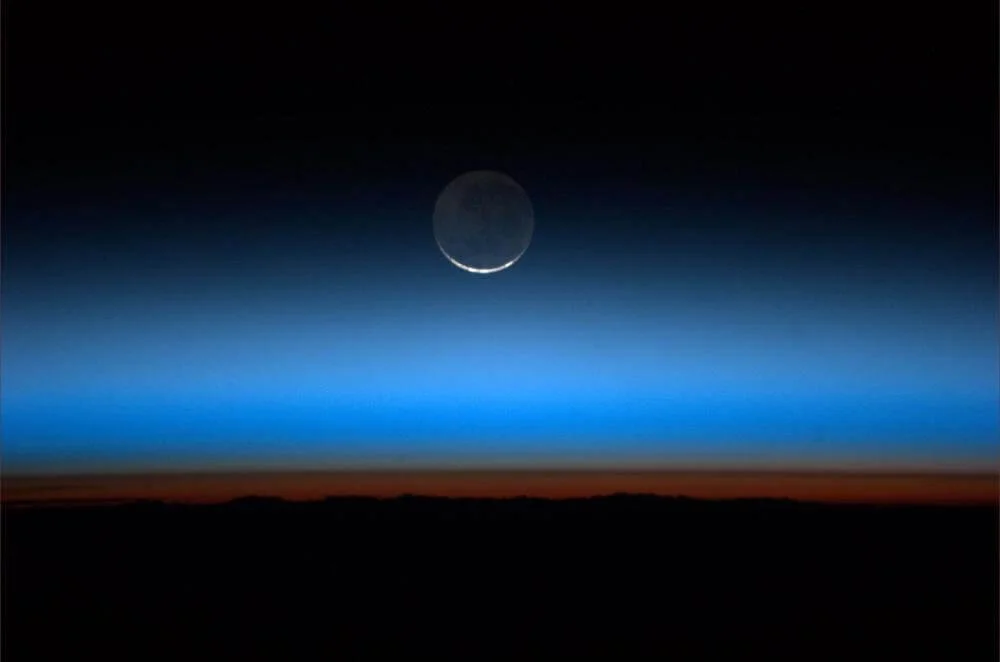
Sun
Sunrise on Tuesday, December 16 is at 07:12 and sunset is at 16:41 providing about 9.5 hours daylight this week. Even after sunset, light from the Sun will dimly illuminate our sky for about 1 hour and 30 minutes. This period is called twilight, which ends around 18:17 this week. For those with a sundial, local noon occurs around 11:57 on December 16, 2025.
Winter officially begins on December 21, 2025 as the Sun reaches its most southern declination. This day is the December solstice which marks the start of winter in the north.
| Day | Sunrise (CST) | Sunset (CST) |
|---|---|---|
| 16-Dec | 7:12 | 16:41 |
| 17-Dec | 7:13 | 16:41 |
| 18-Dec | 7:13 | 16:42 |
| 19-Dec | 7:14 | 16:42 |
| 20-Dec | 7:15 | 16:43 |
| 21-Dec | 7:15 | 16:43 |
| 22-Dec | 7:16 | 16:44 |
| 23-Dec | 7:16 | 16:44 |
| 24-Dec | 7:16 | 16:45 |
| 25-Dec | 7:17 | 16:45 |
Moon
Moonrise for Tuesday, December 16, is at 04:14 and moonset occurs at 14:06. On December 16, 2025, the Moon will exhibit a waning crescent phase with 9% disk illumination. By December 25, 2025, the Moon will exhibit a waxing crescent phase with 31% disk illumination. New moon occurs on December 19, 2025, at 19:43.
International Space Station (ISS) Observing
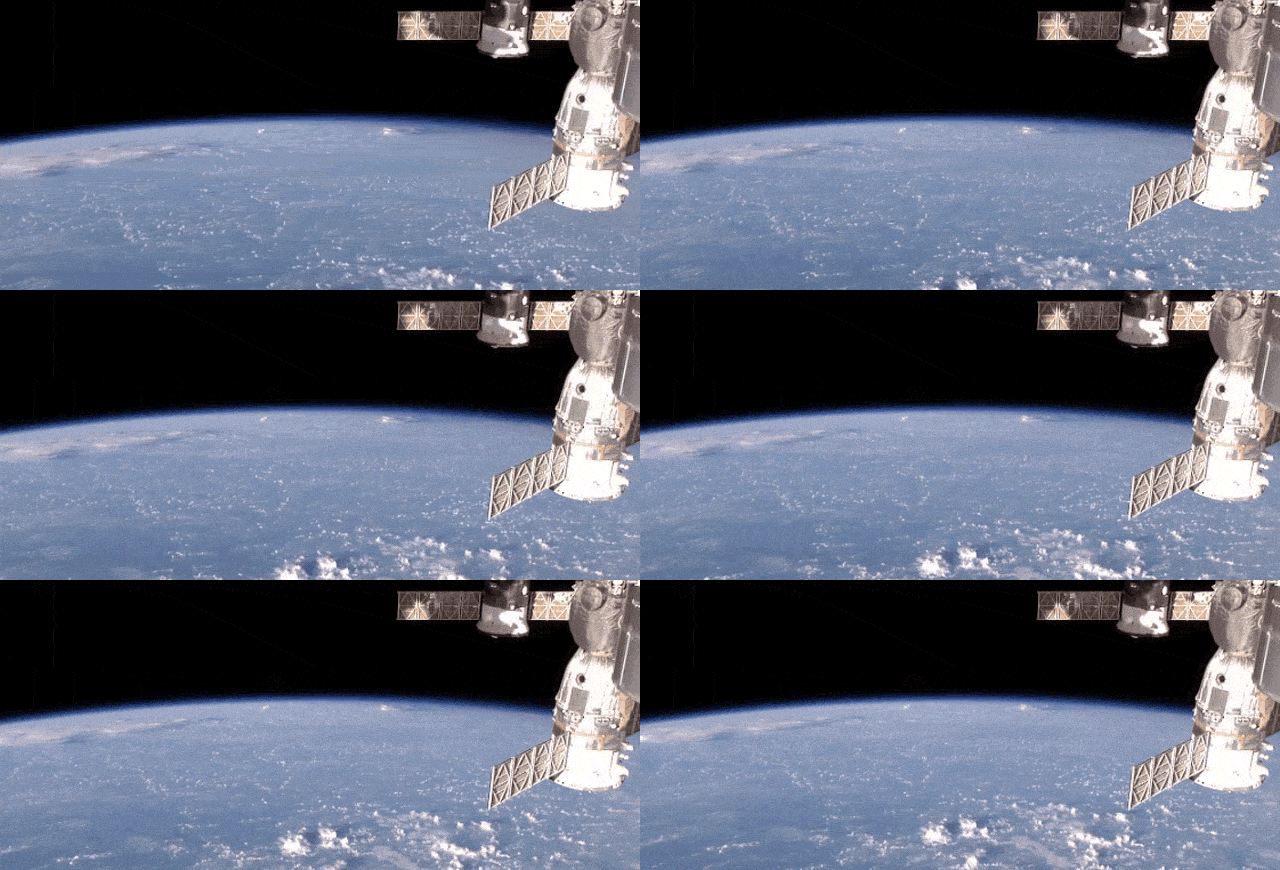
Visible passes of ISS from St. Louis for the week of December 16 occur during Morning hours. You can use https://heavens-above.com/ to set your viewing location and get times for where you are.
Detailed information regarding all unmanned exploration of our universe, missions past, present, and planned, can be found at Jet Propulsion Laboratories
The Visible Planets
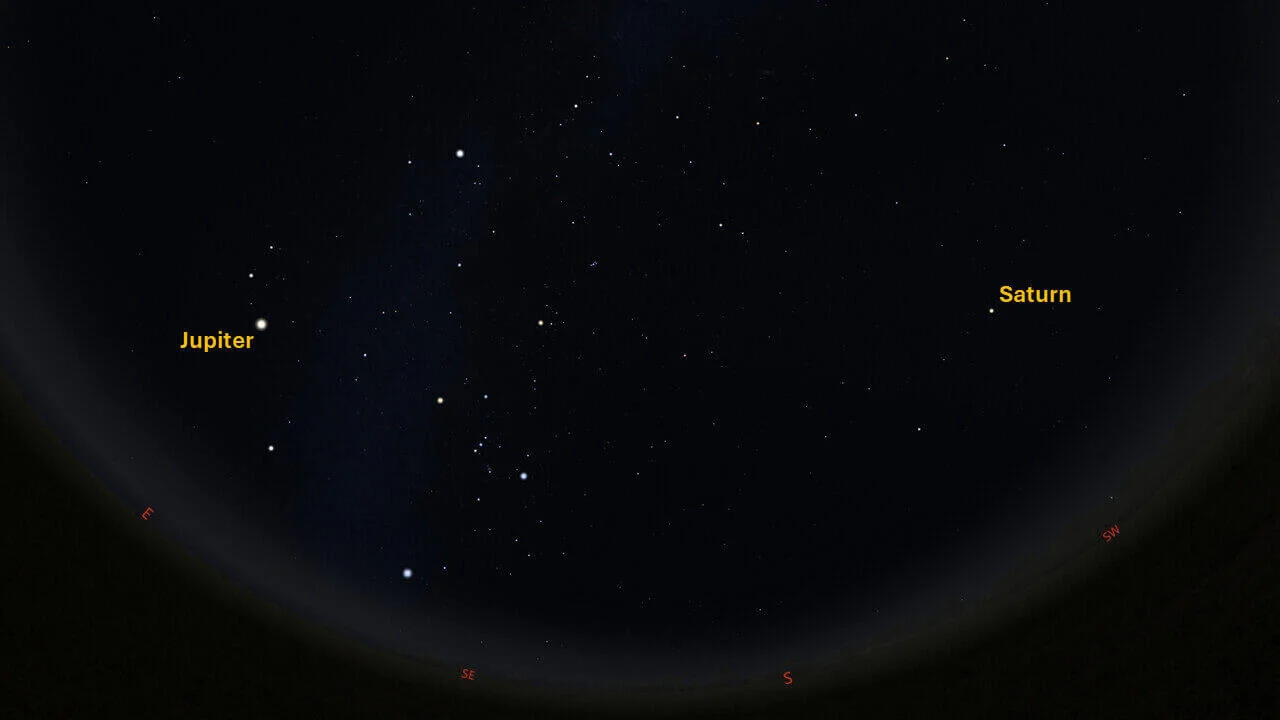
Looking south at 21:00 on December 16, 2025. Credit: Stellarium, EG
Two naked eye planets will be visible this week. Saturn is visible after sunset in the south. Jupiter can be found in the east around 9 pm. and
Jupiter
This week, Jupiter rises around 18:46. Look for Jupiter in the east around 21:00. Jupiter reaches opposition on January 10, 2026. As we continue towards this date, Jupiter will continue to rise earlier each week.
Saturn
Saturn is now visible after sunset in the south once it is dark and sets around 23:53. Saturn reaches solar conjunction on March 12 next year. As we head towards this date, Saturn will be seen more and more west each week.
Our next Star Party will be held on Friday, February 6, 2026, from 5:30 pm until 8:30 pm
On the first Friday of each month, the St. Louis Astronomical Society and the Saint Louis Science Center will set up a number of telescopes outdoors and be on-hand to answer your questions. Telescope viewing begins once it is dark.
The St. Louis Astronomical Society helps host the monthly Star Parties at the Saint Louis Science Center. In addition to our nighttime viewings, they also help facilitate our daytime event called Solar Sundays. These daytime viewing sessions occur every third Sunday each month from 11:00-15:00 weather permitting. Visit SLAS’s website linked above to learn about other telescope events SLAS hosts around the St. Louis area.
James S. McDonnell Planetarium
Night Sky Update: December 16-25, 2025
Subjects