This is the Saint Louis Science Center’s NIGHT SKY UPDATE for the week of Friday, February 27, 2026
Information updated weekly or as needed.
Times given as local St. Louis time this week will be in Central Standard Time (CST). For definitions of terminology used in the night sky update, click the highlighted text. If relying on times posted in Universal Time (UT), St. Louis is -6 hours when CST. Times posted in the Night Sky Update are in the 24-hour format.
Join us for our next star party, Friday, March 6, 2026, held in association with the St. Louis Astronomical Society. For details, see the information at the bottom of this page or visit https://www.slsc.org/explore/mcdonnell-planetarium/public-telescope-viewings/
Observing Highlight
At the start of the year, a new comet named C/2026 A1 (MAPS) was discovered that captured a lot of attention due to it being a Kreutz sungrazing comet. In the late 19th century, astronomer Heinrich Carl Friedrich Kreutz discovered while studying known comets that some of them were sungrazing comets. He also observed that these sungrazing comets followed the same orbit suggesting they were fragments of a large progenitor object that broke apart.
The discovery of a new Kreutz sungrazer is not unusual, however its distance when discovered is what was interesting. Most Kreutz comets are discovered close to the Sun not long before they make their perihelion approach by telescopes like the Solar and Heliospheric Observatory (SOHO). Using its LASCO 2 and LASCO 3 coronagraphs, SOHO has discovered over 5200 comets of which roughly 90% are sungrazers. Most Kreutz sungrazers are small comets that are destroyed as they approach perihelion. However, some larger Kreutz sungrazers have survived their close approach to the Sun.
The main reason why comet C/2026 A1 (MAPS) has received so much attention has to do with where it was in the solar system when it was discovered. The comet was discovered on January 13, 2026, by the MAPS observatory in Chile, when it was about 2 AU from the Sun. This makes it the most distant Kreutz comet discovered before its perihelion. The comet’s nucleus is estimated to have a diameter of 2.4 kilometers making it much larger than most Kreutz comets. Due to its size and early detection, many have become excited about the possibility of this comet behaving in ways similar to other larger Kreutz family comets. One such example is comet C/2011 W3 (Lovejoy).
Like C/2026 A1 (MAPS), C/2011 W3 was a Kreutz family comet. It was also the last comet of the 21st century to be given the moniker of “Great Comet”. While there is no set definition of what a “Great Comet” is, most sources suggest the term is reserved for exceptionally bright comets that are easily seen to the naked eye. In the last 30+ years, there have only been four Great Comets; Comet Hale-Bopp, Comet Hyakutake, C/2006 P1 (McNaught) and C/2011 W3 (Lovejoy). In David J. Eicher’s book “Comet! Visitors From Deep Space” the author states that in the last 2000 years, humans have seen around 70 Great Comets. So, when mention of a possible new Great Comet is presented, observers are quick to respond with excitement. Experienced comet observers however, will know that comets are fickle things which rarely behave in ways that support the growing hype.
Unfortunately, most comets that receive this kind hype rarely perform in the way most would hope. A recent example was C/2023 A3 Tsuchinshan-ATLAS. When this comet was first discovered it was a little over 7 AU from the Sun. The nucleus was already active at that distance and as such a lot of hype built up around what it would be like in 2024 when it was near the Sun. While C/2023 A3 did perform well, which included naked eye visibility, I would not say it was exceptionally bright. Around perihelion, C/2023 A3 reached a peak magnitude of roughly -4.9. While that is exceptionally bright, it was still lost in the Sun’s glare. Once we started to see it in twilight skies it a dimmed enough that under dark skies it could be seen naked eye with some ease, however for most, binoculars were necessary. When it comes to comets, it is best to temper the excitement until we are closer to the ideal time for observation.
Kreutz family comets also pose a challenge for viewers in the northern hemisphere. Due to the geometry of their orbits, Kreutz comets favor viewers in the southern hemisphere. For us in the north our best chance to view a Kreutz comet near its perihelion is in September and October. Unfortunately, C/2026 A1 (MAPS) reaches perihelion on April 4, 2026.
Current models show C/2026 A1 (MAPS) could reach a peak magnitude of -4 when at perihelion on April 4. At this time however, the comet will appear far to close to the Sun for anyone to safely view it. After perihelion, the comet’s magnitude will quickly dim making it unlikely northern hemisphere observers will have a chance to see it. Our one hope is that like other larger Kreutz family comets, C/2026 A1 (MAPS) could produce a long bright tail that might be visible under twilight skies.
While it is unlikely that C/2026 A1 (MAPS) will be the next “Great Comet”, it could still have some surprises in store for us. This will be a comet to keep track of if you are interested in observing comets whether we get to see something or not. Comet C/2026 A1 (MAPS) will continue to brighten through the month of March as it approaches perihelion. Following comets from their discovery, through the hype and into how the comet truly performs is an important lesson in comet observations. It also remains possible that it could have outburst events that dramatically cause it to brighten beyond what models are suggesting. Only time will tell.
For current magnitude estimates I recommend visiting the Comet Observation Database (COBS). Most recent magnitude estimates show the comet is between 12 and 13 magnitude. Under dark skies, comet C/2026 A1 (MAPS) should be bright enough to observe with moderate sized telescopes.
Two other resources I recommend for a deeper understanding of comet C/2026 A1 (MAPS) are
And
Lunar Eclipse March 3, 2026
This year there are two lunar eclipses visible from North America. The first is a total lunar eclipse occurring on March 3, 2026. The second eclipse is a deep partial eclipse occurring on August 28, 2026. Visibility of these eclipses will vary depending on your location. The lunar eclipse in March this year favors the western half of the continent while the eclipse in August favors the eastern half. For those of you viewing from the St. Louis region, we will see roughly half of the eclipse in March and the entire eclipse in August.
If you have never seen a lunar eclipse, they are long events that occur over hours. Lunar and solar eclipses occur when three solar system bodies align in a straight-line configuration called a syzygy. In the case of lunar and solar eclipses, the three objects involved are the Sun, Earth and Moon, the order of which determines the type of eclipse. For an eclipse to occur, the Moon must be at its new or full phase. If it is new moon, a solar eclipse is possible and if at full moon, a lunar eclipse is possible. Even though both phases typically occur once a month, the Moon’s orbit is tilted about 5.1° to Earth ecliptic which is why most new and full moons to don’t produce the require syzygy.
During a lunar eclipse the Moon will slowly pass through Earth’s shadow. First through its penumbra and then through its umbra if the alignment allows. Sometimes we will only see part of the Moon pass through Earth’s umbra producing a partial eclipse. On March 3, 2026, we will see the Moon pass entirely into Earth’s umbra producing a total lunar eclipse.
The eclipse on March 3, 2026, will last a little over 5.5 hours running from 08:44 to 14:23 UTC. Converting for St. Louis time, that would be 02:44 to 08:23 CST. Unfortunately, the Moon sets around 06:32 CST limiting how much of the eclipse we can observe. The good news is totality begins at 05:02 when the Moon will still be about 14° above the western horizon. From St. Louis we will see around 3.5 hours of the eclipse which begins at 02:44 CST ending as the Moon sets around 06:30 CST. The partial eclipse begins at 03:50 CST and totality begins at 05:04 CST.
If your western view is obscured by trees you will want to find a place with a clear view to the west. Being that it will still be winter, dress for temperatures about 20° colder than it is. Astronomy is a hobby where you are mostly stationary. You will quickly become cold if you do not prepare for cold temperatures. If early morning views are not something you are comfortable with, there is another eclipse in August that occurs partially in evening hours. Learn more about the 2026 lunar eclipses at the links below.
March 3, 2026, Total Lunar Eclipse
August 27/28, 2026, Partial Lunar Eclipse
T CrB Nova Update 2/27/2026
If you are still interested in seeing the recurrent nova T Coronae Borealis, there is still hope. The nova has not yet occurred meaning we are in a waiting game. If you are still interested in this event, the part of the sky the nova will appear in is found in the east before sunrise. You can find the constellation Corona Borealis rising in the east by 11 pm. By midnight the location of T CrB will be roughly 20° above the eastern horizon. If you don’t fancy waking up early to check on T CrB you can follow recent observations posted on the AAVSO website. You can find that here. Current magnitude estimates of the system show it at 10th magnitude.
The Sun and Moon
Sun
Sunrise on Friday, February 27 is at 06:45 and sunset is at 17:44 providing about 11.5 hours of daylight at the start of the week. Even after sunset, light from the Sun will dimly illuminate our sky for about 1 hour and 30 minutes. This period is called twilight, which ends around 19:20 this week. For those with a sundial, local noon occurs around 12:13 on February 27, 2026.
| Day | Sunrise (CST) | Sunset (CST) |
| 27-Feb | 6:36 | 17:52 |
| 28-Feb | 6:34 | 17:53 |
| 01-Mar | 6:33 | 17:54 |
| 02-Mar | 6:31 | 17:55 |
| 03-Mar | 6:30 | 17:56 |
| 04-Mar | 6:28 | 17:57 |
| 05-Mar | 6:27 | 17:58 |
| 06-Mar | 6:25 | 17:59 |
| 07-Mar | 6:24 | 18:00 |
Moon
Moonrise for Friday, February 27, is at 13:43 and moonset occurs at 05:05 the following morning. On February 27, 2026, the Moon will exhibit a waxing gibbous phase with 85% disk illumination. By March 7, 2026, the Moon will exhibit a waning gibbous phase with 81% disk illumination. Full moon occurs on March 3, 2026, at 05:38.
International Space Station (ISS) Observing

Visible passes of ISS from St. Louis for the week of February 20 occur during morning hours. If viewing from St. Louis Missouri, the best passes of ISS occur on March 2 and 3. You can find information about these and other satellite pass at https://heavens-above.com. If you are not viewing from the St. Louis area, make sure to change your viewing location for your local times.
Visible Planets
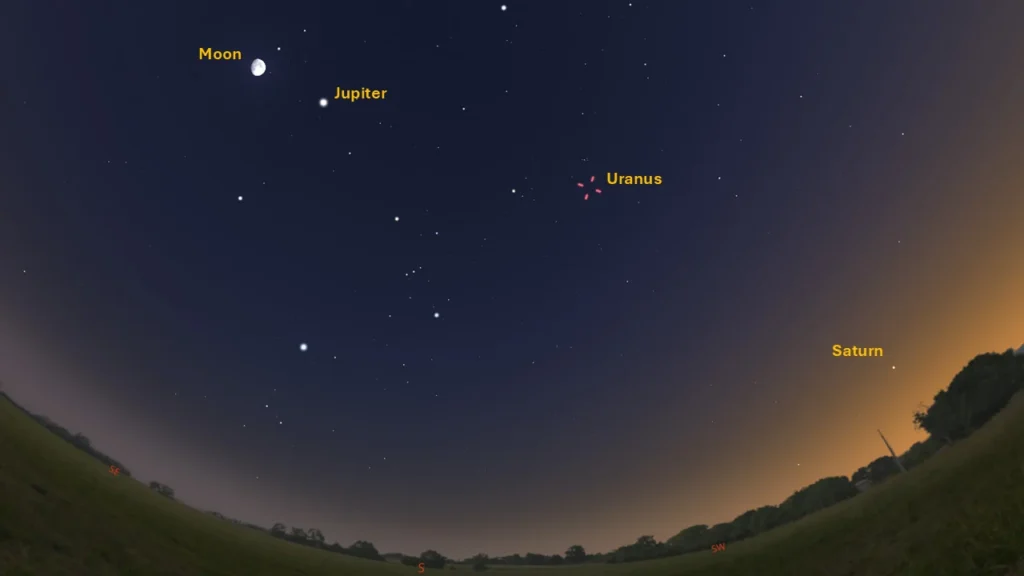
View looking south on February 27,2026, at 18:30. Image created using Stellarium
Two naked eye planets will be visible this week. Jupiter will be found high in the east after sunset. Saturn will be found low in the west after sunset.
Jupiter
Jupiter will be visible in the east about 30 minutes after sunset, By 7 pm, it can be found nearly overhead north of the constellation Orion. Jupiter remains visible until 3 am at which time its low altitude will make it difficult to find for some viewers. Jupiter sets a little before 04:00. Jupiter’s current apparition continues through June and some of July as it heads towards superior conjunction on July 29, 2026.
Saturn
Saturn is found in the west about 30 minutes after sunset and sets around 19:30 this week. Saturn reaches superior conjunction on March 25, 2026. The current apparition of Saturn is coming to an end. As we get into March, Saturn will become increasingly difficult to find as it appears closer to the Sun each day.
Uranus
Around 7 pm this week, the planet Uranus will be found high overhead in the west. Its current magnitude is 5.7 putting it within naked eye visibility only from dark locations. In reality, most will need to use binoculars to have a chance to spot this distant world. You can find Uranus in the constellation Taurus about 4° south of the Pleiades star cluster. Uranus will be near the stars 13 Tau and 14 Tau.
Our next Star Party will be held on Friday, March 6, 2026, from 5:30 pm until 8:30 pm.
On the first Friday of each month, the St. Louis Astronomical Society and the Saint Louis Science Center will set up a number of telescopes outdoors and be on hand to answer your questions. Telescope viewing begins once it is dark.
The St. Louis Astronomical Society helps host the monthly Star Parties at the Saint Louis Science Center. In addition to our nighttime viewings, they also help facilitate our daytime event called Solar Sundays. These daytime viewing sessions occur every Sunday through Labor Day. After Labor Day they occur on the 3rd Sunday each month. Visit SLAS’s website linked above to learn about other telescope events SLAS hosts around the St. Louis area.
James S. McDonnell Planetarium
Night Sky Update for February 27, 2026
Subjects