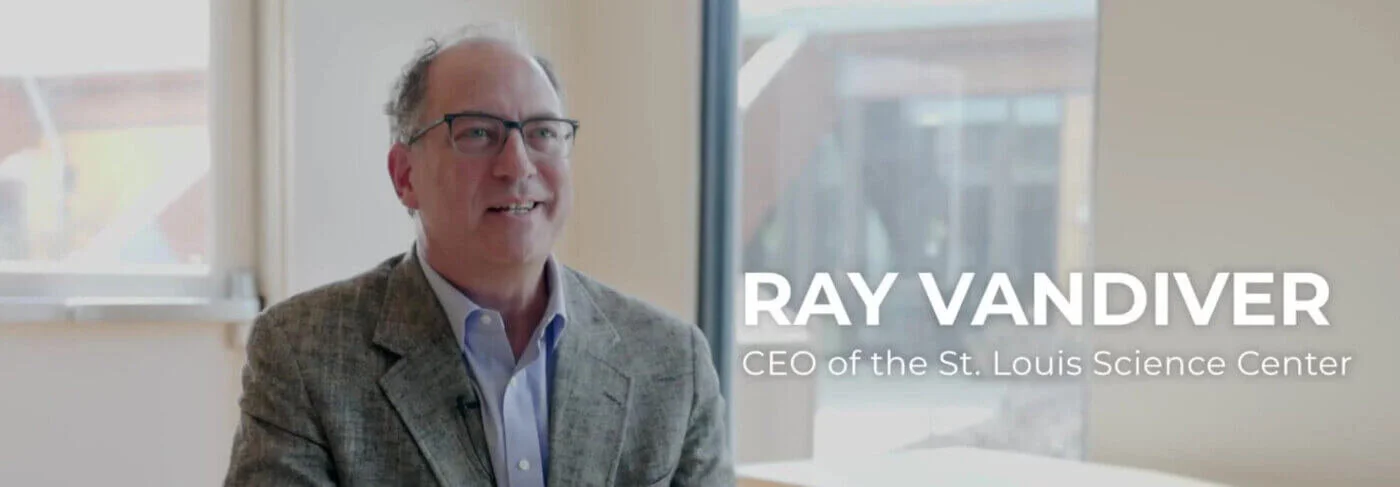
ST. LOUIS — Ray Vandiver has taken over leadership of the St. Louis Science Center as it faces sluggish revenue and attendance growth, as well as an era of widespread science denial.
Robert Cohen, Post-Dispatc
Nikki Green, left, and Dave Benson hold up the pieces as Rogers Elementary students, including Benson’s daughter Abby, center, celebrate after building a catenary arch at the St. Louis Science Center on Thursday, April 3, 2025.
Robert Cohen, Post-Dispatch
As a first step, Vandiver, who became president and CEO on Feb. 28, is spearheading a new plan to find more sustainable funding sources. But the St. Louis native also believes the center can overcome its challenges by building on its strengths: being a public steward of scientific learning and creating a hands-on, inclusive environment.
Key to the strategy will be trumpeting the science that occurs in St. Louis, he said. “Research shows that visitors are looking for a fun family experience that’s educational,” said Vandiver, 60, who will earn a salary of $425,000. “We can provide opportunities for them to discover the excitement of science.”
The science center, at Interstate 64 and Oakland Avenue, is one of five taxpayer-funded cultural institutions in St. Louis, all of them overseen by the Metropolitan Zoological Park and Museum District.
The tax money is the science center’s major source of funding — as it is for most ZMD museums — and accounts for about half of its annual revenue.
The center also relies on “earned revenue,” or money it generates through fees and programs. The organization’s biggest drivers are parking fees, “guest experiences” and the Omnimax theater, a five-story domed screen that shows scientific documentaries and films.
Yet over the years, revenue has been volatile. Part of the reason is a drop in visitors. In 2019, 1.1 million people visited the science center. In 2023, there were 563,318 visitors, the organization reported.
From 2018 to 2020, the organization saw consecutive years of revenue shortfalls, with losses amounting to a total of $3.8 million over that period, according to financial filings.
It received an injection of cash from pandemic bailouts, which enabled the organization to boast a $10 million surplus in 2021. But revenue fell again the following year.
In 2023, the latest available year of data, the center posted a surplus of $1.7 million, up from a shortfall of $873,0000 the year before, filings show.
Attendance is also starting to rebound, with 618,888 visitors last year.
“Coming out of COVID, we’re seeing financial strength improve. We’re seeing attendance increase,” Vandiver said. “There’s good momentum. … There’s some feeling of renewal.”
As part of a new strategic plan, Vandiver wants the center to focus on research in the St. Louis region, including work in aerospace, transportation, and plant and health sciences.
“This is science that’s actually happening here and now,” Vandiver said. “It will be making the pitch of potential careers and opportunities and promoting our city for the thousands upon thousands of tourists that come through.”
Robert Cohen, Post-Dispatch
What exactly that will look like, and whether that includes partnerships with area companies, is yet to be determined.
But Mark Wrighton, chair of the center’s board and Washington University’s former chancellor, said those types of partnerships are a key reason why Vandiver was hired.
“He’s an innovator. He’s a great communicator, and he’s going to help us build relationships with the entire community,” Wrighton said.
By doing so, he added, the center hopes to grow its roughly $4 million endowment, which is among the lowest of the ZMD institutions.
Prior to the science center, Vandiver spent more than a decade at the Discovery Lab in Tulsa, Oklahoma, where he helped turn it from a small startup to a nationally recognized museum. It achieved accreditation from the American Alliance of Museums three years after opening.
Vandiver put together Discovery Lab’s business model and helped it become financially stable through what he called “strategic partnerships and community connections.” One in particular was with Tulsa Public Schools, in which the Discovery Lab became the districtwide center for science, engineering, technology and mathematics, or STEM. Through the partnership, the museum secured long-term funding while providing STEM programs to thousands of students.

Robert Cohen, Post-Dispatch
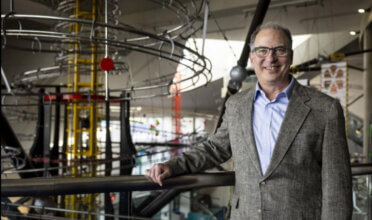
Vandiver, who grew up in south St. Louis, credits his love of science to his childhood visits to the center’s planetarium. He earned an undergraduate degree in physics from St. Louis University before earning a master’s and postdoctoral degrees in physics from Missouri S&T.
His career leading science centers began by accident. His wife enlisted him to build exhibits for her traveling science museum in mid-Missouri while he was a graduate student.
“We had a blast,” Vandiver said.
From there, they started the Bootheel Youth Museum in Malden and focused on hands-on exhibits.
During his time in Malden, Vandiver became friends with Dwight Crandall, who is credited with modernizing the St. Louis Science Center. Crandall helped Vandiver get a job at the Oregon Museum of Science and Industry, where Vandiver worked before Tulsa.
Allie Schallert, Post-Dispatch
“So the St. Louis Science Center has been a big part of my career,” Vandiver said.
A month into his new gig in St. Louis, Vandiver is eager to build new plans. He’s met multiple times with Wrighton and has begun evaluating the center’s business model.
“He’s taking the helm,” Wrighton said.
After his interview with the Post-Dispatch, Vandiver headed to the structures exhibit, where guests learn to build a catenary arch.
“It’s maybe the finest example of a hands-on science museum exhibit because it has problem-solving, collaboration — you have to delegate as a group, learn how to communicate,” Vandiver said.
It’s the type of exhibit the center does best, he said, because it embodies the excitement and discovery the organization wants to convey.
“Science doesn’t just happen in class,” Vandiver said. “It’s a mindset.”

Robert Cohen, Post-Dispatch