This is the Saint Louis Science Center’s DAY SKY UPDATE for the Month of September 2025.
Information updated monthly or as needed.
Times given as local St. Louis time which is Central Daylight Time (CDT). For definitions of terminology used in the night sky update, click the highlighted text. If relying on times posted in Universal Time (UT), St. Louis is -5 hours when CDT. Additionally, times will be posted in a 24-hour format.
Join us for our next solar telescope viewing, Sunday, September 21, held in association with the St. Louis Astronomical Society. These viewing sessions are weather dependent. For details, see the information at the bottom of this page or visit
Daytime Astronomy Primer
For most, astronomy is a hobby that is left to the darkness of night. While most astronomical objects are only visible at night, the day sky can offer a careful observer several astronomical targets along with a multitude of atmospheric phenomena to enjoy. When posted, the DAY SKY UPDATE will explore these possibilities which may include a highlight of the month, cloud observing, sun rise/set times, daytime Moon information, daytime planets and other topics. As always, when viewing during daytime, you must use caution as the Sun is always near.
Aside from solar filters, there are other safety steps that you should consider. Sunscreen, hats and sunglasses are always advisable. Visible light is how we observe the world around us, however, there is light we cannot see. Ultraviolet (UV) and infrared (IR) light are great examples of this. While both are an issue if you are using an optical system, UV light is an issue through exposure. This can be mitigated by using sunscreen, sunglasses and limiting exposed skin. While sunglasses are not safe instruments to view the Sun with, they do protect your eyes from exposure to ultraviolet light that we are susceptible to during the day. If you would like to learn more about UV and its dangers use the buttons below.
Cloud of the Month
On those days where you can see a mature thunderstorm out in the distance, one might notice a dome or bubble-like protrusion extending above the top of the anvil. These eye-catching clouds are called overshooting tops and are not as simple as they may seem. They form above severe thunderstorms and are often associated with storms that produce a variety of hazards such as hail, damaging winds, heavy rain, and tornadoes.
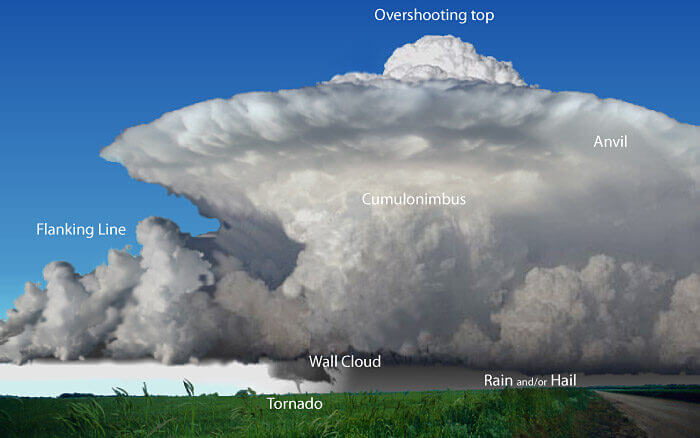
Image showing the typical features of a classic supercell thunderstorm. Image credit: NOAA
Just like any other good storm, it starts off with an abundant supply of moisture, instability, and a lifting mechanism. Some thunderstorms will have a strong updraft that continues to rise until it reaches the tropopause, where the air now decrease with height. The now stable warm air acts as a ceiling, forcing the rising air to spread out horizontally, forming the anvil cloud. But in the case with the overshooting top, the storm updrafts are so powerful that its momentum penetrates through the tropopause and into the stable layer of the stratosphere, the second layer of our atmosphere! This forces the upper part of the cloud to rise above the anvil and “bubble” up, giving it that well known appearance.
What’s fascinating about this cloud formation is the fact that overshooting tops transport large amounts of water vapor between the troposphere into the stratosphere. The stratosphere is relatively dry, with the troposphere holding about 99% of the atmosphere’s water vapor. Water vapor is an important greenhouse gas, and its presence in the atmosphere influences the Earth’s radiation budget, which is basically the balance between incoming solar radiation and outgoing energy from the Earth back into space. The relationship between the increase in water vapor in the atmosphere contributing to warmer temperatures, and warmer temperatures causing an increase in water vapor is known as a positive feedback loop. Even though water vapor in the stratosphere is very low, any increase in the amount of water vapor can contribute to this positive feedback loop and an increase in stratospheric ozone depletion.
Aside from being able to easily see an overshooting top from a distant storm, there are a few characteristics to keep in mind as well. They don’t last a very long, typically ranging from five to twenty minutes. If an overshooting top has lasted more than ten minutes, or if you’ve noticed that one dissipated and another formed shortly after, that signifies a strong or severe thunderstorm. This can bring large hail, heavy rainfall, intense lightning, damaging winds, and even tornadoes. In the case that you are watching this storm (and observing the overshooting top) from a distance, these hazards might not be in your direct path since overshooting tops indicate the storms core and intensity, it is still well advised to stay weather aware.
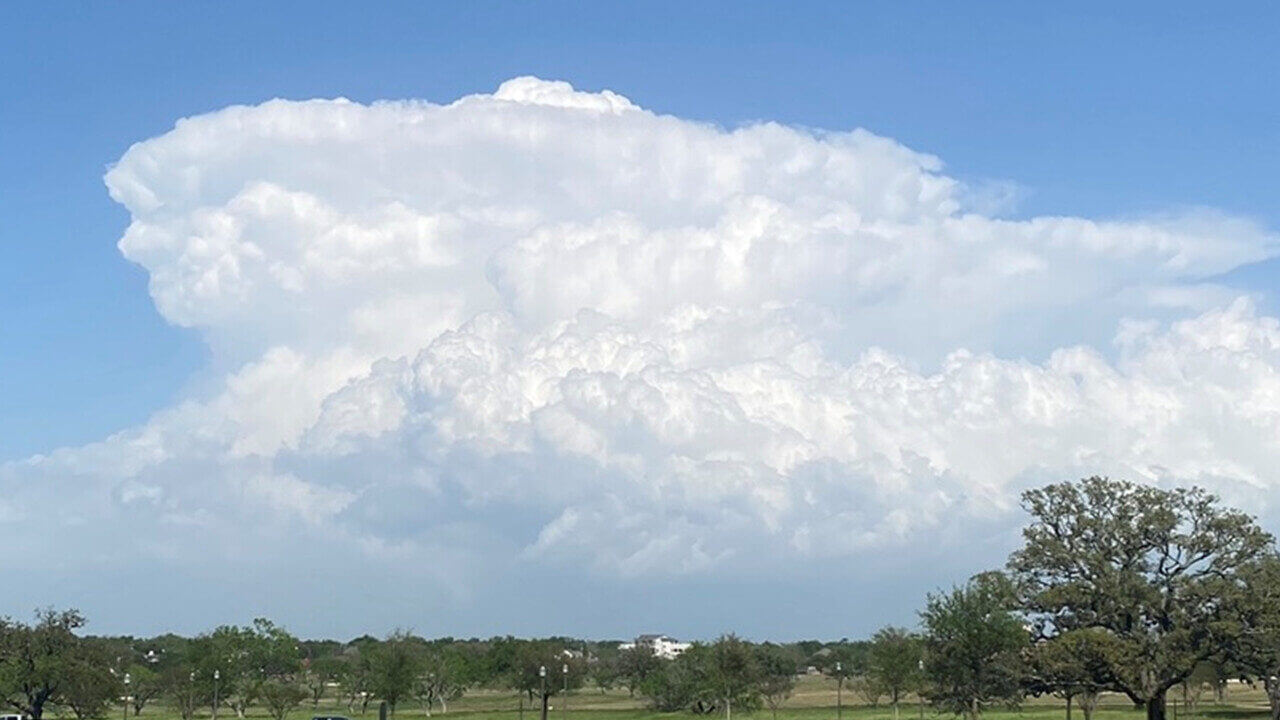
Image showing a supercell with overshooting top near College Station, Texas on January 27, 2023. Image credit: Alex Guajardo
Aside from observing these clouds with our own eyes, nowcasting and using satellite imagery is especially important when trying to forecast and determine the lifecycle of these storms. As the overshooting top ascends above the anvil, it rises adiabatically, meaning it is cooling without any transfer of heat with the surrounding air. This means the overshooting top will be significantly cooler in temperature than the surrounding anvil cloud is. This can be seen via satellite, specifically using the infrared brightness temperature channel. One can go to the GOES Image Viewer (linked is of the continental US) and view the Sandwich RGB band to view these clouds tops! They can also be viewed using visible imagery (GeoColor in the link). It is easier to view overshooting tops in the visible spectrum when there is a low Sun angle like in the morning or during the late afternoon because the Sun will cast shadows onto the anvil, but you just have to find those lumpy, bubble-like features.
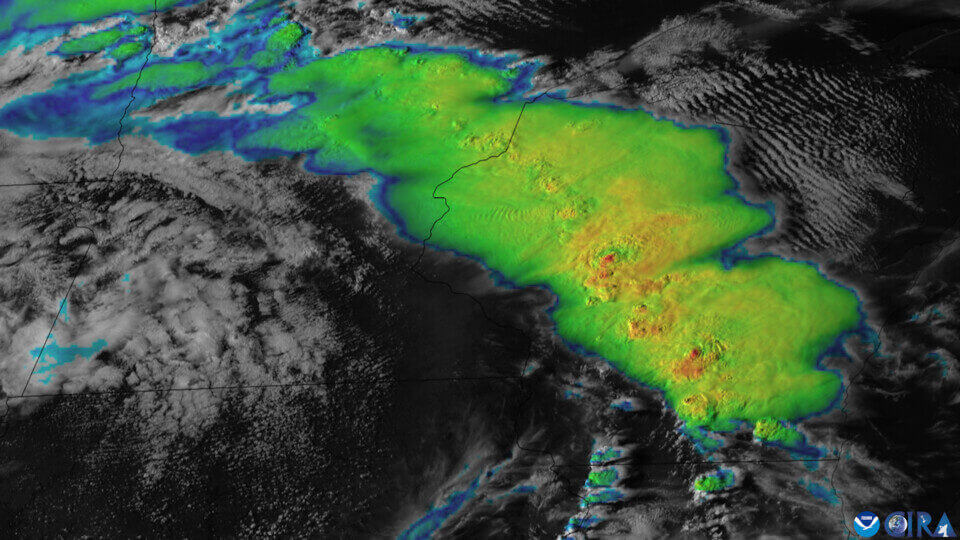
This image shows infrared and satellite imagery of severe storms moving through Minnesota and Wisconsin, where cold overshooting tops are shown in red. Image credit: NOAA CIRA
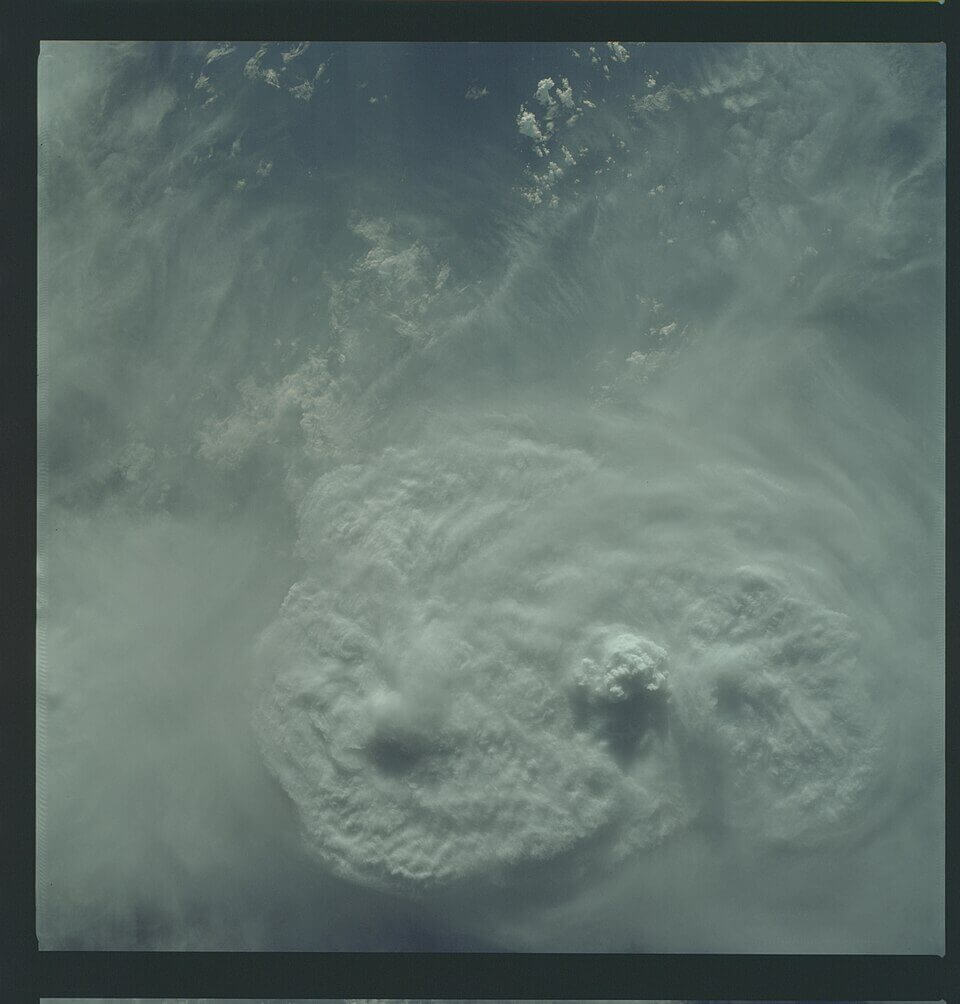
Image showing an overshooting top casting shadows on the anvil. Image credit: Project Apollo Archive, NASA
Overshooting tops are a great reminder that atmospheric dynamics can show the evolution of storms right Infront of our eyes. Overshooting tops form from a very strong thunderstorm, when powerful updrafts go past the equilibrium level, past the anvil, and into the lower parts of the stratosphere. They are a reminder that everything within the climate system is connected, and one storm can be largely influential. Not all severe storms will have an overshooting top, but every overshooting top will be accompanied by severe weather, so be diligent.
The Sun and the Moon
Sun Information
The month of September sees the Sun continue towards its southern standstill. If you track the position of sunrise or sunset this month you will find these positions are shifting to the south. Maximum altitude also changes each day. The Sun’s maximum altitude will shift from 57.1° on September 1, 2025, to 48.3° on September 30, 2025.
The next major position of the Sun occurs on September 22, 2025, as the Sun reaches the September equinox. For us in the northern hemisphere, this is the autumnal equinox which signals the start of fall. Be on the lookout for Orb Weaver spiders as they are becoming active in late summer.
Sunrise and Sunset Times for St. Louis Missouri
The sunrise and sunset times below were calculated by the Earth Systems Research Laboratories for NOAA. These times are calculated using equations for Jean Meeus’s Astronomical Algorithms. The atmosphere complicates these calculations due to the refraction of sunlight as it passes through the atmosphere. For the times listed below, the amount of atmospheric refraction is assumed to be 0.833°. Variations in the atmosphere can change the amount of refraction so the times posted are accurate to within a minute for latitudes between +/- 72°. You can learn more about these calculations and where to generate times for areas outside of St. Louis, Missouri by using the buttons below
Moon (daytime views)
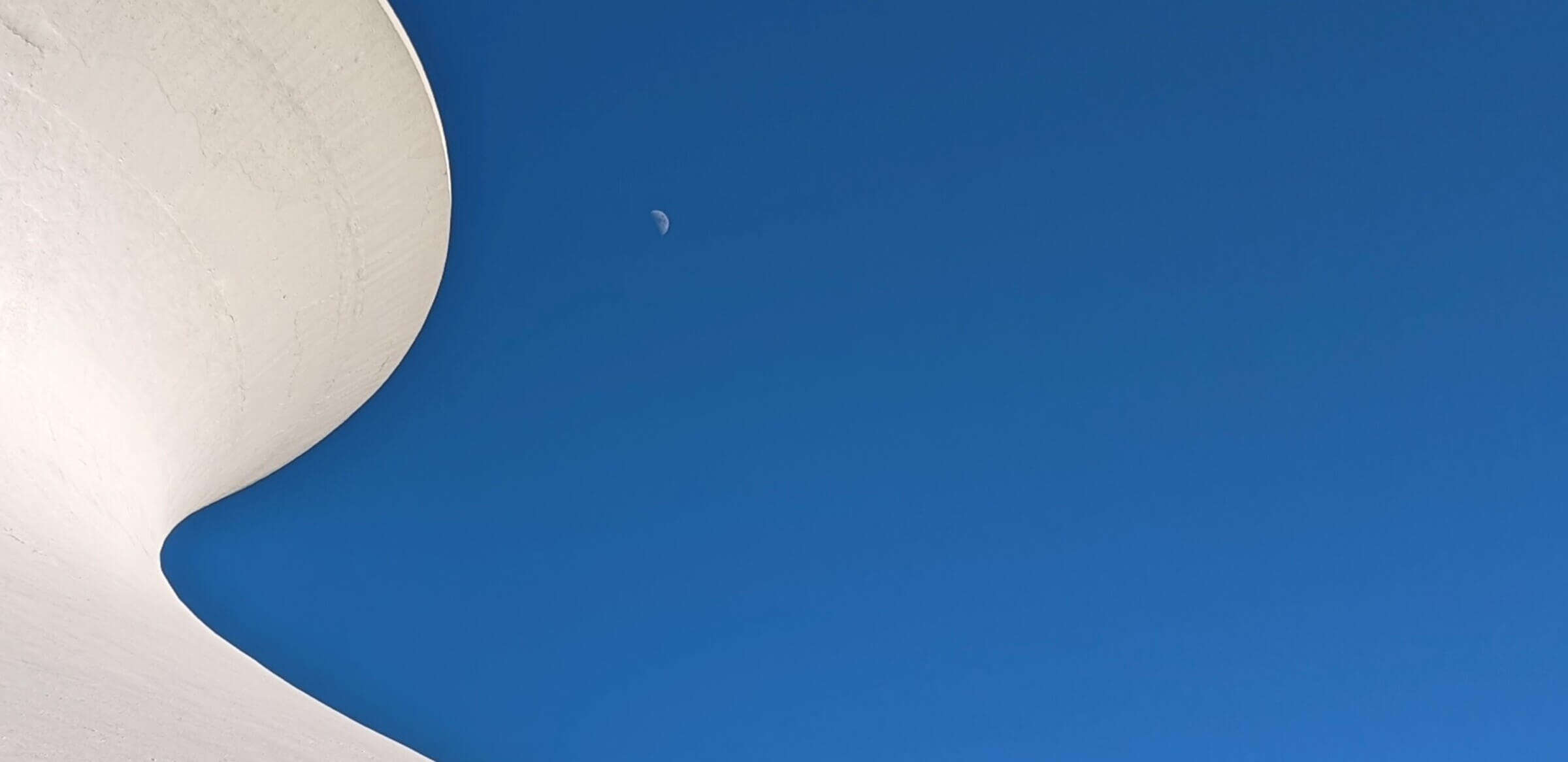
First quarter moon occurred on August 31, 2025, and last quarter moon occurs on September 14, 2025. The best daytime views of the Moon are always near the quarter phases. Look for the Moon in the afternoon at the beginning of September. When we are near last quarter phase, look for the Moon in the morning. The Moon crosses the ecliptic at its ascending node this month on September 7, 2025, and then at its descending node on September 20, 2025. This behavior occurs because the Moon’s orbit around Earth is tilted about 5.1° with respect to Earth’s ecliptic. This nodal cycle of the Moon is called a draconic month which 27.2 days long. Being aware of these crossing nodes helps observers know if the Moon will appear south or north of the ecliptic.
Solar Sunday is now held every 3rd Sunday of the month from 11:00 a.m. until 3:00 p.m. (Weather Dependent)
On the third Sunday each month, the St. Louis Astronomical Society and the Saint Louis Science Center will set up a number of safe solar telescopes outdoors and be on-hand to answer your questions. Telescope viewing begins at 11:00 a.m.
The St. Louis Astronomical Society helps host the monthly Star Parties at the Saint Louis Science Center. In addition to our daytime viewings, they also help facilitate our nighttime Public Telescope Viewing. These nighttime viewing sessions occur on the 1st Friday each month. Visit SLAS’s website linked above to learn about other telescope events SLAS hosts around the St. Louis area.
The Day Sky Update is compiled by McDonnell Planetarium staff.