This is the Saint Louis Science Center’s NIGHT SKY UPDATE for the week of Friday, June 19, 2026
Information updated weekly or as needed.
Times given as local St. Louis time this week will be in Central Daylight Time (CDT). For definitions of terminology used in the night sky update, click the highlighted text. If relying on times posted in Universal Time (UT), St. Louis is -5 hours when CDT. Times posted in the Night Sky Update are in the 24-hour format.
Join us for our next star party, Friday, August 7, 2026, held in association with the St. Louis Astronomical Society. For details, see the information at the bottom of this page or visit https://www.slsc.org/explore/mcdonnell-planetarium/public-telescope-viewings/
Observing Highlight
This week, astronomical summer begins as the Sun reaches its northern most declination of the year. This is known as the June solstice which marks the start of summer in the northern hemisphere. As a result of the changing seasons, a new part of the sky will dominate what we see overhead.
On June 21, 2026, at 03:24, the Sun will reach a declination of +23.44°. Six months later on December 21, 2026, the Sun will reach a declination of -23.44°. These two days represent the moments of solar standstill or what most would call a solstice. The Sun’s varying declination throughout the year is a result of Earth’s axial tilt of 23.44° which is the reason we have seasonal changes. Visually, the Sun appears higher or lower in the sky depending on which of these dates we are closer to. This observation became the backbone for how we track time. Our modern calendar measures a tropical year which is one complete cycle of seasons. Ancient humans observed this by watching the Sun’s varying position throughout the year.
Turning our attention to geography, you may have seen on a map or globe, two lines referencing the Tropic of Cancer and the Tropic of Capricorn. These are circles of latitude with measurements of ±23.5°. These circles of latitude represent the northern and southernmost places on Earth in which the Sun can appear at the zenith. Like the seasons, where we can see the Sun at the zenith changes each day due to Earth’s axial tilt.
The climate zone between these circles of latitude is known as the tropics. This area receives more direct solar radiation than anywhere on the planet influencing atmospheric circulation and weather patterns around the world. If you would like to learn more about these impacts I recommend NOAA’s article on global weather which can be found here.
With the change of seasons, comes a change in the sky above us. New constellations will dominate these short summer evenings. Looking east around 10 pm, our summer sky will be fully in view. The brightest stars in the east will be Vega, Altair and Deneb making up the summer asterism known as the Summer Triangle. Each bright star being found in the constellations, Lyra, Aquila and Cygnus.
To the west of the Summer Triangle, you can find a bow tie shape of stars which is the body of the constellation Hercules. South of this is the large bell shape of the constellation Ophiuchus which is flanked by Serpens Cauda and Serpens Caput. Finally, to the south of this, you will find the teapot shape of Sagittarius and the fishhook shape of Scorpius. This group of nine constellations represent the brightest patterns of our summer sky.
The brightest parts of the Milky Way visible in the northern hemisphere can be seen in the summer sky. Traveling to a dark location you will find the center of the galaxy between Sagittarius, Scorpius and Ophiuchus. The other bright section of the Milky Way seen in our summer sky is the Orion Spur. This small spiral arm is the home of our solar system and is found between the Carina-Sagittarius arm and the Large Perseus arm of the Milky Way. In the summer months, the Orion Spur is visible in the Summer Triangle. In winter months, we see it near the constellation Orion.
There are several good binocular targets to track down in the summer sky. Messier objects 4, 6, 7, 8, 13, 16, and 22 are good places to start for deep sky observing. These are a mix of Open and globular star cluster and a few nebulae. Star system such as Epsilon Lyrae, Alberio and Alpha Librae are great beginning targets for those new to star systems with multiple visible stellar components.
From July 16 to August 24, the Perseid meteor shower will be active. Peak activity is expected on August 12/13, 2026, when the shower is expected to produce around 100 meteors per hour if viewing from a dark location. 2026 will be a good year for the Perseids due to the Moon exhibiting its new moon phase on August 12.
There is a lot to keep us busy in the summer months but remember, available dark hours are short. With nearly 15 hours of daylight and another 4 of twilight, we only have about 5 hours of good dark sky to work with.
T CrB Nova Update 6/21/2026
If you are still interested in seeing the recurrent nova T Coronae Borealis, there is still hope. The nova has not yet occurred meaning we are in a waiting game. If you are still interested, the part of the sky the nova will appear overhead by the time it is dark. The star system T Coronae Borealis is found in the constellation Corona Borealis which looks like a small U-shape of stars next to the constellation Boötes. If you cannot observe the sky directly, you can track the behavior of T CrB by checking current magnitude estimates posted at AAVSO here or by visiting spaceweather.com. Current magnitude estimates of the system show it at 10th magnitude.
The Sun and Moon
Sun
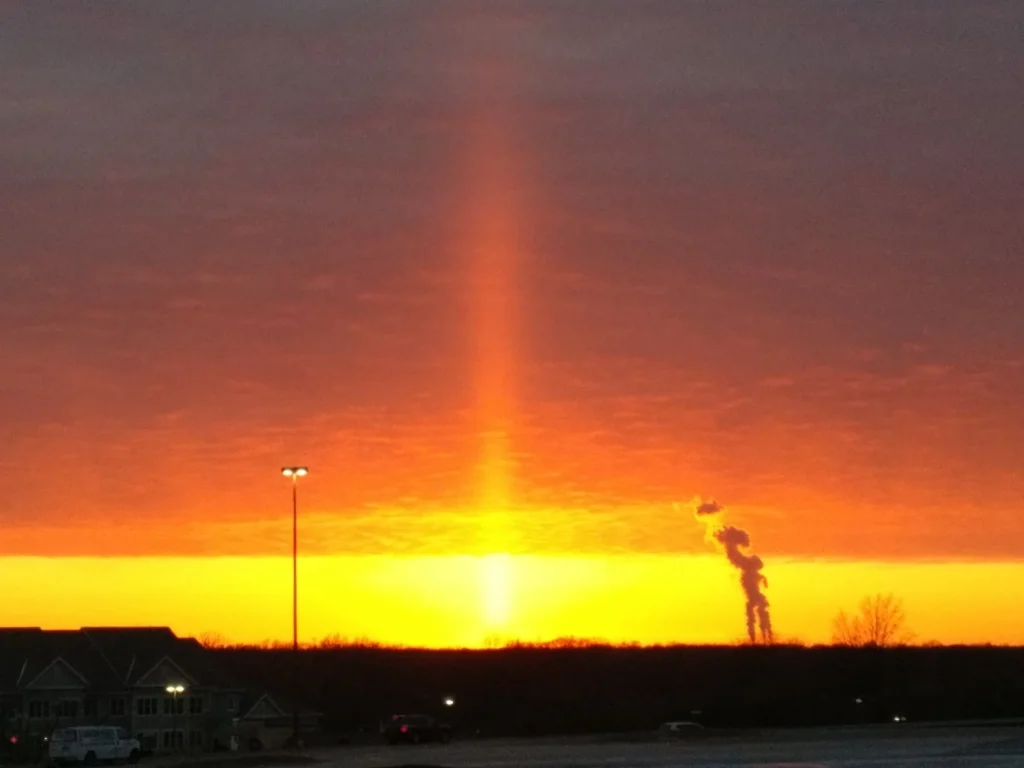
Sunrise on Friday, June 19 is at 05:36 and sunset is at 20:26 providing nearly 15 hours of daylight. Even after sunset, light from the Sun will dimly illuminate our sky for about 2 hours. This period is called twilight, which ends around 22:27 this week. For those with a sundial, local noon occurs around 13:03 on June 19, 2026.
| Day | Sunrise (CDT) | Sunset (CDT) |
| 19-June | 5:36 | 20:28 |
| 20-June | 5:36 | 20:28 |
| 21-June | 5:36 | 20:29 |
| 22-June | 5:37 | 20:29 |
| 23-June | 5:37 | 20:29 |
| 24-June | 5:37 | 20:29 |
| 25-June | 5:38 | 20:29 |
| 26-June | 5:38 | 20:29 |
| 27-June | 5:38 | 20:29 |
Moon
Moonrise for Friday, June 19, is at 10:44 and moonset occurs at 00:11 the following day. On June 19, 2026, the Moon will exhibit a waxing crescent phase with 31% disk illumination. By June 27, 2026, the Moon will exhibit a waxing gibbous phase with 97% disk illumination. First quarter moon occurs on June 21, 2026, at 16:55.
International Space Station (ISS) Observing
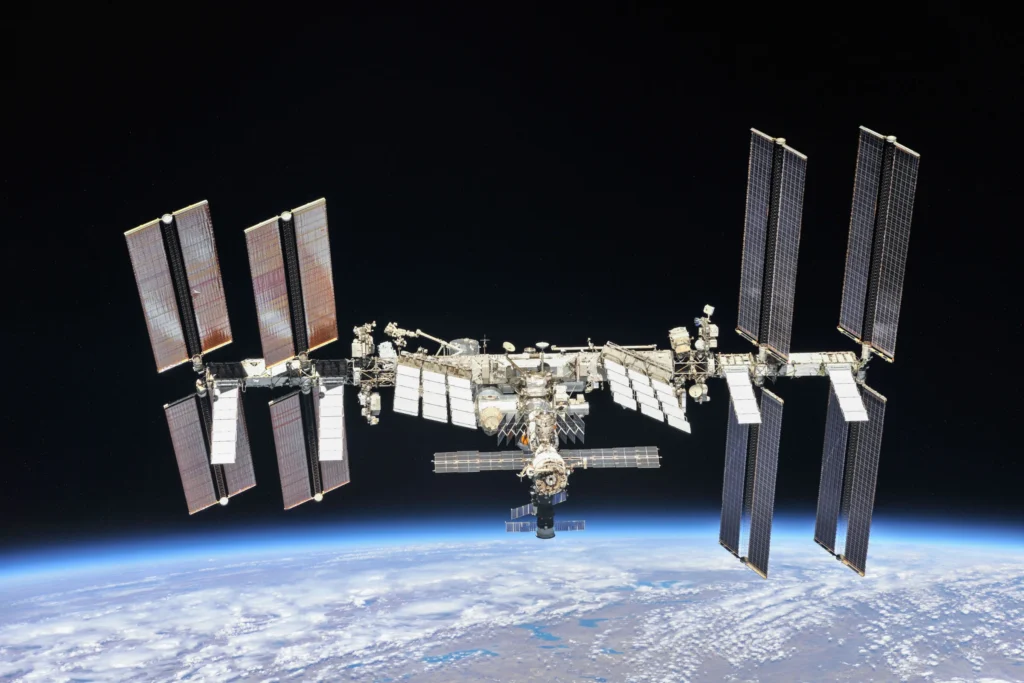
Visible passes of ISS from St. Louis for the week of June 19 occur during morning hours. The best of these occur on June 22, 24 and 25. You can find information about these and other satellite passes at https://heavens-above.com. If you are not viewing from the St. Louis area, make sure to change your viewing location for your local times.
Visible Planets
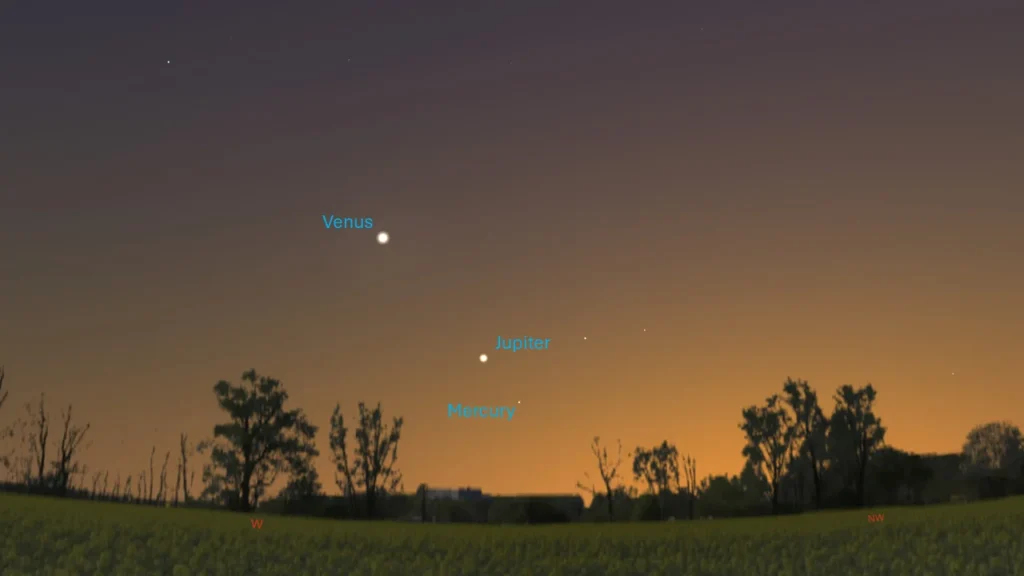
View looking west on June 21, 2026, at 21:00. Image created using Stellarium
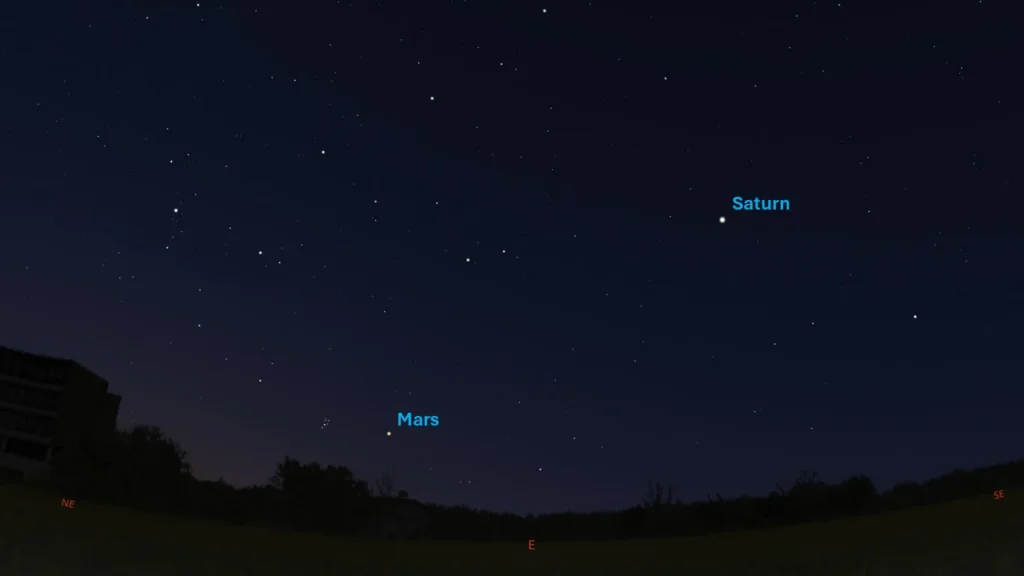
View looking east on June 22, 2026, at 04:30. Image created using Stellarium
Five naked eye planets will be visible this week. Venus, Jupiter and Mercury will be found in the west about 30 minutes after sunset. Saturn and Mars are visible in the east before sunrise.
Mercury
Mercury is still visible in the west about 30 minutes after sunset. Look for the planet about 9° above the western horizon. Unfortunately, each night Mercury will appear lower to the horizon as it is now past greatest elongation. Mercury reaches inferior conjunction on July 12, 2026.
Venus
Venus is visible in the west after sunset. Its current evening apparition will continue until October as it approach inferior conjunction on October 23, 2026. Venus sets by 22:57.
Mars
Those with a clear view to the east might be able to spot Mars around 04:30. It will be found about 11° above the horizon. By 05:00, Mars will be 17° above the eastern horizon but twilight will impact your chances to see the planet.
Jupiter
Jupiter is now lower to the horizon than Venus. You can still find the planet in the west about 30 minutes after sunset. Jupiter’s current apparition continues through June and some of July as it heads towards superior conjunction on July 29, 2026. Jupiter set around 22:12 this week.
Saturn
Saturn can be found rising in the east around 03:00. By 5am, Saturn can be found about 38° above the horizon.
Our next Star Party will be held on Friday, August 7, 2026 from 6:30 pm to 10:00 pm.
On the first Friday of each month, the St. Louis Astronomical Society and the Saint Louis Science Center will set up a number of telescopes outdoors and be on hand to answer your questions. Telescope viewing begins once it is dark.
The St. Louis Astronomical Society helps host the monthly Star Parties at the Saint Louis Science Center. In addition to our nighttime viewings, they also help facilitate our daytime event called Solar Sundays. These daytime viewing sessions occur every Sunday through Labor Day. After Labor Day they occur on the 3rd Sunday each month. Visit SLAS’s website linked above to learn about other telescope events SLAS hosts around the St. Louis area.
James S. McDonnell Planetarium
Night Sky Update for June 19, 2026
Subjects