This is the Saint Louis Science Center’s NIGHT SKY UPDATE for the week of Friday, June 12, 2026
Information updated weekly or as needed.
Times given as local St. Louis time this week will be in Central Daylight Time (CDT). For definitions of terminology used in the night sky update, click the highlighted text. If relying on times posted in Universal Time (UT), St. Louis is -5 hours when CDT. Times posted in the Night Sky Update are in the 24-hour format.
Join us for our next star party, Friday, August 7, 2026, held in association with the St. Louis Astronomical Society. For details, see the information at the bottom of this page or visit https://www.slsc.org/explore/mcdonnell-planetarium/public-telescope-viewings/
Observing Highlight
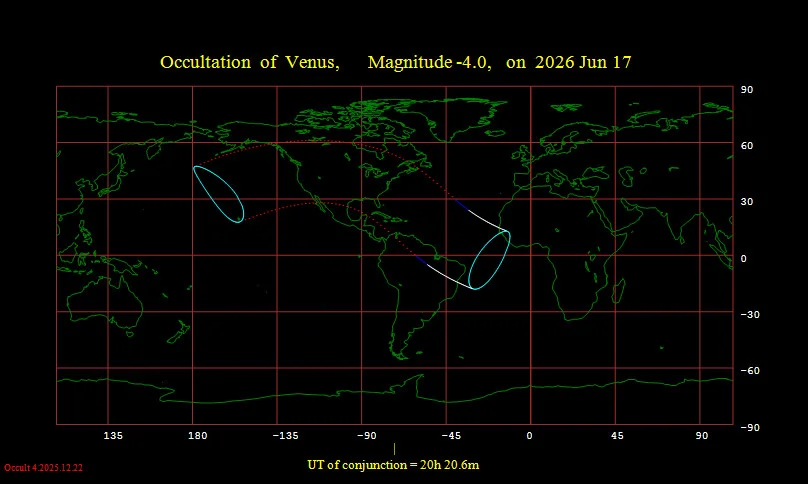
Map showing where the Venus occultation is visible on June 17, 2026. Image credit IOTA.
This week the Moon will occult the planet Venus on Wednesday, June 17, 2026. While lunar occultations are normally easy events to watch, this one occurs in the daytime which means you will need to use a telescope or binoculars to see it.
Occultations are a type of syzygy in which one object passes in front of another obscuring it from view. The Moon occults Venus about twice a year, but it will only be visible along a narrow path along Earth’s surface.
The occultation on June 17, 2026, will be visible along a path that starts around western Africa and northern South America, crosses over most of North America ending in the Pacific Ocean. Timings and length of the event will vary depending on your viewing location. For St. Louis, Missouri, the Moon starts to occult Venus around 14:18 CDT and Venus begins to reappear around 15:49 CDT. If you do not live in St. Louis, you can find timings for cities along the occultation path at The International Occultation Timing Association.
Unfortunately, the occultation occurs during the daytime for most locations along the path. Due to this, you will have to exercise some caution when viewing it. Daytime views of planets are not inherently dangerous, but when objects appear near the Sun it becomes hazardous. On June 17, Venus and the Moon will appear roughly 38° from the Sun. This is not what I would normally call close but when scanning the sky for daytime targets you are often sweeping back and forth across the sky. Losing track of where they should be could result in scanning too close to the Sun. If you accidentally sweep across the Sun without out filters on the binocular or telescope there is a high risk of permanent eye damage. Due to this potential danger, only attempt to see the occultation if you have a good grasp on the nuances of finding targets in the daytime.
The easiest way to find the pair will be with a telescope on a go-to mount. My plan is to use a white light solar filter to first locate the Sun. White light filters are safe solar filters designed to show the Sun’s photosphere. Once I have aligned on the Sun, I will slew the telescope over to the planet Venus. Once I know I am no longer pointed towards the Sun, I will take off the solar filter to scan for Venus.
You might think finding the Moon would be easier, but they may not be the case. The Moon will only be 3 days old with 11.1% disk illumination. With such a small amount of the lunar disk illuminated, the contrast between the bright lunar surface and the bright background sky might prove to be difficult.
On November 3, 2021, I observed a lunar occultation of Mercury in the daytime. I was successful at finding Mercury, but I was unable to resolve the Moon. A major difference in this event was the Moon was only 1.8% illuminated. This is a significant difference in Moon phase, and I expect the Moon will be easier to see on the 17th, however it could still be a challenge. A possible solution to the contrast problem is a lunar filter. This could darken the background sky enough to make seeing the Moon easier.
If you do not have a telescope, Venus is bright enough to see in the daytime with binoculars. It helps to know the altitude and azimuth of Venus. From St. Louis, Venus and the Moon will have and azimuth around +120° and an altitude of 61°. A compass will help to find the right azimuth, and you can use your hand to measure degrees in the sky. When held at arm’s length and one eye closed, a closed fist from side to side will cover approximately 10° of sky.
As of this writing, the weather forecast is not promising for us in the St. Louis area. It looks to be partially cloudy with chances of thunderstorms in the afternoon. Four days is still far enough out that things could improve but we will have to wait and see.
T CrB Nova Update 6/14/2026
If you are still interested in seeing the recurrent nova T Coronae Borealis, there is still hope. The nova has not yet occurred meaning we are in a waiting game. If you are still interested, the part of the sky the nova will appear overhead by the time it is dark. The star system T Coronae Borealis is found in the constellation Corona Borealis which looks like a small U-shape of stars next to the constellation Boötes. If you cannot observe the sky directly, you can track the behavior of T CrB by checking current magnitude estimates posted at AAVSO here or by visiting spaceweather.com. Current magnitude estimates of the system show it at 10th magnitude.
The Sun and Moon
Sun
Sunrise on Friday, June 12 is at 05:36 and sunset is at 20:26 providing nearly 15 hours of daylight. Even after sunset, light from the Sun will dimly illuminate our sky for about 2 hours. This period is called twilight, which ends around 22:24 this week. For those with a sundial, local noon occurs around 13:01 on June 12, 2026.
| Day | Sunrise (CDT) | Sunset (CDT) |
| 12-June | 5:36 | 20:26 |
| 13-June | 5:36 | 20:26 |
| 14-June | 5:36 | 20:27 |
| 15-June | 5:36 | 20:27 |
| 16-June | 5:36 | 20:27 |
| 17-June | 5:36 | 20:28 |
| 18-June | 5:36 | 20:28 |
| 19-June | 5:36 | 20:28 |
| 20-June | 5:36 | 20:28 |
Moon
Moonrise for Friday, June 12, is at 03:04 and moonset occurs at 18:03. On June 12, 2026, the Moon will exhibit a waning crescent phase with 8% disk illumination. By June 20, 2026, the Moon will exhibit a waxing crescent phase with 40% disk illumination. New moon occurs on June 14, 2026, at 21:54.
International Space Station (ISS) Observing
Visible passes of ISS from St. Louis for the week of June 12 occur during morning hours. The best of these occur on June 19 and June 20. You can find information about these and other satellite passes at https://heavens-above.com. If you are not viewing from the St. Louis area, make sure to change your viewing location for your local times.
Visible Planets
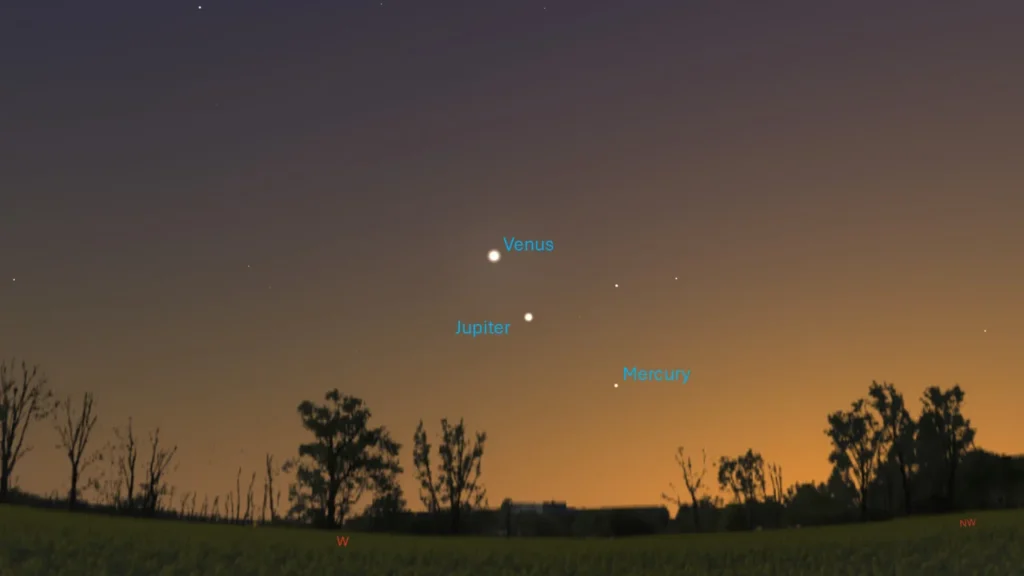
View looking west on June 14, 2026, at 21:00. Image created using Stellarium
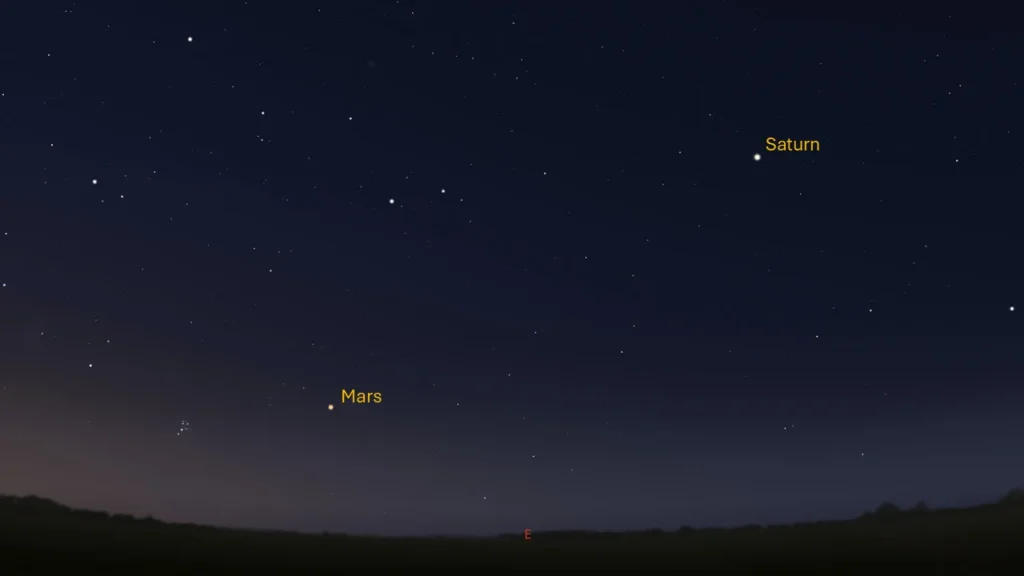
View looking east on June 15, 2026, at 05:00. Image created using Stellarium
Five naked eye planets will be visible this week. Venus, Jupiter and Mercury will be found in the west about 30 minutes after sunset. Saturn and Mars are visible in the east before sunrise.
Mercury
Mercury is still visible in the west about 30 minutes after sunset. Look for the planet about 11° above the western horizon. It reaches greatest eastern elongation on June 15, 2026.
Venus
Venus is visible in the west after sunset. Its current evening apparition will continue until October as it approach inferior conjunction on October 23, 2026. Venus sets by 22:59.
Mars
Those with a clear view to the east might be able to spot Mars around 04:30. It will be found about 9° above the horizon. By 05:00, Mars will be 15° above the eastern horizon but twilight will impact your chances to see the planet.
Jupiter
Jupiter is now lower to the horizon than Venus. You can still find the planet in the west about 30 minutes after sunset. Jupiter’s current apparition continues through June and some of July as it heads towards superior conjunction on July 29, 2026. Jupiter set around 22:34 this week.
Saturn
Saturn can be found rising in the east around 04:00. By the start of civil twilight, Saturn can be found about 20° above the horizon.
Our next Star Party will be held on Friday, August 7, 2026 from 6:30 pm to 10:00 pm.
On the first Friday of each month, the St. Louis Astronomical Society and the Saint Louis Science Center will set up a number of telescopes outdoors and be on hand to answer your questions. Telescope viewing begins once it is dark.
The St. Louis Astronomical Society helps host the monthly Star Parties at the Saint Louis Science Center. In addition to our nighttime viewings, they also help facilitate our daytime event called Solar Sundays. These daytime viewing sessions occur every Sunday through Labor Day. After Labor Day they occur on the 3rd Sunday each month. Visit SLAS’s website linked above to learn about other telescope events SLAS hosts around the St. Louis area.
James S. McDonnell Planetarium
Night Sky Update for June 12, 2026
Subjects