Day Sky Update November 2026
This is the Saint Louis Science Center’s DAY SKY UPDATE for the Month of November 2026.
Information updated monthly or as needed.
Times given as local St. Louis time which is Central Standard Time (CST). For definitions of terminology used in the day sky update, click the highlighted text. If relying on times posted in Universal Time (UT), St. Louis is -6 hours when CST. Additionally, times will be posted in a 24-hour format.
Join us for our next solar telescope viewing each month on the third Sunday, held in association with the St. Louis Astronomical Society. These viewing sessions are weather dependent. For details, see the information at the bottom of this page or visit https://www.slsc.org/explore/mcdonnell-planetarium/public-telescope-viewings/
Daytime Astronomy Primer
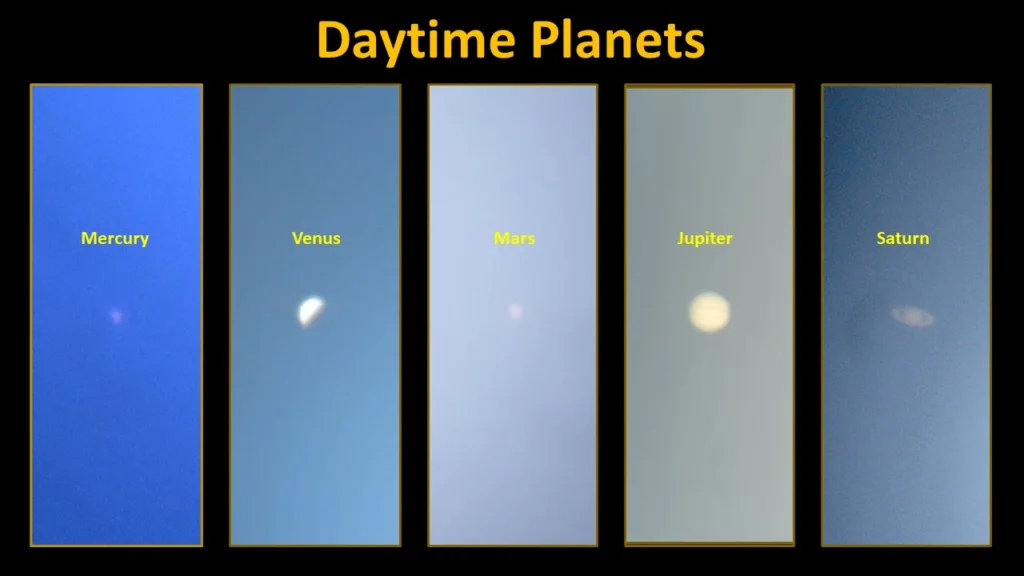
Image shows daytime telescope view of the five naked eye planets. Image credit: Eric Gustafson
For most, astronomy is a hobby that is left to the darkness of night. While most astronomical objects are only visible at night, the day sky can offer a careful observer several astronomical targets along with a multitude of atmospheric phenomena to enjoy. When posted, the DAY SKY UPDATE will explore these possibilities which may include a highlight of the month, cloud observing, sun rise/set times, daytime Moon information, daytime planets and other topics. As always, when viewing during daytime, you must use caution as the Sun is always near.
Aside from solar filters, there are other safety steps that you should consider. Sunscreen, hats and sunglasses are always advisable. Visible light is how we observe the world around us, however, there is light we cannot see such as ultraviolet (UV) and infrared (IR) lights. While both are an issue if you are using an optical system, UV light is an issue through exposure. This can be mitigated by using sunscreen, sunglasses and limiting exposed skin. While sunglasses are not safe instruments to view the Sun with, they do protect your eyes from exposure to ultraviolet light that we are susceptible to during the day.
Cloud of the Month
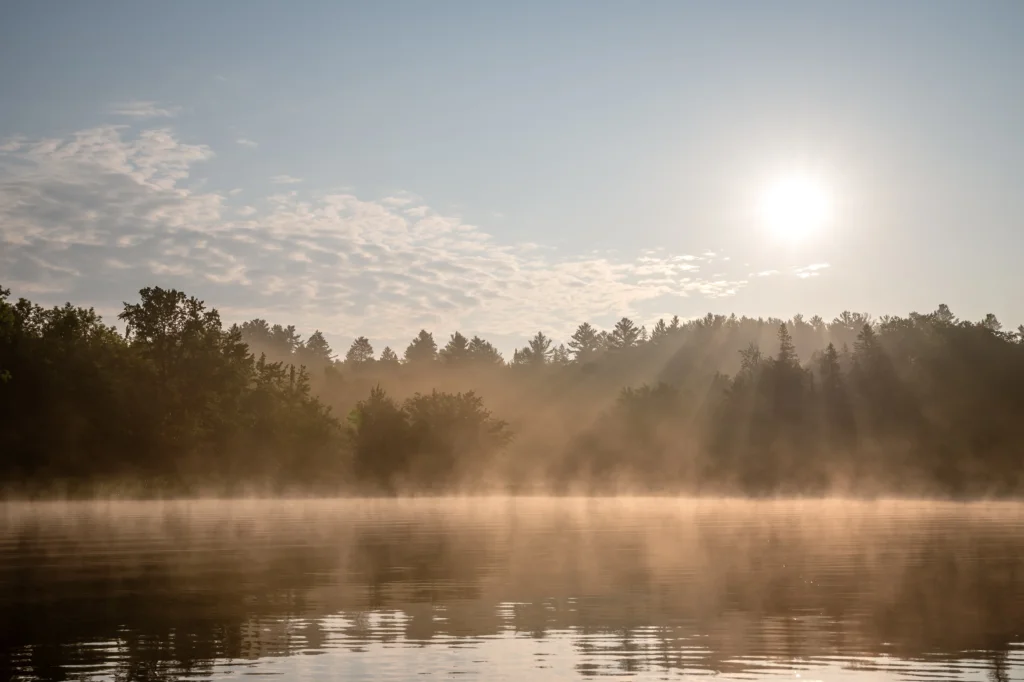
As we get deeper into the season of Autumn, we will likely start experiencing a phenomenon that casts a veil on our environment. This month we will explore a cloud like feature called mist. In short, mist is described as tiny water droplets suspended in the air. But how does mist form and how is it different from fog?
To understand mist, we need to begin by discussing water vapor. Our atmosphere is full of water vapor because of evaporation, which is when liquid water changes into a gas. This presence of water vapor creates moisture which is called humidity. The atmosphere can only hold on to a certain amount of water vapor at a given temperature. When it reaches that limit, the air is fully saturated and can no longer hold any more water vapor. Any extra moisture will condense into liquid water droplets.
Mist forms when warm moist air near the surface cools and the water vapor condenses into tiny droplets we can see. Mist mostly forms near bodies of water, in the early morning when the ground starts to warm up, or after it rains. Mist has a smaller droplet size, which makes it more “transparent”. You can think of mist as being a “light fog”. Because of this, mist is not very dense. Fog is known for significantly reducing visibility which can make travel very dangerous. The National weather service will issue a “Dense Fog Advisory” when visibility drops to below a quarter of a mile or less. Mist allows visibility 1km or more, so the NWS does not have any advisories to issue. Mist doesn’t tend to stay very long either, dissipating quickly if the surrounding air starts to warm or if the wind picks up.
Despite mist and fog forming in the same way, they do have important differences that affect visibility, weather forecasting, and transportation. If you are interested in learning more about fog, check out one of our older blogs here.
The Sun and the Moon
Sun Information
The month of November sees the Sun decreasing its altitude each day as it continues towards the December Solstice. When viewed from St. Louis, the Sun’s maximum altitude will shift from 36.8° on November 1, 2026, to 29.6° on November 30, 2026. The next major position of the Sun occurs on December 21, 2026, as the Sun reaches the December solstice. This day sees the beginning of winter in the northern hemisphere and summer in the southern hemisphere.
Day Light Saving time ends on November 1, 2026, shifting us back to Daylight Standard Time. Those that still have active gardens should be prepared for frost this month. Traditionally mid-October is when we start seeing the first light frosts but temperatures in October 2026 were unseasonably warm.
Activity along the Mississippi flay-way continues through November bringing migratory birds that often overwinter in Missouri. Several duck and small bird species will begin to arrive. You will also likely start seeing Bald Eagles and Rough-Legged Hawks. The later of these I have already seen hunting in Forest Park. You can find more information on overwintering birds of Missouri here.
| Dec. Solstice | Dec. 21, 2026 |
| March Equinox | March 20, 2027 |
| June Solstice | June 21, 2027 |
| Sept. Equinox | Sept. 23, 2027 |
Sunrise and Sunset Times for St. Louis Missouri
The sunrise and sunset times below were calculated by the Earth Systems Research Laboratories for NOAA. These times are calculated using equations for Jean Meeus’s Astronomical Algorithms. The atmosphere complicates these calculations due to the refraction of sunlight as it passes through the atmosphere. For the times listed below, the amount of atmospheric refraction is assumed to be 0.833°. Variations in the atmosphere can change the amount of refraction so the times posted are accurate to within a minute for latitudes between +/- 72°.
| Day | Sunrise (CST) | Sunset (CST) |
| 1-Nov | 6:28 | 17:00 |
| 2-Nov | 6:29 | 16:59 |
| 3-Nov | 6:30 | 16:58 |
| 4-Nov | 6:31 | 16:57 |
| 5-Nov | 6:32 | 16:56 |
| 6-Nov | 6:33 | 16:55 |
| 7-Nov | 6:34 | 16:54 |
| 8-Nov | 6:35 | 16:53 |
| 9-Nov | 6:36 | 16:52 |
| 10-Nov | 6:37 | 16:51 |
| 11-Nov | 6:38 | 16:51 |
| 12-Nov | 6:40 | 16:50 |
| 13-Nov | 6:41 | 16:49 |
| 14-Nov | 6:42 | 16:48 |
| 15-Nov | 6:43 | 16:47 |
| 16-Nov | 6:44 | 16:47 |
| 17-Nov | 6:45 | 16:46 |
| 18-Nov | 6:46 | 16:45 |
| 19-Nov | 6:47 | 16:45 |
| 20-Nov | 6:48 | 16:44 |
| 21-Nov | 6:49 | 16:44 |
| 22-Nov | 6:50 | 16:43 |
| 23-Nov | 6:52 | 16:42 |
| 24-Nov | 6:53 | 16:42 |
| 25-Nov | 6:54 | 16:42 |
| 26-Nov | 6:55 | 16:41 |
| 27-Nov | 6:56 | 16:41 |
| 28-Nov | 6:57 | 16:41 |
| 29-Nov | 6:58 | 16:40 |
| 30-Nov | 6:59 | 16:40 |
Moon (daytime views)
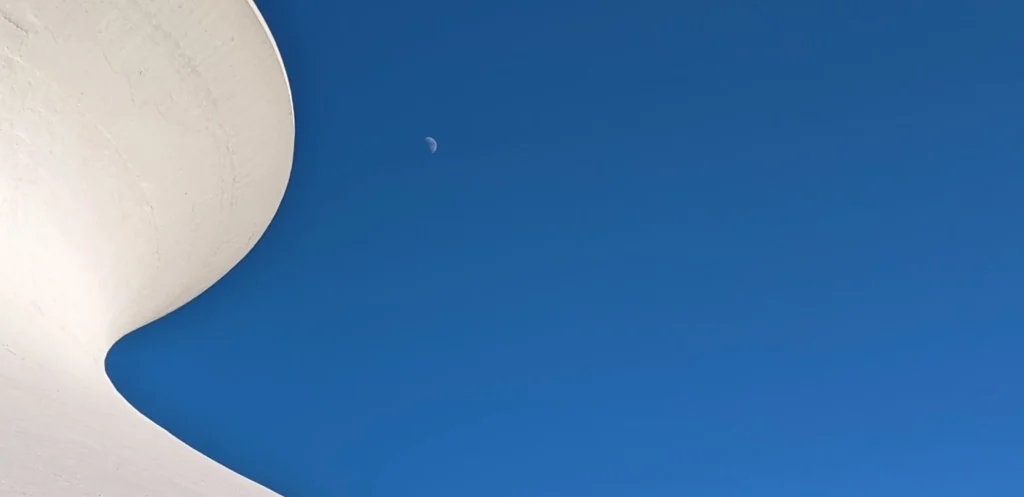
Last quarter moon occurs on November 1, 2026, and first quarter moon occurs on October 17, 2026. The best daytime views of the Moon are always near the quarter phases. Look for the Moon in the morning at the beginning of November. When we are near first quarter phase, look for the Moon in the afternoon.
The Moon crosses the ecliptic at its descending node this month on November 3, 2026, and then at its ascending node on November 17, 2026. This behavior occurs because the Moon’s orbit around Earth is tilted about 5.1° with respect to Earth’s ecliptic. This nodal cycle of the Moon is called a draconic month which is 27.2 days long. During each nodal cycle, the Moon crosses Earth’s ecliptic twice at what are called the ascending and descending nodes. Being aware of these crossing nodes helps observers know if the Moon will appear south or north of the ecliptic.
| Phase | Date | Time (CDT*/CST) |
| Full Moon | October 25, 2026 | 23:12* |
| Last Quarter | November 01, 2026 | 14:29 |
| New Moon | November 09, 2026 | 01:02 |
| First Quarter | November 17, 2026 | 05:48 |
| Full Moon | November 24, 2026 | 08:54 |
Solar Sunday occurs on the third Sunday of the month from 11:00 a.m. until 3:00 p.m. (Weather Dependent).
Each month on the third Sunday, the St. Louis Astronomical Society and the Saint Louis Science Center will set up a number of safe solar telescopes outdoors and be on hand to answer your questions. Telescope viewing begins at 11:00 a.m. and is weather dependent.
The St. Louis Astronomical Society helps host the monthly Star Parties at the Saint Louis Science Center. In addition to our daytime viewings, they also help facilitate our nighttime Public Telescope Viewing. These nighttime viewing sessions occur on the 1st Friday each month. Visit SLAS’s website linked above to learn about other telescope events SLAS hosts around the St. Louis area.
Subjects