This is the Saint Louis Science Center’s DAY SKY UPDATE for the Month of August 2025.
Information updated monthly or as needed.
Times given as local St. Louis time which is Central Daylight Time (CDT). For definitions of terminology used in the night sky update, click the highlighted text. If relying on times posted in Universal Time (UT), St. Louis is -5 hours when CDT. Additionally, times will be posted in a 24-hour format.
Join us for our next solar telescope viewing, Sunday, August 10, 17, 24 and 31, held in association with the St. Louis Astronomical Society. These viewing sessions are weather dependent. For details, see the information at the bottom of this page or visit
Daytime Astronomy Primer
For most, astronomy is a hobby that is left to the darkness of night. While most astronomical objects are only visible at night, the day sky can offer a careful observer several astronomical targets along with a multitude of atmospheric phenomena to enjoy. When posted, the DAY SKY UPDATE will explore these possibilities which may include a highlight of the month, cloud observing, sun rise/set times, daytime Moon information, daytime planets and other topics. As always, when viewing during daytime, you must use caution as the Sun is always near.
Aside from solar filters, there are other safety steps that you should consider. Sunscreen, hats and sunglasses are always advisable. Visible light is how we observe the world around us, however, there is light we cannot see. Ultraviolet (UV) and infrared (IR) light are great examples of this. While both are an issue if you are using an optical system, UV light is an issue through exposure. This can be mitigated by using sunscreen, sunglasses and limiting exposed skin. While sunglasses are not safe instruments to view the Sun with, they do protect your eyes from exposure to ultraviolet light that we are susceptible to during the day. If you would like to learn more about UV and its dangers use the buttons below.
Cloud of the Month
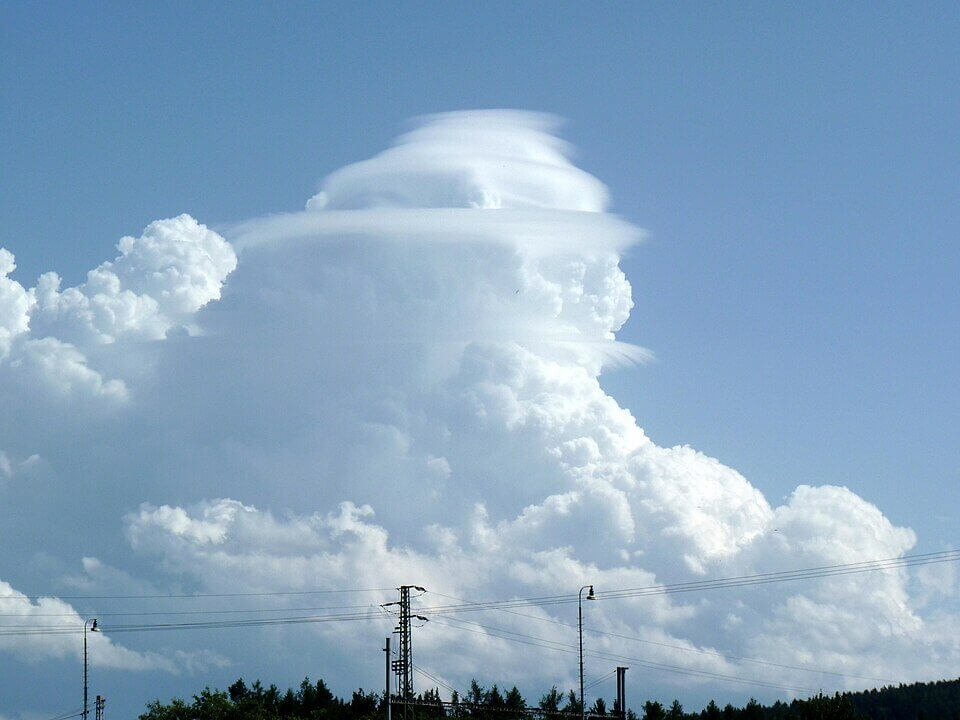
This image shows a pileus cloud at the top of a Cumulonimbus cloud. Image credit: Marra
With the peak of summer bringing us our hottest temperatures and even more extreme weather, it’s the perfect time to continue looking up and observe different cloud formations. A distinctive cloud that one can see during the summertime is known as the pileus cloud. It is in the form of a hood or cap above the upper part of a cumuliform cloud. They often get mistaken for lenticular clouds, but pileus will never form on their own, and they form from different circumstances.
It starts with an already formed cumulus cloud with a strong updraft. This causes the warm, moist air to move upwards beyond the top of the cumulus. The air will start to cool and expand, and once it reaches its dew point, the water vapor in the air will condense and a horizontal cloud will start to form over the cumulus. Pileus are fairly short lived since they are absorbed by the cumulus beneath it, which will continue to grow from the strengthening updraft. Although they don’t create any disruptive weather themselves, the presence of a pileus over a cumulus cloud can signal a very strong updraft, which can indicate its transformation into a cumulonimbus. The later of these could develop into severe weather. The intensity of a thunderstorm is directly related to the strength of the updraft which leads to heavy rainfall and potentially large hail.
Pileus clouds do not just form over cumuliform clouds. They will form through the same dynamics above ash clouds from volcanoes, and mushrooms clouds from nuclear blasts.

This image taken from ISS show a pileus cloud over a volcanic plume from the eruption of the Sarychev Peak volcano on June 12, 2009. Image credit: NASA
As you are looking at a pileus cloud, you are actively looking at atmospheric dynamics taking place right in front of your eyes. It is mesmerizing watching it change and evolve as the minutes go by. They take different shapes and sometimes can even stack on top of each other like pancakes. They can be very small and transparent or very large and opaque. Sometimes you can even see different pileus clouds all over a multi-cell thunderstorm system! It’s important to remember that seeing them on top of towering cumulonimbus clouds could indicate that severe weather is near. On a hot summer day when cumulus clouds are taking over the sky, look up, you might see a nice little cap hugging that cotton ball cloud.
The Sun and the Moon
Sun Information
The month of August sees the Sun continue towards its southern standstill. If you track the position of sunrise or sunset this month you will find these positions are shifting to the south. Maximum altitude also changes each day. The Sun’s maximum altitude will shift from 69.2° on August 1, 2025, to 59.7° on August 31, 2025.
The next major position of the Sun occurs on September 22, 2025, as the Sun reaches the September equinox. For us in the northern hemisphere, this is the autumnal equinox which signals the start of fall. Through August, annual cicadas will serenade you throughout the day as dragonflies continue to be active. Be on the lookout for Orb Weaver spiders as they are becoming active in late summer.
Sunrise and Sunset Times for St. Louis Missouri
The sunrise and sunset times below were calculated by the Earth Systems Research Laboratories for NOAA. These times are calculated using equations for Jean Meeus’s Astronomical Algorithms. The atmosphere complicates these calculations due to the refraction of sunlight as it passes through the atmosphere. For the times listed below, the amount of atmospheric refraction is assumed to be 0.833°. Variations in the atmosphere can change the amount of refraction so the times posted are accurate to within a minute for latitudes between +/- 72°. You can learn more about these calculations and where to generate times for areas outside of St. Louis, Missouri by using the buttons below
Moon (daytime views)
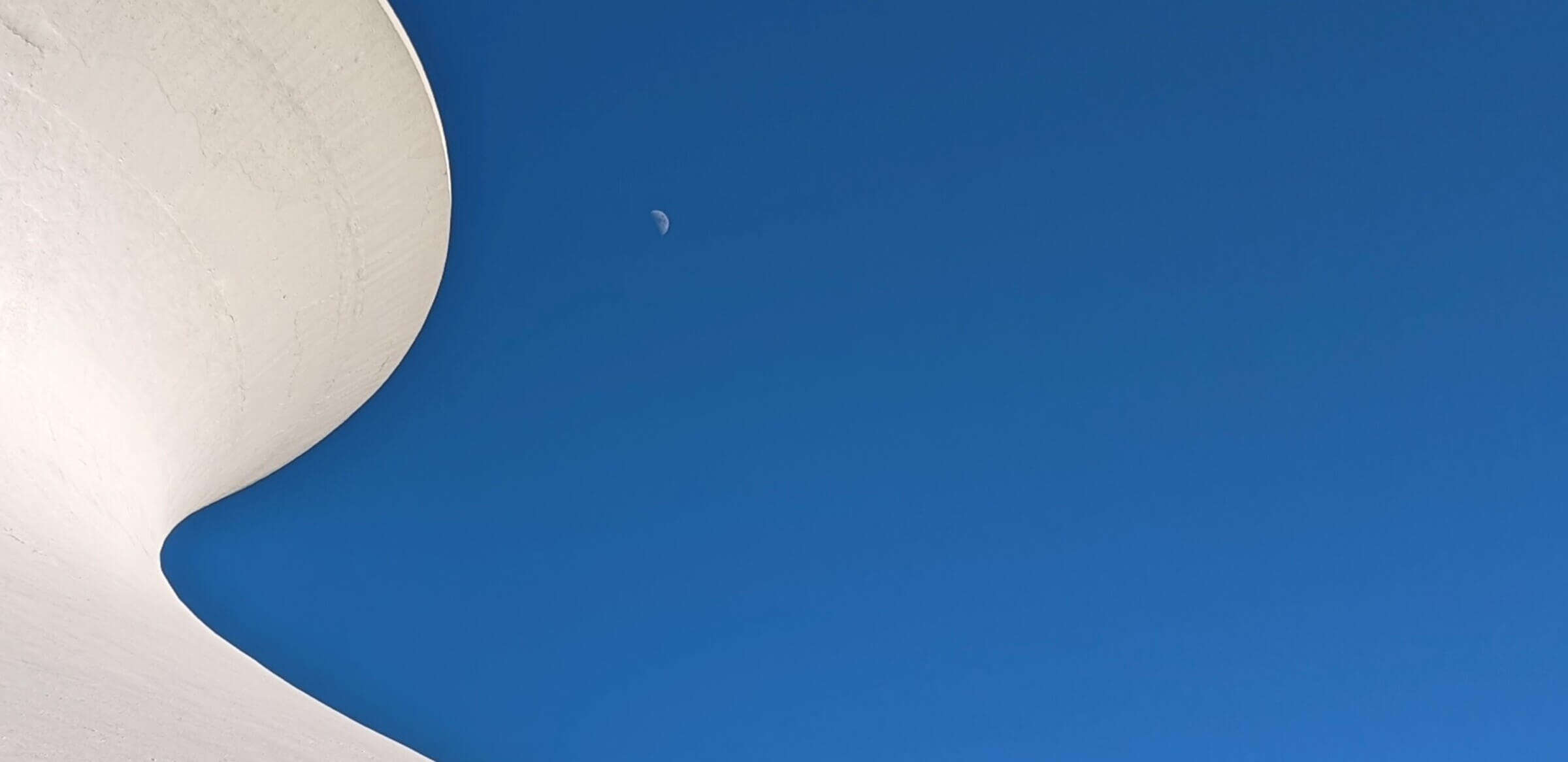
First quarter moon occurs on August 1, 2025, and last quarter moon occurs on August 16, 2025. The best daytime views of the Moon are always near the quarter phases. Look for the Moon in the afternoon at the beginning of August. When we are near last quarter phase, look for the Moon in the morning. The Moon crosses the ecliptic at its ascending node this month on August 11, 2025, and then at its descending node on August 24, 2025. This behavior occurs because the Moon’s orbit around Earth is tilted about 5.1° with respect to Earth’s ecliptic. This nodal cycle of the Moon is called a draconic month which 27.2 days long. Being aware of these crossing nodes helps observers know if the Moon will appear south or north of the ecliptic.
Solar Sunday is now held every Sunday through Labor Day from 11:00 a.m. until 3:00 p.m. (Weather Dependent)
On Sundays through Labor Day, the St. Louis Astronomical Society and the Saint Louis Science Center will set up a number of safe solar telescopes outdoors and be on-hand to answer your questions. Telescope viewing begins at 11:00 a.m.
The St. Louis Astronomical Society helps host the monthly Star Parties at the Saint Louis Science Center. In addition to our daytime viewings, they also help facilitate our nighttime Public Telescope Viewing. These nighttime viewing sessions occur on the 1st Friday each month. Visit SLAS’s website linked above to learn about other telescope events SLAS hosts around the St. Louis area.
The Day Sky Update is compiled by McDonnell Planetarium staff.
Subjects