This is the Saint Louis Science Center’s DAY SKY UPDATE for the Month of December 2025.
Information updated monthly or as needed.
Times given as local St. Louis time which is Central Standard Time (CST). For definitions of terminology used in the night sky update, click the highlighted text. If relying on times posted in Universal Time (UT), St. Louis is -6 hours when CST. Additionally, times will be posted in a 24-hour format.
Join us for our next solar telescope viewing, Sunday, December 21, held in association with the St. Louis Astronomical Society. These viewing sessions are weather dependent. For details, see the information at the bottom of this page or visit
Daytime Astronomy Primer
For most, astronomy is a hobby that is left to the darkness of night. While most astronomical objects are only visible at night, the day sky can offer a careful observer several astronomical targets along with a multitude of atmospheric phenomena to enjoy. When posted, the DAY SKY UPDATE will explore these possibilities which may include a highlight of the month, cloud observing, sun rise/set times, daytime Moon information, daytime planets and other topics. As always, when viewing during daytime, you must use caution as the Sun is always near.
Aside from solar filters, there are other safety steps that you should consider. Sunscreen, hats and sunglasses are always advisable. Visible light is how we observe the world around us, however, there is light we cannot see. Ultraviolet (UV) and infrared (IR) light are great examples of this. While both are an issue if you are using an optical system, UV light is an issue through exposure. This can be mitigated by using sunscreen, sunglasses and limiting exposed skin. While sunglasses are not safe instruments to view the Sun with, they do protect your eyes from exposure to ultraviolet light that we are susceptible to during the day. If you would like to learn more about UV and its dangers use the buttons below.
Observing Highlight
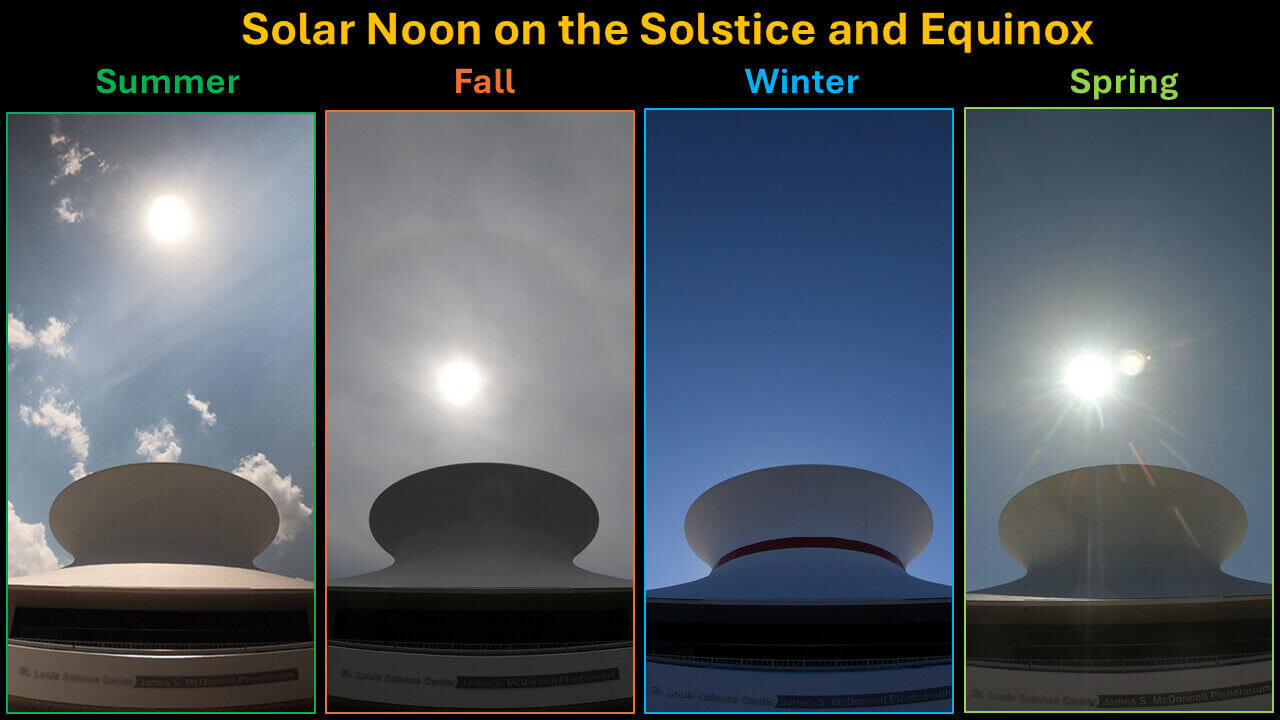
Each image shows the position of the Sun over the James S. McDonnell Planetarium at local noon on the two solstice and equinox. Image credit: Eric Gustafson.
For northern hemisphere observers, the winter solstice occurs this month on Sunday, December 21, 2025. The solstice in December marks the day when the Sun reaches its greatest declination south of the celestial equator (-23.5°). The Sun’s declination changes because Earth’s rotational axis is tilted. As a result, Earth’s northern and southern hemispheres are exposed to varying amounts of direct sunlight which in turn drives things such as the seasons and weather patterns.
As we note the position of the Sun through the seasons, the Sun’s track from east to west varies. The changing position of the Sun at sunset/sunrise shifts between two extremes called solar standstills. These standstill positions indicate the occurrence of a solstice. Our ancestors learned long ago to track these changing positions which helped us create a solar-based calendar.
An easy way to monitor the Sun’s seasonal position is to note the Sun’s altitude at local noon. Local noon is when the Sun’s appears its highest for the day which is not always at the same time. If you don’t have an easy way to measure the Sun’s altitude, you can always measure the length of shadows cast by objects at local noon. You can do this by using a gnomon that remains in the same place. The term gnomon usually describes the part of a sundial that casts a shadow but a stick in the ground will accomplish the same thing. As the Sun’s altitude changes throughout the year, the shadow cast by your gnomon will increase or decrease in length.
Cloud of the Month
Sometimes when we look up and observe clouds, they might look like they come straight from a science fiction film. That’s the perfect way to describe this month’s cloud. They are called fallstreak hole clouds (also known as hole punch clouds.)
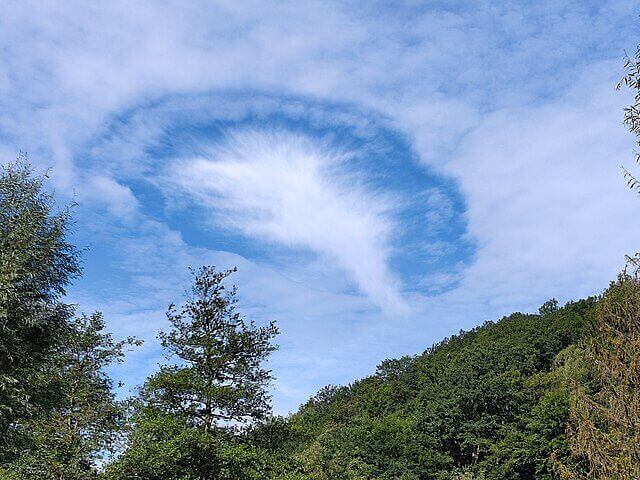
Image showing fallstreak cloud observed over Belgium in 2024. Photo credit: Bernadette Dupont.
They form circular or elliptical gaps in mid (altocumulus) to upper (cirrocumulus) level clouds and leave wispy clouds in the center. These clouds are high in the atmosphere where it is above freezing, so in theory water should be frozen. But sometimes there is a phenomenon that occurs where water droplets will remain in their liquid form instead of freezing. This is called supercooled water and it occurs when there is a lack of condensation nuclei. Water vapor needs a surface to be able to condense onto and microscopic particles like pollen, dust, sea salt spray, pollution, etc., will act as seeds for water to condense.
But what starts this process even further is the presence of aircraft. As air moves around the wings and the propellers, a process known as adiabatic expansion occurs. The surrounding air will expand without any heat exchange and will cause the air to cool. Even though there is a lack of condensation nuclei, this cooling is enough for water droplets to freeze. These new ice crystals continue to grow and eventually get too heavy and start falling. That’s what leaves the very distinctive hole behind, and it continues to expand outward as more droplets start to freeze.
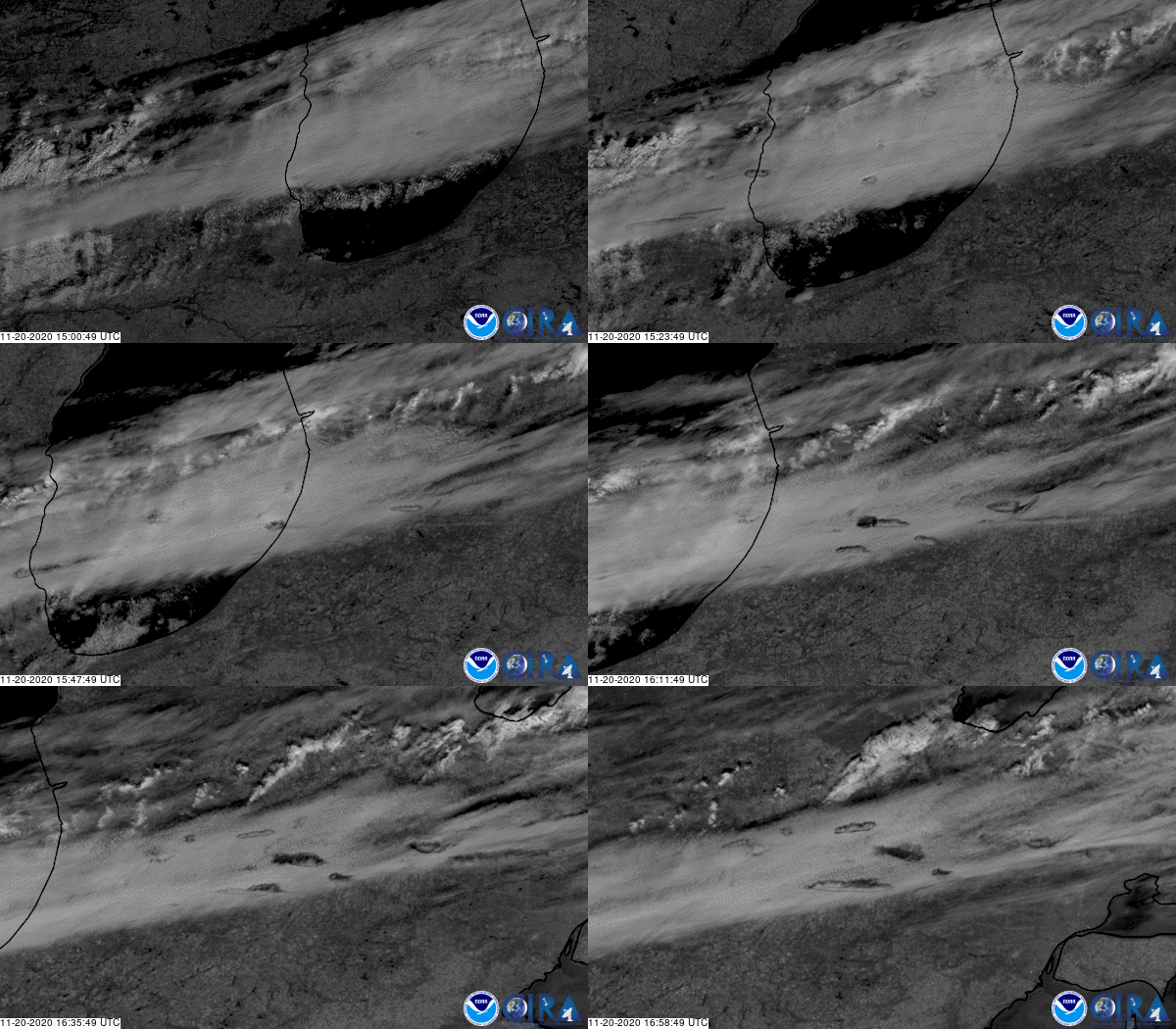
GIF showing GOES East geostationary satellite (GOES 16) capturing fallstreak clouds moving over Michigan. Image credit: NOAA
Research suggests that the way the aircraft enters the cloud will affect the way it looks. When planes pass through the cloud at a more intense sharp angle, the result is a more circular hole punch. If the plane passes at a more shallow angle, it then causes a long line to be cut through the cloud (these are typically known as canal clouds).
These clouds are not as rare as one might think. It all comes to just being at the right place at the right time and of course looking up.
The Sun and the Moon
Sun Information
The month of December sees the Sun reach its southern standstill. If you track the position of sunrise or sunset this month you will find these positions are shifting to the south until December 21, after which it will begin to head back towards its northern standstill. Maximum altitude also changes each day. The Sun’s maximum altitude will shift from 29.4° on December 1, 2025, to 27.9° on December 21, 2025. By December 31, 2025, the Sun will be back up to 28.3°.
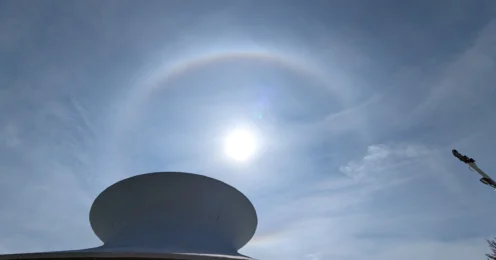
The next major position of the Sun occurs on December 21, 2025, as the Sun reaches the December solstice. Be on the lookout for atmospheric optics such as ice halos around the Sun or Sun pillars above the Sun at sunrise and sunset. Be cautious when looking for these and make sure you do not look directly at the Sun.
Sunrise and Sunset Times for St. Louis Missouri
The sunrise and sunset times below were calculated by the Earth Systems Research Laboratories for NOAA. These times are calculated using equations for Jean Meeus’s Astronomical Algorithms. The atmosphere complicates these calculations due to the refraction of sunlight as it passes through the atmosphere. For the times listed below, the amount of atmospheric refraction is assumed to be 0.833°. Variations in the atmosphere can change the amount of refraction so the times posted are accurate to within a minute for latitudes between +/- 72°. You can learn more about these calculations and where to generate times for areas outside of St. Louis, Missouri by using the buttons below
Moon (daytime views)
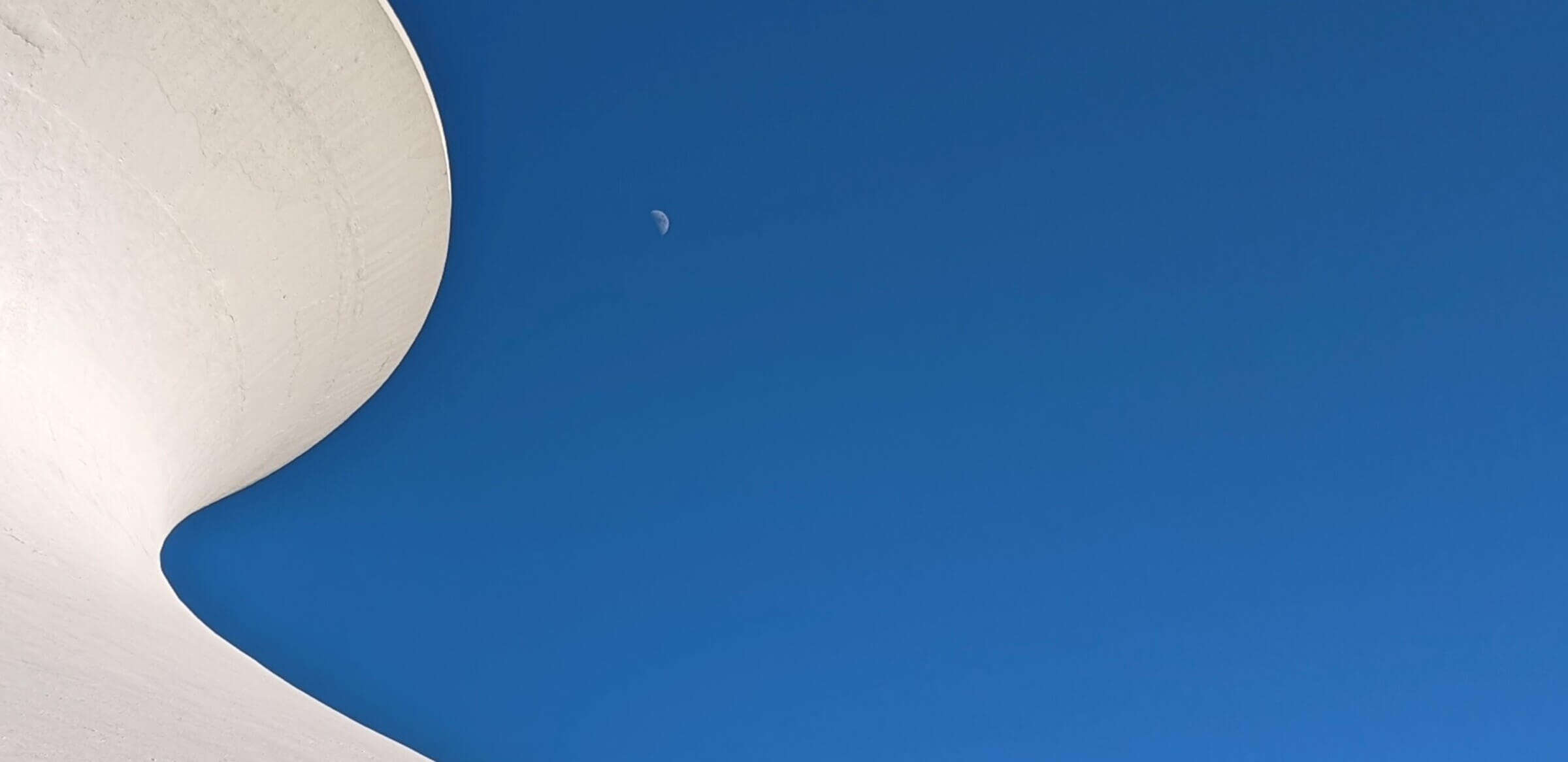
Last quarter moon occurs on December 11, 2025, and first quarter moon occurs on December 27, 2025. The best daytime views of the Moon are always near the quarter phases. Look for the Moon in the morning at the beginning of December. When we are near first quarter phase, look for the Moon in the afternoon.
The Moon crosses the ecliptic at its descending node this month on December 11, 2025, and then at its ascending node on December 25, 2025. This behavior occurs because the Moon’s orbit around Earth is tilted about 5.1° with respect to Earth’s ecliptic. This nodal cycle of the Moon is called a draconic month which 27.2 days long. Being aware of these crossing nodes helps observers know if the Moon will appear south or north of the ecliptic.
Solar Sunday is now held every 3rd Sunday of the month from 11:00 a.m. until 3:00 p.m. (Weather Dependent)
On the third Sunday each month, the St. Louis Astronomical Society and the Saint Louis Science Center will set up a number of safe solar telescopes outdoors and be on-hand to answer your questions. Telescope viewing begins at 11:00 a.m.
The St. Louis Astronomical Society helps host the monthly Star Parties at the Saint Louis Science Center. In addition to our daytime viewings, they also help facilitate our nighttime Public Telescope Viewing. These nighttime viewing sessions occur on the 1st Friday each month. Visit SLAS’s website linked above to learn about other telescope events SLAS hosts around the St. Louis area.
The Day Sky Update is compiled by McDonnell Planetarium staff.
Subjects