This is the Saint Louis Science Center’s DAY SKY UPDATE for the Month of February 2025.
Information updated monthly or as needed.
Times given as local St. Louis time which is Central Standard Time (CST). For definitions of terminology used in the night sky update, click the highlighted text. If relying on times posted in Universal Time (UT), St. Louis is -6 hours when CST. Posted times will also be in the 24-hour format.
Join us for our next solar telescope viewing, Sunday, February 16, 2025, held in association with the St. Louis Astronomical Society. For details, see the information at the bottom of this page or visit
Daytime Astronomy Primer
For most, astronomy is a hobby that is left to the darkness of night. While most astronomical objects are only visible at night, the day sky can offer a careful observer several astronomical targets along with a multitude of atmospheric phenomena to enjoy. When posted, the DAY SKY UPDATE will explore these possibilities which may include a highlight of the month, cloud observing, sun rise/set times, daytime Moon information, daytime planets and other topics. As always, when viewing during daytime, you must use caution as the Sun is always near.
Aside from solar filters, there are other safety steps that you should consider. Sunscreen, hats and sunglasses are always advisable. Visible light is how we observe the world around us, however, there is light we cannot see. Ultraviolet (UV) and infrared (IR) light are great examples of this. While both are an issue if you are using an optical system, UV light is an issue through exposure. This can be mitigated by using sunscreen, sunglasses and limiting exposed skin. While sunglasses are not safe instruments to view the Sun with, they do protect your eyes from exposure to ultraviolet light that we are susceptible to during the day. If you would like to learn more about UV and its dangers use the buttons below.
Cloud of the Month
Thundersnow, an uncommon atmospheric phenomenon, occurred across the Midwest at the beginning of the year. This spectacular weather event combines the familiar elements of a thunderstorm with the magic of snow, creating an exciting and mesmerizing experience for those who witness it. To understand how thundersnow occurs, let’s start off by exploring the basics of thunderstorms.
Thunderstorms are convective storms that form when moist air rises in a conditionally unstable environment. They go through different stages of growth, development, and dissipation. A thunderstorm has reached its final step of development once the top of the towering cumulus starts to look like an anvil. But for thunderstorms to form, it needs to have the right ingredients.
Moisture – Moisture is essential for cloud formation in general, and is typically abundant in warm, humid conditions. Moisture originating from the Gulf of Mexico is what usually fuels storms in the central US.
Lift – Lift will usually come from differences in air density, where warmer, less dense air will rise upward. This can be triggered by warm air rising along a frontal zone, the effect of terrain like mountain slopes, or uneven heating on the surface.
Instability – Air is considered unstable if a parcel of air is forced upwards and continues to rise, or if it continues to sink when given a nudge downward. A combination of cold air aloft and a warm surface will generally produce an unstable atmosphere. As the warm air rises and cools, it becomes less dense, allowing it to continue to rise and fuel the storms development.
A fully developed thunderstorm cloud will have small ice crystals in its upper level, a mixture of ice crystals and hail in the middle layer, and a mixture of hail and water droplets in its lower level. As air rises within a thunderstorm, collisions between water droplets, ice crystals, and hail will generate static electricity. This process separates the charges within the cloud, creating areas of positive and negative energy. When the electrical charge difference becomes large enough, the energy is discharged as lightning. Lightning can occur within a cloud, from one cloud to another, from cloud to ground, or from a cloud to the surrounding air. The sudden discharge will heat up the surrounding air, reaching temperatures five times hotter than the surface of the sun. This extreme heating causes the air to expand rapidly, resulting in the shock wave that gives us the sound of thunder.
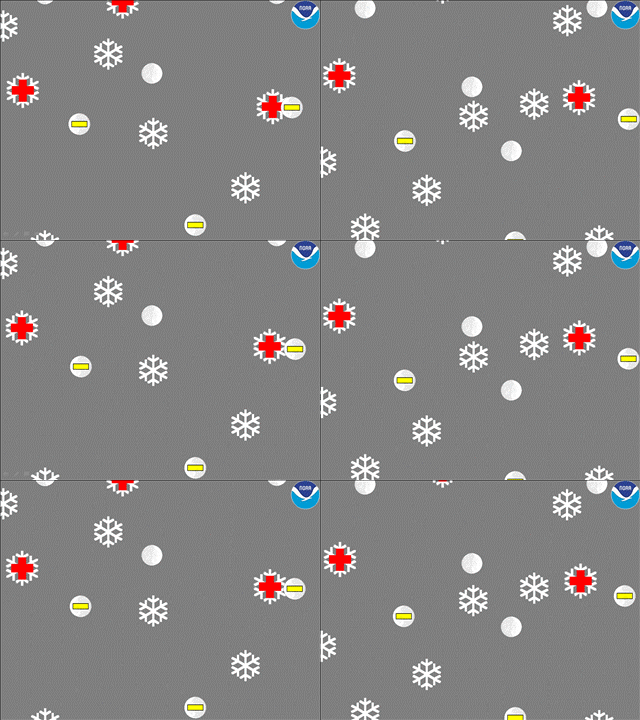
GIF showing how ice crystals with a positive charge are less dense and will float up, while the negatively charged hail is more dense meaning it will fall downward within a cloud. Photo credit: NOAA
Thunderstorms typically thrive in warmer weather during spring and summer when the air is moist and unstable. So how does this process differ when it comes to winter conditions?
Thundersnow forms under similar conditions to regular thunderstorms, with one main difference. Moisture is still essential and in the case during winter, this will often come from large bodies of water like lakes or a nearby ocean. Lift and instability are also still important. Frontal systems and low-pressure systems can provide the lift to continue to build an unstable atmosphere. The one ingredient that is different is the presence of cold air. There needs to be cold air aloft for the precipitation to fall down as snow. All of these conditions allow for the same process of thunderstorms to form but this time with snowfall.
Depending on the vertical temperature profile, if the surface temperature is above freezing, snow will melt as it falls to the surface. During the winter storm at the beginning of January, some areas were experiencing thunder sleet. This occurs when a falling snowflake reaches a patch of above freezing temperatures and starts to melt, it will then fall past a patch of subfreezing temperatures near the surface, and it will refreeze into a tiny ice pellet called sleet.
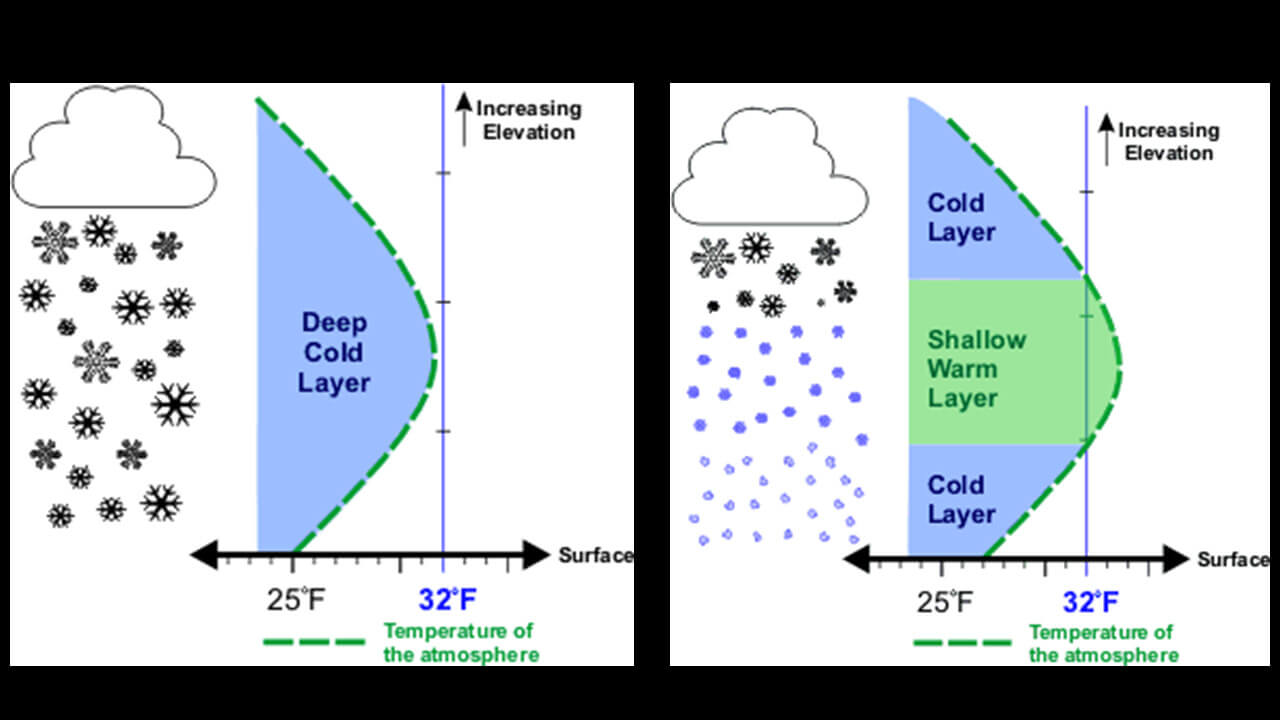
Images showing the vertical temperature profile associated with snow (left) and sleet (right). Photo credit: NWS
Thundersnow events tend to produce intense snowfall, in some cases exceeding 2 inches per hour. This can lead to very dangerous situations like poor visibility and hazardous travel conditions. The lightning that occurs during thundersnow events tends to be cloud to cloud lightning. Snow also absorbs sound very well, which is why thunder during these events tends to sound softer and less like the crackles and rumbles we are so used to.
Lightning and thunder are commonly observed during the warm season, but when the right ingredients come into play, something spectacular can happen. Thundersnow is something that not many people get to experience, and it can be very exciting once you do. They tend to occur in regions such as the great lakes, the great plains, or during nor’easters along the eastern coast. It’s a great reminder that one additional atmospheric condition can turn something very ordinary like thunderstorms into something very unique like thundersnow.
The Sun and the Moon
Sun Information
During February 2025, the Sun will continue its journey back towards its northern standstill later this year in June. If you track the position of sunrise or sunset this month you will find these positions are shifting to the north. Maximum altitude will also change each day as the Sun reaches higher altitudes each day closer to the June solstice. For February 2025, the Sun’s maximum altitude will shift from 34.5° on February 1st, to 43.7° on February 28th. The next major position of the Sun occurs on March 20, 2025, as the Sun reaches the March equinox. On this date, Spring begins in the northern hemisphere and fall begins in the southern hemisphere.
Sunrise and Sunset Times for St. Louis Missouri
The sunrise and sunset times below were calculated by the Earth Systems Research Laboratories for NOAA. These times are calculated using equations for Jean Meeus’s Astronomical Algorithms. The atmosphere complicates these calculations due to the refraction of sunlight as it passes through the atmosphere. For the times listed below, the amount of atmospheric refraction is assumed to be 0.833°. Variations in the atmosphere can change the amount of refraction so the times posted are accurate to within a minute for latitudes between +/- 72°. You can learn more about these calculations and where to generate times for areas outside of St. Louis, Missouri by using the buttons below
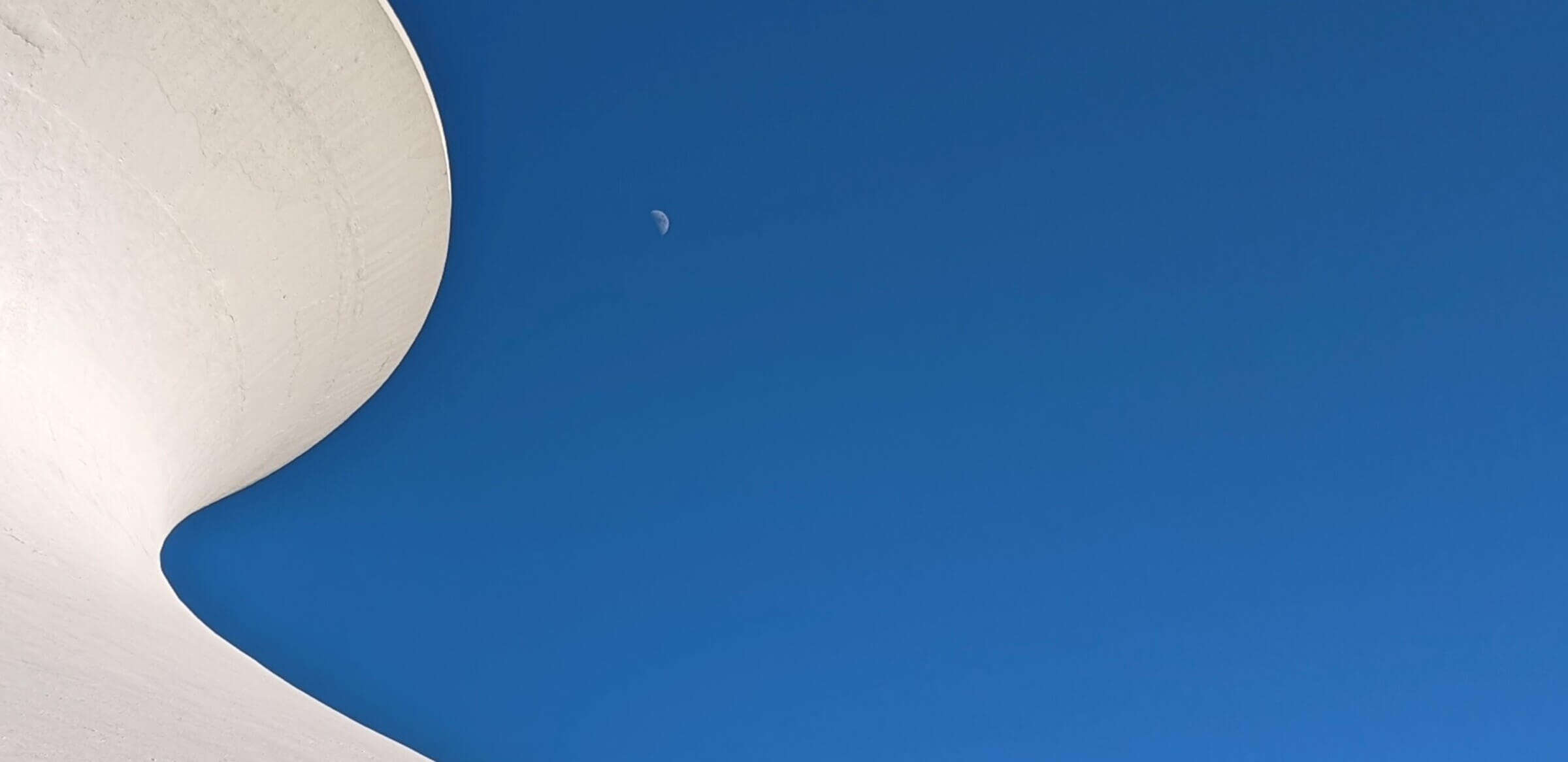
Moon (daytime views)
The Moon is one of the best daytime targets. Throughout most of the synodic month, the Moon can be viewed during the day. There are, however, ideal phases during which the Moon is much easier to find and see. There are only two phases of the Moon during which it is not visible in daytime; these are new moon and full moon. During new moon, the Moon is between Earth and the Sun. The side facing us is not reflecting sunlight and will not be visible. The only time we can see the Moon during new moon is when we see its silhouette during a solar eclipse.
During full moon, daytime views are not possible because the Moon is appearing near the anti-solar point in the sky. Because of this position, the Moon rises while the Sun is setting. The closer the moon is to one of these two phases, the more difficult it is to find it in daytime.
The ideal time to look for the Moon during the day is when the Moon is near a quarter phase. During a quarter phase, the contrast between the Moon and the sky will be good making it easier to find. If the Moon is near first quarter, you should look for it in the afternoon. If it is near last quarter, look for it in the morning. The table below will list the main phases of the Moon for the current lunation.
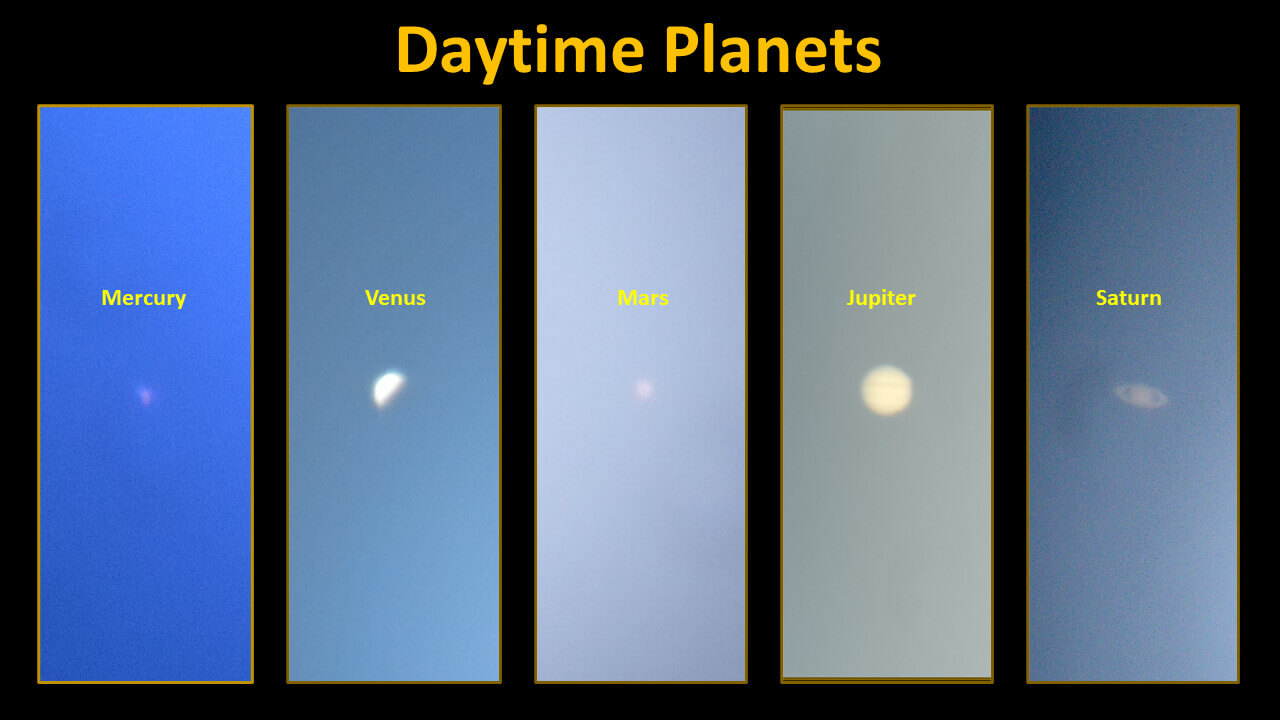
Daytime Planets
Tracking down the planets in the daytime is another great option for daytime astronomy. With the use of a telescope, all five naked planets can be seen in daylight hours. Several factors will impact your success in finding these planets. These include time of day, their elongation from the Sun and viewing conditions. When it is near sunrise or sunset, the contrast between the sky and the planet will be better. Viewing conditions such as seeing or transparency will impact how well you see the planet. And lastly, a planet’s elongation from the Sun is an angular measurement of how far from the Sun we can see the planet. If the planet and Sun appear too close together, the bright glare of the Sun can overwhelm the dimmer planet. Additionally, the closer the planet appears to the Sun, the more dangerous it is to view the planet. As a rule of thumb, many suggest 8° of elongation to be the cutoff. Any closer you risk accidentally looking at the Sun.
I do not recommend attempting to view planets in daytime for someone that is new to telescopes. Due to the inherent dangers in using a telescope during the day, this is an option I suggest reserving for when someone is more experienced in the use of a telescope. Desktop planetarium software can also help you find the position of a planet and what their solar elongation is. I recommend using the free software called Stellarium. Before using telescopes to find daytime planets I recommend using binoculars. Once you figure out the planet’s solar elongation, you can position yourself near a building that blocks the Sun from view. This way there is no chance you will accidentally look at the Sun.
Current planets that are ideal for daytime views this month are Venus and Jupiter.
Venus
Venus is bright enough to easily be seen with binoculars during daytime hours. Its solar elongation will shift from 44.9° on February 1 to 31.0° on February 28. A good way to start looking for Venus is to wait until the Sun is about to set. Trees and buildings will likely block the Sun from view making it safer. Venus will also reach its greatest illuminated extent this month on February 14, 2025. As we approach this date, it may be possible for some to find Venus naked eye during the day.
Jupiter
During daylight hours you will need to use a telescope to spot Jupiter. Jupiter rises between noon and 10 am this month. An ideal time to start looking for Jupiter is after 13:00 (1pm). The higher Jupiter appears in the sky, the more difficult it will be to find the planet due to contrast.
Our next Solar Sunday will be held on Sunday, February 16, 2025, from 11:00 a.m. until 3:00 p.m. (Weather Dependent)
On the third Sunday of each month, the St. Louis Astronomical Society and the Saint Louis Science Center will set up a number of safe solar telescopes outdoors and be on-hand to answer your questions. Telescope viewing begins at 11:00 a.m.
The St. Louis Astronomical Society helps host the monthly Star Parties at the Saint Louis Science Center. In addition to our daytime viewings, they also help facilitate our nighttime Public Telescope Viewing. These nighttime viewing sessions occur on the 1st Friday each month. Visit SLAS’s website linked above to learn about other telescope events SLAS hosts around the St. Louis area.
The Day Sky Update is compiled by McDonnell Planetarium staff.
Subjects