This is the Saint Louis Science Center’s DAY SKY UPDATE for the Month of July 2025.
Information updated monthly or as needed.
Times given as local St. Louis time which is Central Daylight Time (CDT). For definitions of terminology used in the night sky update, click the highlighted text. If relying on times posted in Universal Time (UT), St. Louis is -5 hours when CDT. Additionally, times will be posted in a 24-hour format.
Join us for our next solar telescope viewing, Sunday, July 6, 13, 20 and 27, held in association with the St. Louis Astronomical Society. These viewing sessions are weather dependent. For details, see the information at the bottom of this page or visit
Daytime Astronomy Primer
For most, astronomy is a hobby that is left to the darkness of night. While most astronomical objects are only visible at night, the day sky can offer a careful observer several astronomical targets along with a multitude of atmospheric phenomena to enjoy. When posted, the DAY SKY UPDATE will explore these possibilities which may include a highlight of the month, cloud observing, sun rise/set times, daytime Moon information, daytime planets and other topics. As always, when viewing during daytime, you must use caution as the Sun is always near.
Aside from solar filters, there are other safety steps that you should consider. Sunscreen, hats and sunglasses are always advisable. Visible light is how we observe the world around us, however, there is light we cannot see. Ultraviolet (UV) and infrared (IR) light are great examples of this. While both are an issue if you are using an optical system, UV light is an issue through exposure. This can be mitigated by using sunscreen, sunglasses and limiting exposed skin. While sunglasses are not safe instruments to view the Sun with, they do protect your eyes from exposure to ultraviolet light that we are susceptible to during the day. If you would like to learn more about UV and its dangers use the buttons below.
Observing Highlight
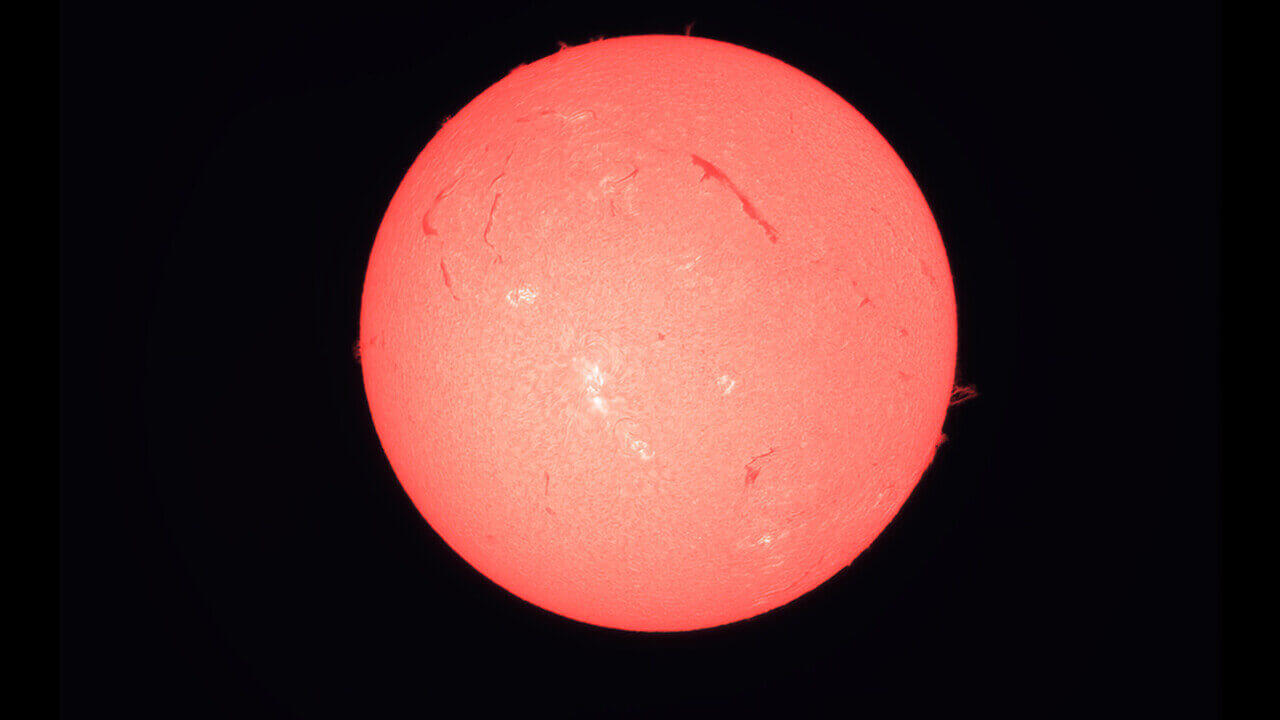
H-alpha image of the Sun captured on June 9, 2025. Image credit: Chris Hanson.
The Sun remains active this year as we are still near solar maximum. For those equipped to safely view the Sun using proper solar filters, it remains one of the most dynamic targets we can enjoy from our backyards. Sunspot activity has been more modest over the last few months, however H-alpha views of the Sun have been spectacular.
H-alpha telescopes are narrowband filters that target the 656nm wavelength of light from the Sun which appears red to us. H-alpha light is emitted through a process in which an electron in a hydrogen atom absorbs energy causing it to jump from its 2nd energy level to a higher one. What level the electron jumps to is dependent on how much energy is absorbed. Eventually, the electron falls back to its 2nd energy level as the electron emits the absorbed energy as a photon. H-alpha light is emitted as the electron falls from its 3rd to 2nd energy level. This behavior occurs in the Sun’s chromosphere where temperatures are much higher than the photosphere below.
There are several solar features visible through H-alpha telescopes. The most common are sunspots, prominence and filaments. Sunspots are not as prominent as they are through white light filters, however, they can still be spectacular. Often surrounding them, you will see brighter material called plage. Prominence and filaments are the same kind of structure but differ in how we see them. Prominence appear as extensions off the limb of the Sun. Filaments appear as dark grey lines on the disk of the Sun. Both features are dense clouds of material suspended above the Sun’s surface by magnetic fields.
In the H-alpha image above, There are a few sunspot groups visible due to the bright plage around them. More prominent are the filaments on the solar disk, and prominence extending off the Sun’s limb. You may also notice the Sun looks granulated or pitted like an orange peel. The structures that give rise to this appearance are called solar granules which are the tops of convective cells.
H-alpha telescopes are not the ideal entry point into safe solar observation; however, they offer some of the best views of activity on the Sun. The features we see with these telescopes are highly dynamic, sometimes evolving in just hours. These filters also provided us with clear evidence of solar flares as they occur. When these huge releases of energy occur, they appear as intense brightening near sunspot groups. The best way to know if what you are seeing is a solar flare, check NOAA’s Space Weather Prediction Center. There you will find a chart showing x-ray flux from the Sun. When a flare occurs, it appears as a sharp spike in the x-ray flux graph.
Always be careful when using solar filters. Make sure to inspect all equipment before using it to ensure it is still in usable condition. If there is ever doubt, it is best to stop using the equipment until you can get more information or recommendations from the manufacturer. The American Astronomical Society has a good primer on solar observing and eye safety. You can find that here.
Cloud of the Month
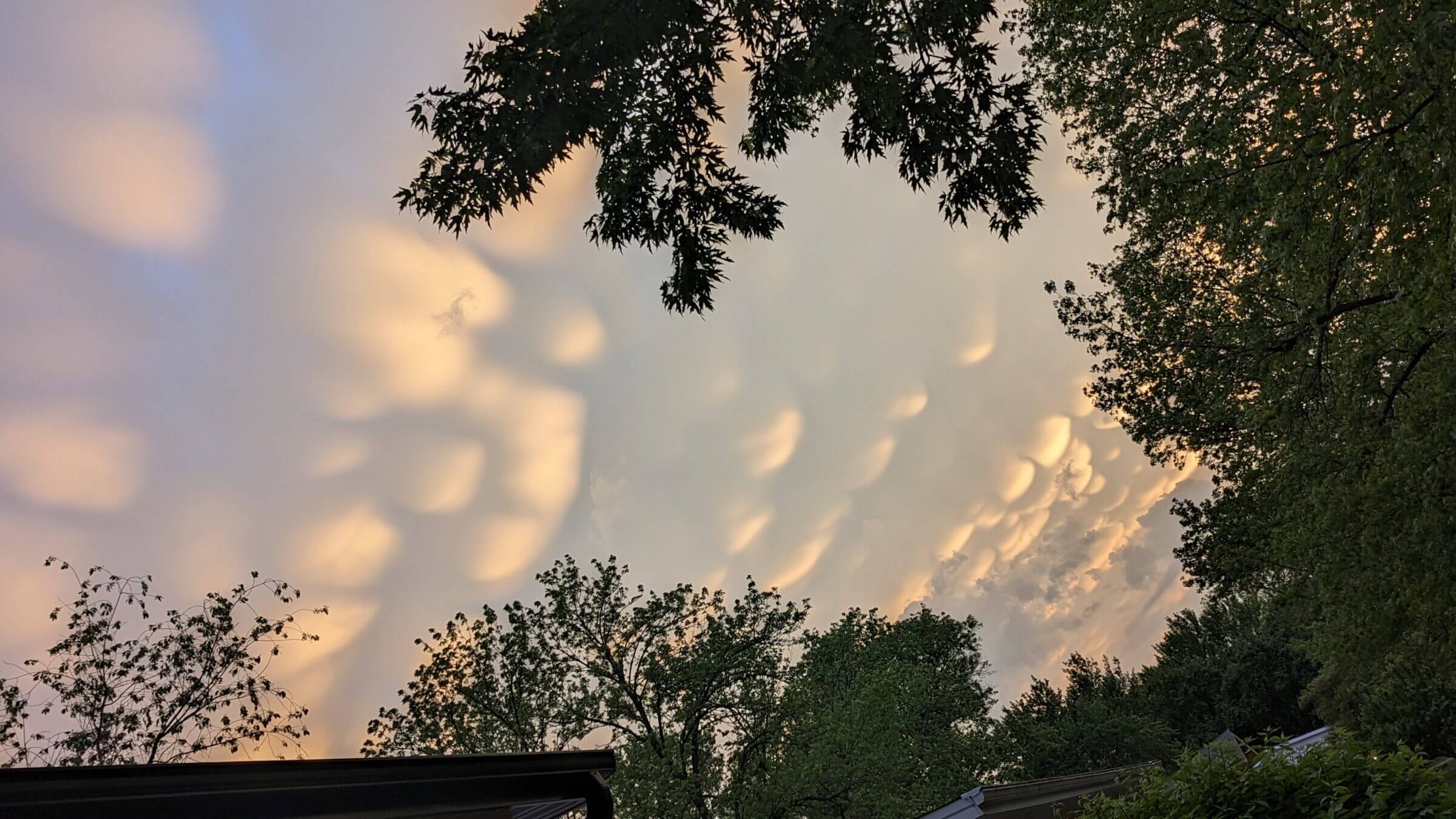
Mammatus clouds seen near St. Louis, Missouri on May 8, 2023. Image credit: Eric Gustafson
On a stormy day, one might look up and see some breathtaking clouds that are drooping down below the cloud base and look like bubbles extending down. These clouds are known as mammatus, and they really show how complex atmospheric fluid dynamics and cloud physics can be.
The Glossary of Meteorology defines mammatus clouds as “hanging protuberances, like pouches, on the underside of a cloud.” They most often occur on the edges and slopping underside (the anvil) of a cumulonimbus cloud but can also form in association with altostratus, altocumulus, cirrus, pyrocumulus (clouds formed from volcanic eruptions or forest fires), and sometimes even contrails. About 43% of mammatus events are associated with thunderstorms, squalls, or cumulonimbus clouds, but that doesn’t mean mammatus clouds are directly related to significant weather events. There is often a misconception that when one sees mammatus clouds, that severe weather is either on the way or has already happened, but that’s not always the case. They have been observed in all types of environments.
Little is still known about the environment, formation, properties, microphysics, and dynamics of mammatus, but there are some features and characteristics that can be helpful with identification. Aside from their very prominent lobes, one will notice that they are not opaque and don’t always form uniformly or in a line. The horizontal dimensions of an individual lobe is on average 1 to 3km in diameter but can get as large as 8km. On average they vertically extend 0.3 to 1.1km down below the cloud base. Some studies also suggest that the horizontal and vertical scales can be nearly equal. Mammatus tend to appear in a local patch under the cumulonimbus anvil but can also spread out over hundreds of kilometers.
Majority of studies suggest that within the lobes, hydrometeors (water or ice particles that are formed from condensation) are comprised mostly of ice particles, and liquid water was not found is large quantities. Microphysical observations inside mammatus are inconsistent because a study done by aircraft penetration inside mammatus clouds showed that water was very prominent inside the lobes. In general, it is believed that they are comprised mostly of ice but may contain liquid water.
The duration of a field of mammatus can range from fifteen minutes up to an hour, while a singular lobe has a lifetime of about ten minutes. A research study from 1906 suggests that mammatus clouds are more likely to occur between 2:00pm and 5:00pm local time. This might be due to the fact that during these times, the sun is illuminating the underside of the clouds, creating that very breathtaking view, making them more visible. Another reason can be related to daytime heating, which is when most cumulonimbus clouds form.
Because of the limited observations, there is a lack of microphysical data to determine the formation and evolution of mammatus clouds. Subcloud (region below the cloud base) evaporation and sublimation (process of a solid turning into a gas) is the most cited mechanism to explain mammatus development. Hydrometeors, whether they are ice crystals, snow aggregates, liquid water, or even a mixture, will fall from a cloud base into saturated air and begin to sublimate and evaporate. Cooling right below the cloud base allows for the saturated lobes to descend. Eventually the lobes will no longer be buoyant and will start to return upward, creating an even more rounded shape.
Although the sight of mammatus clouds doesn’t pose any significant weather threat, their spectacular characteristics and often occurrences raise many scientific questions that challenge our views of cloud microphysics. Further studies could help provide insights into microphysical and dynamical processes occurring within these clouds. So next time you are near a developed cumulonimbus cloud with an anvil, look up and try to identify those bobble-like clouds hanging right underneath it. Of course there doesn’t always have to storms in the area to just look up and start observing.
The Sun and the Moon
Sun Information
The month of July sees the Sun continue towards its southern standstill. If you track the position of sunrise or sunset this month you will find these positions are shifting to the south. Maximum altitude also changes each day. The Sun’s maximum altitude will shift from 74.4° on July 1, 2025, to 69.4° on July 31, 2025.
The next major position of the Sun occurs on September 22, 2025, as the Sun reaches the September equinox. For us in the northern hemisphere, this is the autumnal equinox which signals the start of fall. Through July the world around us will continue to bloom. Dragonflies are active this month as are fireflies once the sun sets.
Sunrise and Sunset Times for St. Louis Missouri
The sunrise and sunset times below were calculated by the Earth Systems Research Laboratories for NOAA. These times are calculated using equations for Jean Meeus’s Astronomical Algorithms. The atmosphere complicates these calculations due to the refraction of sunlight as it passes through the atmosphere. For the times listed below, the amount of atmospheric refraction is assumed to be 0.833°. Variations in the atmosphere can change the amount of refraction so the times posted are accurate to within a minute for latitudes between +/- 72°. You can learn more about these calculations and where to generate times for areas outside of St. Louis, Missouri by using the buttons below
Moon (daytime views)
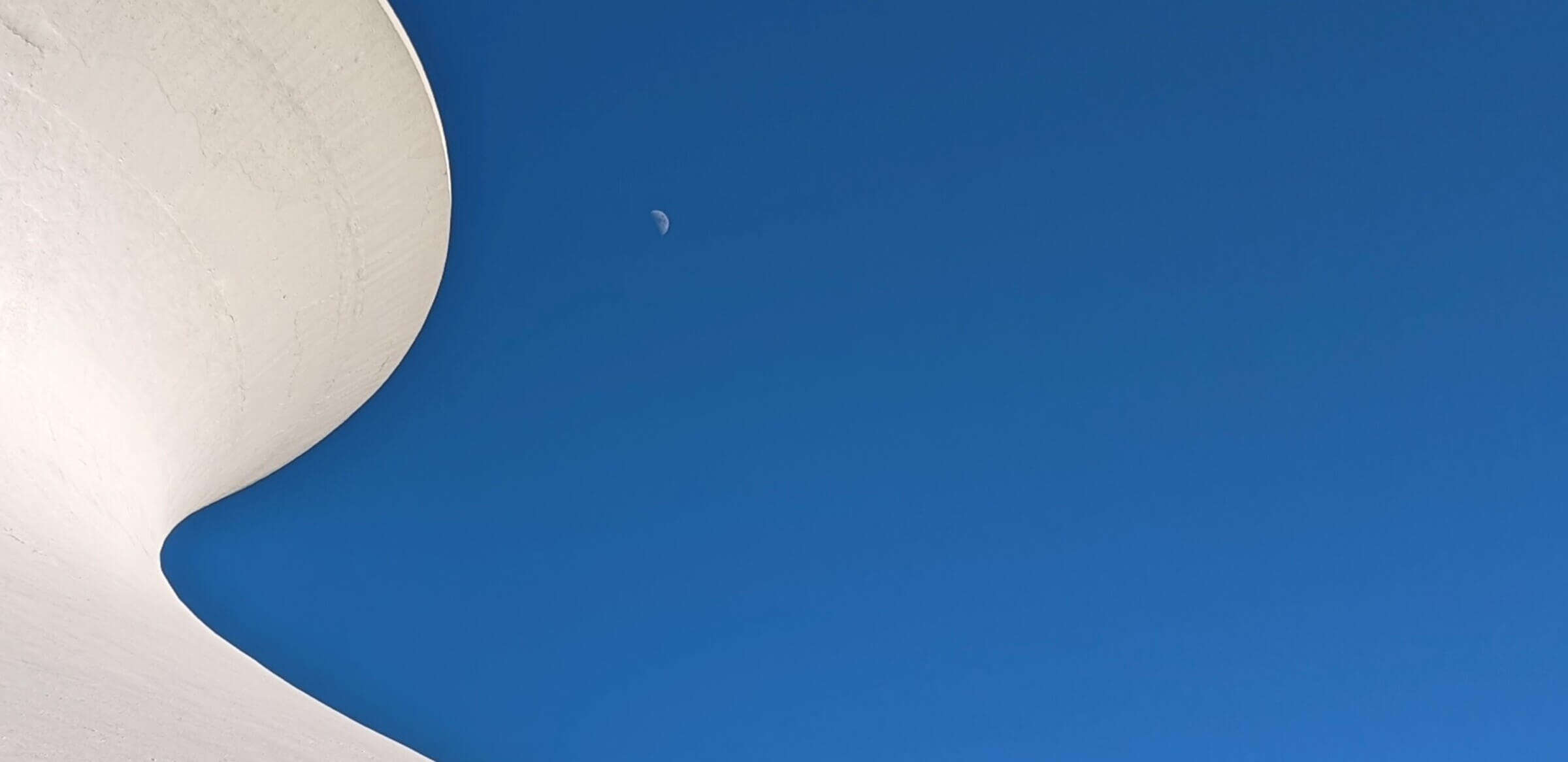
First quarter moon occurs on July 2, 2025, and last quarter moon occurs on July 17, 2025. The best daytime views of the Moon are always near the quarter phases. Look for the Moon in the afternoon at the beginning of July. When we are near last quarter phase, look for the Moon in the morning. The Moon crosses the ecliptic at its ascending node this month on July 15, 2025, and then at its descending node on July 28, 2025. This behavior occurs because the Moon’s orbit around Earth is tilted about 5.1° with respect to Earth’s ecliptic. This nodal cycle of the Moon is called a draconic month which 27.2 days long. Being aware of these crossing nodes helps observers know if the Moon will appear south or north of the ecliptic.
Solar Sunday is now held every Sunday through Labor Day from 11:00 a.m. until 3:00 p.m. (Weather Dependent)
On Sundays through Labor Day, the St. Louis Astronomical Society and the Saint Louis Science Center will set up a number of safe solar telescopes outdoors and be on-hand to answer your questions. Telescope viewing begins at 11:00 a.m.
The St. Louis Astronomical Society helps host the monthly Star Parties at the Saint Louis Science Center. In addition to our daytime viewings, they also help facilitate our nighttime Public Telescope Viewing. These nighttime viewing sessions occur on the 1st Friday each month. Visit SLAS’s website linked above to learn about other telescope events SLAS hosts around the St. Louis area.
The Day Sky Update is compiled by McDonnell Planetarium staff.
Subjects