Day Sky Update March 2026
This is the Saint Louis Science Center’s DAY SKY UPDATE for the Month of March 2026.
Information updated monthly or as needed.
Times given as local St. Louis time which is Central Standard Time (CST) until March 8, 2026, when Day Light Saving Time returns. Once this occurs, times posted will be in Central Daylight Time (CDT). For definitions of terminology used in the night sky update, click the highlighted text. If relying on times posted in Universal Time (UT), St. Louis is -6 hours when CST and -5 hours when CDT. Additionally, times will be posted in a 24-hour format.
Join us for our next solar telescope viewing, Sunday, March 15, held in association with the St. Louis Astronomical Society. These viewing sessions are weather dependent. For details, see the information at the bottom of this page or visit https://www.slsc.org/explore/mcdonnell-planetarium/public-telescope-viewings/
Daytime Astronomy Primer
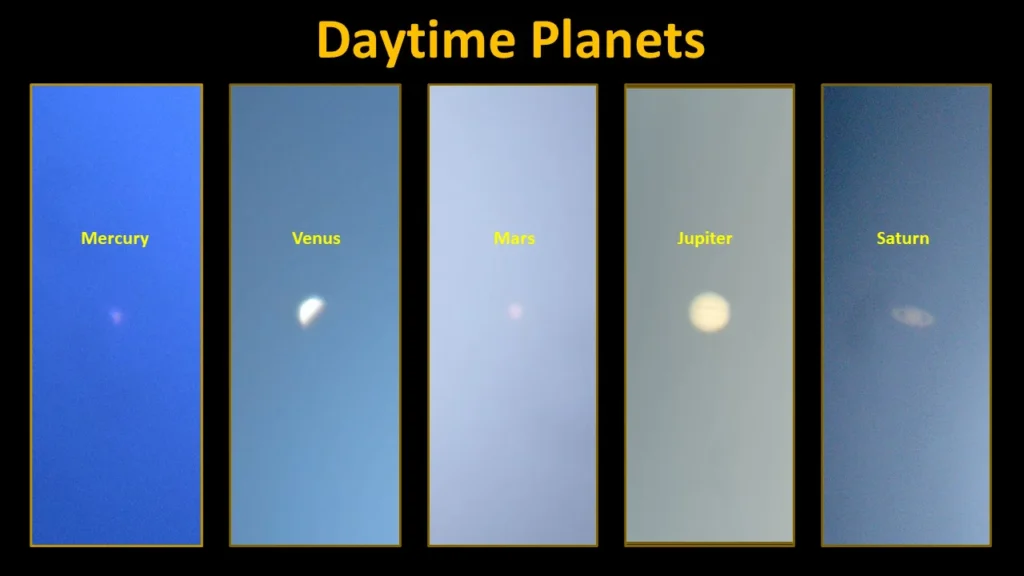
Image shows daytime telescope view of the five naked eye planets. Image credit: Eric Gustafson
For most, astronomy is a hobby that is left to the darkness of night. While most astronomical objects are only visible at night, the day sky can offer a careful observer several astronomical targets along with a multitude of atmospheric phenomena to enjoy. When posted, the DAY SKY UPDATE will explore these possibilities which may include a highlight of the month, cloud observing, sun rise/set times, daytime Moon information, daytime planets and other topics. As always, when viewing during daytime, you must use caution as the Sun is always near.
Aside from solar filters, there are other safety steps that you should consider. Sunscreen, hats and sunglasses are always advisable. Visible light is how we observe the world around us, however, there is light we cannot see such as ultraviolet (UV) and infrared (IR) lights. While both are an issue if you are using an optical system, UV light is an issue through exposure. This can be mitigated by using sunscreen, sunglasses and limiting exposed skin. While sunglasses are not safe instruments to view the Sun with, they do protect your eyes from exposure to ultraviolet light that we are susceptible to during the day.
Observing Highlight
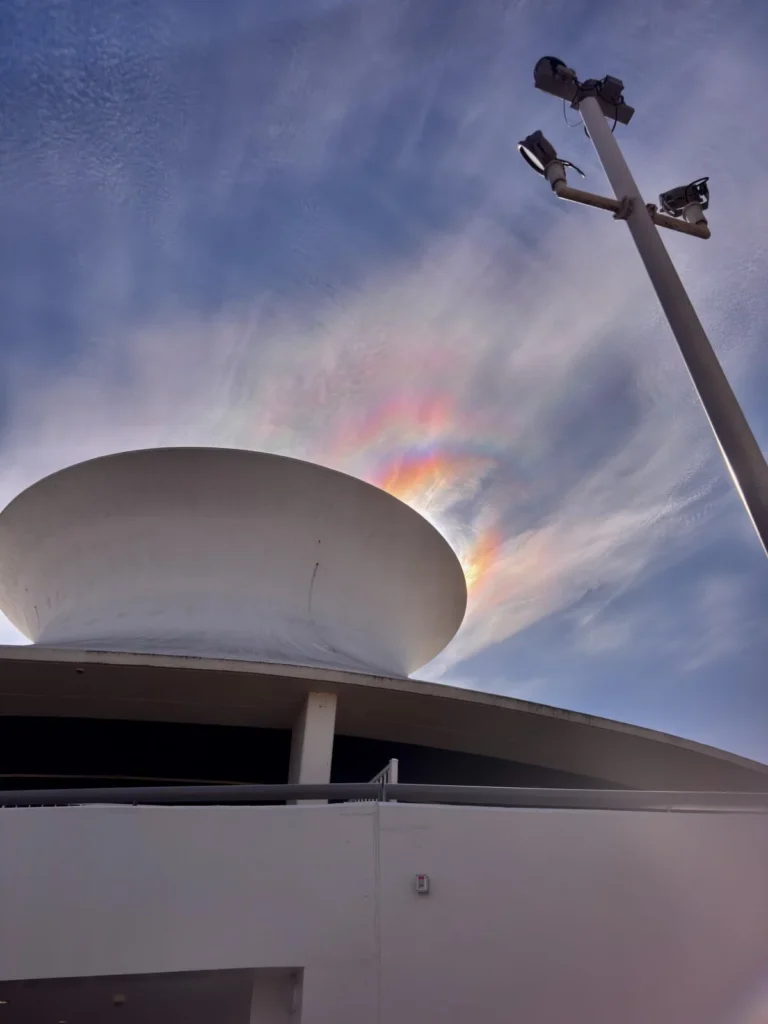
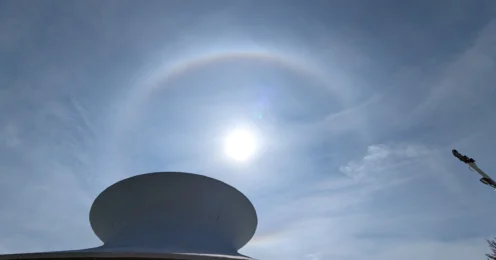
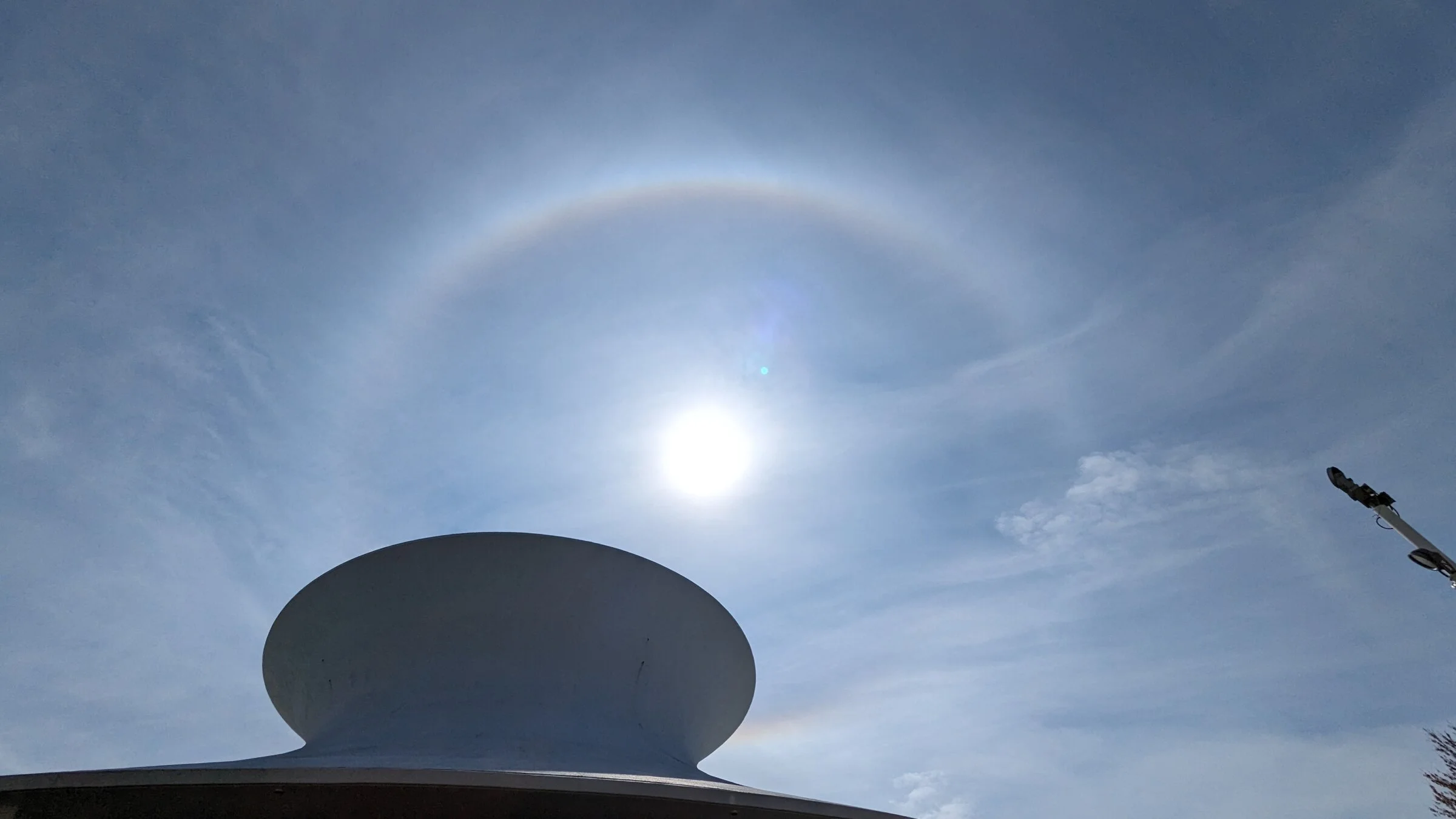
Image showing corona above the James S. McDonnell Planetarium. Image credit: Jessica Amann
Corona
Last month, on February 12th, a stunning atmospheric optic, called a corona, appeared above the James S. McDonnell Planetarium. A solar corona looks like a collection of small pastel rings around the Sun while the central ring, or aureole, is an intense orange and red. A corona may seem similar to a halo, they both form rings around the Sun or Moon, but they are not the same. A corona is much smaller and formed through diffraction of light, while a halo is formed by refraction. The order of the color of rings also varies; A corona’s inner ring past the aureole is blue and the outer ring is red. The colors of a halo’s ring are reversed. To read more about the colors of a corona click here
A corona appears when several small particles in the atmosphere (water droplets, ice crystals, pollen) diffract sunlight or moonlight. Smaller particles will produce larger coronae, but the particles must be uniform in size for the rings to be vibrant. The corona that was imaged has three vibrant rings, but the shape of the ring is elongated. The odd shape is likely because of the quickly changing cloud conditions altering the nature or size of the particles producing the display. When the droplet size changes the corona can become unstructured and lose its shape. It also does not matter if the particles are transparent or opaque, so pollen in the atmosphere can also form a corona. Pollen particles are not always spherical, so the resulting corona is usually an elliptical shape rather than the spherical corona produced by water or ice crystals.
When attempting to view a solar corona, or any other solar phenomenon, make sure to safely shield the sun to avoid any damage to your vision.
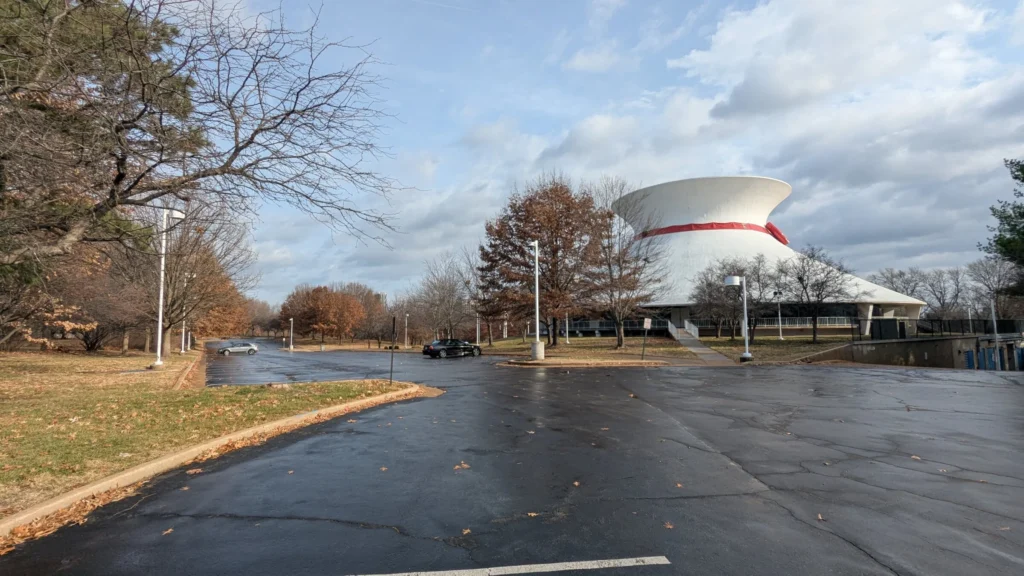
Image showing dew outside the James S. McDonnell Planetarium. Image credit: Eric Gustafson
Dew Point
Towards the end of December, you may have noticed the ground was wet even though it had not rained. This week’s highlight will explore why this occurred through by exploring the topic of dew point.
Dew is the moisture that forms as the result of condensation (water changing from a gas to a liquid) on surface level objects that have temperatures that are below the dew point temperature. An example we can compare this process to is when drops form on the outside of a glass containing a cold drink. But to really understand what’s going on, we must first talk about what dew point temperature is.
Dew point is the temperature at which air needs to be cooled (with no change in pressure) for saturation to occur. It is a direct measure of atmospheric moisture, because of this, the dew point is the best indicator for the water vapor content. When there are high dew points, there is high water vapor content. Low dew point temperatures indicate low water vapor content. It’s also important to remember that warm air can hold more moisture than cool air.
It is beneficial to talk about the relationship between dew point and humidity as well. When the air temperature and dew point temperature are close together, the relative humidity is high, and when they are far apart, the relative humidity is low. When the air temperature and dew point are equal, the air is saturated and relative humidity is 100 percent. But solely paying attention to what the humidity level is outside can be very misleading. If the temperature and dew point are both 25°F, the relative humidity will be 100%, A temperature of 85°F and a dew point of 65°F produces a relative humidity of 51%. It will feel more humid on the 80°F day because it has a higher dew point. If you want to accurately judge how dry or “humid” it feels outside, look at the dew point temperature instead of relative humidity.
We also have to understand a little bit of the diurnal (daily) temperature range and the Earths energy budget (the balance between incoming solar radiation and the outgoing thermal radiation back into space). If there are clouds present, daytime temperatures will be on the lower end since the clouds are blocking and reflecting the shortwave radiation coming from the Sun preventing it from reaching the surface. Nighttime temperatures will be higher because the clouds are trapping in the shortwave infrared radiation emitted from the Earth and radiating it back down. If there are no clouds, daytime temperatures will be warmer since the shortwave radiation coming from the Sun directly reaches the surface. Nighttime temperatures on the other hand will then be cooler due to the fact that there are no obstacles blocking the longwave radiation radiating off the surface back into space, leading to rapid cooling.
Dew is more likely to form on nights that are clear and calm over those that are cloudy and windy. Calm winds prevent warmer air from above to mix down, meaning that the cooler air will stay located near surface level. We had a warm front come into the area recently, which lingered for a couple days making the environmental air warmer than usual. Radiative cooling (the cooling of the Earth’s surface at night) helps the ground and objects on the ground to become much cooler than the surrounding air. The air near the surface will start to cool when it comes into contact with these surfaces. It eventually drops down to the dew point temperature and can’t hold onto any more water vapor. That’s when the water vapor will condense. This is shown by beads of water appearing on vegetation, vehicles, or the ground looking like it just rained inches.
Dew is not rare by any means, especially when you drink a lot of cold drinks. But what’s fun is learning how a lot of these ordinary things happen. Exploring the complexities of science and how it is integrated into our daily lives, and that’s what makes learning and observing so important.
Cloud of the Month
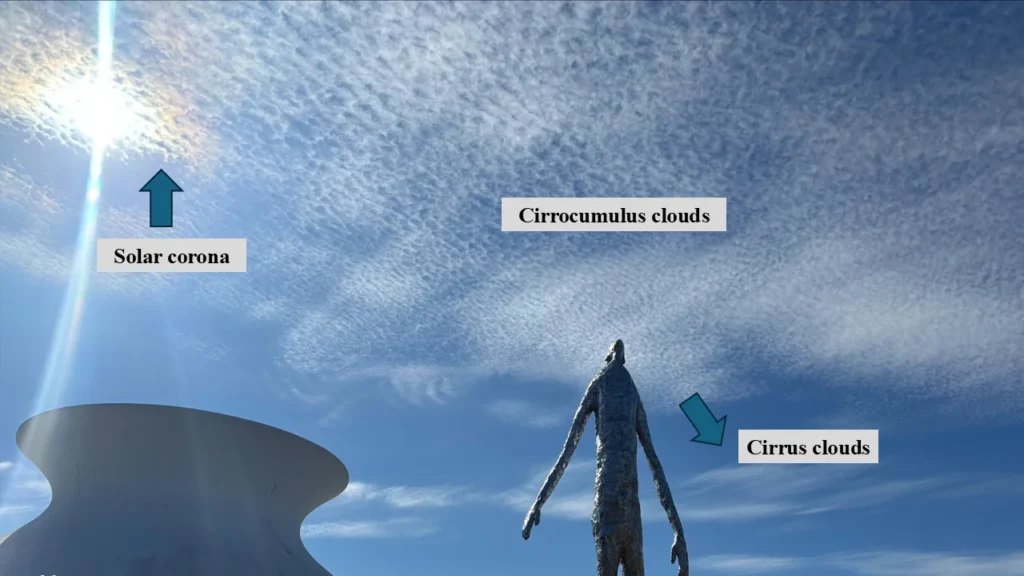
Image showing a solar corona caused by cirrocumulus in the top left, cirrus clouds that most likely formed from the cirrocumulus towards the bottom, and cirrocumulus clouds in the center at the James S McDonnell Planetarium February 12th, 2026. Image credit: Alex Guajardo
One of the major cloud groups are high altitude clouds, which typically form above 16,000 feet from the surface. Because of this, these clouds are comprised of mostly ice crystals which gives them a very distinct look compared to midlevel and low-level clouds. There are 3 major types of high-level clouds, one of them being cirrocumulus. In Latin, cirrus means “curl of hair” and cumulus means “heap”.
When you look at a cirrocumulus cloud, they appear as very small, rounded puffs that can form in patches alone and have no particular pattern, often looking like little grains of rice. You know you are looking at cirrocumulus clouds because each cloudlet will appear no larger than the width of your finger held at arm’s length. Cirrocumulus clouds can also form in rows, making a rippling effect and often given the name “mackerel” sky, resembling the scales of a fish. This happens because of shear, the change in wind speed and/or direction over a certain distance. We see those undulating ripples or waves when the air above and below the cloud layer move at different speeds or directions.
Cirrocumulus clouds are most common in the wintertime and often indicate fair, cool weather. They are also fairly short lived and tend to transition to cirrus and cirrostratus clouds. You’ll often find all three clouds accompanied together or get to see the transition from one cloud to another in just a span of a couple minutes.
Cirrocumulus clouds can also help produce certain atmospheric optics. Under the right conditions, one can see iridescence (little patches or bands of pastel colors), as well as coronas (pastel-colored rings surrounding either the Sun or the Moon). Because cirrocumulus clouds can evolve into cirrus or cirrostratus, one may also get the chance to see what are known as halos, rings or arcs encircling the Sun. Remember when looking up and trying to observe these atmospheric optics, to never look directly at the Sun. Do your best to block the Sun with your hand or use a building as a shield. If you want to learn more about different atmospheric optics, check out this website!
The Sun and the Moon
Sun Information
The month of March sees the Sun continue to head towards its northern standstill later this year in June. The Sun’s maximum altitude will shift from 44.0° on March 1, 2026, to 55.7° on March 31, 2026. The next major position of the Sun occurs on March 20, 2026, as the Sun reaches the March equinox. The March equinox marks the start of spring for the northern hemisphere and with it a return to sever weather season.
The return of Daylight Saving Time occurs this month on Sunday, March 8, 2026, and will run to Sunday, November 1, 2026. When this occurs, Times will be posted in Central Daylight Time (CDT) which is -5 hours from Universal Time (UT).
| March Equinox | March 20, 2026 |
| June Solstice | June 21, 2026 |
| Sept. Equinox | Sept. 22, 2026 |
| Dec. Solstice | Feb. 21, 2026 |
Sunrise and Sunset Times for St. Louis Missouri
The sunrise and sunset times below were calculated by the Earth Systems Research Laboratories for NOAA. These times are calculated using equations for Jean Meeus’s Astronomical Algorithms. The atmosphere complicates these calculations due to the refraction of sunlight as it passes through the atmosphere. For the times listed below, the amount of atmospheric refraction is assumed to be 0.833°. Variations in the atmosphere can change the amount of refraction so the times posted are accurate to within a minute for latitudes between +/- 72°.
| Day | Sunrise (CST)*/(CDT) | Sunset (CST)*/(CDT) |
| 1-Mar | 6:33 | 17:54 |
| 2-Mar | 6:31 | 17:55 |
| 3-Mar | 6:30 | 17:56 |
| 4-Mar | 6:28 | 17:57 |
| 5-Mar | 6:27 | 17:58 |
| 6-Mar | 6:25 | 17:59 |
| 7-Mar | 6:24 | 18:00 |
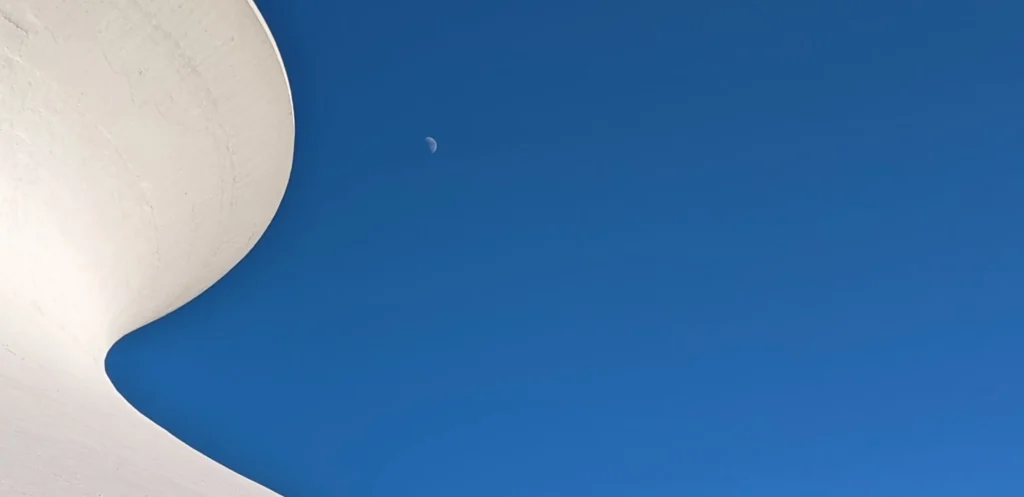
Moon (daytime views)
Last quarter moon occurs on March 9, 2026, and first quarter moon occurs on March 24, 2026. The best daytime views of the Moon are always near the quarter phases. Look for the Moon in the morning at the beginning of March. When we are near first quarter phase, look for the Moon in the afternoon.
The Moon crosses the ecliptic at its descending node this month on March 3, 2026, and then at its ascending node on March 17, 2026. This behavior occurs because the Moon’s orbit around Earth is tilted about 5.1° with respect to Earth’s ecliptic. This nodal cycle of the Moon is called a draconic month which 27.2 days long. Being aware of these crossing nodes helps observers know if the Moon will appear south or north of the ecliptic.
As the Moon reaches its descending node this month, it will also reach it full phase. As a result a total lunar eclipse will occur. While this is not a daytime event, it will be a sight worth waking up for. The eclipse occurring on March 3, 2026, is a total lunar eclipse. To learn more about this eclipse visit the Night Sky Update.
| Phase | Date | Time (CST) |
| Full Moon | March 3, 2026 | 05:38 |
| Last Quarter | March 09, 2026 | 04:39 |
| New Moon | March 17, 2026 | 20:24 |
| First Quarter | March 24, 2026 | 14:18 |
| Full Moon | April 1, 2026 | 21:12 |
Solar Sunday is now held every 3rd Sunday of the month from 11:00 a.m. until 3:00 p.m. (Weather Dependent)
On the 3rd Sunday each month, the St. Louis Astronomical Society and the Saint Louis Science Center will set up a number of safe solar telescopes outdoors and be on hand to answer your questions. Telescope viewing begins at 11:00 a.m.
The St. Louis Astronomical Society helps host the monthly Star Parties at the Saint Louis Science Center. In addition to our daytime viewings, they also help facilitate our nighttime Public Telescope Viewing. These nighttime viewing sessions occur on the 1st Friday each month. Visit SLAS’s website linked above to learn about other telescope events SLAS hosts around the St. Louis area.
Subjects