This is the Saint Louis Science Center’s DAY SKY UPDATE for the Month of November 2025.
Information updated monthly or as needed.
Times given as local St. Louis time which is Central Standard Time (CST) except for November 1, 2025, which is the last day of Central Daylight Time (CDT). For definitions of terminology used in the night sky update, click the highlighted text. If relying on times posted in Universal Time (UT), St. Louis is -6 hours when CST. Additionally, times will be posted in a 24-hour format.
Join us for our next solar telescope viewing, Sunday, November 16, held in association with the St. Louis Astronomical Society. These viewing sessions are weather dependent. For details, see the information at the bottom of this page or visit
Daytime Astronomy Primer
For most, astronomy is a hobby that is left to the darkness of night. While most astronomical objects are only visible at night, the day sky can offer a careful observer several astronomical targets along with a multitude of atmospheric phenomena to enjoy. When posted, the DAY SKY UPDATE will explore these possibilities which may include a highlight of the month, cloud observing, sun rise/set times, daytime Moon information, daytime planets and other topics. As always, when viewing during daytime, you must use caution as the Sun is always near.
Aside from solar filters, there are other safety steps that you should consider. Sunscreen, hats and sunglasses are always advisable. Visible light is how we observe the world around us, however, there is light we cannot see. Ultraviolet (UV) and infrared (IR) light are great examples of this. While both are an issue if you are using an optical system, UV light is an issue through exposure. This can be mitigated by using sunscreen, sunglasses and limiting exposed skin. While sunglasses are not safe instruments to view the Sun with, they do protect your eyes from exposure to ultraviolet light that we are susceptible to during the day. If you would like to learn more about UV and its dangers use the buttons below.
Cloud of the Month
Cloud of the month has always been about looking up, learning, recognizing, and understanding the clouds we see. This month’s cloud really emphasizes how important it is to look up and observe, because coming together can lead to a new cloud classification. This cloud is called asperitas which comes from the Latin word meaning roughness and it’s described as looking like the rough sea underneath the cloud base.
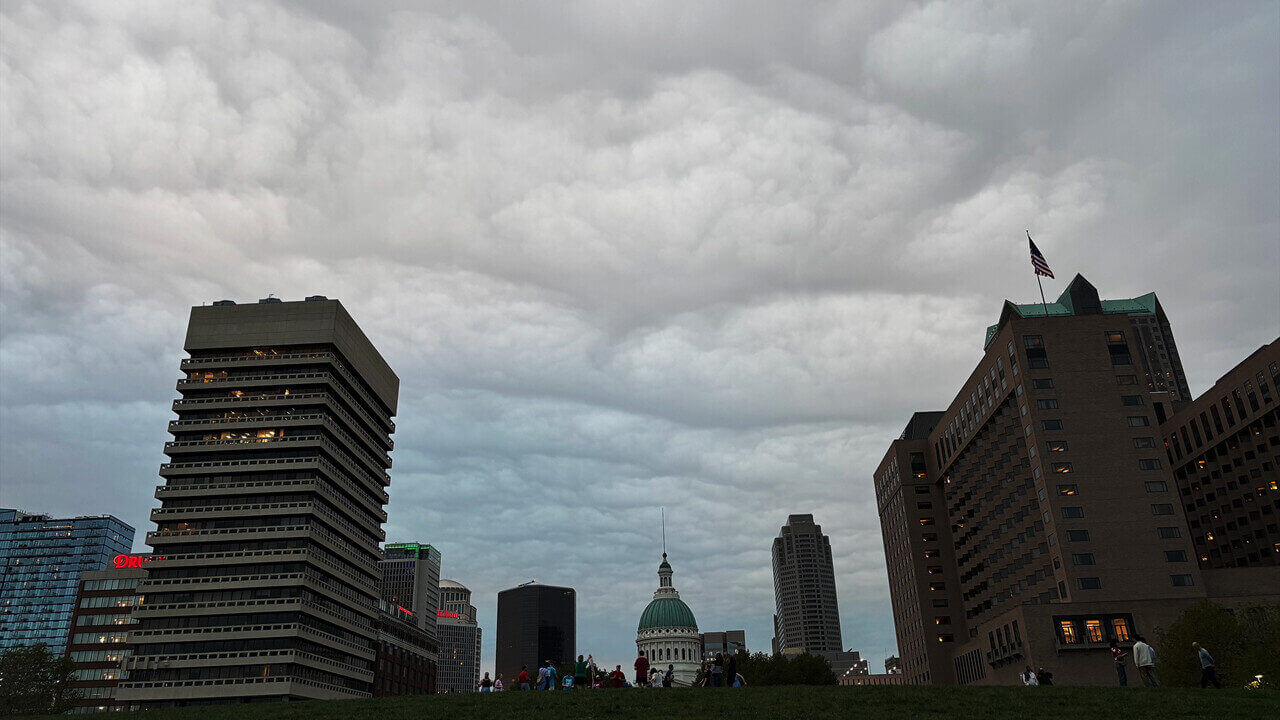
Image showing gravity waves and turbulence caused by asperitas clouds in downtown St Louis October 10, 2025. Image credit: Alex Guajardo
It all started when founder of the Cloud Appreciation Society, Gavin Pretor-Pinney received his first photo of this rough wave looking cloud from a woman in Cedar Rapids, Iowa in 2008. People from all around the world continued to upload their photos to the CAS’s website photo gallery, and Gavin knew he had to do something about it. He went to the Royal Meteorological Society in England to fight for this cloud’s classification but was told he had to go to the World Meteorological Organization.
Gavin got in touch with Professor Giles Harrison from the University of Reading to start learning more about the cloud and see if they could figure out how it forms. It’s still a mystery to this day but it is most likely due to turbulence that intervenes with an already existing cloud, which for most cases is going to be an altocumulus or stratocumulus cloud.
This turbulence comes from gravity waves (think of throwing a rock into a body of water causing ripples). These are vertical waves in the atmosphere that are created by a trigger mechanism that forces an air parcel to rise but because the environment is stable, the air parcel will sink back down. This causes the clouds to oscillate up and down giving it that very distinctive turbulent ocean appearance.
They look ominous and will sometimes be mistaken for mammatus clouds since they both appear to be sinking from the bottom of their cloud base but seeing them does not mean severe weather is on the way. They are pretty short lived, only lasting between 10 to 20 minutes. And just like any other cloud, asperitas clouds can look very different and take on many characteristics. Sometimes the gravity waves are more dramatic, causing a droopier oscillating appearance. In other instances, the turbulence stands out more, causing the clouds to look more choppy and messy.
The asperitas cloud was officially recognized in 2017 by the World Meteorological Organization and was the first new cloud formation to be added to the International Cloud Atlas since 1951.
This is a great reminder to show that citizen science is very important to take part in because we can continue to learn and advance our understanding of what’s around us. Continue looking up, continue taking pictures, and continue learning. Asperitas clouds are there to help us remember that.
Giles Harrison, the lead professor of the research team said, “The sky is often full of clues to weather changes, and asperitas provides distinctive visualization of complex turbulent air motions in the lower atmosphere.”
The Sun and the Moon
Sun Information
The month of November sees the Sun continues towards its southern standstill. If you track the position of sunrise or sunset this month you will find these positions are shifting to the south. Maximum altitude also changes each day. The Sun’s maximum altitude will shift from 36.7° on November 1, 2025, to 29.6° on November 30, 2025.
Daylight Saving Time ends this month on November 2, 2025, returning us to Daylight Standard Time. Once this occurs, Those of us in the Central Time Zone will shift to Central Standard Time (CST) which is -6 hours from Universal Time (UT). If you do not live in the Central Time Zone, Time and Date has a useful converter to calculate your time difference from UT. You can find that here.
The next major position of the Sun occurs on December 21, 2025, as the Sun reaches the December solstice. For us in the northern hemisphere, this is the winter solstice which signals the start of winter. Be on the lookout for Orb Weaver spiders, leaves changing color and the presence of frosts in the mornings.
Sunrise and Sunset Times for St. Louis Missouri
The sunrise and sunset times below were calculated by the Earth Systems Research Laboratories for NOAA. These times are calculated using equations for Jean Meeus’s Astronomical Algorithms. The atmosphere complicates these calculations due to the refraction of sunlight as it passes through the atmosphere. For the times listed below, the amount of atmospheric refraction is assumed to be 0.833°. Variations in the atmosphere can change the amount of refraction so the times posted are accurate to within a minute for latitudes between +/- 72°. You can learn more about these calculations and where to generate times for areas outside of St. Louis, Missouri by using the buttons below
Moon (daytime views)
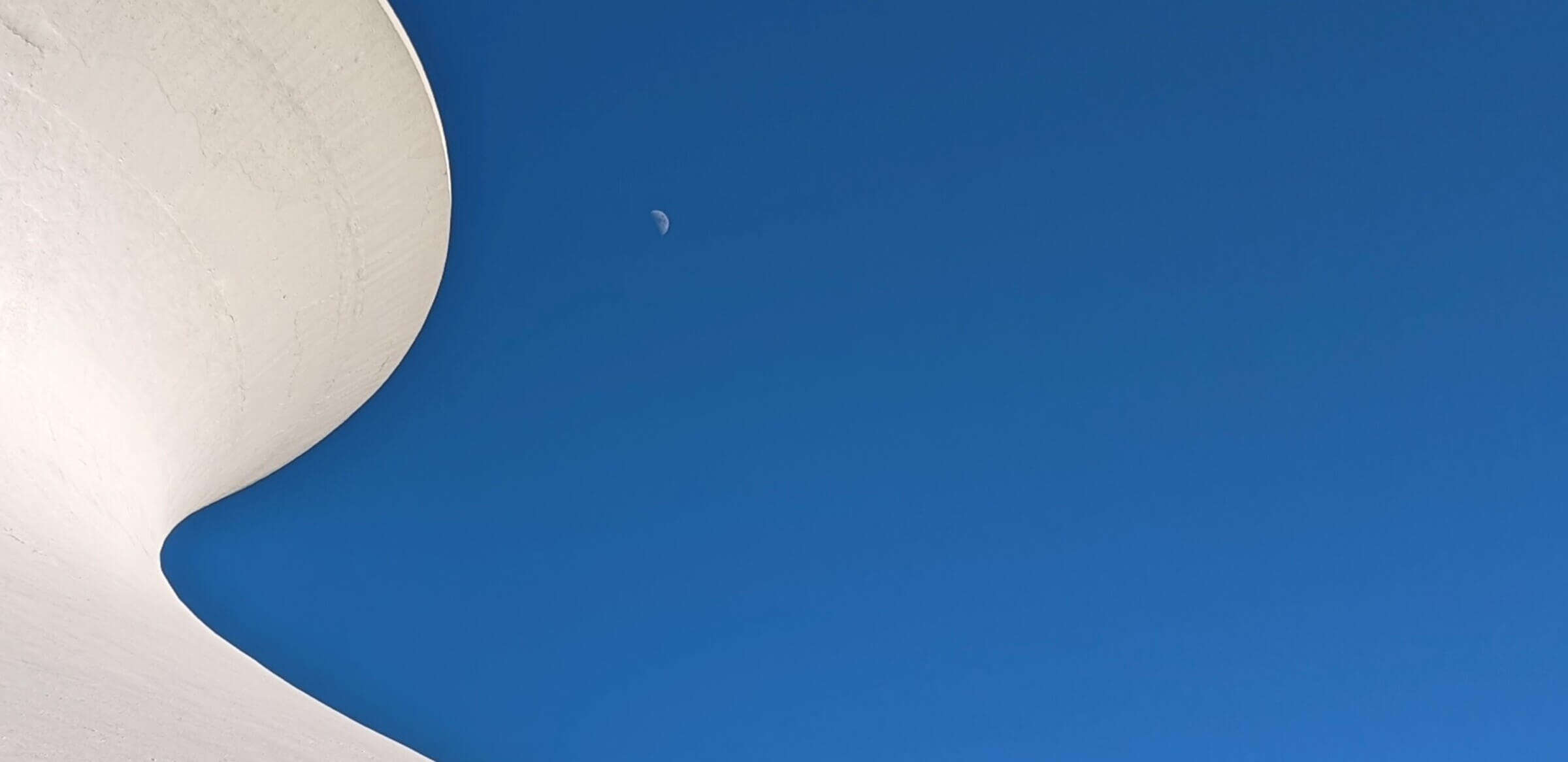
Last quarter moon occurs on November 11, 2025, and first quarter moon occurs on November 28, 2025. The best daytime views of the Moon are always near the quarter phases. Look for the Moon in the morning at the beginning of November. When we are near first quarter phase, look for the Moon in the afternoon. The Moon crosses the ecliptic at its ascending node this month on November 1, 2025, and then at its descending node on November 14, 2025. The Moon returns to its ascending node on November 28, 2025. This behavior occurs because the Moon’s orbit around Earth is tilted about 5.1° with respect to Earth’s ecliptic. This nodal cycle of the Moon is called a draconic month which 27.2 days long. Being aware of these crossing nodes helps observers know if the Moon will appear south or north of the ecliptic.
Solar Sunday is now held every 3rd Sunday of the month from 11:00 a.m. until 3:00 p.m. (Weather Dependent)
On the third Sunday each month, the St. Louis Astronomical Society and the Saint Louis Science Center will set up a number of safe solar telescopes outdoors and be on-hand to answer your questions. Telescope viewing begins at 11:00 a.m.
The St. Louis Astronomical Society helps host the monthly Star Parties at the Saint Louis Science Center. In addition to our daytime viewings, they also help facilitate our nighttime Public Telescope Viewing. These nighttime viewing sessions occur on the 1st Friday each month. Visit SLAS’s website linked above to learn about other telescope events SLAS hosts around the St. Louis area.
The Day Sky Update is compiled by McDonnell Planetarium staff.
Subjects