This is the Saint Louis Science Center’s NIGHT SKY UPDATE for the week of Friday, April 10, 2026
Information updated weekly or as needed.
Times given as local St. Louis time this week will be in Central Daylight Time (CDT). For definitions of terminology used in the night sky update, click the highlighted text. If relying on times posted in Universal Time (UT), St. Louis is -5 hours when CDT. Times posted in the Night Sky Update are in the 24-hour format.
Join us for our next star party, Friday, May 1, 2026, held in association with the St. Louis Astronomical Society. For details, see the information at the bottom of this page or visit https://www.slsc.org/explore/mcdonnell-planetarium/public-telescope-viewings/
Observing Highlight
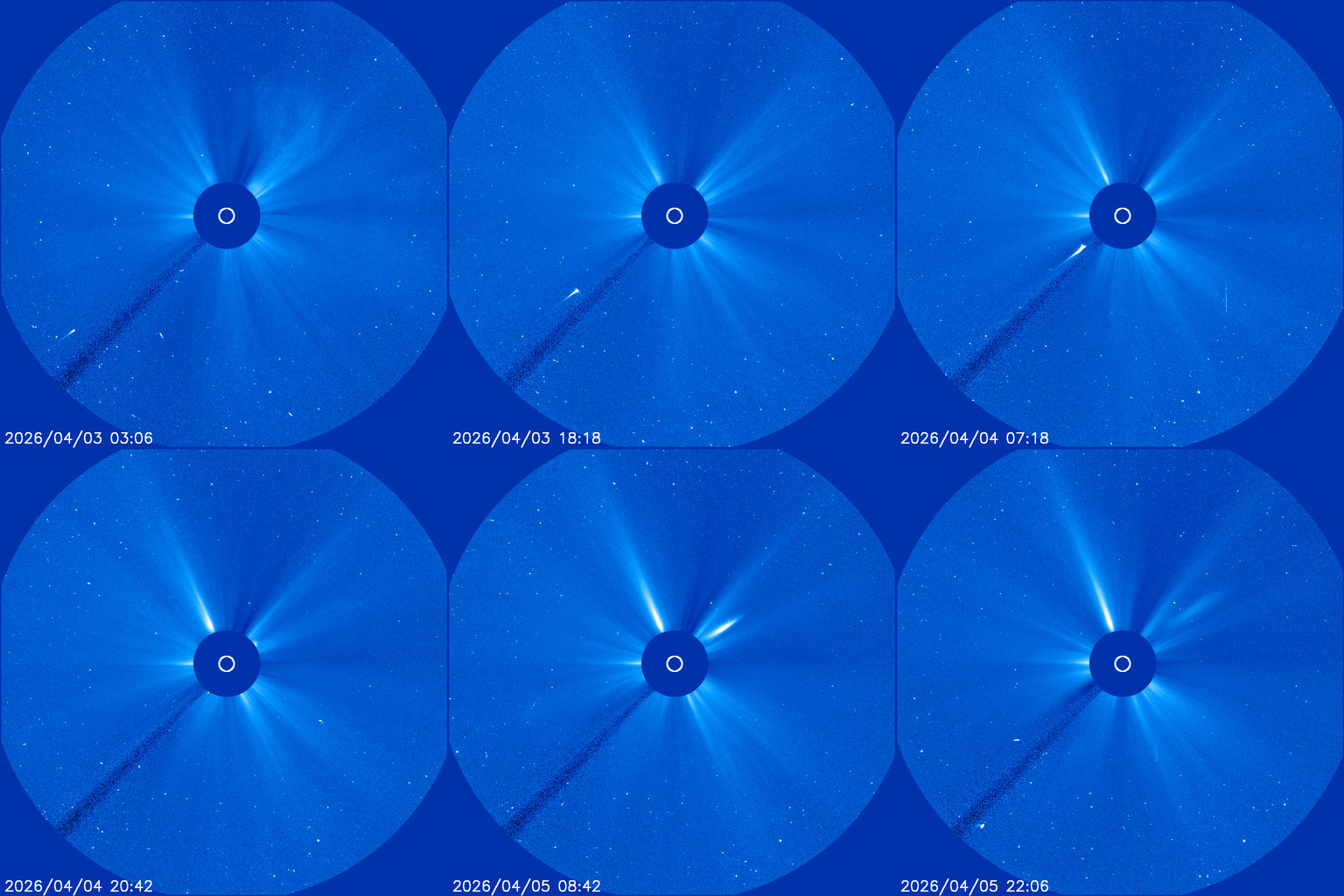
View of comet C/2026 A1 (MAPS)’s demise captured by SOHO’s LASCO 3 coronagraph. In the GIF you can see the comet suddenly brighten which is likely when it broke apart and disintegrated. Image credit: NASA, ESO
Unfortunately, comet C/2026 A1 (MAPS) did not pan out to be the comet of the year many hoped it would be. For anyone new to comet observing, this is a lesson we all learn at some point. Comets often get hyped early on but end up under performing relative to the hype. Even the mighty comet 1P/Halley (Halley’s Comet) which has recorded observations dating back to 240 BCE, was a disappointment during its last apparition in 1986.
If you haven’t heard yet, comet C/2026 A1 (MAPS) broke apart and disintegrated as it approached perihelion on April 4, 2026. This fate became more likely once it was understood that the comet was much smaller than initial estimates. If you look at the GIF posted above, you can see the comet underwent a sudden brightening which was likely the moment that comet started to break apart. Even though C/2026 A1 (MAPS) failed to become the bright comet we hoped for, it was still fun to watch on the coronagraphs aboard GOES-19 and SOHO.
Which brings me to the next comet on the hype train; comet C/2025 R3 (PANSTARRS). This comet was discovered in September 2025 by the Pan-STARRS survey telescope in Hawaii. Early estimates suggested this visitor from the Oort Cloud would have a peak magnitude between 6 and 8. Now closer to its date of perihelion on April 19, 2026, C/2025 R3 (PANSTARRS) will likely peak around magnitude 3 or 4 putting it within naked eye visibility for those observing from a dark location.
Because this comet is passing between the Sun and Earth on April 19, it is possible that forward scattering of sunlight by dust from the comet could cause its peak magnitude to be brighter.
Our best chance to view comet C/2025 R3 (PANSTARRS) will be over the next week. The comet is currently passing through the constellation Pegasus which can be found rising in the east around 5 am. Unfortunately, this coincides with the start of astronomical twilight which will impact our chance of finding the comet. Around 5 am, C/2025 R3 (PANSTARRS) will be found about 10° above the horizon through April 16. Past this date, the comet will appear lower to the horizon each day as it approaches perihelion on April 19.
On April 19, 2026, comet C/2025 R3 (PANSTARRS) will be about 10° above the eastern horizon around 05:35. Nautical twilight will just be starting which will make finding the comet difficult. Its low altitude will also prove challenging unless you have clear views of the eastern horizon. By the start of May, comet C/2025 R3 (PANSTARRS) will have shifted to the evening sky but will be much too low for us to find from St. Louis.
Only time will tell how good comet C/2025 R3 (PANSTARRS) will be. Its current magnitude is estimated to be about 5.6. It is possible the comet will brighten enough for us to easily find in binoculars from a light polluted location like St. Louis. If you are willing to travel somewhere dark, the comet could become naked eye visible. With comets, always be dubious of the hype. Articles are already popping up describing this as a “rare comet” or a “naked eye comet.” It is good to be excited but always be a little skeptical when come to comets.
Comet Resources
Comet Observation Database (COBS)
T CrB Nova Update 4/10/2026
f you are still interested in seeing the recurrent nova T Coronae Borealis, there is still hope. The nova has not yet occurred meaning we are in a waiting game. If you are still interested, the part of the sky the nova will appear in is found rising in the east by 10 pm. The star system T Coronae Borealis is found in the constellation Corona Borealis which looks like a small U-shape of stars next to the constellation Boötes.
By 3 am the location of T CrB will be nearly overhead. Besides observing the sky directly, you can track the behavior of T CrB by checking current magnitude estimates posted at AAVSO here or by visiting spaceweather.com. Current magnitude estimates of the system show it at 10th magnitude.
The Sun and Moon
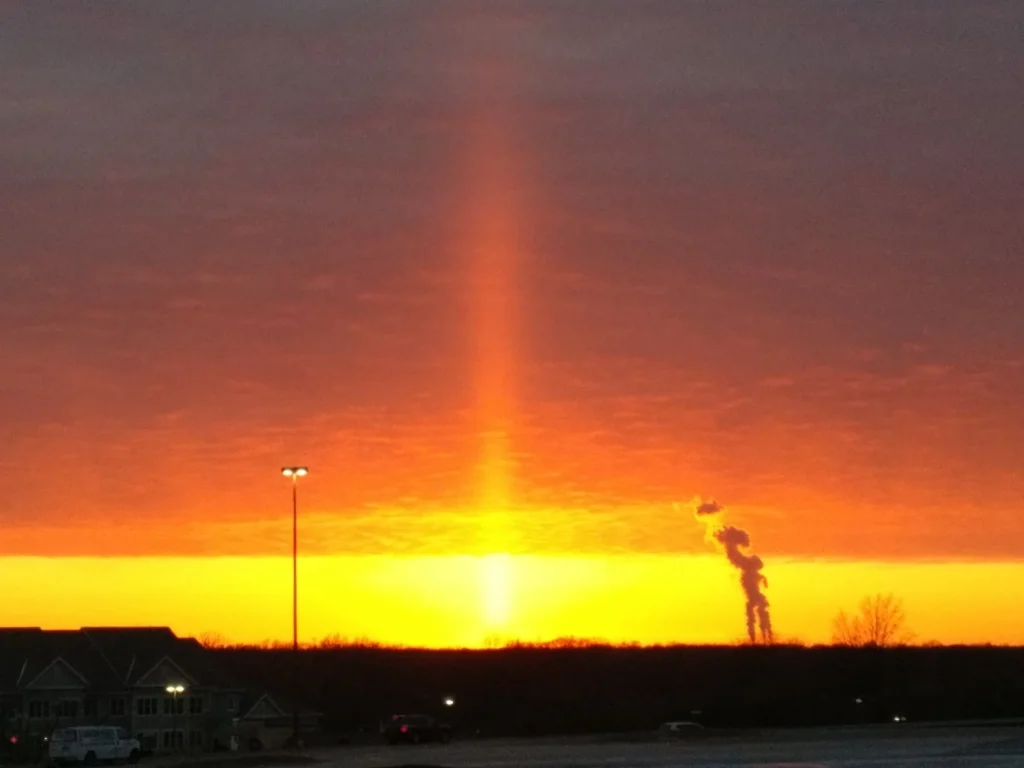
Sun
Sunrise on Friday, April 10 is at 06:32 and sunset is at 19:33 providing about 13 hours of daylight. Even after sunset, light from the Sun will dimly illuminate our sky for about 1 hour and 40 minutes. This period is called twilight, which ends around 21:07 this week. For those with a sundial, local noon occurs around 13:03 on April 10, 2026.
| Day | Sunrise (CDT) | Sunset (CDT) |
| 10-Apr | 6:32 | 19:33 |
| 11-Apr | 6:30 | 19:34 |
| 12-Apr | 6:29 | 19:35 |
| 13-Apr | 6:27 | 19:36 |
| 14-Apr | 6:26 | 19:37 |
| 15-Apr | 6:24 | 19:38 |
| 16-Apr | 6:23 | 19:39 |
| 17-Apr | 6:22 | 19:39 |
| 18-Apr | 6:20 | 19:40 |
Moon
Moonrise for Friday, April 10, is at 02:54 and moonset occurs at 12:18. On April 10, 2026, the Moon will exhibit a waning crescent phase with 44% disk illumination. By April 18, 2026, the Moon will exhibit a waxing crescent phase with 3% disk illumination. New moon occurs on April 17, 2026, at 06:52.
International Space Station (ISS) Observing
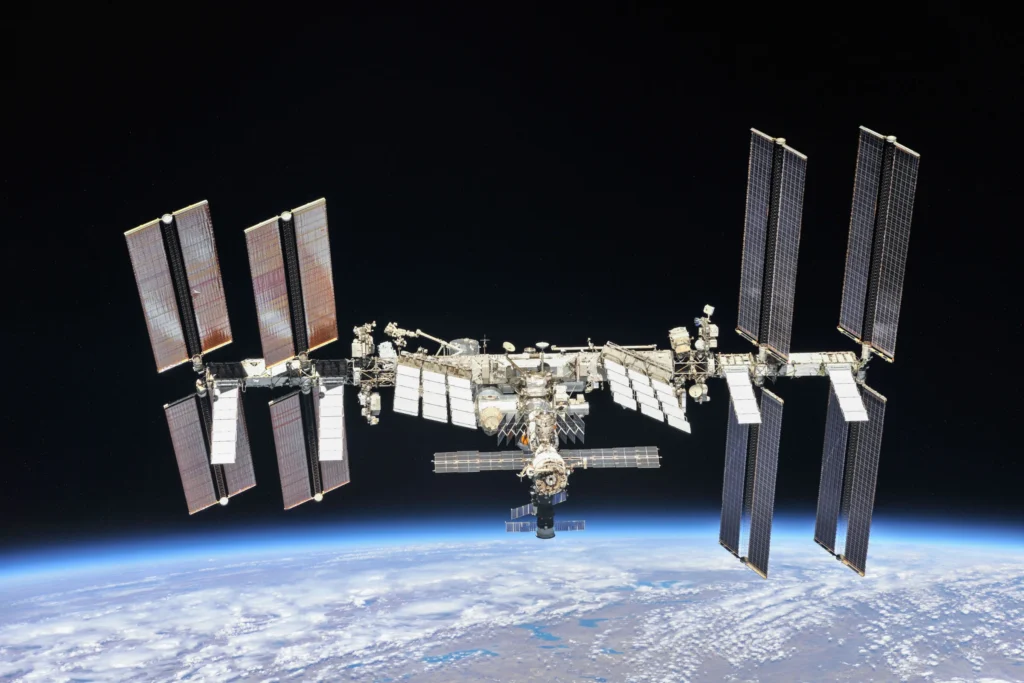
Visible passes of ISS from St. Louis for the week of April 10 occur during morning hours with the best passes occurring on April 15 and 17. You can find information about these and other satellite pass at https://heavens-above.com. If you are not viewing from the St. Louis area, make sure to change your viewing location for your local times.
Visible Planets
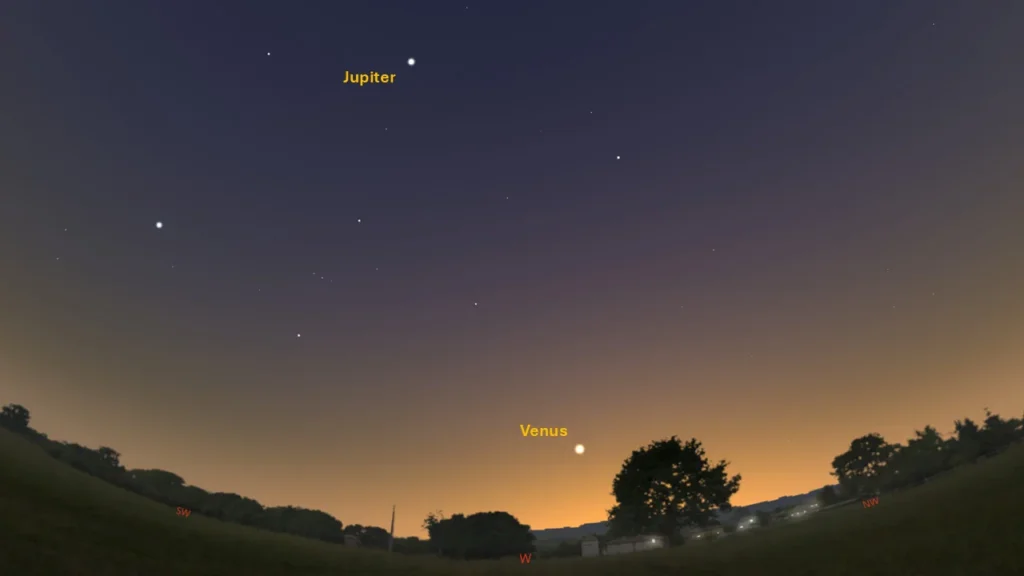
View looking west on April 10,2026, at 20:00. Image created using Stellarium
Two naked eye planets will be visible this week. Jupiter will be found high in the west and Venus low in the west after sunset. Mars and Saturn are starting to climb out of the glare of the Sun before sunrise. By May, we should start seeing them in the east before sunrise.
Venus
Venus can now be seen low in the west after sunset. Its current evening apparition will continue until October as it approach inferior conjunction on October 23, 2026.
Jupiter
Jupiter will be visible high in the west about 30 minutes after sunset, Jupiter remains visible until 1 am at which time its low altitude will make it difficult to find for some viewers. Jupiter’s current apparition continues through June and some of July as it heads towards superior conjunction on July 29, 2026.
Our next Star Party will be held on Friday, May 1, 2026.
On the first Friday of each month, the St. Louis Astronomical Society and the Saint Louis Science Center will set up a number of telescopes outdoors and be on hand to answer your questions. Telescope viewing begins once it is dark.
The St. Louis Astronomical Society helps host the monthly Star Parties at the Saint Louis Science Center. In addition to our nighttime viewings, they also help facilitate our daytime event called Solar Sundays. These daytime viewing sessions occur every Sunday through Labor Day. After Labor Day they occur on the 3rd Sunday each month. Visit SLAS’s website linked above to learn about other telescope events SLAS hosts around the St. Louis area.
James S. McDonnell Planetarium
Night Sky Update for April 10, 2026
Subjects