This is the Saint Louis Science Center’s NIGHT SKY UPDATE for the week of Saturday, April 27, 2025.
Information updated weekly or as needed.
Times given as local St. Louis time this week will be in Daylight Saving Time. For definitions of terminology used in the night sky update, click the highlighted text. If relying on times posted in Universal Time (UT), St. Louis is -5 hours when CDT. Times posted in the Night Sky Update are in the 24-hour format.
Join us for our next star party, Friday, May 2, 2025, held in association with the St. Louis Astronomical Society.
Observing Highlight of the Week
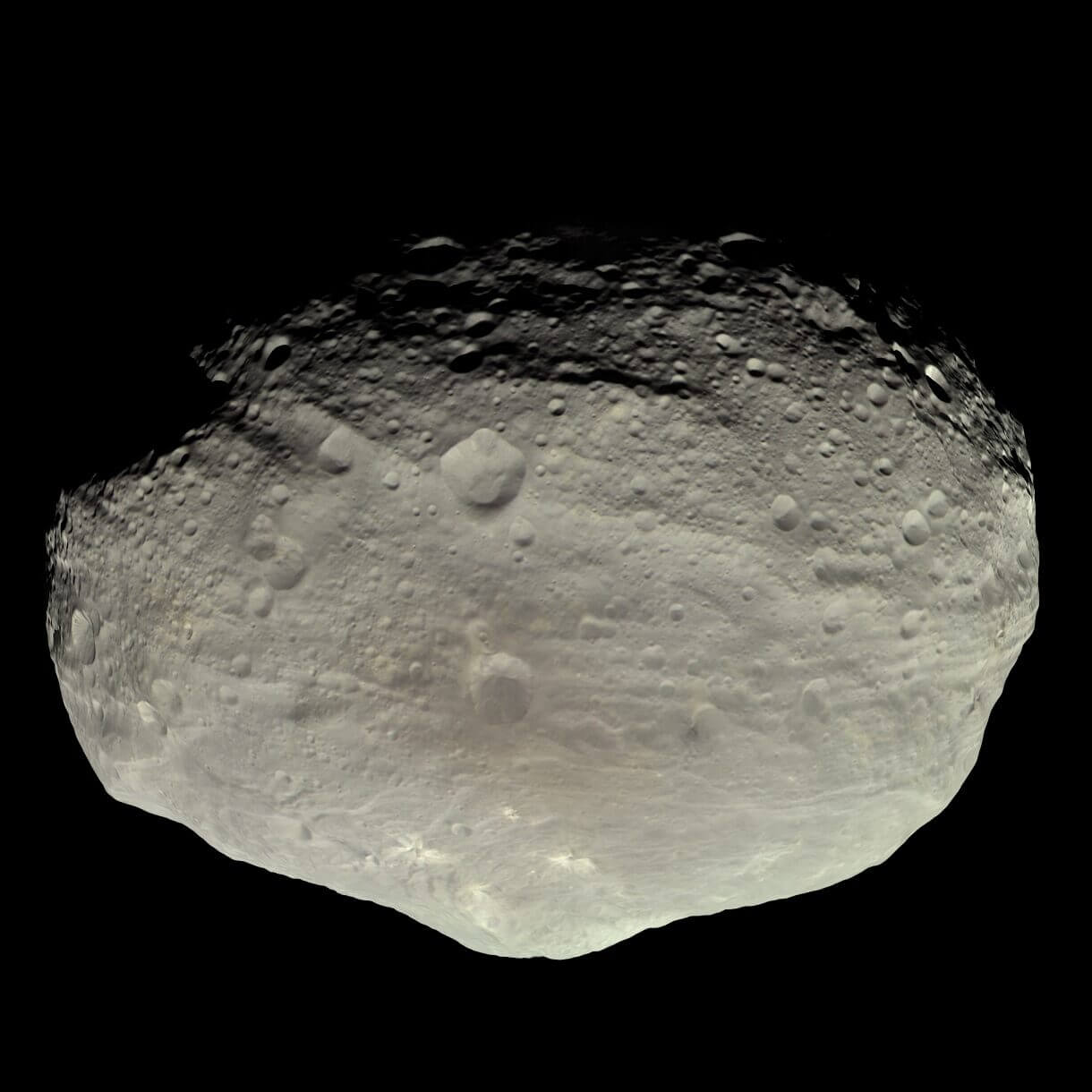
This image of asteroid (4) Vesta was captured by the Dawn spacecraft on July 24, 20211. Image credit: NASA / JPL / MPS / DLR / IDA / Björn Jónsson.
On May 2, 2025, the asteroid (4) Vesta reaches opposition which is when an object appears near the anti-solar point in the sky. When near opposition objects appear brighter than any other time during an apparition. This happens due to something called the opposition effect. If you have never tracked down an asteroid before, this is one of your best opportunities as Vesta nears opposition later this week.
Asteroid (4) Vesta orbits the Sun every 3.63 years. Its mean diameter is roughly 525 km making the asteroid 3.26 times smaller than the Moon. Vesta is a member of the main asteroid belt with an average distance from the Sun of 2.36 AU. Vesta is a largely intact differentiated asteroid. This means Vesta’s interior experienced partial melting allowing for geochemical separation of minerals forming a core, mantle and crust. Studying this process is fundamental to understanding the formation of our solar system. NASA’s Dawn mission studied asteroid (4) Vesta and the dwarf planet Ceres from 2007-2018 providing scientists a unique tool for studying the evolution of planetary bodies. You can learn about the Dawn mission here.
To find Vesta, you will need to find the constellation Libra. This constellation culminates around 01:30 this week. The easiest way to find Libra is to first find Scorpius. Around 01:30, Scorpius is rising in the south southeastern sky. While the lower part of the constellation will be difficult to see at this point, the top half should be visible for most which looks like a triangular kite with a long string pointing down to the horizon. Where the string of bright stars connects to the triangle shape, you will see a bright orange/red colored star called Antares. This famous red supergiant is the brightest star in Scorpius.
From Antares you will see three bright stars arranged in a line that extends roughly south to north. These stars are called 𝝅 Sco, δ Sco and β Sco which represent the head of the scorpion. If you can find these, keep shifting west until you see a triangle shape of stars. These are the brightest stars of Libra which are named Zubeneschamali, Zubenelgenubi and Brachium. Asteroid (4) Vesta is located a little over 7° northwest of Zubeneschamali on April 28, 2025. Each night the asteroid will shift westward due to retrograde motion. The illusion of backward motion is caused by Earth catching up to Vesta in our orbit and then passing it by. Vesta’s retrogression ends about midway through June 2025. This week we will see Vesta shift between the bright stars 16 Lib and µ Vir. The best way to identify these specific stars is to use a proper star atlas or a desktop planetarium software such as Stellarium.
T CrB Nova Update 4/27/2025
If you are still interested in seeing the recurrent nova T Coronae Borealis, there is still hope. The nova has not yet occurred meaning we are in a waiting game. It could happen this year or it could happen next year. We will have to wait and see. If you are still interested in this event, the part of the sky the nova will appear in is rising earlier each night. By midnight, the constellation Corona Borealis will be found high in the eastern sky. Spaceweather.com is still posting magnitude estimates from the AAVSO. This is the resource I recommend following to keep up with any changes in the star’s brightness. Current magnitude of the system is 10.0.
The Sun and Moon
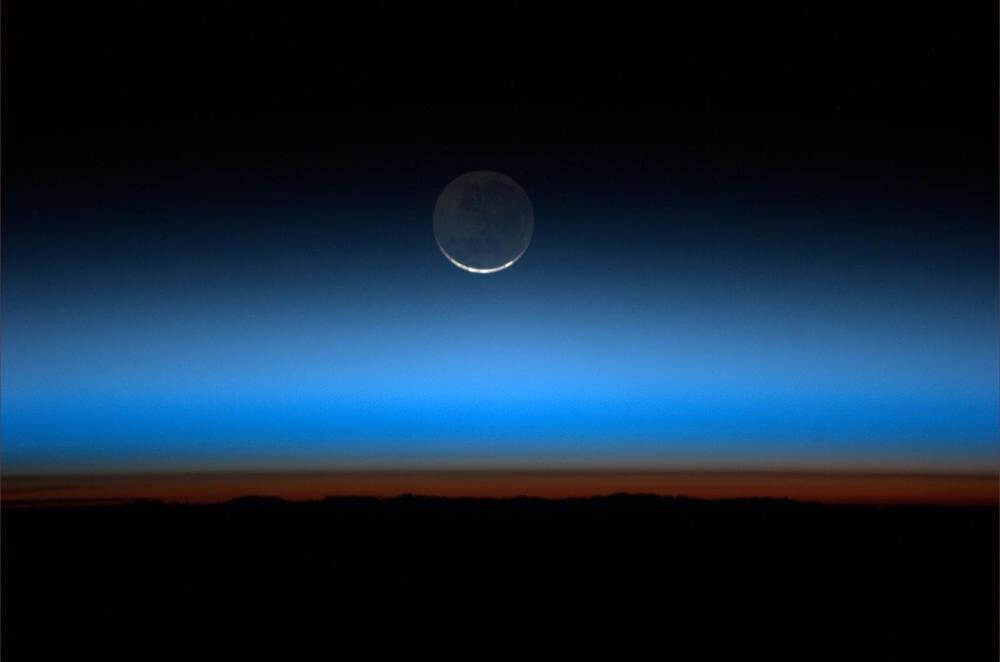
The Moon as seen from the International Space Station, on July 31, 2011.
Credit: NASA
Sun
Sunrise is at 06:08 on Sunday, April 27 and sunset is at 19:49 providing about 14 hours of daylight. Even after sunset, light from the Sun will dimly illuminate our sky for about 1 hour and 40 minutes. This period is called twilight, which ends around 21:29 this week. For those with a sundial, local noon occurs around 12:59 on April 19, 2025.
Moon
Moonrise for Saturday, April 27, was at 05:46 and moonset occurs at 20:09. The Moon starts the week off exhibiting a new moon phase. By the end of the week the Moon will exhibit a waxing gibbous phase with 63% disk illumination. First quarter moon occurs on May 4, 2025, at 08:52 CDT.
International Space Station (ISS) Observing
Visible passes of ISS from St. Louis for the week of April 27 occur during morning hours. The table below lists the best of these passes. If you do not live in the area, you can use https://heavens-above.com/ to set your viewing location and get times for where you are.
Magnitude (Mag): The Measure of brightness for a celestial object. The lower the value is, the brighter the object will be.
Altitude (Alt): The angle of a celestial object measured upwards from the observer’s horizon.
Azimuth (Az): The direction of a celestial object, measured clockwise from an observer’s location with north being 0°, east being 90°, south being 180° and west being 270°.
Detailed information regarding all unmanned exploration of our universe, missions past, present, and planned, can be found at Jet Propulsion Laboratories
The Visible Planets
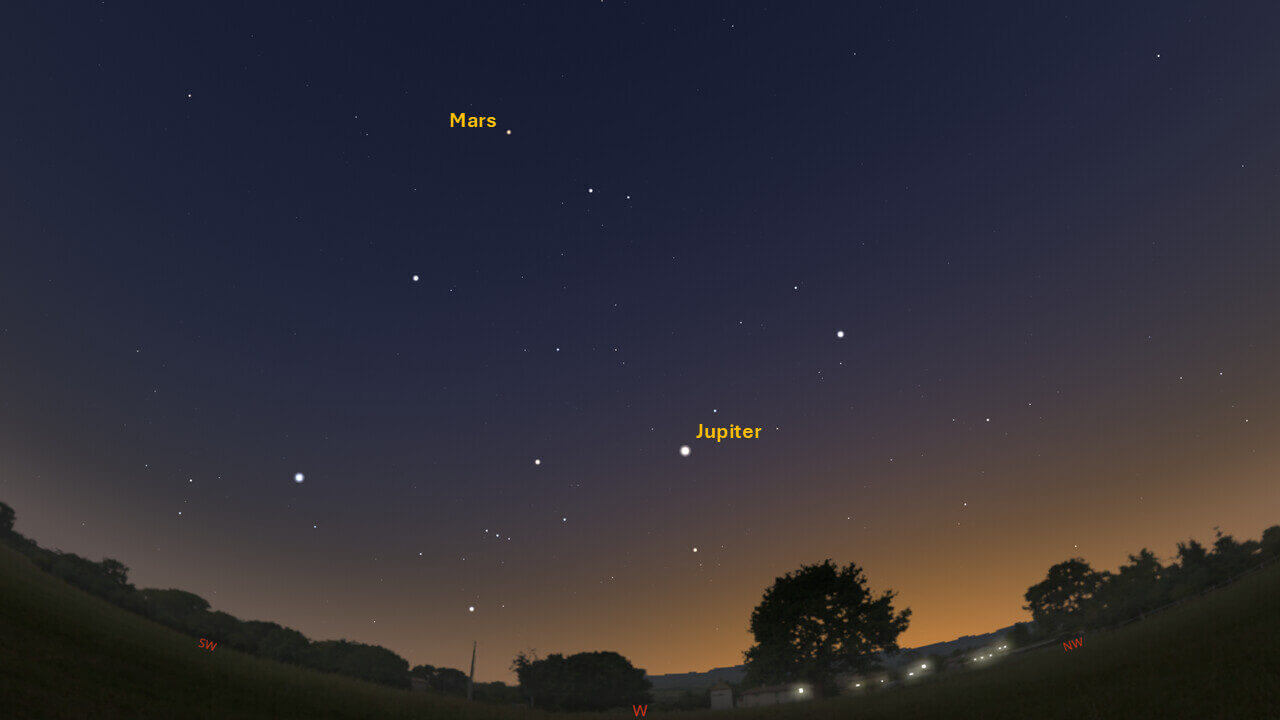
Looking west at 20:30 on April 27, 2025. Credit: Stellarium, EG
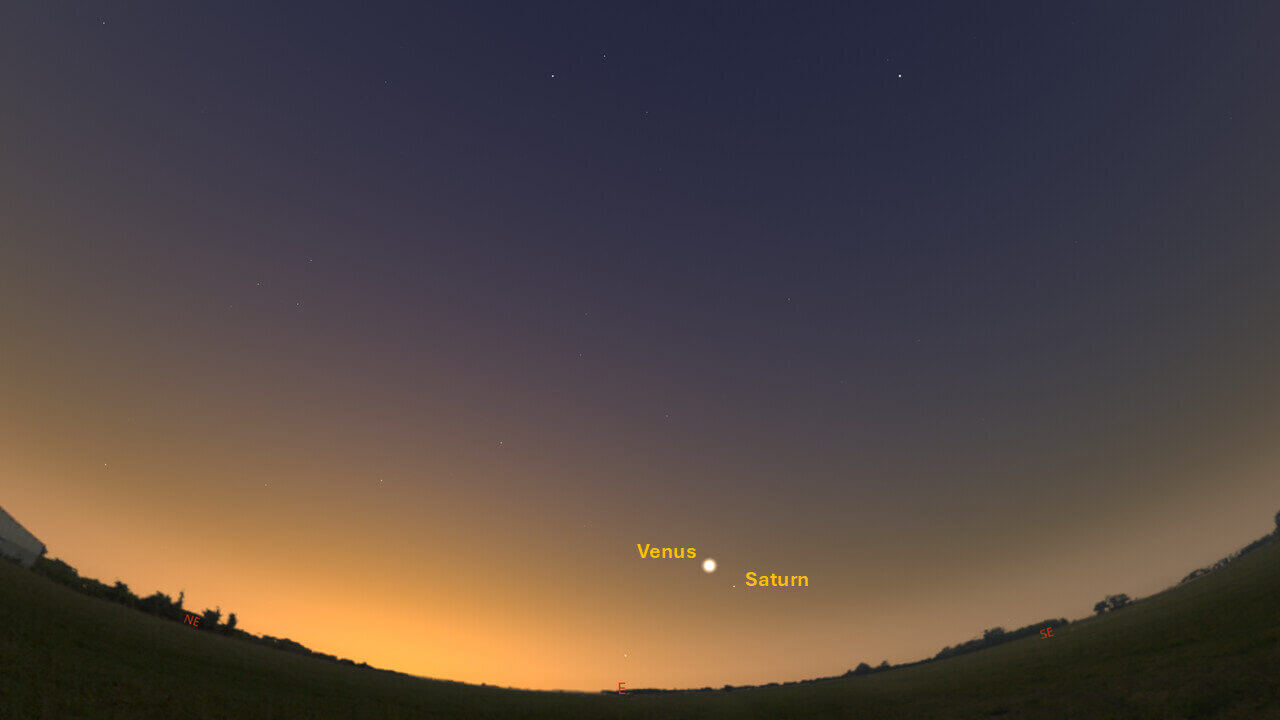
Looking east at 05:30 on April 28, 2025. Credit: Stellarium, EG
Four naked eye planets will be visible this week. Mars and Jupiter are still visible after sunset once it is dark. Venus and Saturn have returned to morning views becoming visible just before sunrise in the east.
Venus
Venus has begun a morning apparition. Venus will be visible in the east before sunrise for the rest of the year. The planet reaches its greatest illuminated extent on April 27, 2025. Look for Venus about 45 minutes before sunrise in the east.
Mars
Look for Mars overhead high in the western sky after sunset. Mars has shifted into the constellation Cancer. The current apparition of Mars will continue throughout the rest of 2025. Watch for the Red Planet as it shifts westward through the year. Mars sets around 02:00 this week.
Jupiter
Jupiter will be visible in the west not long after sunset. Jupiter sets by 23:13, remaining visible up to 22:00. Jupiter reaches superior conjunction on June 24, 2025.
Saturn
Saturn has returned to morning visibility rising just before the Sun. Look for the planet in the east about 30 minutes before sunrise. It will be difficult to see in the bright twilight skies, however, it is just east of Venus. If you have binoculars, you can scan the sky about 3.5° east of Venus for a chance to spot Saturn.
Our next Star Party will be held on Friday, May 2, 2025, from 6:30 pm until 9:30 pm
On the first Friday of each month, the St. Louis Astronomical Society and the Saint Louis Science Center will set up a number of telescopes outdoors and be on-hand to answer your questions. Telescope viewing begins once it is dark. Regardless of the weather on May 2, join us indoors in our planetarium theater for our “Monthly Sky Lecture”.
This free, indoor star program will introduce you to the current night sky. Doors open 15 minutes before show time. Once a show is underway, there are no late admissions due to safety issues in the darkened theater.
The St. Louis Astronomical Society helps host the monthly Star Parties at the Saint Louis Science Center. In addition to our nighttime viewings, they also help facilitate our daytime event called Solar Sundays. These daytime viewing sessions occur on the 3rd Sunday of each month. Visit SLAS’s website linked above to learn about other telescope events SLAS hosts around the St. Louis area.
James S. McDonnell Planetarium
Night Sky Update: April 27-May 5, 2025
Subjects