This is the Saint Louis Science Center’s NIGHT SKY UPDATE for the week of Friday, February 13, 2026
Information updated weekly or as needed.
Times given as local St. Louis time this week will be in Central Standard Time (CST). For definitions of terminology used in the night sky update, click the highlighted text. If relying on times posted in Universal Time (UT), St. Louis is -6 hours when CST. Times posted in the Night Sky Update are in the 24-hour format.
Join us for our next star party, Friday, February 6, 2026, held in association with the St. Louis Astronomical Society. For details, see the information at the bottom of this page or visit https://www.slsc.org/explore/mcdonnell-planetarium/public-telescope-viewings/
Observing Highlight
This week’s highlight is the red giant star Mira. Also known as Omicron Ceti, Mire is an AGB star which is nearing its end. It is a pulsating variable star that experiences a change in its radius and brightness due to the star expanding and contracting. The main mechanism that causes this is believed to be the ionization of helium. This in turn changes the opacity of the star trapping radiation which causes it to expand and brighten. As the star expands it starts to cool, eventually leading to a contraction of the star and a drop in brightness. This process will continue until the star loses enough mass through stellar winds. What remains of Mira will be a dense core of mostly carbon and oxygen which cannot collapse any further due to electron degeneracy pressure. This dense stellar core remnant is known as a white dwarf.
The variable behavior of Mira is well documented as it fades in and out of naked eye visibility. It is possible that Mira was known to be variable since ancient times, however, the first recorded observation of Mira’s variability was in 1596 by astronomer David Fabricius.
Mira’s period of variability occurs over 332 days. Once the star reaches its maximum brightness in February of March this year, it will slowly fade from view over a few months. It will be difficult to follow the star through its complete fade as it will be lost to the glare of the Sun from late March to June.
To locate Mira, look to the southwest this week around 18:30. If you can find Saturn in the southwest and Orion in the south, you will find Mira about halfway between them. It will appear as the brightest star between them near a large backwards question mark shape of stars. This pattern and Mira are part of the constellation Cetus.
T CrB Nova Update 2/13/2026
If you are still interested in seeing the recurrent nova T Coronae Borealis, there is still hope. The nova has not yet occurred meaning we are in a waiting game. If you are still interested in this event, the part of the sky the nova will appear in is found in the east before sunrise. You can find the constellation Corona Borealis rising in the east by midnight. By 1 am the location of T CrB will be 20° above the eastern horizon. If you don’t fancy waking up early to check on T CrB you can follow recent observations posted on the AAVSO website. You can find that here. Current magnitude estimates of the system show it at 10th magnitude.
The Sun and Moon
Sun
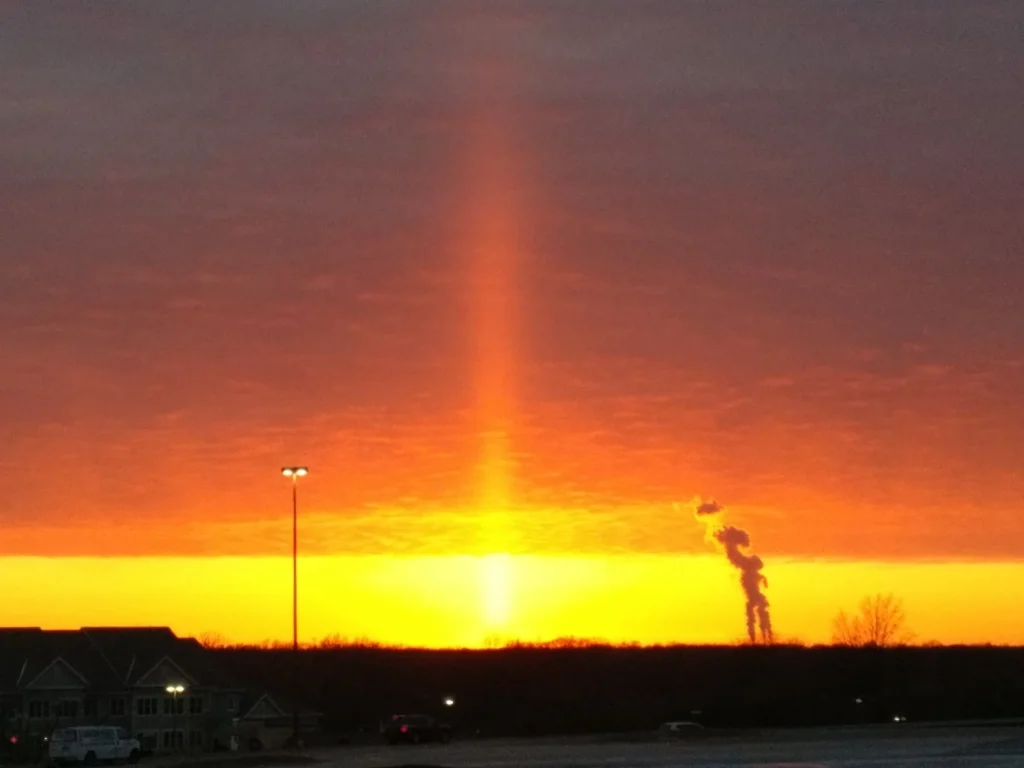
Sunrise on Friday, February 13 is at 06:54 and sunset is at 17:36 providing about 10.5 to 11 hours of daylight this week. Even after sunset, light from the Sun will dimly illuminate our sky for about 1 hour and 30 minutes. This period is called twilight, which ends around 19:02 this week. For those with a sundial, local noon occurs around 12:16 on February 9, 2026.
| Day | Sunrise (CST) | Sunset (CST) |
| 13-Feb | 6:54 | 17:36 |
| 14-Feb | 6:53 | 17:38 |
| 15-Feb | 6:51 | 17:39 |
| 16-Feb | 6:50 | 17:40 |
| 17-Feb | 6:49 | 17:41 |
| 18-Feb | 6:48 | 17:42 |
| 19-Feb | 6:46 | 17:43 |
| 20-Feb | 6:45 | 17:44 |
| 21-Feb | 6:44 | 17:45 |
Moon
Moonrise for Friday, February 13, is at 04:42 and moonset occurs at 13:42. On February 13, 2026, the Moon will exhibit a waning crescent phase with 13% disk illumination. By February 21, 2026, the Moon will exhibit a waxing crescent phase with 0% disk illumination. New moon occurs on February 17, 2026, at 06:01.
International Space Station (ISS) Observing
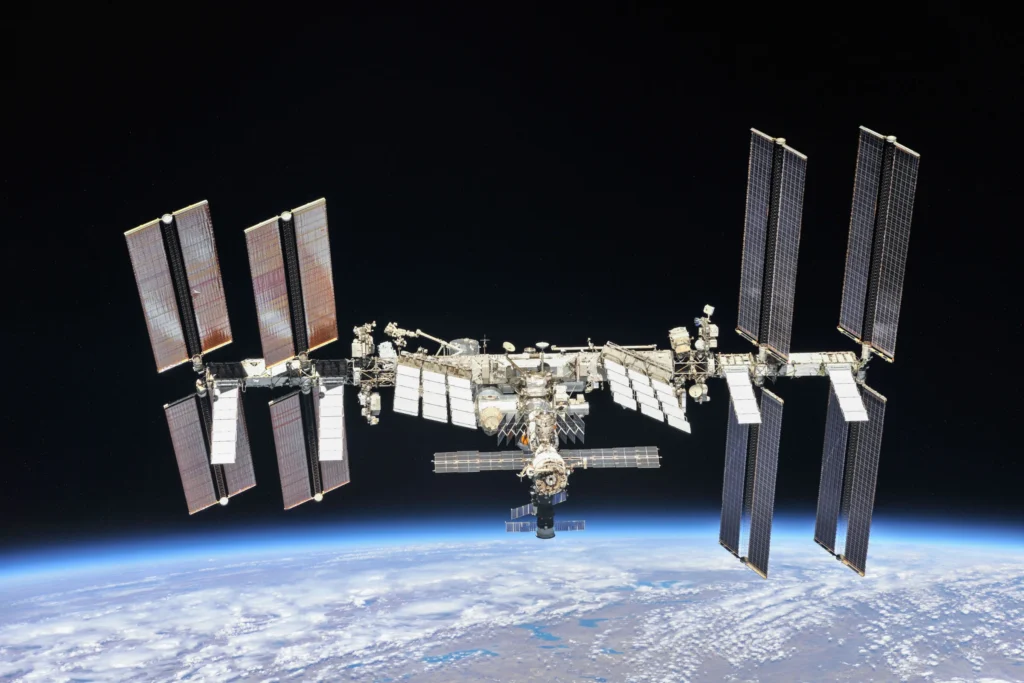
Visible passes of ISS from St. Louis for the week of February 13 occur during morning hours. If viewing from St. Louis Missouri, the best passes of ISS occur on February 15 and 16. You can find information about these and other satellite pass at https://heavens-above.com. If you are not viewing from the St. Louis area, make sure to change your viewing location for your local times.
Visible Planets
Three naked eye planets will be visible this week. Jupiter will be found high in the east after sunset. Saturn and Mercury will be found low in the west after sunset.
Mercury
This week presents a brief window to spot the planet Mercury. The nearest planet to the Sun is exhibiting an evening apparition which means you can look for the elusive planet in the west about 30 minutes after sunset. Mercury reaches maximum eastern elongation on February 19, 2026. On this evening Mercury will be about 9° above the western horizon below Saturn and a thin waxing crescent moon. To have any chance to spot Mercury you will near a view to west the that is clear of trees or buildings. Most observers will likely need binoculars to find Mercury so make sure you know when the Sun sets and only attempt to find Mercury after that time.
Jupiter
Jupiter will be visible in the east about 30 minutes after sunset, By 7 pm, it can be found nearly overhead north of the constellation Orion. Jupiter remains visible until 3 am at which time its low altitude will make it difficult to find for some viewers. Jupiter sets a little before 5 am. Jupiter’s current apparition continues through June and some of July as it heads towards superior conjunction on July 29, 2026.
Saturn
Saturn is found in the west about 30 minutes after sunset and sets a little after 8 pm this week. Saturn reaches superior conjunction on March 25, 2026. The current apparition of Saturn is coming to an end. As we get into March, Saturn will become increasingly difficult to find as it appears closer to the Sun each day.
Uranus
Around 7 pm this week, the planet Uranus will be found high overhead in the west. Its current magnitude is 5.7 putting it within naked eye visibility only from dark locations. In reality, most will need to use binoculars to have a chance to spot this distant world. You can find Uranus in the constellation Taurus about 4° south of the Pleiades star cluster. Uranus will be near the stars 13 Tau and 14 Tau.
Our next Star Party will be held on Friday, March 6, 2026, from 5:30 pm until 8:30 pm.
On the first Friday of each month, the St. Louis Astronomical Society and the Saint Louis Science Center will set up a number of telescopes outdoors and be on hand to answer your questions. Telescope viewing begins once it is dark.
The St. Louis Astronomical Society helps host the monthly Star Parties at the Saint Louis Science Center. In addition to our nighttime viewings, they also help facilitate our daytime event called Solar Sundays. These daytime viewing sessions occur every Sunday through Labor Day. After Labor Day they occur on the 3rd Sunday each month. Visit SLAS’s website linked above to learn about other telescope events SLAS hosts around the St. Louis area.
James S. McDonnell Planetarium
Night Sky Update for February 13-21, 2026
Subjects