This is the Saint Louis Science Center’s NIGHT SKY UPDATE for the week of Sunday, January 19, 2025.
Information updated weekly or as needed.
Times given as local St. Louis time this week will be in Central Standard Time (CST). For definitions of terminology used in the night sky update, click the highlighted text. If relying on times posted in Universal Time (UT), St. Louis is -6 hours when CST.
Join us for our next star party, Friday, February 7, 2025, held in association with the St. Louis Astronomical Society.
For details, see the information at the bottom of this page or visit: https://www.slsc.org/explore/mcdonnell-planetarium/public-telescope-viewings
Observing Highlight of the Week
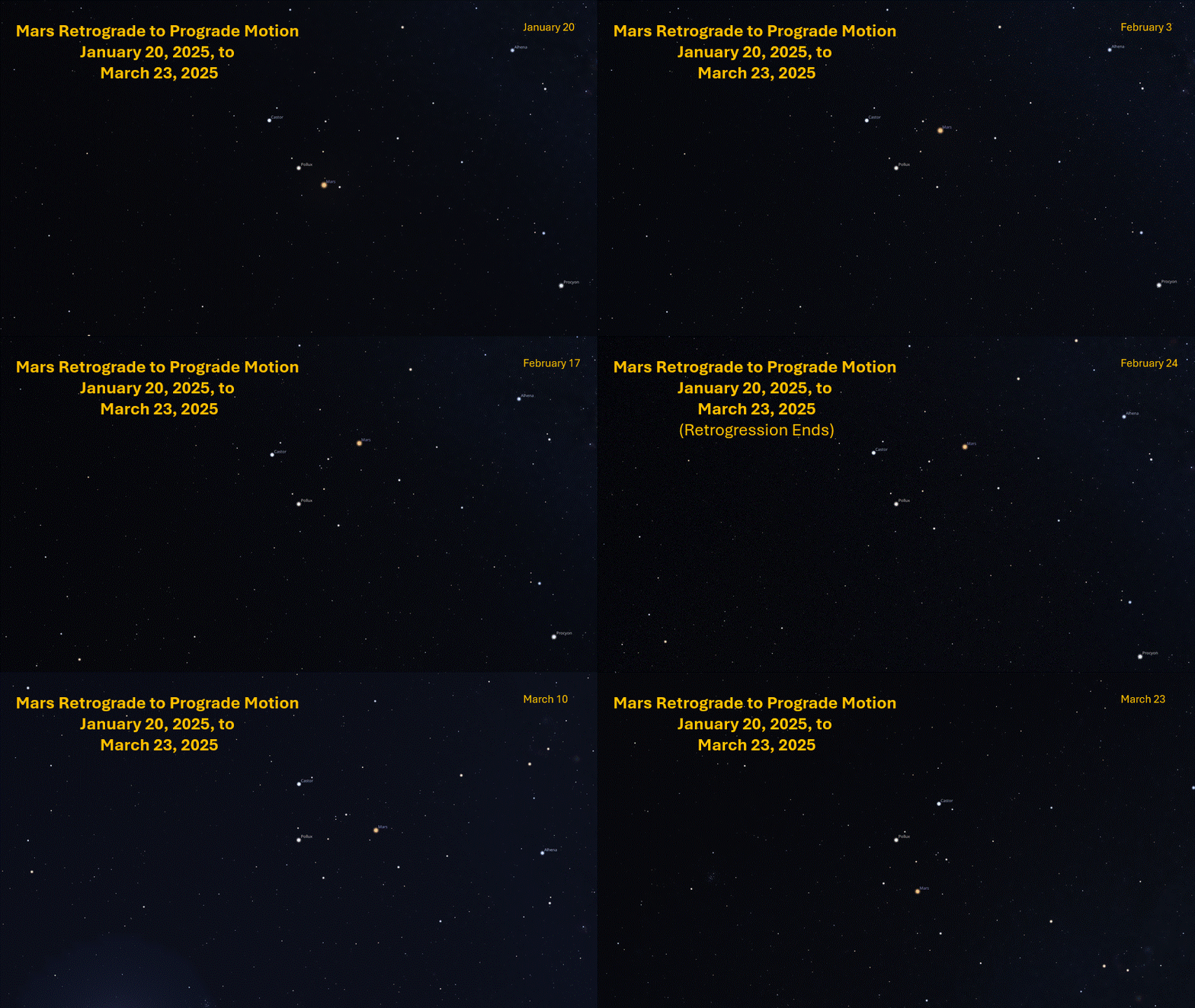
The map above shows the position of Mars amongst the background sky over roughly 7-day periods. Image created using Stellarium.
A couple of events involving planets occur this week. Venus and Saturn will be near conjunction on January 19, 2025, and Mars will be seen near the bright star Pollux from January 20-26, 2025.
Venus, Saturn and eventually Mercury
Conjunctions occur as two or more solar system objects share the same celestial longitude. We will not be able to see the exact moment of conjunction because it occurs a few hours after the two planets set. However, while they are visible, Venus and Saturn will be seen about 3° apart. If you keep an eye on these planets through March 2025, you will notice how they are moving away from one another. Venus will remain high in the southwestern sky after sunset while Saturn will be found closer to the Sun each day after the conjunction.
Saturn reaches superior conjunction on March 12, 2025. This is when Saturn will appear on the opposite side of the Sun from Earth. Because of this, we will start to lose Saturn to the Sun’s glare a few weeks before superior conjunction. In the latter half of February, Saturn will become increasingly difficult to find as it will be low to the western horizon. On February 25, 2025, Mercury joins Saturn as it starts a new evening apparition. For those with clear views to the west, you might find Mercury and Saturn a little more than 1.5° apart. The pair will reach conjunction after they set but like with Venus and Saturn this month, they will make for a nice target. Unfortunately, you will be fighting bright twilight skies so binoculars will likely be needed to spot the planets. Start looking for Mercury and Saturn around 6:00 pm on February 25,2025.
This is the first of three evening apparitions for Mercury in 2025. It is also the worst. When at maximum elongation, Mercury will only be 18° from the Sun. Mercury’s best evening apparition occurs from June through the start of August this year. When at maximum elongation, Mercury will appear about 25° from the Sun giving us our best chance to see Mercury after sunset in the west this year.
For early birds, the next morning apparition of Mercury occurs from April through the start of June. When at maximum elongation, Mercury will appear roughly 28° from the Sun. This will be our best chance this year to see Mercury before sunrise in the east.
Mars and Pollux
As of December 6, 2024, Mars has exhibited retrograde motion. This is when Mars appears to move backwards with respect to its normal eastward (prograde) shift amongst the background sky. This is only an illusion caused by Earth catching up to Mars in our orbit and passing it by. This happens because Earth is closer to the Sun and as a result, we move faster in our orbit than Mars does. As we catch up to Mars and pass it by, we see the planet from changing angles of observation. As a result, Mars appears to shift amongst the background sky opposite of its normal wanderings. This apparent backwards motion of Mars is a product of parallax.
Over the next week, we will see Mars pass by the bright star Pollux first appearing east of Pollux on January 20. By January 26, Mars will be seen south of the bright star. During this time, Mars and Pollux will appear separated by a little more than 2°. If you keep watching Mars past this week, it will eventually move west of Pollux due to retrograde motion. Mars will continue to shift westward until retrogression ends on February 24, 2025. After this date, Mars will resume its normal prograde motion shifting back towards the bright star Pollux. Mars will appear east of Pollux again by March 23, 2025.
The behavior of planets was a key part of how the solar system was discovered. Today these behaviors are a great reminder of this discovery and how the simple act of observation led to an immense amount of knowledge.
January 13, 2025, Mars Occultation
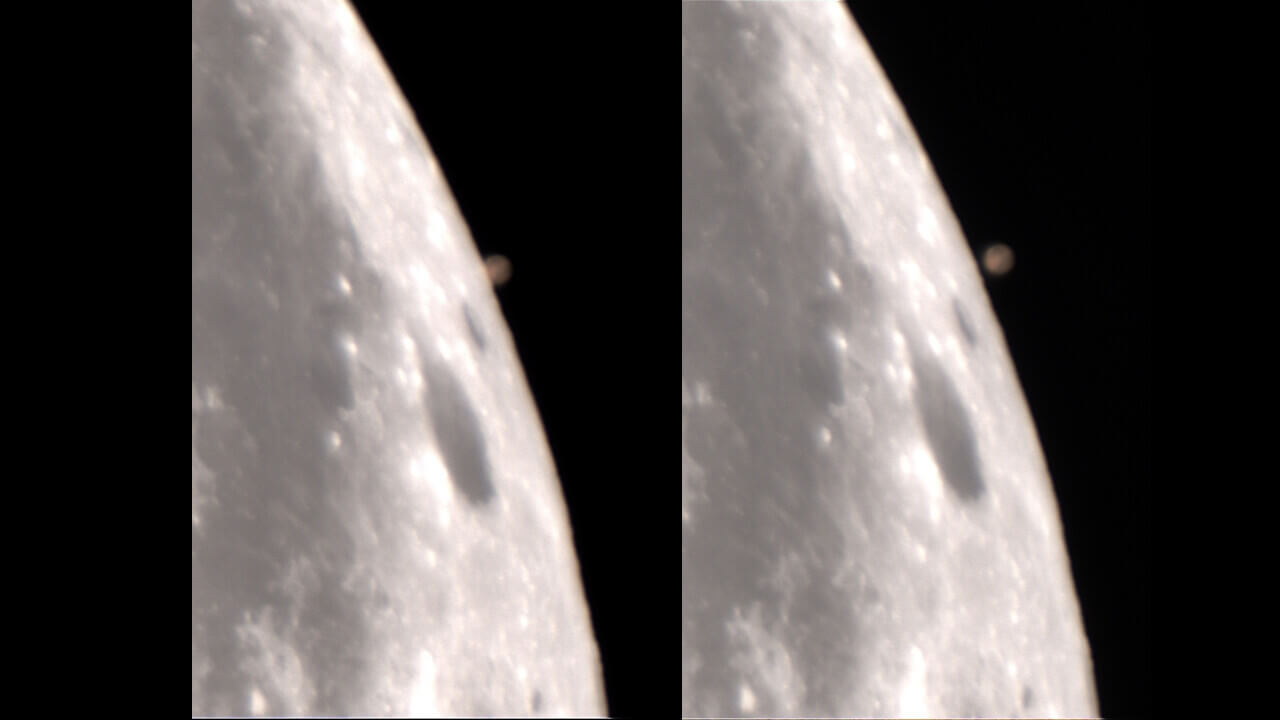
On January 13, 2025, an occultation of Mars was visible from the St. Louis region. The two images above show Mars reappearing from behind the Moon on that night. Images credit: Randy Harrison of River Bend Astronomy Club and Lookin’ Up Optics.
Mars Opposition January 15, 2025
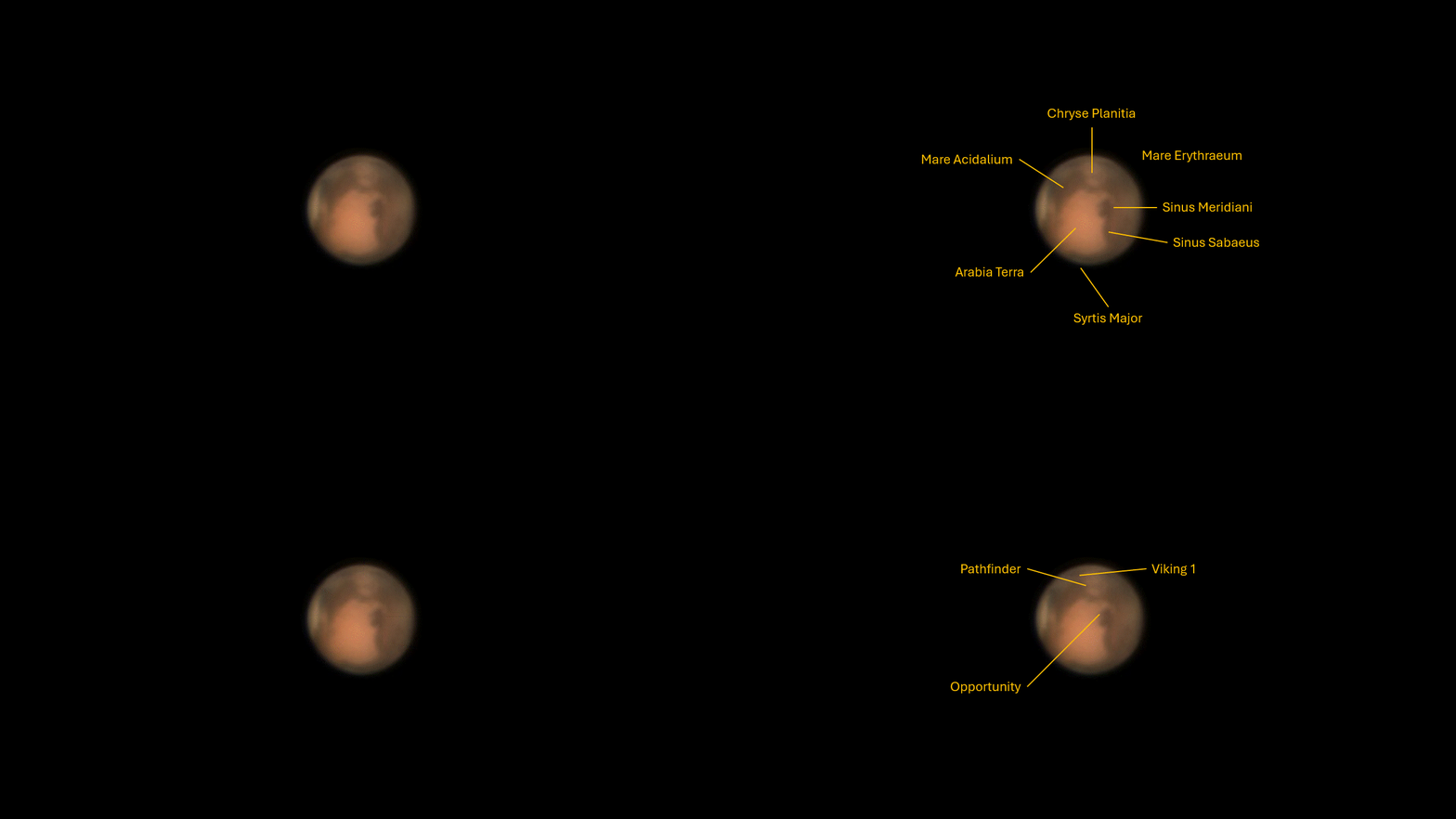
Mars reached opposition on January 15, 2025. The image above was recorded one night later on January 16, 2025. Several prominent surface features were visible. Image credit: Randy Harrison of River Bend Astronomy Club and Lookin’ Up Optics.
The Sun and Moon
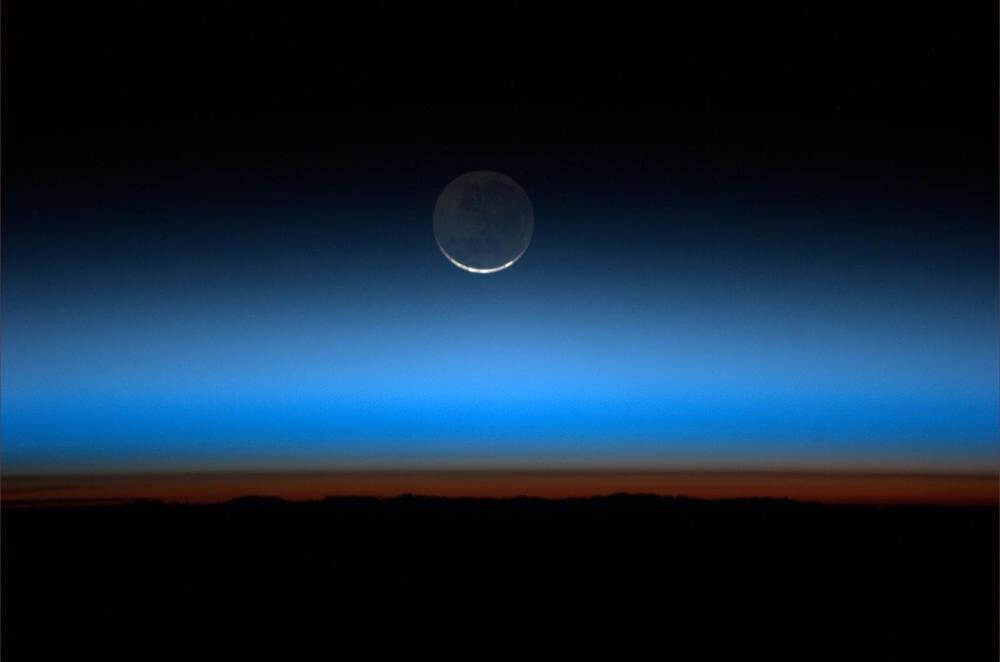
The Moon as seen from the International Space Station, on July 31, 2011.
Credit: NASA
Sun
Sunrise is at 7:15 am on Sunday, January 19 and sunset is at 5:08 pm providing around 10 hours of daylight. Even after sunset, light from the Sun will dimly illuminate our sky for about 1 hour and 30 minutes. This period is called twilight, which ends around 6:42 pm this week. For those with a sundial, local noon occurs around 12:11 pm on January 19, 2025.
Moon
Moonrise for Sunday, January 19, is at 11:06 pm and moonset occurs at 10:36 am the following morning. The Moon starts the week off with a waning gibbous phase exhibiting 68% disk illumination. By the end of the week the Moon will exhibit a waning crescent phase with 3% disk illumination. Last quarter moon occurs on January 21, 2025, at 2:31 pm.
International Space Station (ISS) Observing
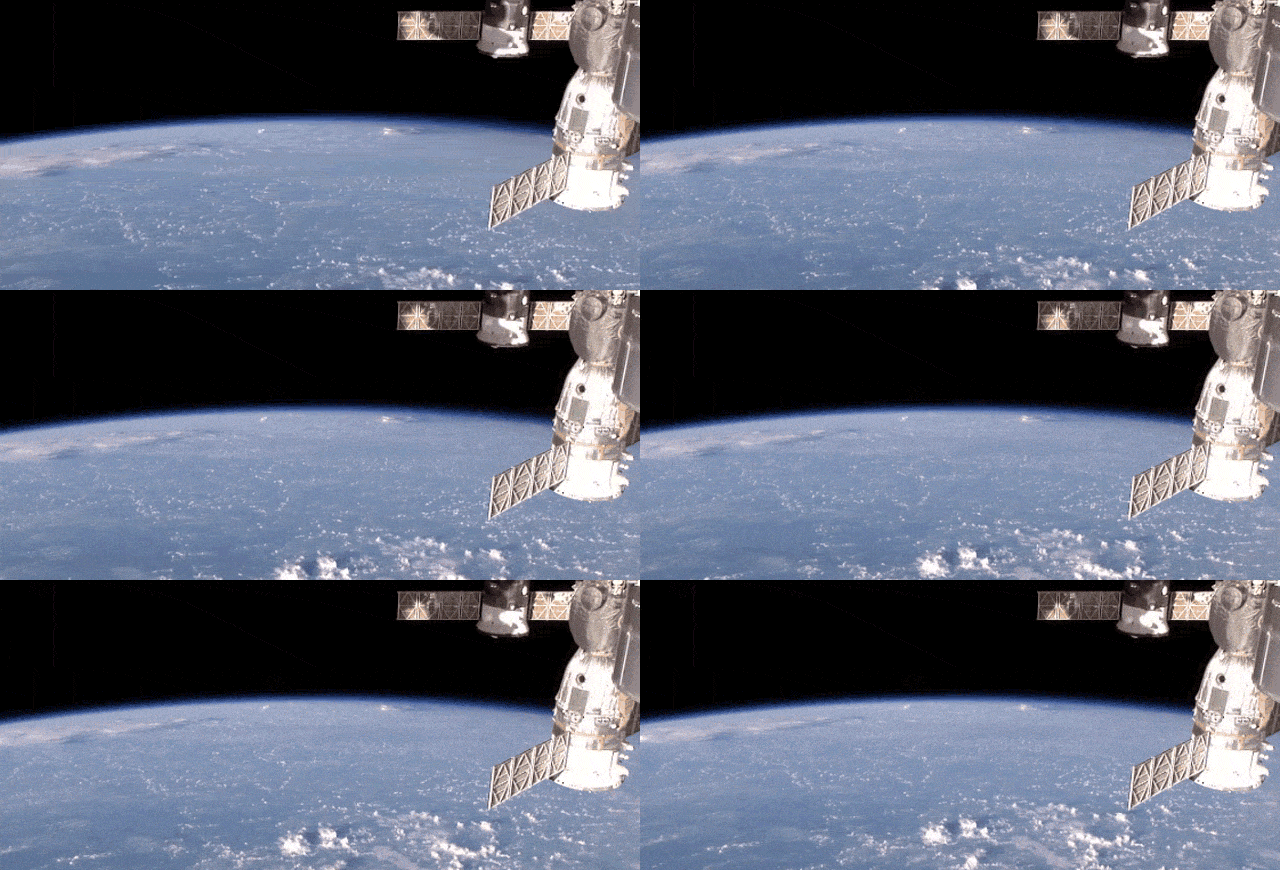
There are several visible passes of ISS from St. Louis for the week of January 19. They occur during evening hours. The table below lists the best of these passes that will be seen from St. Louis. If you do not live in the area, you can use https://heavens-above.com/ to set your viewing location and get times for where you are.
Magnitude (Mag): The Measure of brightness for a celestial object. The lower the value is, the brighter the object will be.
Altitude (Alt): The angle of a celestial object measured upwards from the observer’s horizon.
Azimuth (Az): The direction of a celestial object, measured clockwise from an observer’s location with north being 0°, east being 90°, south being 180° and west being 270°.
Detailed information regarding all unmanned exploration of our universe, missions past, present, and planned, can be found at Jet Propulsion Laboratories:
The Visible Planets
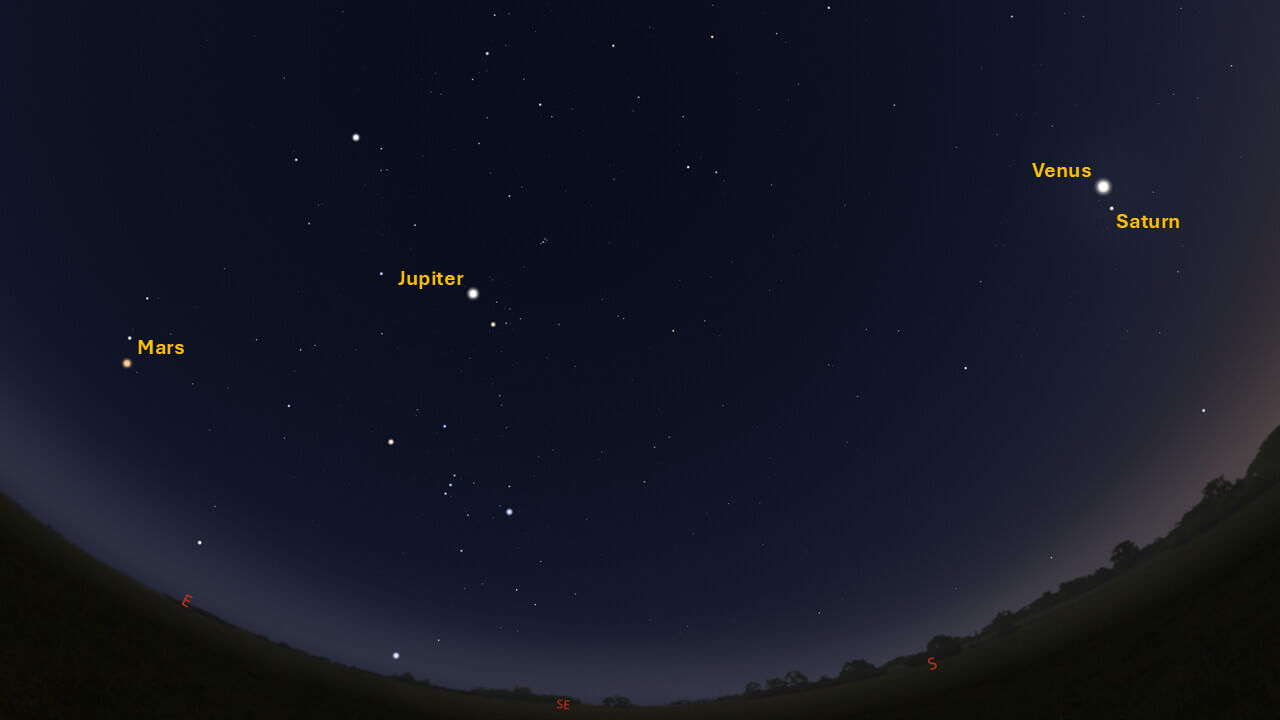
Looking southeast at 6:00 pm on January 19, 2025. Credit: Stellarium, EG

Looking south at 1:00 am on January 20, 2025. Credit: Stellarium, EG
This week, four naked eye planets are visible. All four are visible in the evening sky with Venus, Jupiter and Saturn visible not long after sunset. Mars rises a little later, becoming visible in evening hours.
Venus
Venus will be visible in the southwest after sunset. You can start looking for Venus about 15 minutes after the Sun sets. Venus will set by 8:57 pm. Venus is now headed towards inferior conjunction which occurs on March 22, 2025. Over the next couple of months, Venus will continue to appear closer to the Sun until we lose Venus to the Sun’s glare.
Mars
Mars is now past opposition. Look for it rising in the east about 40 minutes after sunset. The current apparition of Mars will continue throughout the rest of 2025. Watch for the Red Planet as it shifts westward through the year.
Jupiter
Now past opposition, Jupiter rises before the Sun sets. Look for Jupiter in the east as the sky begins to darken. Jupiter sets a little before 4 am.
Saturn
Saturn will be visible in the southwest shortly after sunset. Saturn now sets around 8:49 pm. Each week Saturn will set about 25 minutes earlier than it did the week before.
Our next Star Party will be held on Friday, February 7, 2024, from 5:30 pm until 8:30 pm
On the first Friday of each month, the St. Louis Astronomical Society and the Saint Louis Science Center will set up a number of telescopes outdoors and be on-hand to answer your questions. Telescope viewing begins once it is dark. Regardless of the weather on February 7, join us indoors in our planetarium theater for our “Monthly Sky Lecture.” Showtime is at 7 pm
This free, indoor star program will introduce you to the current night sky. Doors open 15 minutes before show time. Shows begins at 7 p.m. Sorry, no late admissions due to safety issues in the darkened theater.
The St. Louis Astronomical Society helps host the monthly Star Parties at the Saint Louis Science Center. In addition to our nighttime viewings, they also help facilitate our daytime event called Solar Sundays. These daytime viewing sessions occur on the 3rd Sunday of each month. Visit SLAS’s website linked above to learn about other telescope events SLAS hosts around the St. Louis area.
James S. McDonnell Planetarium
Night Sky Update: January 19-27,2025
Subjects