This is the Saint Louis Science Center’s NIGHT SKY UPDATE for the week of Friday, May 1, 2026
Information updated weekly or as needed.
Times given as local St. Louis time this week will be in Central Daylight Time (CDT). For definitions of terminology used in the night sky update, click the highlighted text. If relying on times posted in Universal Time (UT), St. Louis is -5 hours when CDT. Times posted in the Night Sky Update are in the 24-hour format.
Join us for our next star party, Friday, May 1, 2026, held in association with the St. Louis Astronomical Society. For details, see the information at the bottom of this page or visit https://www.slsc.org/explore/mcdonnell-planetarium/public-telescope-viewings/
Observing Highlight: May Day
Paging through a modern calendar, one will find several familiar days that represent major celebrations that are observed around the world. Days such as Halloween o New Years celebrations are a few examples. No matter what traditions or celebrations are included, calendars are a scheme intended to organize the passage of time most commonly based on astronomical cycles and observations. Many of these holidays or traditions included in calendars often represent days of astronomical significance connecting us to ancient knowledge that drove the advancement of humanity.
Our modern calendar is solar based which measures a tropical year or one full cycle of the seasons. Ancient calendars often used lunar cycles as their time piece. However, as agriculture developed, the need to effectively track seasons became important. Ancient sites such as Stonehenge offer us a glimpse of how our ancestors discovered and observed how our sky behaved in predictable ways. Around the world large stone megaliths were often built to observe the position of the Sun and Moon. In some cases, multiple settlements were built along site lines aligning them with the positions of astronomical bodies. The entire landscape of a region was often used in this way. One of the best documented examples of this are the settlements found throughout Chaco Canyon.
The most familiar days in our standard solar calendar that represent astronomical observations are the solstice in June and December and the equinox in March and September. These astronomical positions mark the start of the seasons. Days that are less obvious are days such as Halloween (Samhain) and Groundhog Day which are known as cross-quarter days.
Cross-quarter days represent the halfway point between an equinox and solstice. We see them as the halfway point to the start of the next season. For ancient astronomers, these represented the start of seasons. As an example, Halloween marked the beginning of winter for the Celts. Daytime was growing shorter, the world was becoming cooler, they were entering the dark time of the year. It is no surprise that these changes would influence their behavior and beliefs.
One of these cross-quarter days occurs this week which is known as May Day. Many know this as a spring festival. You might find celebrations in western Europe that include a maypole with ribbons tied to it or floral wreathes and crowns. In Germany it is known as Walpurgis Night and ancient Romans called it Floralia. However, one of the most ancient celebrations for this day is the Gaelic celebration Beltane. Beltane traditionally marked the start of summer and was seen as a fire festival. It was the opposite of Samhain (Halloween). If Samhain marked the start of darkness, Beltane marks the resurgence of light in the world.
Cross-quarter days occur on fixed dates on our modern calendar even though they occur a few days after the set date. The cross-quarter days no longer occur on the fixed date because of something called precession. Gravitational effects caused mostly by the Moon and Sun cause Earth to wobble on its axis of rotation. This is a slow change that takes about 26,000 years to complete one wobble. Due to this wobble, the astronomical positioning that defines the eight seasonal positions of Earth slowly drifts. Our modern calendar corrects for this by using an intercalary period known as a leap year. If we did not do this, the seasons would slowly drift through the months. If we didn’t correct for precession our calendar would be off by a month roughly every century.
While May Day might not be a day many of us celebrate, it remains a link to ancient knowledge our ancestors gave us that was crucial to the success of humanity. We can celebrate this ancient knowledge by observing the position of the Sun each day. A simple way to do this is to set up a gnomon, using it to mark the position of the noon shadow each week until June 21. If you do this you will find that the noon shadow will get shorter each day until the June solstice occurs.
T CrB Nova Update 5/1/2026
If you are still interested in seeing the recurrent nova T Coronae Borealis, there is still hope. The nova has not yet occurred meaning we are in a waiting game. If you are still interested, the part of the sky the nova will appear in is found rising in the east by 10 pm. The star system T Coronae Borealis is found in the constellation Corona Borealis which looks like a small U-shape of stars next to the constellation Boötes.
By 3 am the location of T CrB will be nearly overhead. Besides observing the sky directly, you can track the behavior of T CrB by checking current magnitude estimates posted at AAVSO here or by visiting spaceweather.com. Current magnitude estimates of the system show it at 10th magnitude.
The Sun and Moon
Sun
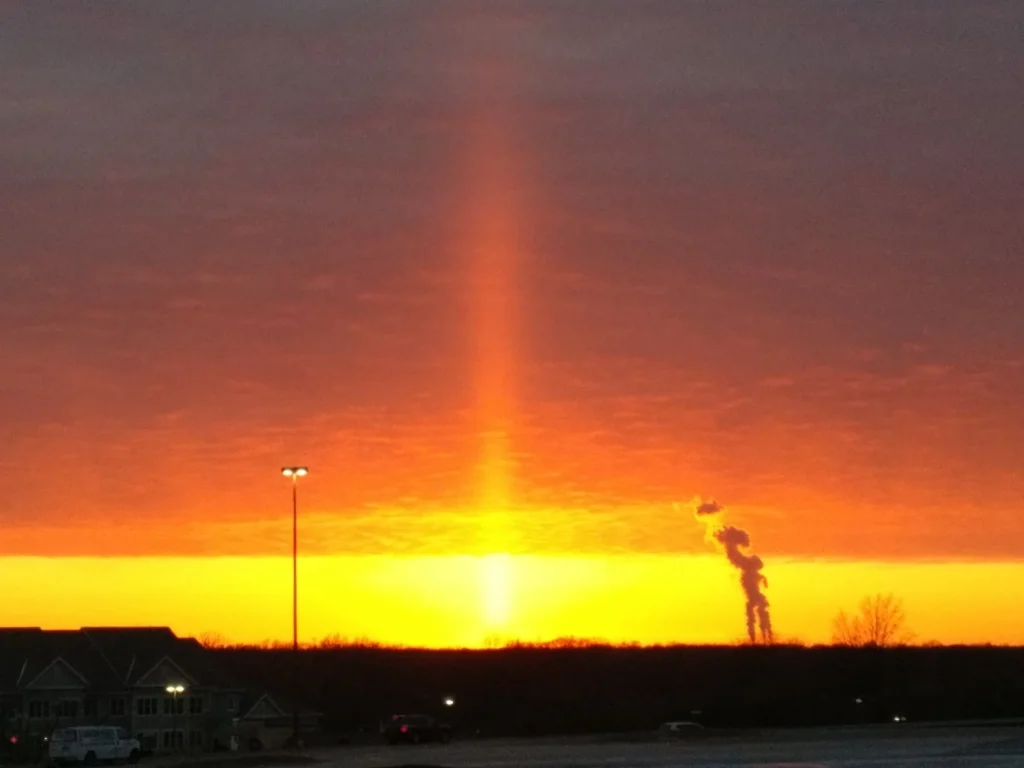
Sunrise on Friday, May 1 is at 06:03 and sunset is at 19:53 providing roughly 14 hours of daylight. Even after sunset, light from the Sun will dimly illuminate our sky for about 1 hour and 40 minutes. This period is called twilight, which ends around 21:34 this week. For those with a sundial, local noon occurs around 12:58 on May 1, 2026.
| Day | Sunrise (CDT) | Sunset (CDT) |
| 01-May | 6:03 | 19:53 |
| 02-May | 6:02 | 19:54 |
| 03-May | 6:01 | 19:55 |
| 04-May | 6:00 | 19:56 |
| 05-May | 5:59 | 19:57 |
| 06-May | 5:58 | 19:58 |
| 07-May | 5:57 | 19:59 |
| 08-May | 5:55 | 19:59 |
| 09-May | 5:54 | 20:00 |
Moon
Moonrise for Friday, May 1, is at 20:18 and moonset occurs at 06:08 the following morning. On May 1, 2026, the Moon will exhibit a full phase with 100% disk illumination. By May 9, 2026, the Moon will exhibit a last quarter phase with 50% disk illumination. Full moon occurs on May 1, 2026, at 12:23. This is the first of two full moons in May. The second full moon in May is on May 31, 2026. When there are two full moons in one month, the second is called a “Blue Moon
International Space Station (ISS) Observing
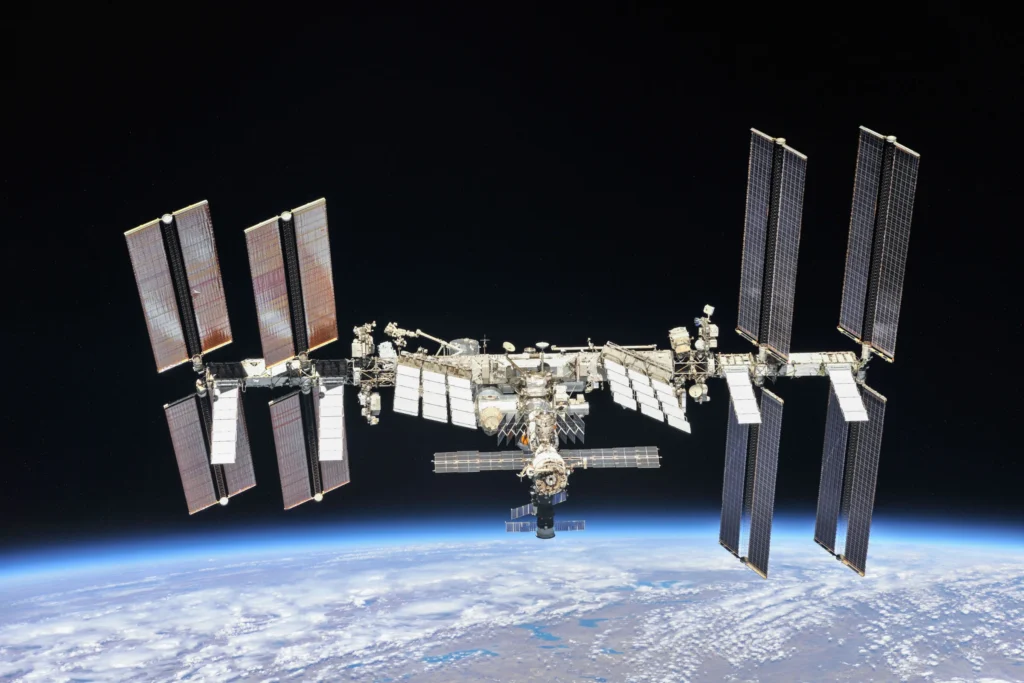
Visible passes of ISS from St. Louis for the week of May 1 occur during morning and evening hours with the best passes occurring on May 6, 8 and 9. You can find information about these and other satellite pass at https://heavens-above.com. If you are not viewing from the St. Louis area, make sure to change your viewing location for your local times.
Visible Planets
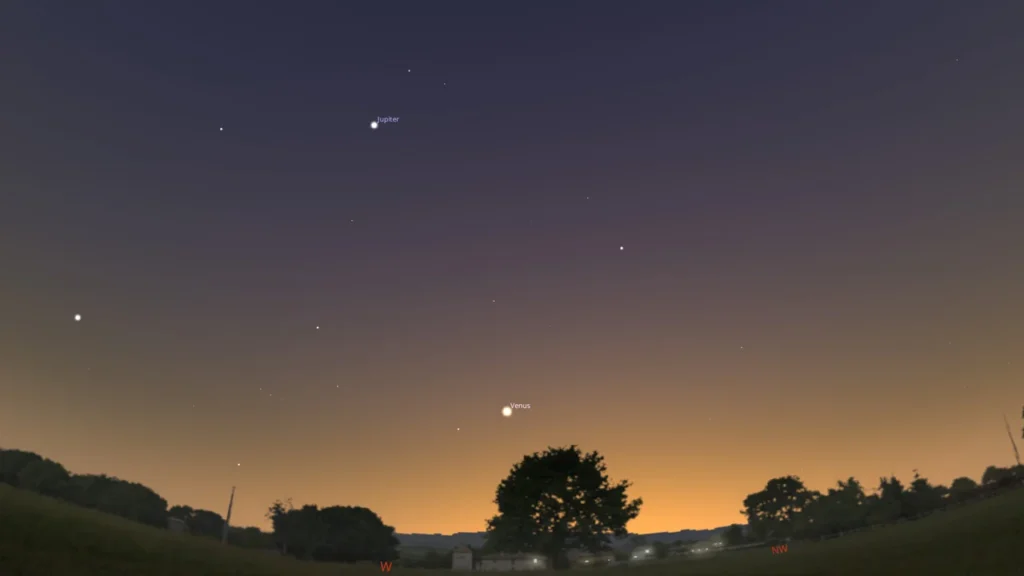
View looking southwest on May 1,2026, at 20:20. Image created using Stellarium
Two naked eye planets will be visible this week. Jupiter will be found in the west and Venus low in the west after sunset. Mars and Saturn are starting to climb out of the glare of the Sun before sunrise. By May, we should start seeing them in the east before sunrise.
Venus
Venus can now be seen low in the west after sunset. Its current evening apparition will continue until October as it approach inferior conjunction on October 23, 2026. Venus sets by 22:09.
Jupiter
Jupiter will be visible in the west about 30 minutes after sunset, Jupiter remains visible a little after midnight. Much later than this, Jupiter will appear too low in altitude making it difficult to find for some viewers. Jupiter’s current apparition continues through June and some of July as it heads towards superior conjunction on July 29, 2026.
Our next Star Party will be held on Friday, May 1, 2026 from 6:30 pm to 9:30 pm.
On the first Friday of each month, the St. Louis Astronomical Society and the Saint Louis Science Center will set up a number of telescopes outdoors and be on hand to answer your questions. Telescope viewing begins once it is dark.
The St. Louis Astronomical Society helps host the monthly Star Parties at the Saint Louis Science Center. In addition to our nighttime viewings, they also help facilitate our daytime event called Solar Sundays. These daytime viewing sessions occur every Sunday through Labor Day. After Labor Day they occur on the 3rd Sunday each month. Visit SLAS’s website linked above to learn about other telescope events SLAS hosts around the St. Louis area.
James S. McDonnell Planetarium
Night Sky Update for May 1, 2026
Subjects