This is the Saint Louis Science Center’s NIGHT SKY UPDATE for the week of Sunday, October 5, 2025.
Information updated weekly or as needed.
Times given as local St. Louis time this week will be in Daylight Saving Time. For definitions of terminology used in the night sky update, click the highlighted text. If relying on times posted in Universal Time (UT), St. Louis is -5 hours when CDT. Times posted in the Night Sky Update are in the 24-hour format.
Join us for our next star party, Friday, November 7, 2025, held in association with the St. Louis Astronomical Society.
For details, see the information at the bottom of this page or visit: https://www.slsc.org/explore/mcdonnell-planetarium/public-telescope-viewings
Observing Highlight of the Week (Comet C/2025 A6 Lemmon)

This image shows location of comet C/2025 A6 (Lemmon) from October 5-13, 2025, at 5 am from St. Louis, Missouri. As the week progresses, the comet will continue to be found lower to the horizon and will likely be too low to see until it shifts to evening views after October 14, 2025. Image created using Stellarium.
The highlight this week is comet C/2025 A6 (Lemmon). Current models suggest this comet will reach a peak magnitude between 3.5 and 2.5 when it is closest to Earth. At this magnitude it is likely to be the brightest comet of the year. Experienced comet observers will know that models predicting comet magnitudes are only forecasts and not guarantees. While it is possible we may see the suggested magnitudes, only time will tell.
C/2025 A6 (Lemmon) was discovered by the Mount Lemmon Survey in images captured on January 3, 2025. Astronomers calculated its inbound orbital period was roughly 1350 years. After the comet passed by Jupiter, its outbound orbit now appears to be around 1155 years. C/2025 A6 (Lemmon) will be nearest Earth on October 21, 2025, at which time we will hopefully see a naked eye comet.
How bright an object appears to us on Earth is a measure of its intrinsic luminosity, its distance and any extinction of its light caused by dust or atmosphere. The value measured is an object’s apparent magnitude. While 2.5 magnitude is well within naked eye visibility, a given brightness value for a bright star-like object will appear brighter than an extended object like C/2025 A6 (Lemmon) with the same magnitude. The reason for this is the brightness measurement of an object is based on the amount of light emitted across the entire object. Extended objects find their light spread across a larger area resulting in a diffuse appearance.
Recent logs of the comet’s magnitude put it at magnitude 6.2 which means it is bright enough to see naked eye from a dark location. Tracking the comet over the last week from a bright suburban sky location with a Bortle 6-7 rating, I found the comet has been fairly easy to find with binoculars provided you can identify specific star fields. The largest binocular I used to spot the comet was 10×50 and the smallest was 8×28. Through binoculars, the comet appeared as a dim fuzzy patch without a bright center. In the lower power binoculars, I had to use averted vision to detect the dim comet. As I switched to views through a small telescope, I started to notice a brighter center in the coma of the comet. I have not seen a tail yet, but I will continue to track C/2025 A6 (Lemmon) and post any updates as I observe them.
For now, C/ 2025 A6 (Lemmon) remains an early morning target. To find C/2025 A6 (Lemmon) last week I had to wait until 05:00 to see it due to tall trees. Those with better views of the northeastern horizon should be able to find the comet much earlier as it is rising this week between 02:00 and 03:00.
Last week the comet passed through the constellation called Lynx. It has since passed into Ursa Major and will continue westward through the constellation until October 14, 2025, when it passes into Canes Venatici. Around this time, the comet will become visible in northwest around 19:00 depending on how clear your horizon view is.
C/2025 A6 (Lemmon) will be closest to Earth on October 21, 2025, as it passes through the constellation Boötes. Looking west around 19:00 you will find the comet a little over 20° above the western horizon at azimuth 288°. To spot the comet on October 21, start by finding the Big Dipper in Ursa Major. This asterism will be found in the northwest at 19:00. Locate the handle of the Big Dipper and follow the direction it points to the west. This will direct you to the bright star Arcturus in the constellation Boötes. Looking east from Arcturus the next bright stars you see are Epsilon, Sigma and Rho Boötis. C/2025 A6 (Lemmon) will be found just below these stars.
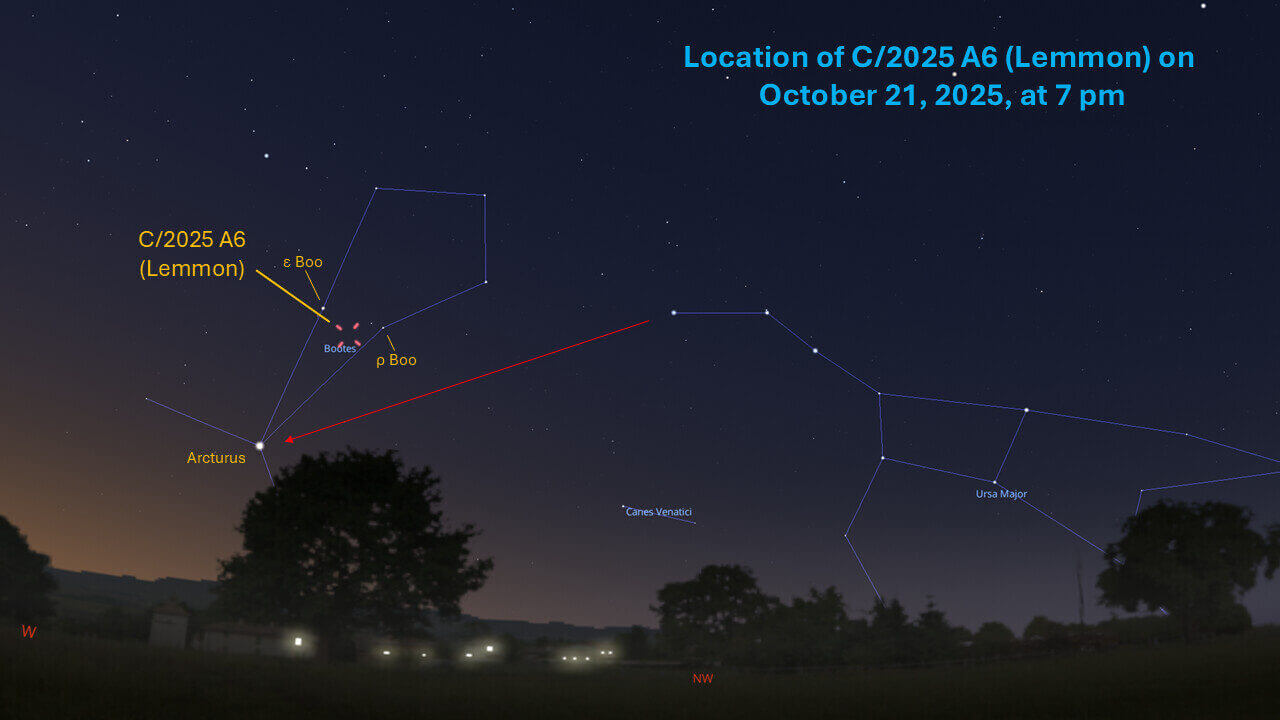
This image shows the location of comet C/2025 A6 (Lemmon) on October 21, 2026 at 7 pm when it is closest to Earth. The comet will be found a little over 20° above the western horizon at this time and date. Image created using Stellarium.
There are several resources available to learn more about comet C/2025 A6 (Lemmon) and recent observations of it. You can find links to these resources below.
COBS – Comet Observation Database
T CrB Nova Update 10/5/2025
If you are still interested in seeing the recurrent nova T Coronae Borealis, there is still hope. The nova has not yet occurred meaning we are in a waiting game. It could happen this year or it could happen next year. We will have to wait and see. If you are still interested in this event, the part of the sky the nova will appear in is found low in the west once it is dark. By 21:45, the constellation Corona Borealis will be hard to find due to tree lines or buildings. Spaceweather.com is still posting magnitude estimates from the AAVSO. This is the resource I recommend following to keep up with any changes in the star’s brightness. Current magnitude of the system is 10.4.
The Sun and Moon
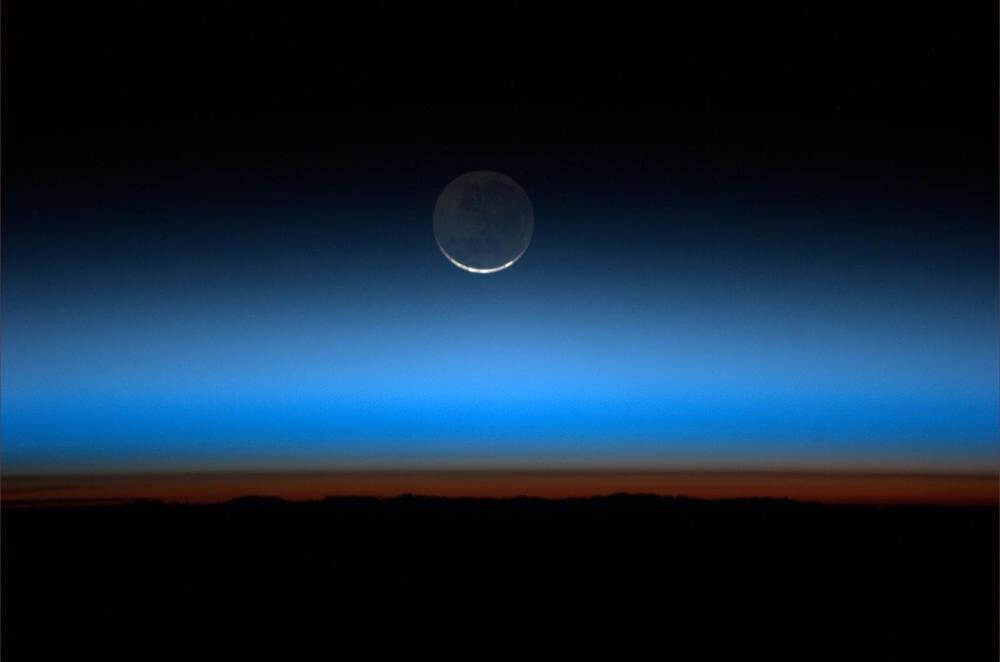
The Moon as seen from the International Space Station, on July 31, 2011.
Credit: NASA
Sun
Sunrise is at 07:01 on Sunday, October 5 and sunset is at 18:37 providing roughly 11.5 hours of daylight. Even after sunset, light from the Sun will dimly illuminate our sky for about 1 hour and 30 minutes. This period is called twilight, which ends around 20:05 this week. For those with a sundial, local noon occurs around 12:49 on October 5, 2025.
Moon
Moonrise for Sunday, October 5, is at 17:50 and moonset occurs at 06:20 the following day. On October 5, 2025, the Moon will exhibit a waxing gibbous phase with 98% disk illumination. By October 13, 2025, the Moon will exhibit a waning crescent phase with 48% disk illumination. Full moon occurs on October 6, 2025, at 22:48 and last quarter moon occurs on October 13, 2025, at 13:13.
International Space Station (ISS) Observing
There are no visible passes of ISS over St. Louis this week. ISS will return to St. Louis skies on October 14, 2025, when it returns to morning passes. Near the end of the week, there are several visible passes of the Chinese space station called Tiangong. The best of these passes are listed in the table below.
Magnitude (Mag): The Measure of brightness for a celestial object. The lower the value is, the brighter the object will be.
Altitude (Alt): The angle of a celestial object measured upwards from the observer’s horizon.
Azimuth (Az): The direction of a celestial object, measured clockwise from an observer’s location with north being 0°, east being 90°, south being 180° and west being 270°.
Detailed information regarding all unmanned exploration of our universe, missions past, present, and planned, can be found at Jet Propulsion Laboratories
The Visible Planets
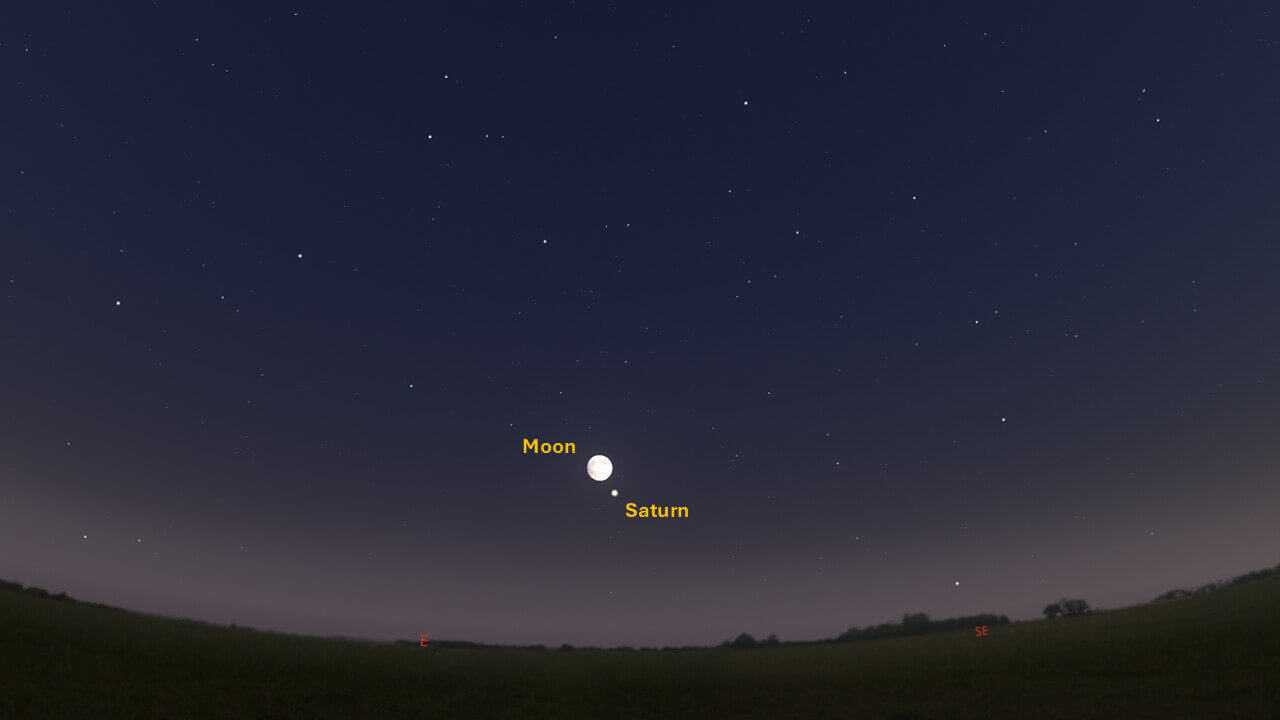
Looking east at 19:15 on October 5, 2025. Credit: Stellarium, EG
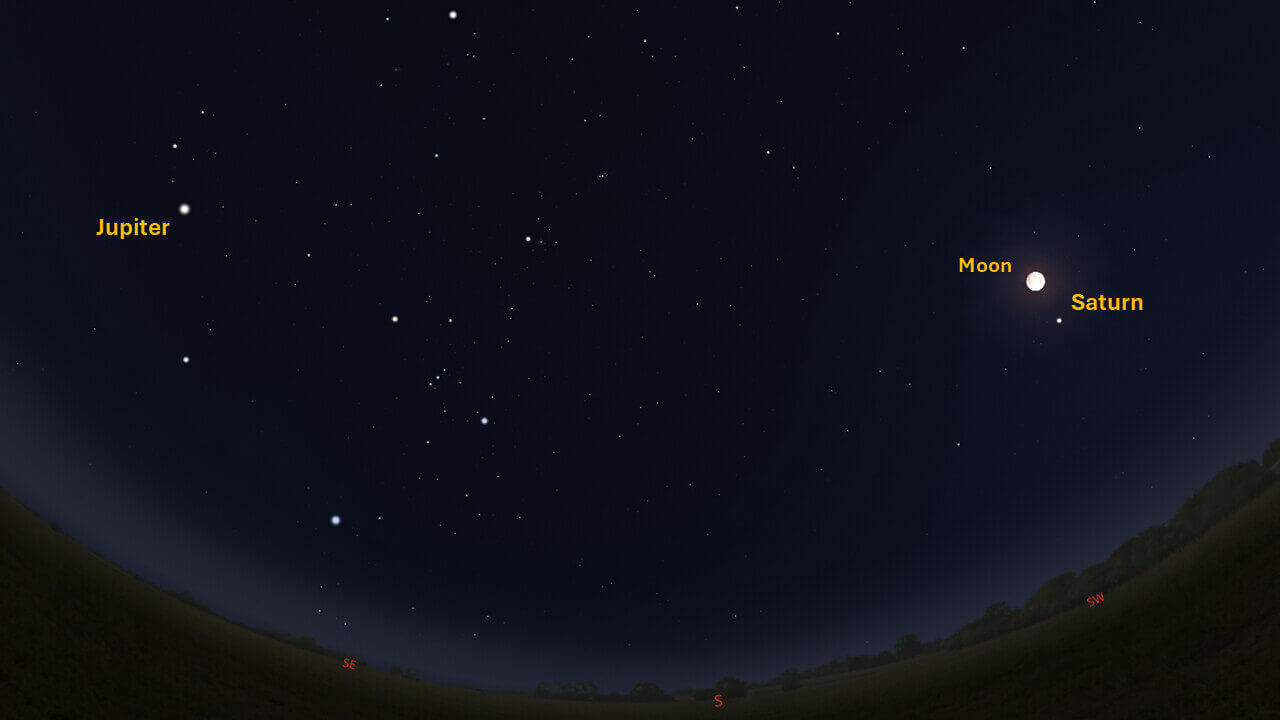
Looking south at 03:15 on October 6, 2025. Credit: Stellarium, EG
Three naked eye planets will be visible this week. Saturn is visible after sunrise in the east. Jupiter can be found in the east after 2 AM and Venus will be found low in the east around 6 AM
Venus
Venus is found in the east before sunrise for the rest of the year. It currently rises around 05:08. Venus should be high enough for most to see after 06:00. Venus reaches superior conjunction on January 6, 2026.
Jupiter
This week, Jupiter rises around 00:28. Look for Jupiter in the east around 02:00. Jupiter reaches opposition on January 10, 2026. As we continue towards this date, Jupiter will continue to rise earlier each week.
Saturn
Saturn is now visible after sunset in the east once it is dark. Saturn rises this week around 18:06. Now past opposition, Saturn is visible after the Sun sets. Saturn reaches solar conjunction on March 12 next year.
Our next Star Party will be held on Friday, November 7, 2025, from 5:30 pm until 8:30 pm
On the first Friday of each month, the St. Louis Astronomical Society and the Saint Louis Science Center will set up a number of telescopes outdoors and be on-hand to answer your questions. Telescope viewing begins once it is dark. Regardless of the weather on November 7, join us indoors in our planetarium theater for our free monthly sky lecture.
The St. Louis Astronomical Society helps host the monthly Star Parties at the Saint Louis Science Center. In addition to our nighttime viewings, they also help facilitate our daytime event called Solar Sundays. These daytime viewing sessions occur every third Sunday each month from 11:00-15:00 weather permitting. Visit SLAS’s website linked above to learn about other telescope events SLAS hosts around the St. Louis area.
James S. McDonnell Planetarium
Night Sky Update: October 5-13, 2025
Subjects