This is the Saint Louis Science Center’s NIGHT SKY UPDATE for the week of Tuesday, October 6, 2026
Information updated weekly or as needed.
Times given as local St. Louis time this week will be in Central Daylight Time (CDT). For definitions of terminology used in the night sky update, click the highlighted text. If relying on times posted in Universal Time (UT), St. Louis is -5 hours when CDT. Times posted in the Night Sky Update are in the 24-hour format.
Join us for our next star party, Friday, November 6, 2026, held in association with the St. Louis Astronomical Society. For details, see the information at the bottom of this page or visit https://www.slsc.org/explore/mcdonnell-planetarium/public-telescope-viewings/
Observing Highlight
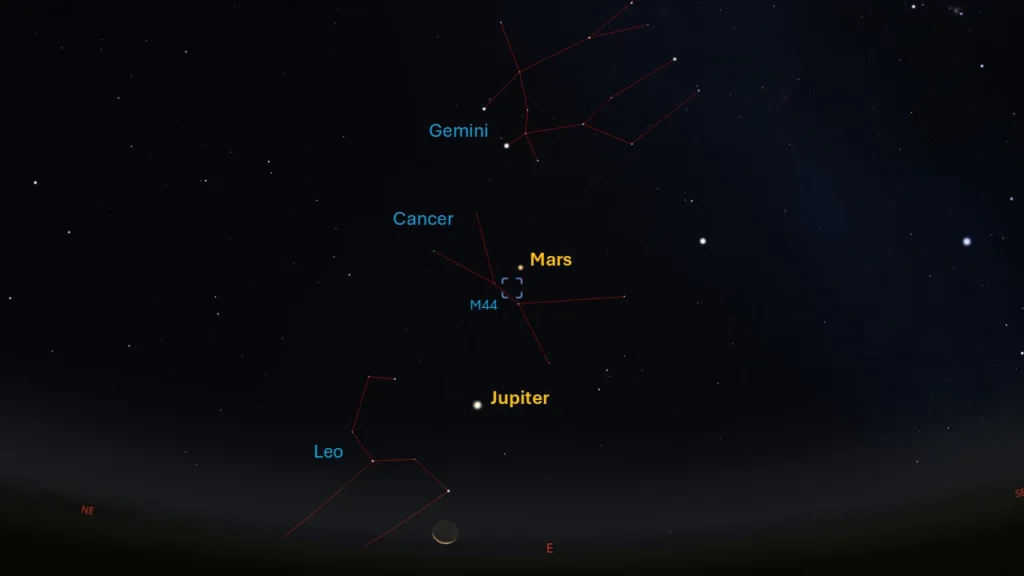
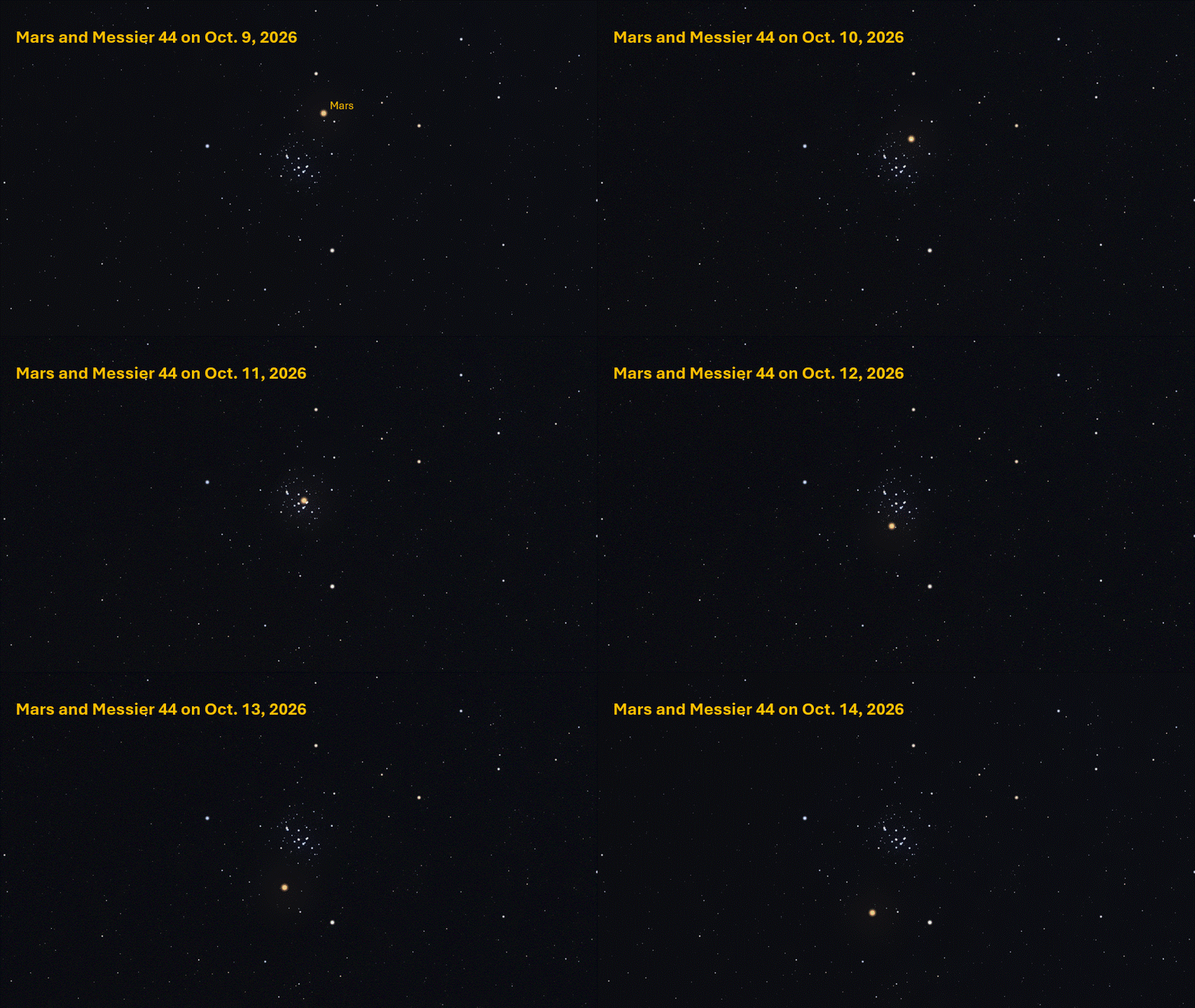
From October 9-14, 2026, Mars will encounter the open star cluster Messier 44. The pair will make for an interesting target each night as the Red Planet passes in front of the star cluster. The pair is best viewed through binoculars however a telescope will improve your views of Mars and stars in the star cluster.
For the rest of October, Mars will pass through the constellation Cancer on its way to pairing with Jupiter in Leo later in November. As Mars wanders through Cancer, it will appear to pass in front of the open star cluster Messier 44. Cancer is not a bright constellation so it may be easier to find if you first identify Gemini and Leo. Gemini is found by finding a large rectangular group of stars northeast of Orion’s shoulder and Leo can be found rising in the east by 4 am. Leo is easy to identify due to the bright backwards question mark shape of stars that mark his head.
The brightest stars in Cancer form an upside down Y-shape that is visible in moderate light pollution. Messier 44 is found near the middle of this Y-shape with Mars currently appearing just west of the star cluster.
Messier 44 (M44) is an open star cluster that is found about 577 light years away making it one of the nearest star clusters. M44 contains about 1,000 stars that are estimated to be between 600 and 700 million years old. Under dark skies it appear as a faint nebulous patch in Cancer. Through binoculars, you will see its brightest stellar members
From October 9 through October 14, Mars will pass in front of the star cluster appearing in a different location each night. The motion of planets against background stars is how our ancestors knew planets were different. The motion of Mars through Cancer is caused by Mars orbiting the Sun. From our view on Earth, planet motions cause them to shift along a path in the sky defined by Earth’s ecliptic. The constellations that cross this path are called zodiac constellations of which there are 13 used in Astronomy.
If you have a telescope, you might be able to see subtle surface features on Mars as ALPO has posted that the next Mars apparition begins on October 14, 2026. The south ice cap on Mars is the most likely feature that could be visible.
T CrB Nova Update 10/6/2026
If you are still interested in seeing the recurrent nova T Coronae Borealis, there is still hope. The nova has not yet occurred meaning we are in a waiting game. If you are still interested, the part of the sky the nova will appear in is found in the west by the time it is dark. The star system T Coronae Borealis is found in the constellation Corona Borealis which looks like a small U-shape of stars next to the constellation Boötes. Once it is dark the location of T CrB will still be high in the west. If you cannot observe the sky directly, you can track the behavior of T CrB by checking current magnitude estimates posted at The Sky Live. Current magnitude estimates of the system show it at 10th magnitude.
The Sun and Moon
Sun
Sunrise on Tuesday, October 6 is at 7:01 and sunset is at 18:36 providing between 11.5 and 11.17 hours of daylight. Even after sunset, light from the Sun will dimly illuminate our sky for about 1 hour and 30 minutes. This period is called twilight, which ends around 20:04 this week. For those with a sundial, local noon occurs around 12:49 on October 6, 2026.
| Day | Sunrise (CDT) | Sunset (CDT) |
| 06-Oct | 7:01 | 18:36 |
| 07-Oct | 7:02 | 18:34 |
| 08-Oct | 7:03 | 18:33 |
| 09-Oct | 7:04 | 18:31 |
| 10-Oct | 7:05 | 18:30 |
| 11-Oct | 7:06 | 18:28 |
| 12-Oct | 7:07 | 18:27 |
| 13-Oct | 7:08 | 18:25 |
| 14-Oct | 7:09 | 18:24 |
| 15-Oct | 7:10 | 18:22 |
| 16-Oct | 7:11 | 18:21 |
Moon
Moonrise for Tuesday, October 6, was at 02:35 and moonset occurs at 16:37. On October 6, 2026, the Moon will exhibit a waning crescent phase with 16% disk illumination. By October 16, 2026, the Moon will exhibit a waxing crescent phase with 33% disk illumination. New moon occurs on October 10, 2026, at 10:50.
International Space Station (ISS) Observing
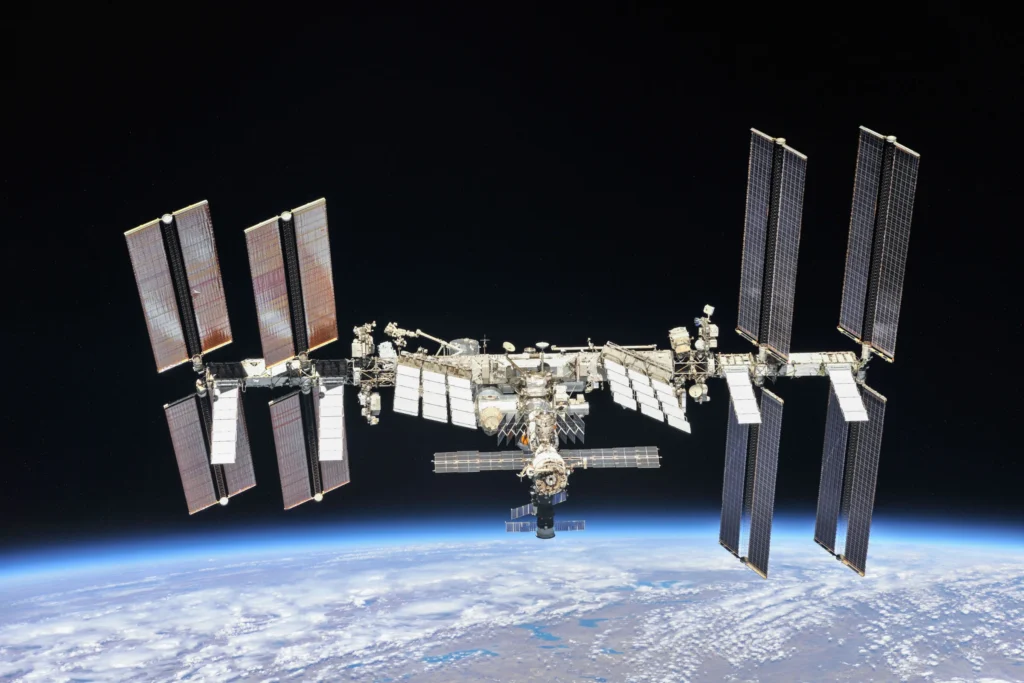
Visible passes of ISS from St. Louis for the week of October 6 resume on October 12, 2026, as ISS returns to morning skies. The best of these occur on October 14 and 15. You can find information about these and other satellite passes at https://heavens-above.com. If you are not viewing from the St. Louis area, make sure to change your viewing location for your local times.
Visible Planets
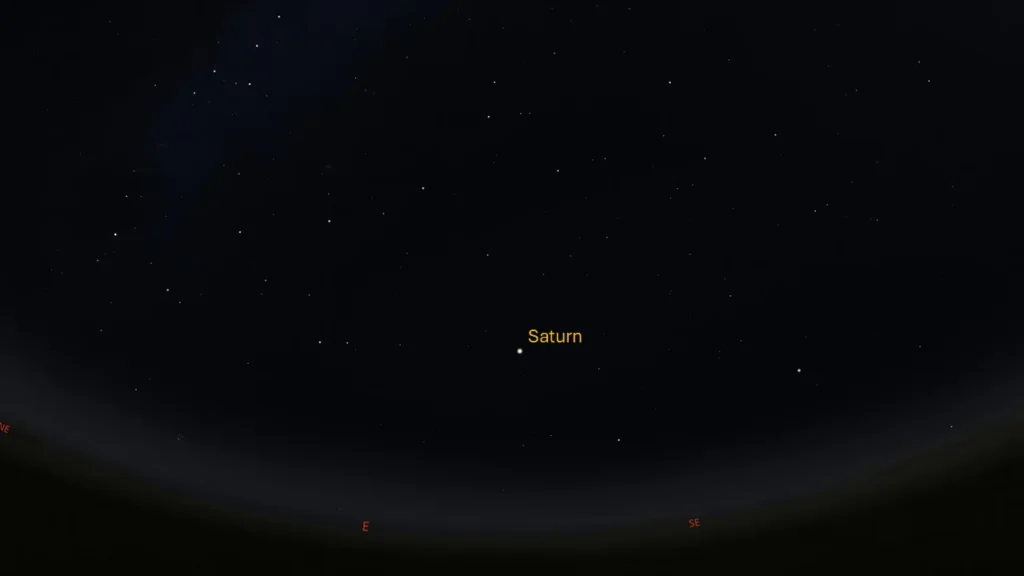
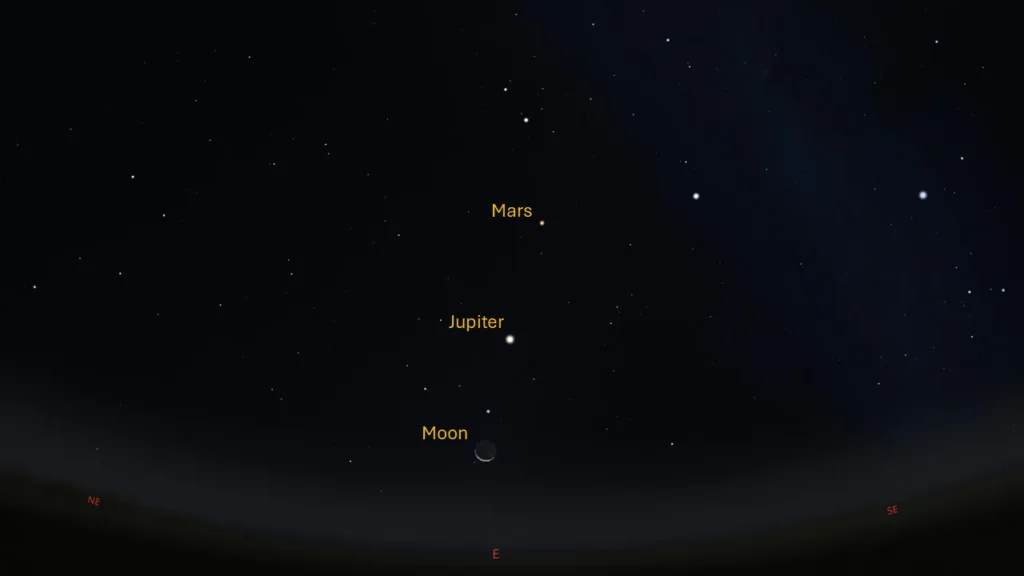
Three naked eye planets will be visible this week. Saturn rises in the east before sunset. Mars and Jupiter are visible in east before sunrise.
Venus
Venus is now too low for most to see. Venus reaches inferior conjunction on October 23, 2026.
Mars
Mars rises around 01:20 this week clearing the 15° mark by 02:45. This apparition of Mars is not the best as it is an aphelic apparition. ALPO’s guide for the Mars 2026-2027 aphelic apparition shows October 14, 2026, as the beginning of the apparition for those using telescopes between 4 and 8 inches. This is the time frame in which most observers can start seeing the surface of Mars through their telescope. Mars reaches opposition on February 19, 2027.
Jupiter
Jupiter rises this week around 02:38. You will need to wait for the giant world to clear trees, but it should be easy to see in the east by 04:00.
Saturn
Saturn now rises in the east before sunset. Once it clears trees and buildings in your area, Saturn will be an easy target for naked eye views. Saturn remains a good target until spring 2027 as it approaches superior conjunction on April 7, 2027.
Uranus
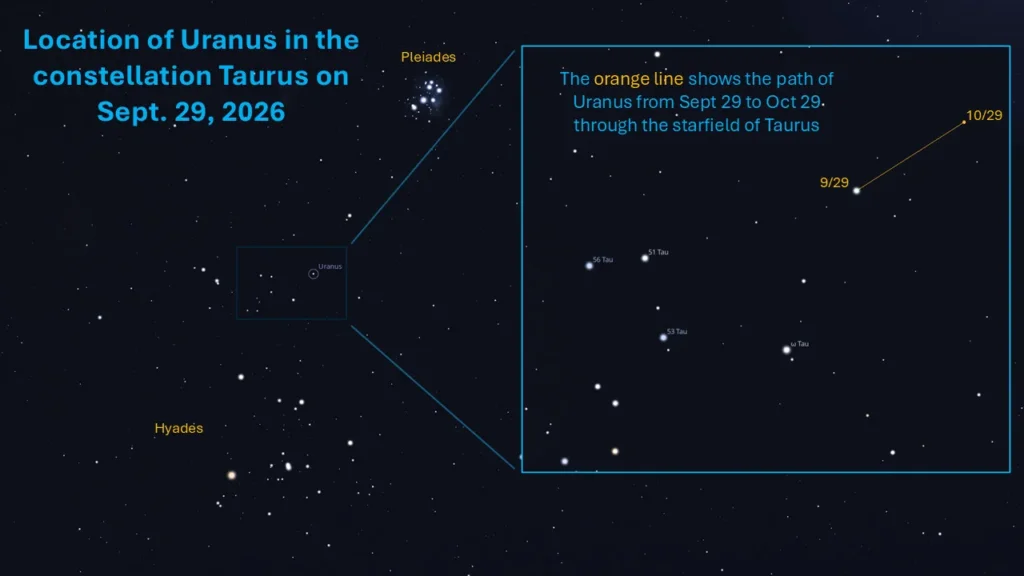
Uranus is technically bright enough to be seen naked eye under dark conditions. However, most will likely still need binoculars to spot the planet. Uranus will remain very easy to find for several years as it passes through the constellation Taurus. The smallest binocular I have used to spot Uranus is a 10×28 binocular. At magnitude 5.7, Uranus was very easy to find with this instrument.
Uranus rises around 20:55 this week but should be easy to find by 22:00. The ice giant can be found in Taurus between the Pleiades and Hyades star clusters.
Our next Star Party will be held on Friday, November 6, 2026 from 5:30 pm to 8:30 pm.
On the first Friday of each month, the St. Louis Astronomical Society and the Saint Louis Science Center will set up a number of telescopes outdoors and be on hand to answer your questions. Telescope viewing begins once it is dark.
The St. Louis Astronomical Society helps host the monthly Star Parties at the Saint Louis Science Center. In addition to our nighttime viewings, they also help facilitate our daytime event called Solar Sundays. These daytime viewing sessions occur on the 3rd Sunday each month. Visit SLAS’s website linked above to learn about other telescope events SLAS hosts around the St. Louis area.
James S. McDonnell Planetarium
Night Sky Update for October 6, 2026
Subjects