This is the Saint Louis Science Center’s NIGHT SKY UPDATE for the week of Sunday, January 12, 2025.
Information updated weekly or as needed.
Times given as local St. Louis time this week will be in Central Standard Time (CST). For definitions of terminology used in the night sky update, click the highlighted text. If relying on times posted in Universal Time (UT), St. Louis is -6 hours when CST.
Join us for our next star party, Friday, February 7, 2025, held in association with the St. Louis Astronomical Society.
For details, see the information at the bottom of this page or visit: https://www.slsc.org/explore/mcdonnell-planetarium/public-telescope-viewings
Observing Highlight of the Week
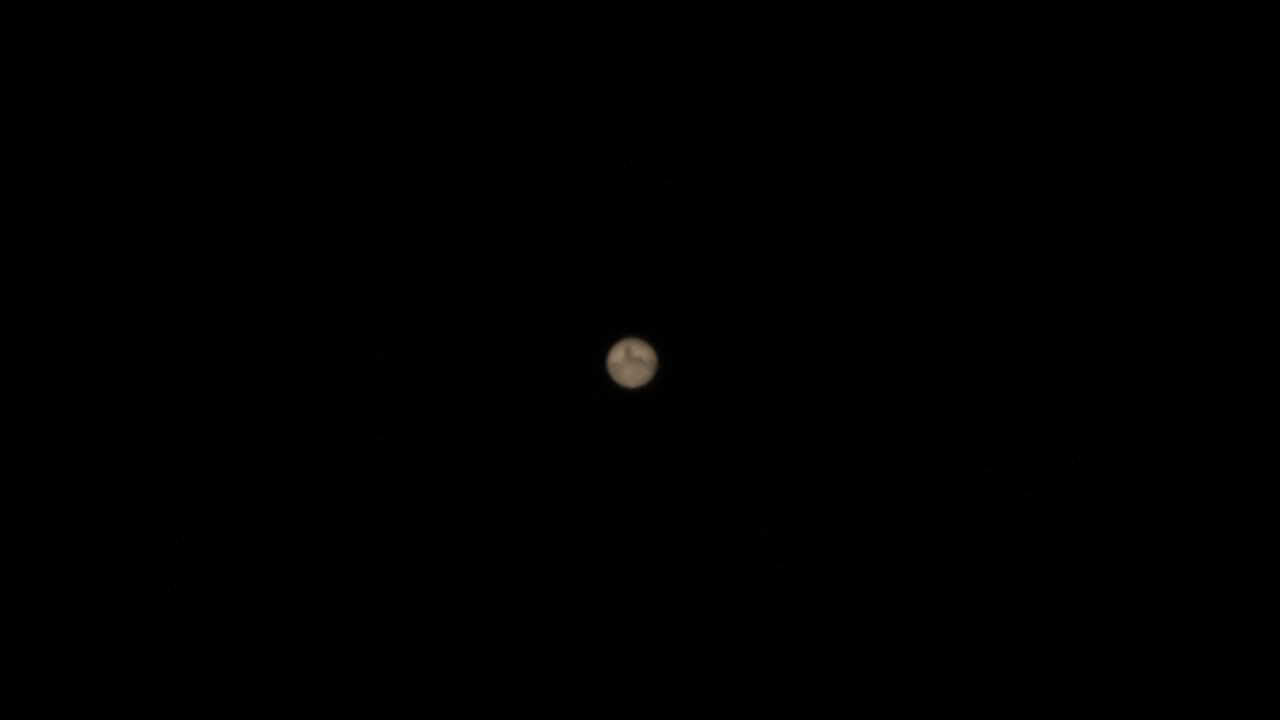
This image was recorded during opposition in 2018. In the image you can see subtle dark and light areas. These are the kind of details you can expect to see when viewing Mars through a telescope. Image Credit: Eric Gustafson.
On January 15, 2025, Mars reaches opposition. From our view on Earth, Mars will appear opposite the Sun on this day rising as the Sun sets. This is important for a few reasons. For agencies such as NASA, when Mars is near opposition, Earth and Mars are closer to one another. Space agencies take advantage of these close approaches to send spacecraft to Mars if any new missions are planned. Mars missions usually launch about 7-9 months before opposition aiming for where the planet will be on the target date. For backyard observers, when Mars is near opposition, we can see surface details on the planet with a modest backyard telescope.
During a Martian apparition, Mars’ apparent magnitude will fluctuate. This happens because the distance between Earth and Mars changes depending on where each planet is in its orbit. Since Earth is closer to the Sun we move faster. This allows Earth to catch up to Mars, eventually passing it by. In this process, the distance between Earth and Mars decreases causing the planet to appear larger and brighter.
For the current apparition, Mars is nearest Earth on January 12, 2025. A few days later, Mars will appear its brightest on January 15, 2025, when it reaches opposition. While proximity is part of why Mars looks brighter, the main reason Mars is brightest at opposition is the opposition effect. This is the same reason the Moon is brightest at full moon (opposition). When an object is at opposition, shadows cast by its surface features are pointed away from Earth. This causes the object to look brighter to us.
While it sounds amazing that you can see the surface of Mars, it is important to temper expectations. A quick search online for images of Mars will result in amazing images from talented planetary imagers. What you see through a telescope will not compare to these. You will be able to see the northern ice cap, you will see dark and bright albedo features, you might even see some dust storms if any are active. Just keep in mind, if it is your first time viewing Mars with a telescope, your initial impression may be one of disappointment. Keep looking, there are nuances to viewing Mars. You will quickly learn some of these as you observe. Poor viewing conditions will impact what you see. If one night is bad, look again some other night. If you don’t have a telescope, look up your local astronomy clubs as they may have public viewing sessions planned. For anyone interested in viewing Mars, I always recommend reading the article for the current apparition of Mars that is posted by the Association of Lunar and Planetary Observers. You can find that here
January 13, 2025, Mars Occultation
On January 13, 2025, Mars will pass behind the Moon in an event called an occultation. Weather permitting this will be visible from much of North America and portions of Northwestern Africa. For viewers in the St. Louis area, the entire occultation is visible.
An occultation occurs when a solar system body passes in front of another astronomical object obscuring it from view. The occulting body can be a moon, planet, asteroid or comet. These events offer astronomers a unique opportunity to study the objects involved. If you are interested in recording occultation timings, there is a group called the International Occultation Timing Association that has articles that explore why it is important and how you can get involved with this citizen science.
The occultation occurs over a period of roughly 3 hours from 7:44 pm CST to 11:52 pm CST. Depending on where you live in the path, the timings for the occultation will vary. In the St. Louis area, Mars will disappear behind the Moon at 8:02 pm reappearing on the other side at 9:13 pm CST. For those outside of the St. Louis area, you can visit In-The-Sky.org to set your viewing location. Once you set your location, search for the Mars occultation on January 13, 2025, for your local timings.
A few days after the occultation, Mars will reach opposition on January 15, 2025. We will explore this more next week.
The Sun and Moon
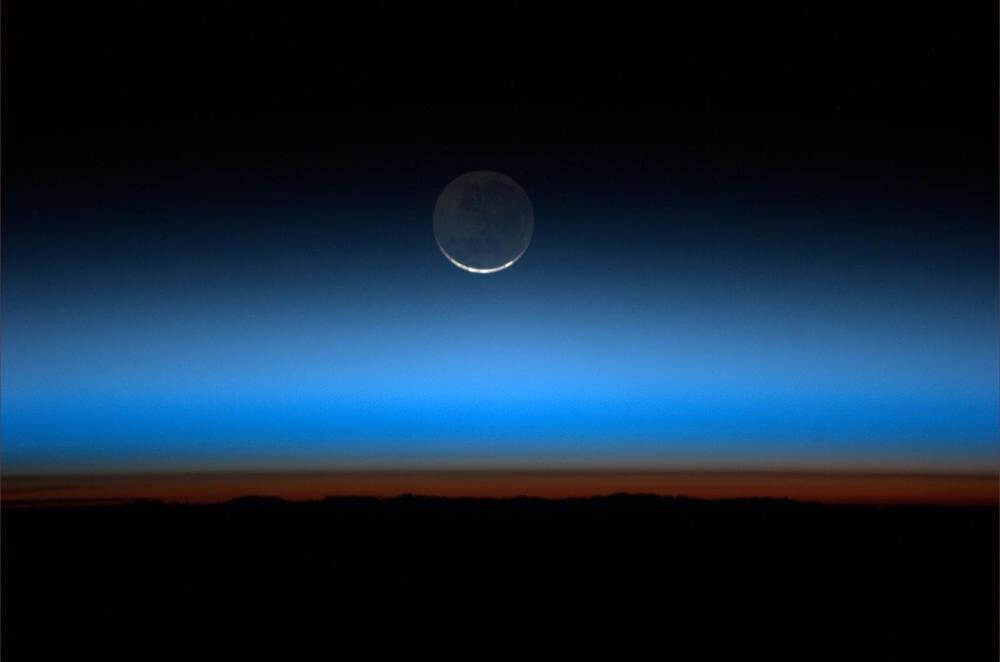
The Moon as seen from the International Space Station, on July 31, 2011.
Credit: NASA
Sun
Sunrise is at 7:18 am on Sunday, January 12 and sunset is at 5:01 pm providing close to 10 hours of daylight. Even after sunset, light from the Sun will dimly illuminate our sky for about 1 hour and 30 minutes. This period is called twilight, which ends around 6:35 pm this week. For those with a sundial, local noon occurs around 12:09 pm on January 12, 2025.
Moon
Moonrise for Sunday, January 12, is at 3:35 pm and moonset occurs at 7:27 am the following morning. The Moon starts the week off with a waxing gibbous phase exhibiting 98% disk illumination. By the end of the week the Moon will exhibit a waxing gibbous phase with 61% disk illumination. The first of 12 full moons in 2025 occurs on January 13, 2025, at 4:27 pm
International Space Station (ISS) Observing
There are several visible passes of ISS from St. Louis for the week of January 12. They occur during evening hours. The table below lists the best of these passes that will be seen from St. Louis. If you do not live in the area, you can use https://heavens-above.com/ to set your viewing location and get times for where you are.
Magnitude (Mag): The Measure of brightness for a celestial object. The lower the value is, the brighter the object will be.
Altitude (Alt): The angle of a celestial object measured upwards from the observer’s horizon.
Azimuth (Az): The direction of a celestial object, measured clockwise from an observer’s location with north being 0°, east being 90°, south being 180° and west being 270°.
Detailed information regarding all unmanned exploration of our universe, missions past, present, and planned, can be found at Jet Propulsion Laboratories:
The Visible Planets
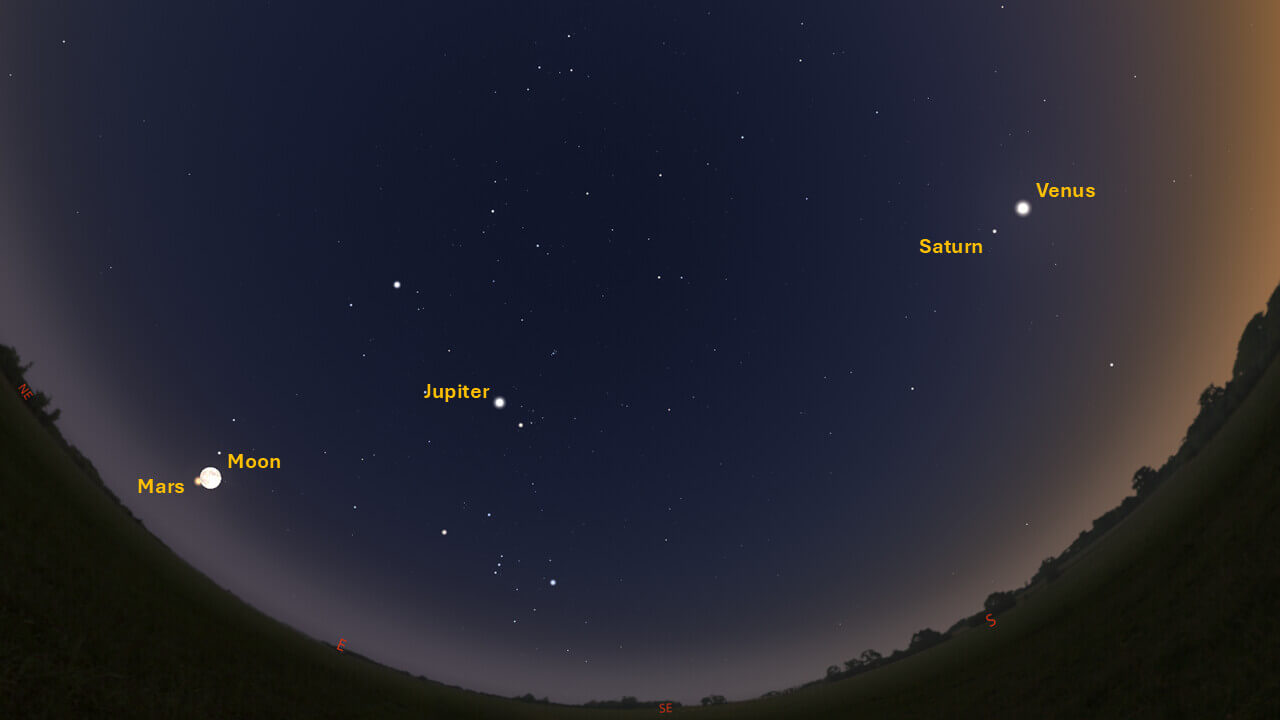
Looking southeast at 5:45 pm on January 13, 2025. Credit: Stellarium, EG
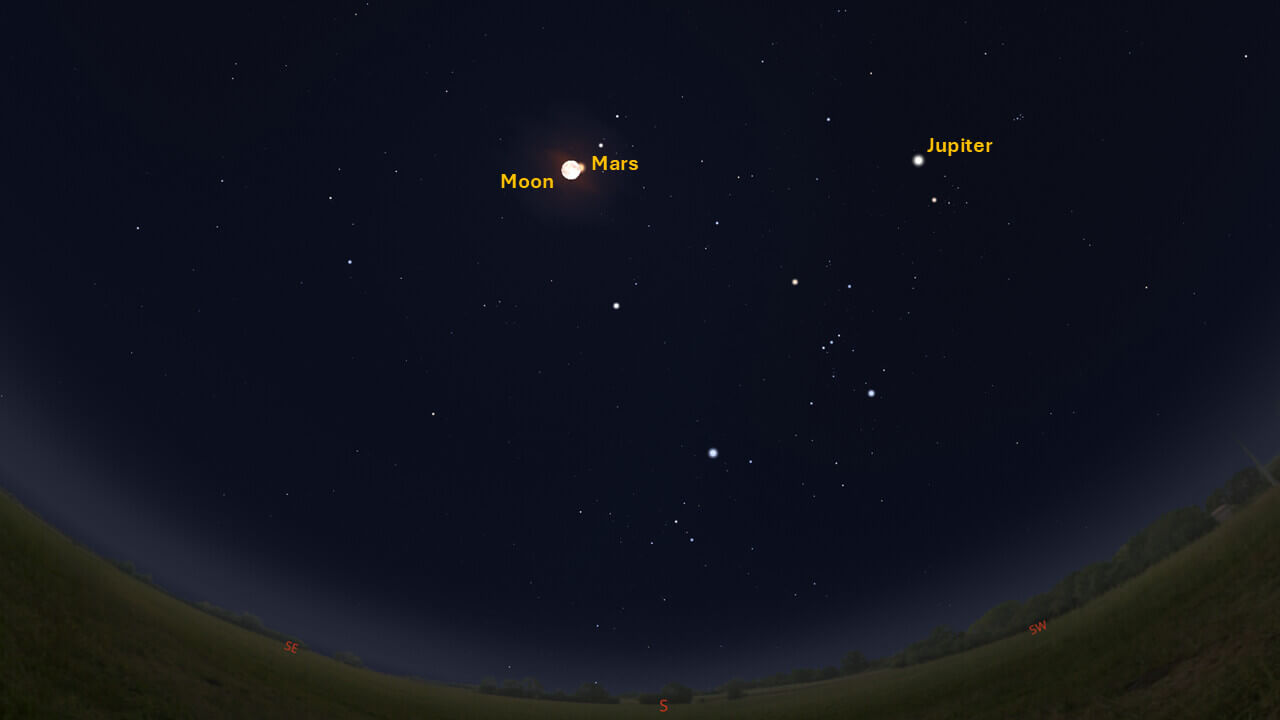
Looking south at 11:45 pm on January 13, 2025. Credit: Stellarium, EG
This week, four naked eye planets are visible. All four are visible in the evening sky with Venus, Jupiter and Saturn visible not long after sunset. Mars rises a little later, becoming visible in evening hours.
Venus
Venus will be visible in the southwest after sunset. You can start looking for Venus about 15 minutes after the Sun sets. Venus will set by 8:50 pm. Venus reaches maximum eastern elongation on January 9, 2025. The next day, Venus will be at dichotomy. When seen through a telescope, Venus exhibits a quarter phase when at dichotomy.
Mars
Mars rises at 5:04 pm and should be visible in the east after 6:00 pm. Mars reaches opposition next on January 15, 2025.
Jupiter
Now past opposition, Jupiter rises before the Sun sets. Look for Jupiter in the east as the sky begins to darken.
Saturn
Saturn will be visible in the southwest shortly after sunset. Saturn now sets around 9:14 pm Each week Saturn will set about 25 minutes earlier than it did the week before.
Our next Star Party will be held on Friday, February 7, 2024, from 5:30 pm until 8:30 pm
On the first Friday of each month, the St. Louis Astronomical Society and the Saint Louis Science Center will set up a number of telescopes outdoors and be on-hand to answer your questions. Telescope viewing begins once it is dark. Regardless of the weather on February 7, join us indoors in our planetarium theater for our “Monthly Sky Lecture.” Showtime is at 7 pm
This free, indoor star program will introduce you to the current night sky. Doors open 15 minutes before show time. Shows begins at 7 p.m. Sorry, no late admissions due to safety issues in the darkened theater.
The St. Louis Astronomical Society helps host the monthly Star Parties at the Saint Louis Science Center. In addition to our nighttime viewings, they also help facilitate our daytime event called Solar Sundays. These daytime viewing sessions occur on the 3rd Sunday of each month. Visit SLAS’s website linked above to learn about other telescope events SLAS hosts around the St. Louis area.
James S. McDonnell Planetarium
Night Sky Update: January 12-20,2025
Subjects