This is the Saint Louis Science Center’s NIGHT SKY UPDATE for the week of Saturday, March 15, 2025.
Information updated weekly or as needed.
Times given as local St. Louis time this week will be in Daylight Saving Time. For definitions of terminology used in the night sky update, click the highlighted text. If relying on times posted in Universal Time (UT), St. Louis is -5 hours when CDT. Times posted in the Night Sky Update are in the 24-hour format.
Join us for our next star party, Friday, April 4, 2025, held in association with the St. Louis Astronomical Society.
Observing Highlight of the Week
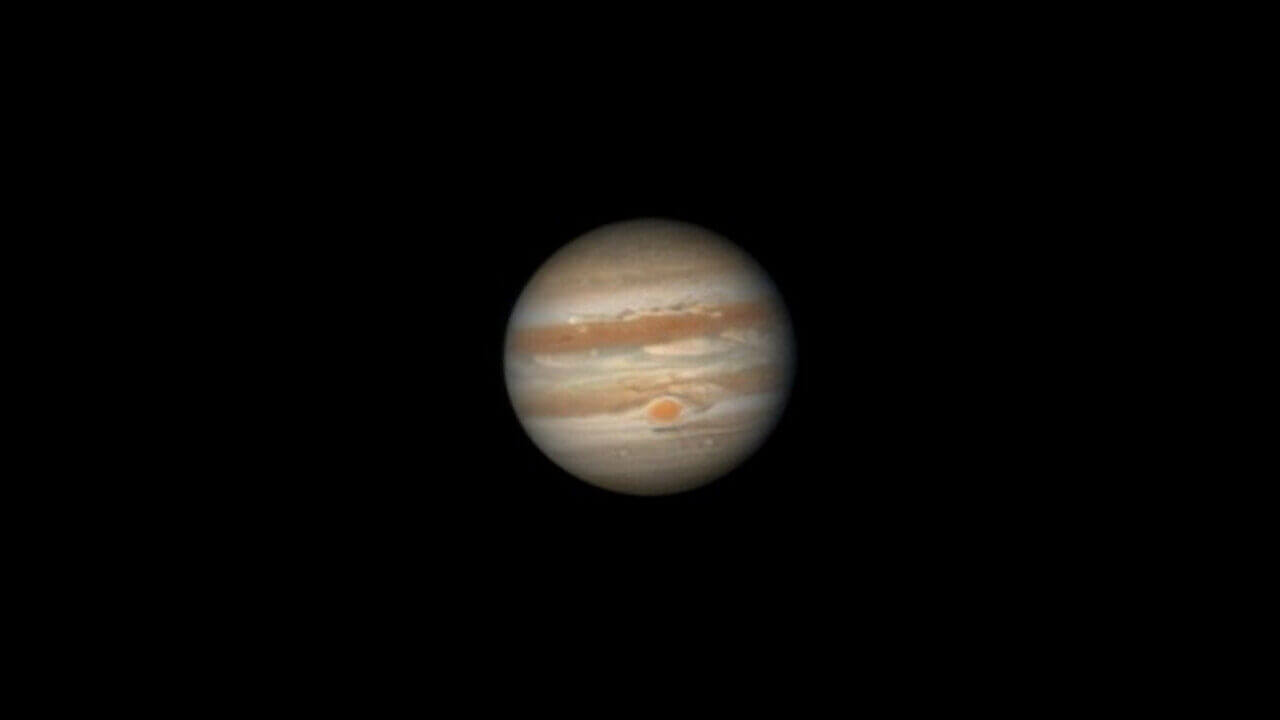
The giant storm in Jupiter’s atmosphere called the Great Red Spot can be seen in this image captured on January 26, 2025, by Randy Harrison of River Bend Astronomy Club and Lookin’ Up Optics.
There are several astronomical events happening this week. Some of them are observable while others are not. Even though we cannot observe all of this week’s highlights, they are important milestones that indicate when certain objects will once again be visible. Let’s start with Jupiter.
Jupiter
For several months, Jupiter has been visible not long after sunset. This will remain the case through the first couple of weeks of June. On June 24, 2025, Jupiter reaches conjunction with the Sun. This is when the giant planet will appear on the other side of the Sun from Earth. As we approach this date, Jupiter will become increasingly difficult to see as its altitude decreases each day closer to the date of conjunction. As a result, Jupiter will appear nearer the Sun each day until we lose it to the glow of twilight.
While Jupiter remains high in the sky after sunset, it will be an excellent target for backyard telescopes. Weather patterns in Jupiter’s atmosphere will appear as bands of dark and light-colored gasses. The darker regions are called belts, and the brighter regions are zones. At higher magnifications, storms, and other complex structures can be seen making Jupiter a dynamic target to observe. Sky and Telescope has an excellent observer’s guide for Jupiter which can be found here.
On March 18, 20, and 23, the Great Red Spot will be in transit as the sky darkens. This famous storm in Jupiter’s atmosphere has been shrinking and my now be smaller that Earth. If this is the case, it is the smallest the storm has ever been. Why the Great Spot is shrinking is still debated, however new research shows a possible correlation between size of the storm and how many smaller storms it encounters. You can read about this research here.
Moon
Last quarter moon occurs this week on March 22, 2025. This is a good time to look for the Moon in the daytime. During its waning phases, daytime views of the Moon are best in morning hours. By March 20, look for the Moon in the southwest shortly after sunrise. It will appear higher in the morning sky each day after the 20th until it starts to appear nearer the Sun. As the Moon shifts into is waning crescent phases, it will become increasingly difficult to see in the daytime.
Venus and Mercury
The last few weeks, Mercury and Venus were easy to spot low in the west after sunset. Unfortunately, both planets have become low enough that they will be tough to see. Both planets are headed towards inferior conjunction this month which is when they pass between Earth and the Sun. After inferior conjunction, both planets will become visible in the east just before sunrise. Inferior conjunction for Venus occurs on March 22. For Mercury, inferior conjunction is on March 24.
Saturn Ring Plane Crossing
Saturn has been lost to the Sun’s glare for a few weeks now. Eventually, Saturn will become visible in the east before sunrise as it starts another apparition. While we wait for Saturn to reappear, Saturn’s ring system will go through a ring plane crossing. Sadly, this event will not be visible from Earth due to the Sun’s glare. Once Saturn returns, its rings will continue to appear nearly edge on when viewed form Earth for a few months. This happens when Saturn approaches an equinox which is roughly every 15 years. Saturn’s next equinox occurs in May 2025. Over the next 15 years, Saturn’s southern hemisphere will be inclined towards Earth. This happens for the same reason Earth has seasons, Saturn’s axis of rotation is tilted. Saturn takes nearly 30 years to cycle through all four seasons.
T CrB Nova Update 3/16/2025
If you are still interested in seeing the recurrent nova T Coronae Borealis, there is still hope. The nova has not yet occurred meaning we are in a waiting game. It could happen this year or it could happen next year. We will have to wait and see. If you are still interested in this event, the part of the sky the nova will appear in is rising earlier each night. By midnight, the constellation Corona Borealis will be found high in the eastern sky. Spaceweather.com is still posting magnitude estimates from the AAVSO. This is the resource I recommend following to keep up with any changes in the star’s brightness. Current magnitude of the system is 10.0.
The Sun and Moon
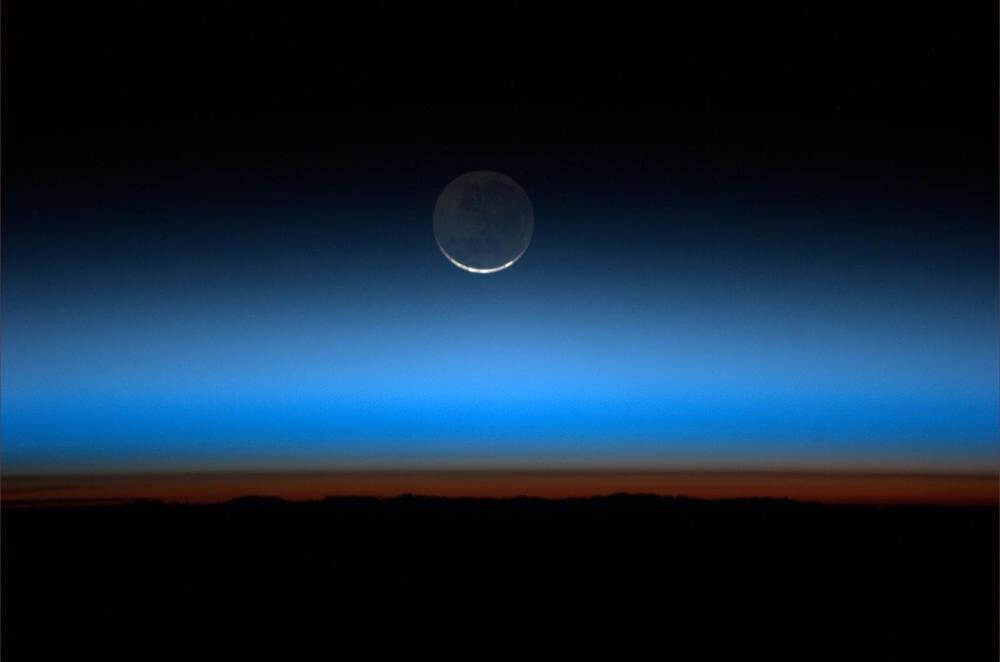
The Moon as seen from the International Space Station, on July 31, 2011.
Credit: NASA
Sun
Sunrise is at 07:11 on Saturday, March 15 and sunset is at 19:09 providing roughly 12 hours of daylight. Even after sunset, light from the Sun will dimly illuminate our sky for about 1 hour and 30 minutes. This period is called twilight, which ends around 20:37 this week. For those with a sundial, local noon occurs around 13:10 on March 15, 2025.
The vernal equinox occurs on March 20, 2025. This officially starts the spring season in the northern hemisphere. Look for daytime to grow longer each day until the June solstice, on June 20, 2025.
Moon
Moonrise for Saturday, March 15, was at 20:44 and moonset occurred at 08:04 the following morning. The Moon starts the week off with a waning gibbous phase exhibiting 97% disk illumination. By the end of the week the Moon will exhibit a waning crescent phase with 35% disk illumination. Last quarter moon occurs on March 22, 2025, at 06:30 CDT.
International Space Station (ISS) Observing
Passes of ISS visible from St. Louis for the week of March 15, occur in evening hours. The table below lists the best of these passes that will be seen from St. Louis. If you do not live in the area, you can use https://heavens-above.com/ to set your viewing location and get times for where you are.
Magnitude (Mag): The Measure of brightness for a celestial object. The lower the value is, the brighter the object will be.
Altitude (Alt): The angle of a celestial object measured upwards from the observer’s horizon.
Azimuth (Az): The direction of a celestial object, measured clockwise from an observer’s location with north being 0°, east being 90°, south being 180° and west being 270°.
Detailed information regarding all unmanned exploration of our universe, missions past, present, and planned, can be found at Jet Propulsion Laboratories
The Visible Planets
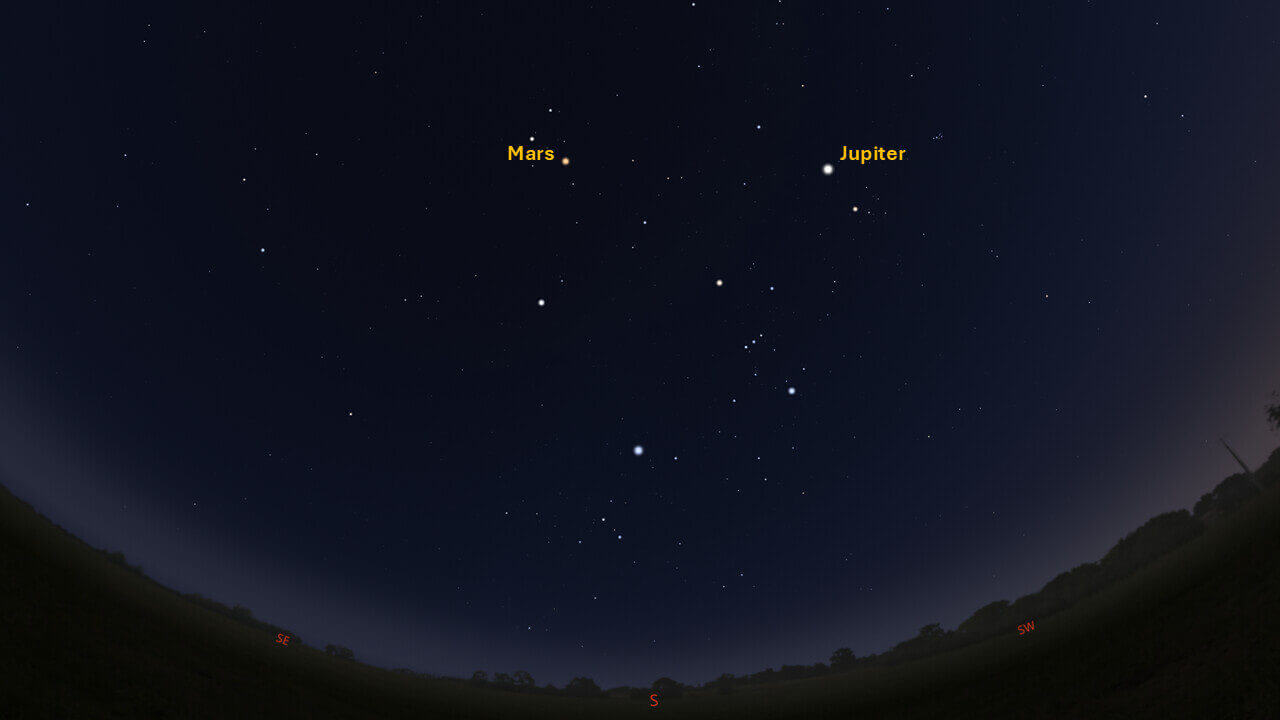
Looking south at 20:00 on March 16, 2025. Credit: Stellarium, EG
This week, Two naked eye planets are visible. Venus and Mercury are now appearing low enough to the horizon that they are hard to find due to trees or buildings.
Mars
Mars is now past opposition. Look for it overhead after sunset. The current apparition of Mars will continue throughout the rest of 2025. Watch for the Red Planet as it shifts westward through the year. Mars sets around 04:16 this week.
Jupiter
Now past opposition, Jupiter rises before the Sun sets. Look for Jupiter high in the west about 30 minutes after sunset. Jupiter sets around 01:29.
Our next Star Party will be held on Friday, April 4, 2025, from 6:30 pm until 9:30 pm
On the first Friday of each month, the St. Louis Astronomical Society and the Saint Louis Science Center will set up a number of telescopes outdoors and be on-hand to answer your questions. Telescope viewing begins once it is dark. Regardless of the weather on April 4, join us indoors in our planetarium theater for our “Monthly Sky Lecture”.
This free, indoor star program will introduce you to the current night sky. Doors open 15 minutes before show time. Once a show is underway, there are no late admissions due to safety issues in the darkened theater.
The St. Louis Astronomical Society helps host the monthly Star Parties at the Saint Louis Science Center. In addition to our nighttime viewings, they also help facilitate our daytime event called Solar Sundays. These daytime viewing sessions occur on the 3rd Sunday of each month. Visit SLAS’s website linked above to learn about other telescope events SLAS hosts around the St. Louis area.
James S. McDonnell Planetarium
Night Sky Update: March 15-23, 2025
Subjects