This is the Saint Louis Science Center’s NIGHT SKY UPDATE for the week of Saturday, April 5, 2025.
Information updated weekly or as needed.
Times given as local St. Louis time this week will be in Daylight Saving Time. For definitions of terminology used in the night sky update, click the highlighted text. If relying on times posted in Universal Time (UT), St. Louis is -5 hours when CDT. Times posted in the Night Sky Update are in the 24-hour format.
Join us for our next star party, Friday, May 2, 2025, held in association with the St. Louis Astronomical Society.
Observing Highlight of the Week
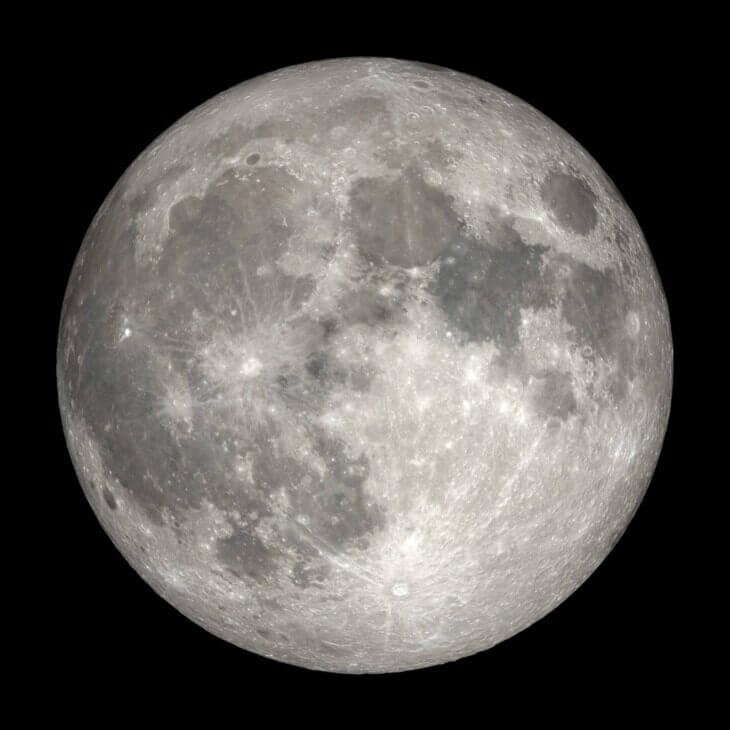
The image above shows the appearance of full moon as it will appear on April 13, 2025, due to libration. Image credit: NASA, SVS, Ernie Wright, Noah Petro and James Tralie.
Full moon occurs this month on April 13, 2025. It is the 4th of 12 full moons this year and it is the first of spring. Tracking full moons was an early method our ancestors used to keep time as many early calendars were lunar based. Lunar calendars eventually evolved into lunisolar calendars as we realized that the lunar phase cycle did not sync with the cycle of seasons. Lunisolar calendars fell out of favor as the mechanism that kept them in sync with seasons involved complex intercalary periods determined by the Metonic Cycle. While lunisolar calendars fell out of favor, they are still used by many to determine dates for various cultural traditions.
One last connection you can still find to past lunar calendars are full moon names. Names such as the full Thunder Moon, Cold Moon or Buck Moon, are names that were given to indicate certain times of year. April’s full moon is often called the full Pink Moon in reference to blooming flowers. While these names are not important today, they are a reminder of times past when time keeping was done with the Moon.
The familiar cycle of moon phases is called the synodic month. It is one of several lunar cycles our ancestors discovered a long time ago. Another lunar cycle is the draconic month. This is a measure of the time it takes the Moon to pass through its crossing nodes. Every 27.21222 days, the Moon’s orbit crosses Earth’s ecliptic twice. Once at the ascending node and once at the descending node. A draconic month is measuring the time between successive passes of one of these nodes. This month along with the synodic month and the anomalistic month, is involved with our ability to predict eclipses.
The anomalistic month is a measure of the Moon’s apsides cycle. In an orbital system there are two apsis. They represent the near and far points in an object’s orbit. The near point is indicated by the prefix “peri” and the far point has the prefix “apo.” The Moon’s apsides are called perigee and apogee. Successive passes of the Moon through one of these points take 25.55455 days. While this type of month is useful for predicting and understanding the magnitude of eclipses, it is also connected to a term that has become popular these days. That term is “supermoon.”
The term supermoon was coined by an astrologer in 1979, who used it to describe a new or full moon which occurs near perigee. He also claimed that supermoons would cause an increase in earthquakes and sever weather, which no such connection has ever been found. While promoting pseudoscience claims such as these are fundamentally problematic, they are not always done in malice. Sometimes misconceptions arise from lack of understanding. In this case, it is well known that high and low tide cycles are influenced by the lunar cycle. It is not surprising that some would mistakenly assume the Moon might influence other physical processes or even behaviors. Misconceptions are understandable; however, it is on us to ask critical questions that help us understand what is happening.
The one good thing that comes from people’s renewed interest in a perigee full moon (supermoon) is an interest in looking up. Getting outside, observing the sky is how we learn more. In time, asking questions will lead us to the answers that help us understand topics such as supermoons. An interesting opportunity is available with April’s full moon. It turns out, this Month’s full moon is the smallest full moon of the year. Full moon occurs a little less than 23 hours before the Moon reaches apogee. November’s full moon is the largest of the year occurring 9 hours before perigee. I used the terms smallest and largest because the Moon looks about 14% larger at perigee. It also appears 30% brighter when at perigee. An interesting observing project would be to see if you can observe this difference. Go outside each month during full moon. See if there is an observable difference as the occurrence of full moon shifts from apogee this spring to perigee this fall. If you had a light meter, you could also see if there is an observable difference in the Moon’s brightness during this shift.
Check out the Moon this week as it shifts a waxing gibbous phase to full moon on April 13, 2025. If you plan to use a telescope make sure to use a lunar eyepiece filter as the Moon is uncomfortably bright when seen through a telescope as it nears full moon.
T CrB Nova Update 4/6/2025
If you are still interested in seeing the recurrent nova T Coronae Borealis, there is still hope. The nova has not yet occurred meaning we are in a waiting game. It could happen this year or it could happen next year. We will have to wait and see. If you are still interested in this event, the part of the sky the nova will appear in is rising earlier each night. By midnight, the constellation Corona Borealis will be found high in the eastern sky. Spaceweather.com is still posting magnitude estimates from the AAVSO. This is the resource I recommend following to keep up with any changes in the star’s brightness. Current magnitude of the system is 9.9.
The Sun and Moon
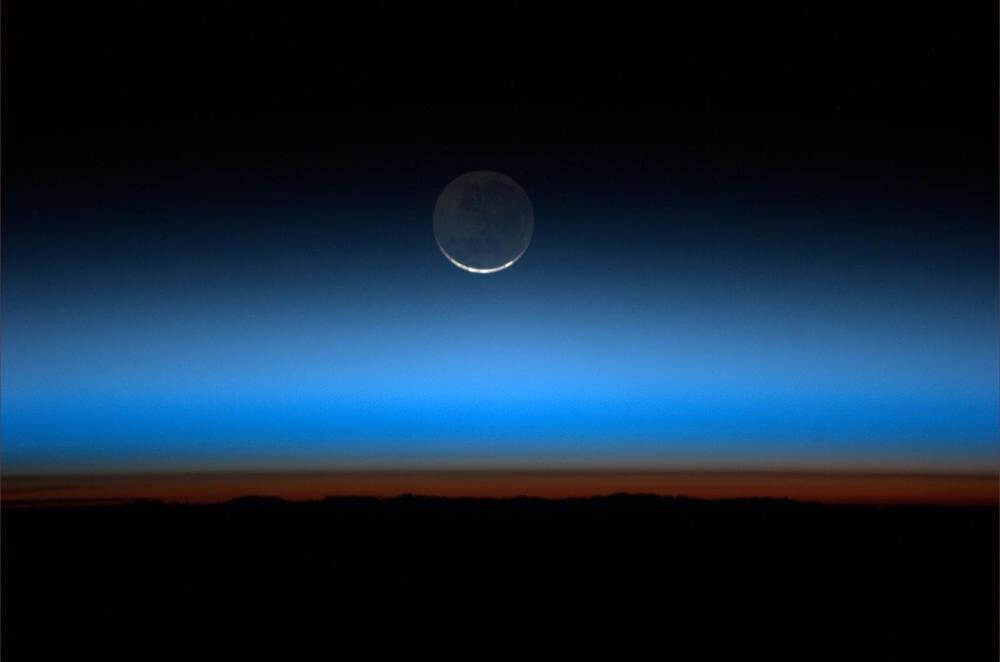
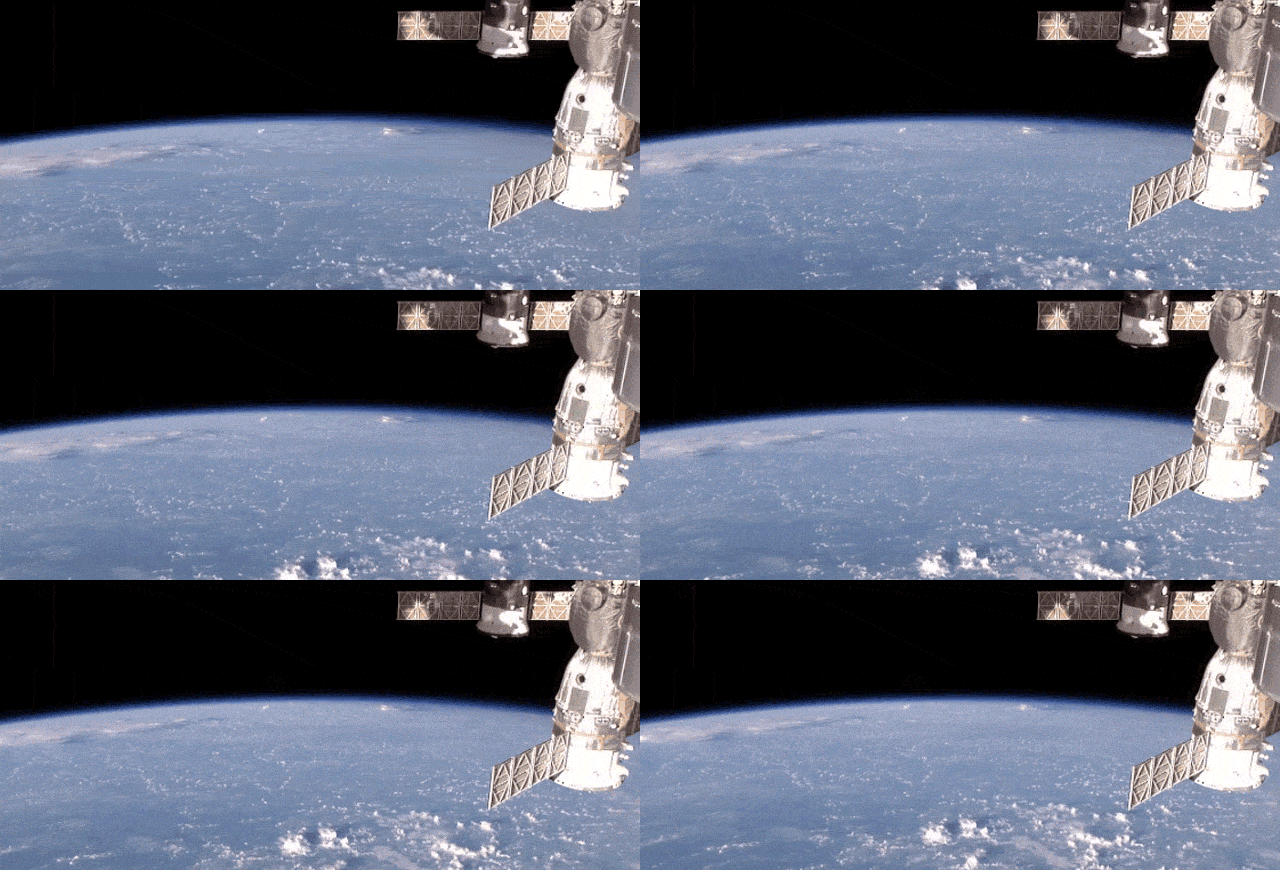
The Moon as seen from the International Space Station, on July 31, 2011.
Credit: NASA
Sun
Sunrise is at 06:39 on Saturday, April 5 and sunset is at 19:28 providing about 13 hours of daylight. Even after sunset, light from the Sun will dimly illuminate our sky for about 1 hour and 40 minutes. This period is called twilight, which ends around 21:01 this week. For those with a sundial, local noon occurs around 13:04 on April 5, 2025.
Moon
Moonrise for Saturday, April 5, was at 12:20 and moonset occurred at 03:46 the following morning. The Moon starts the week off exhibiting a waxing gibbous phase with 60% disk illumination. By the end of the week the Moon will exhibit a full moon on April 13, 2025. Last quarter moon occurs on April 20, 2025, at 20:36 CDT.
International Space Station (ISS) Observing
There are no passes of ISS visible from St. Louis for the week of April 5. ISS will return to St. Louis skies on April 18, 2025, when we will see it during morning hours. The table below lists the best of these passes that will be seen from St. Louis after April 18. If you do not live in the area, you can use https://heavens-above.com/ to set your viewing location and get times for where you are.
Magnitude (Mag): The Measure of brightness for a celestial object. The lower the value is, the brighter the object will be.
Altitude (Alt): The angle of a celestial object measured upwards from the observer’s horizon.
Azimuth (Az): The direction of a celestial object, measured clockwise from an observer’s location with north being 0°, east being 90°, south being 180° and west being 270°.
Detailed information regarding all unmanned exploration of our universe, missions past, present, and planned, can be found at Jet Propulsion Laboratories
The Visible Planets
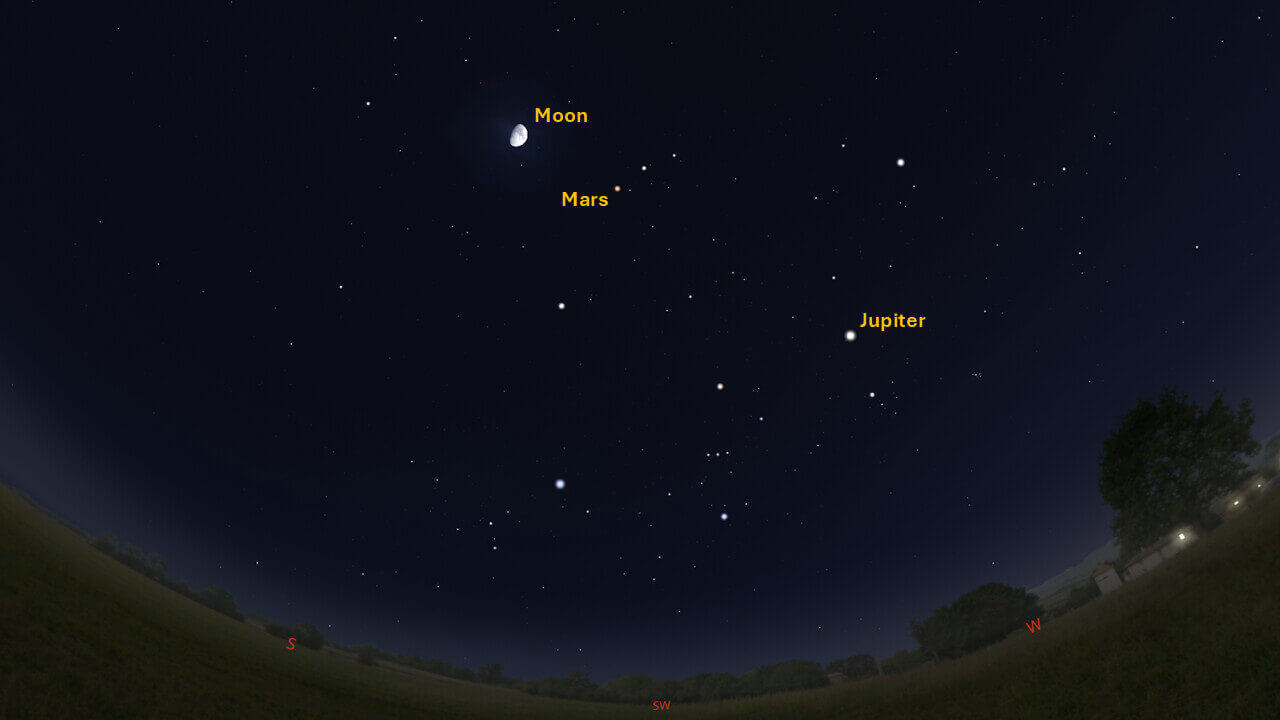
Looking southwest at 20:30 on April 6, 2025. Credit: Stellarium, EG
This week, two naked eye planets are visible. Mars and Jupiter will be visible shortly after sunset.
Mars
Look for Mars overhead after sunset. It is currently found near the bright stars Castor and Pollux. The current apparition of Mars will continue throughout the rest of 2025. Watch for the Red Planet as it shifts westward through the year. Mars sets around 03:00 this week.
Jupiter
Jupiter will be visible high in the west not long after sunset. Jupiter sets by 00:21, remaining visible up to 23:30. Jupiter reaches superior conjunction on June 24, 2025.
Our next Star Party will be held on Friday, May 2, 2025, from 6:30 pm until 9:30 pm
On the first Friday of each month, the St. Louis Astronomical Society and the Saint Louis Science Center will set up a number of telescopes outdoors and be on-hand to answer your questions. Telescope viewing begins once it is dark. Regardless of the weather on May 2, join us indoors in our planetarium theater for our “Monthly Sky Lecture”.
This free, indoor star program will introduce you to the current night sky. Doors open 15 minutes before show time. Once a show is underway, there are no late admissions due to safety issues in the darkened theater.
The St. Louis Astronomical Society helps host the monthly Star Parties at the Saint Louis Science Center. In addition to our nighttime viewings, they also help facilitate our daytime event called Solar Sundays. These daytime viewing sessions occur on the 3rd Sunday of each month. Visit SLAS’s website linked above to learn about other telescope events SLAS hosts around the St. Louis area.
James S. McDonnell Planetarium
Night Sky Update: April 5-13, 2025
Subjects