This is the Saint Louis Science Center’s NIGHT SKY UPDATE for the week of Monday, October 20, 2025.
Information updated weekly or as needed.
Times given as local St. Louis time this week will be in Daylight Saving Time. For definitions of terminology used in the night sky update, click the highlighted text. If relying on times posted in Universal Time (UT), St. Louis is -5 hours when CDT. Times posted in the Night Sky Update are in the 24-hour format.
Join us for our next star party, Friday, November 7, 2025, held in association with the St. Louis Astronomical Society.
For details, see the information at the bottom of this page or visit: https://www.slsc.org/explore/mcdonnell-planetarium/public-telescope-viewings
Observing Highlight Comets C/2025 A6 (Lemmon) & C/2025 R2 (Swan) Updated 10/20/2025
What a difference a day makes………..
Now that C/2025 A6 (Lemmon) and C/2025 R2 (SWAN) are climbing higher above the horizon, they are much easier to see. As both comets reach perigee over the next two days, I wanted to update information based on what I saw on October 19, 2025, from a bright suburban location near St. Louis. I stress the location because it is likely most people reading this will be observing under similar conditions.
Both comets are easy to see now however they are not comets you will easily find if you are just panning across the sky hoping to stumble on them. You will need binoculars and some kind of sky atlas to help identify star fields in the vicinity of the comets.
If you plan to look for the comets, the first thing I recommend doing is to find some kind of planetarium software such as Stellarium. If you do not want to use a software like this, look for an article covering these comets as they will likely have updated maps showing the location of the comets. The maps you need to look for should have stars down to at least magnitude 6. The sky atlas I use in tandem with Stellarium is the “Pocket Sky Atlas” from Sky and Telescope. Stellarium will help you plan your observing session no matter what your target it. Once you know the star field you will be looking at, a sky atlas will be your reference once you are outside. When looking for faint targets, it is ideal to stay outside allowing your eyes to become dark adapted.
I also recommend using a chair. This is useful because holding binoculars steady for long periods is difficult. A chair will allow you to steady yourself while focusing on what you see.
As I update this content it will be informed by observations using equipment that is common to have access to. While I will use telescopes when observing, everything presented below is based on finding the comets with binoculars ranging in size from 8×28 to 10×50 from light polluted areas. It is best to observe the comets through telescopes from a dark location; however, this is not something everybody will have access to.
It is also important to temper expectations regarding what you will see when you find the comet. Until you have seen a comet it is hard to imagine what it might look like. We often see images showing a bright green coma with a complex tail system. These kinds of details are really only visible if you image the comet. When using binoculars, most comets only reveal their comas. If it is a bright comet, its dust tail may be seen. So far only the coma of both comets has been visible for me while using binoculars. They appear as a dim nebulous patch of light that appears much large then the pinpoint view of a star. A useful trick to spot these dim patches is to slowly move your binocular side to side like you are shaking your head to indicate “no.” You don’t have to use wide shakes, rather move your head just enough to adjust your view of the star field. This subtle motion can help you see dimmer objects.
All maps used below represent the sky if viewed from St. Louis, Missouri.
C/2025 A6 (Lemmon) Update 10/20/2025
On October 19, 2025, C/2025 A6 (Lemmon) was fairly easy to see by 19:30. The comet is listed at 4.6 magnitude making it the brighter of the two comets, however it is lower to the horizon placing it deeper into the soup of twilight and city glow. I was able to find the comet inside city limits without and difficulty. When I found the comet I saw a dim nebulous patch with a brighter center. While C/2025 A6 (Lemmon) does have a dust tail, I was unable to see it.
If you are having trouble finding the comet, twilight ends a little before 20:00 this week. If you have clear views to the northwest you might have a chance to find C/2025 A6 (Lemmon) in darker conditions. It will be found less than 10° above the horizon after 20:00 so your view has to be free of trees or buildings.
From October 20-23, C/2025 A6 (Lemmon) is easy to find if you can locate the constellations Ursa Major and Boötes. To do this, first find the Big Dipper in Ursa Major. Once you can find the Big Dipper, follow the curve of its handle to the bright orange star in the northwest called Arcturus. This will be the brightest object in that direction. Once you find Arcturus in Boötes, look for two stars just above Arcturus known as Epsilon and Rho Boötis. Over the next few days, C/2025 A6 (Lemmon) will be passing just below these stars.
Once you have located Epsilon and Rho Boötis, it will be important to identify fainter stars in the area. This is useful because they will help confirm you are looking in the right star filed. For C/2025 A6 (Lemmon), I recommend identifying stars such as 41 Boo, 43 Boo, 45 Boo and 46 Boo. This is where software such as Stellarium will be necessary. Once you have a good feel for the star field near the comets path, grab your binoculars and start scanning the area. While each person will have varying results, when you find the comet, you will see a dim nebulous patch of light that may have a brighter center.
The maps below will walk you through the information suggested above.

You will find Ursa Major (Big Dipper) and Boötes in the northwest after 7pm. Image created using Stellarium.
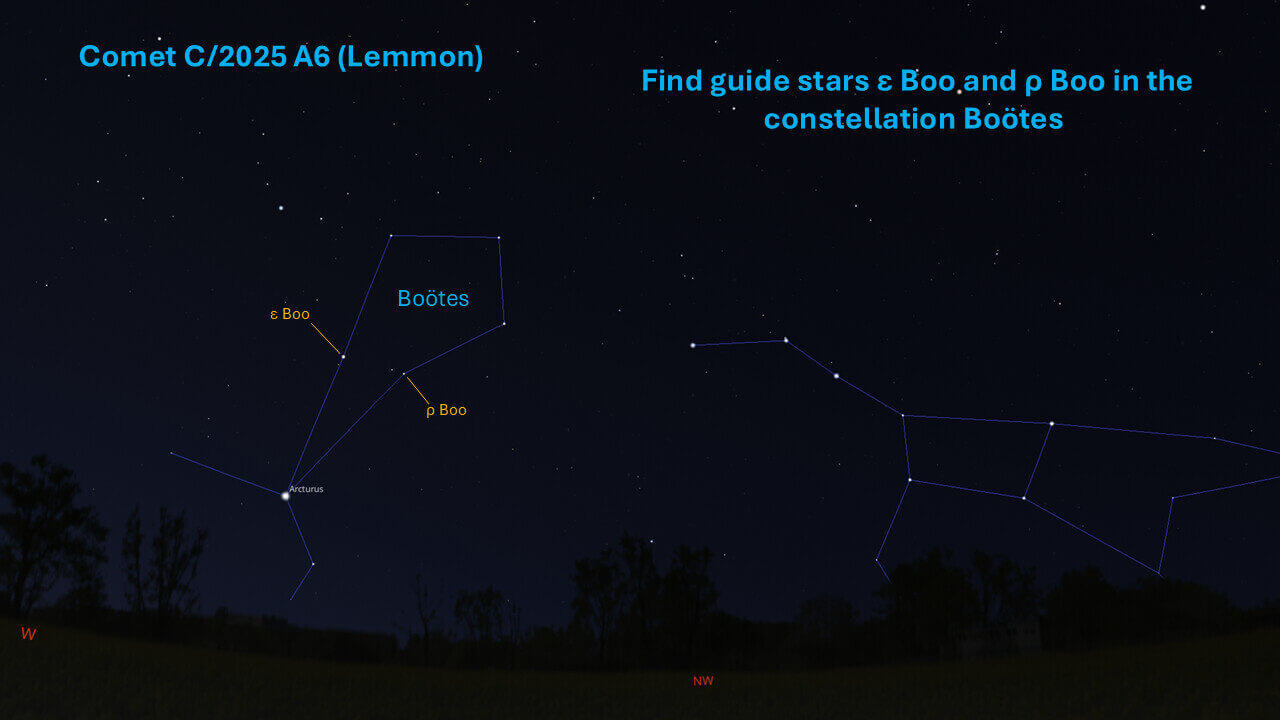
The guide stars Epsilon and Rho Boötis are the two bright stars just above Arcturus. If you are looking before 19:30, you may need binoculars to spot them. Image created using Stellarium.

Fainter stars are useful to make sure you are looking at the right star field. Planetarium software or a sky atlas will help you identify these stars. Image created using Stellarium.
C/2025 R2 (SWAN) Update 10/20/2025
I finally found comet C/2025 R2 (SWAN) on October 19, 2025. While I was still in the city, I tried to find the comet around 19:40 but was unable to find it due to twilight and urban levels of light pollution. To find C/2025 R2 (SWAN), I had to drive about 20 minutes outside of St. Louis city limits and tried again around 20:20. Being under slightly darker suburban skies and observing after twilight made find C/2025 R2 (SWAN) very easy. I was able to see a dim coma easily amongst the bright star field, but no tail is visible.
To find C/2025 R2 (SWAN) over the next few days you should start by locating the constellations Aquila, Sagittarius and Capricornus. Aquila has a diamond-shape and is the southern portion of the Summer Triangle asterism. The bright Summer Triangle star in Aquila is called Altair. Sagittarius and found to the southwest of Altair and Capricornus is found south of Altair. Sagittarius is easy to spot due to the bright tea pot shape of stars within its boundaries. Capricornus is also easy to find as it looks like a big smile in the sky.
Once you have found these constellations, it is time to find fainter stars near the path of C/2025 R2 (SWAN). I recommend using 37 Sgr, 41 Sgr and 44 Sgr in Sagittarius and 6 Cap and 9 Cap in Capricornus. When you can find these stars pan your binoculars a little to the north of each group depending on the date.
If you would like more detailed information about each comet I recommend visiting the website linked below. If you have difficulties finding either comet, I encourage to you to continue trying over the next few weeks when weather conditions allow. They are not hard to see but they will be difficult to find if you are brand new to star gazing. You can always check your local astronomy clubs to see if they have any public observing events over the next few weeks. Even if they do not plan to view these comets during the events you can ask them for advice on how to find them.
The maps below will walk you through the information suggested above.
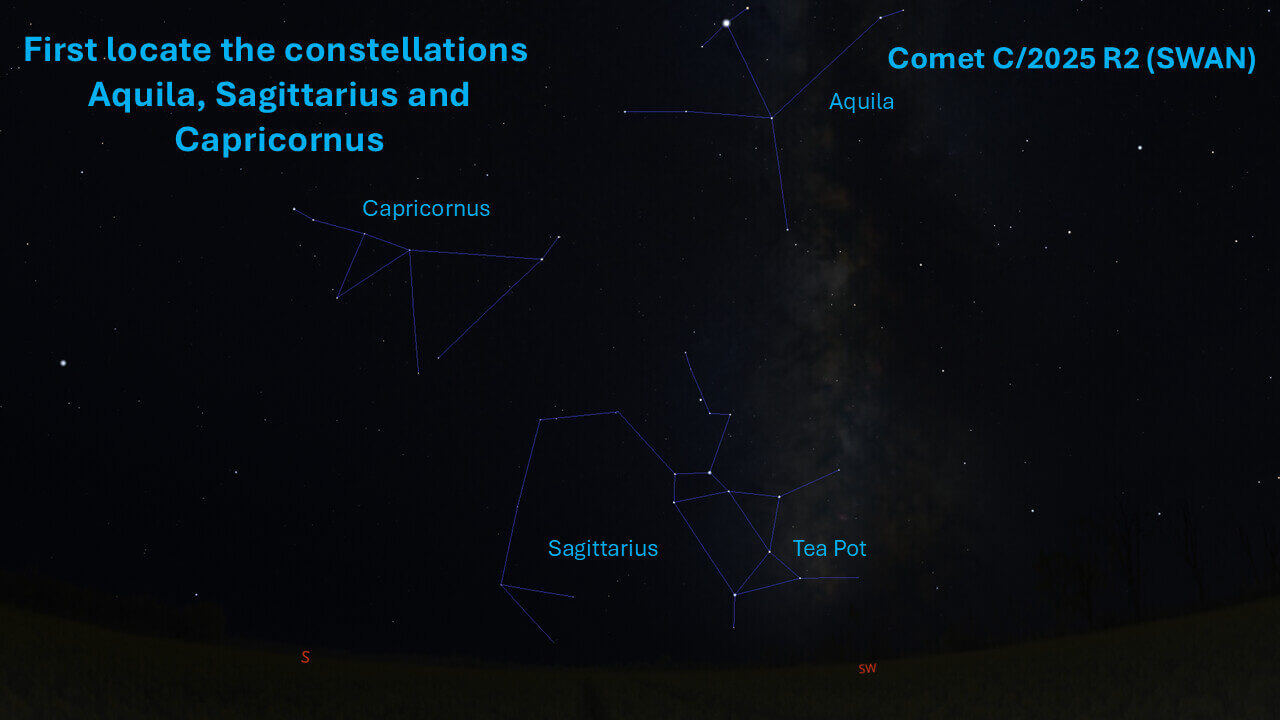
You can start find the constellations Aquila, Sagittarius and Capricornus in the south by 19:30. Image created using Stellarium.

Fainter stars are useful to make sure you are looking at the right star field. Planetarium software or a sky atlas will help you identify these stars. Image created using Stellarium.
Comet Resources
COBS – Comet Observation Database
Our next Star Party will be held on Friday, November 7, 2025, from 5:30 pm until 8:30 pm
On the first Friday of each month, the St. Louis Astronomical Society and the Saint Louis Science Center will set up a number of telescopes outdoors and be on-hand to answer your questions. Telescope viewing begins once it is dark. Regardless of the weather on November 7, join us indoors in our planetarium theater for our free monthly sky lecture.
The St. Louis Astronomical Society helps host the monthly Star Parties at the Saint Louis Science Center. In addition to our nighttime viewings, they also help facilitate our daytime event called Solar Sundays. These daytime viewing sessions occur every third Sunday each month from 11:00-15:00 weather permitting. Visit SLAS’s website linked above to learn about other telescope events SLAS hosts around the St. Louis area.
James S. McDonnell Planetarium
Night Sky Update: October 20, 2025
Subjects