This is the Saint Louis Science Center’s NIGHT SKY UPDATE for the week of Friday, April 3, 2026
Information updated weekly or as needed.
Times given as local St. Louis time this week will be in Central Daylight Time (CDT). For definitions of terminology used in the night sky update, click the highlighted text. If relying on times posted in Universal Time (UT), St. Louis is -5 hours when CDT. Times posted in the Night Sky Update are in the 24-hour format.
Join us for our next star party, Friday, May 1, 2026, held in association with the St. Louis Astronomical Society. For details, see the information at the bottom of this page or visit https://www.slsc.org/explore/mcdonnell-planetarium/public-telescope-viewings/
Observing Highlight
Well, it is official, spring has begun. The vernal equinox officially occurred at 14:45 CDT on March 20, 2026, as the Sun crossed the celestial equator at its ascending node. As a result, the Sun’s altitude will continue to increase in the northern hemisphere as it heads towards the June solstice. NOAA has posted its spring outlook which appears to forecast above-normal temperatures and worsening drought conditions. NOAA reports that 55% of the US is already experiencing moderate to exceptional drought conditions. The season has begun following some wild weather that included a historic blizzard in the north and historic triple digit temperatures for others. I would expect spring 2026 will have quite a bit more in store for us.
Just like spring brings us changes in weather, the sky is also changing. Familiar favorites such as Orion are still visible, however as spring progresses, Orion and the surrounding sky will become increasingly difficult to observe.
Replacing the winter sky are familiar highlights of the spring sky. Constellations such as Leo, Virgo and Boötes will become the patterns we see most of the night. Learning the bright constellations goes a long way for the spring sky as it is much dimmer than other seasons. We see less stars in the spring sky because we are looking away from the galactic plane.
Bright stars such as Regulus in Leo, Spica in Virgo and Arcturus in Boötes will be important stars to learn. These are easy to find regardless of how dark your sky might be. Regulus is a 4 star system. Telescopes can split Regulus into two stars called Regulus A and B. Arcturus is an orange giant star that is the 4th brightest star visible at night. Arcturus together with the summer star Vega and the winter star Capella divide the northern sky into thirds. Spica is a double star that consists of two blue hydrogen fusing dwarf stars. The primary star has a mass that is 10.5 times that of the Sun meaning a potential end for the star could be a supernova.
Deep sky objects to look forward to are galaxies such as Messier 101, 51, 81 and 82. The globular star cluster M3 in Canes Venatici makes for a great binocular target. If you do not have binoculars or a telescope, the open star cluster known as the Coma Cluster in the constellation Coma Berenices is an easy naked eye target.
For those interested in looking for deep sky objects, knowing the moon phase is will be important. When near full moon, the Moon appears much brighter due to the opposition effect. With this increased brightness, the Moon will make observing deep sky targets more difficult. Full moons over the next three months occur on April 2, May 1, May 31 and June 29 (first full moon of summer). The full moon occurring on May 31 is the 2nd in one month making it a blue moon. Due to the Moon’s synodic cycle be roughly 29.5 days, it is possible to have two full moons in one month. The other type of blue moon occurs when there are 4 full moons in one season. The next seasonal blue moon occurs on May 20, 2027.
The best planets to look for this spring are Venus and Jupiter. You will find Venus in the west after sunset and Jupiter overhead about 30 minutes after sunset. Saturn followed by Mars will start to climb out of the Sun’s glare in April becoming targets in May provided you have a clear view to the east.
On April 25, 2026, The Moon will occult the bright star Regulus. Unfortunately, the start of the occultation occurs before the Sun sets in St. Louis. By 20:16 CDT, Regulus will begin to reappear near the northwestern limb of the Moon. Binoculars or a telescope are recommended but it is an event visible with the unaided.
Lastly, April and the start of May might have two comets for us to track down. The comets are called C/2026 A1 (MAPS) and C/2025 R3 (PanSTARRS). For information on C/2026 A1 (MAPS) view previous Night Sky Updates in 2026. As for C/2025 R3 (PanSTARRS), more information will be given in later posts of the Night Sky Update.
Comet C/2026 A1 (MAPS) Updates
Comet C/2026 A1 (MAPS) will reach perihelion on April 4, 2026. Estimates for its size have decreased to just 0.2 km. This is much smaller then early estimates which suggested the comet could be as large as 2 km. Due to its small size some believe the comet will break up as it approaches its perihelion on April 4. New estimates put the peak magnitude for C/2026 A1 (MAPS) at -2.1 magnitude at perihelion. If this proves to be correct, this magnitude will not be bright enough for daytime visibility. The best way to watch C/2026 A1 (MAPS) over the next few days will be through coronographs aboard the SOHO and GOES-19 spacecraft.
GOES CCOR-1, LASCO C2 and LASCO C3 Coronographs
T CrB Nova Update 4/3/2026
f you are still interested in seeing the recurrent nova T Coronae Borealis, there is still hope. The nova has not yet occurred meaning we are in a waiting game. If you are still interested, the part of the sky the nova will appear in is found rising in the east by 10 pm. The star system T Coronae Borealis is found in the constellation Corona Borealis which looks like a small U-shape of stars next to the constellation Boötes.
By 3 am the location of T CrB will be nearly overhead. Besides observing the sky directly, you can track the behavior of T CrB by checking current magnitude estimates posted at AAVSO here or by visiting spaceweather.com. Current magnitude estimates of the system show it at 10th magnitude.
The Sun and Moon
Sun
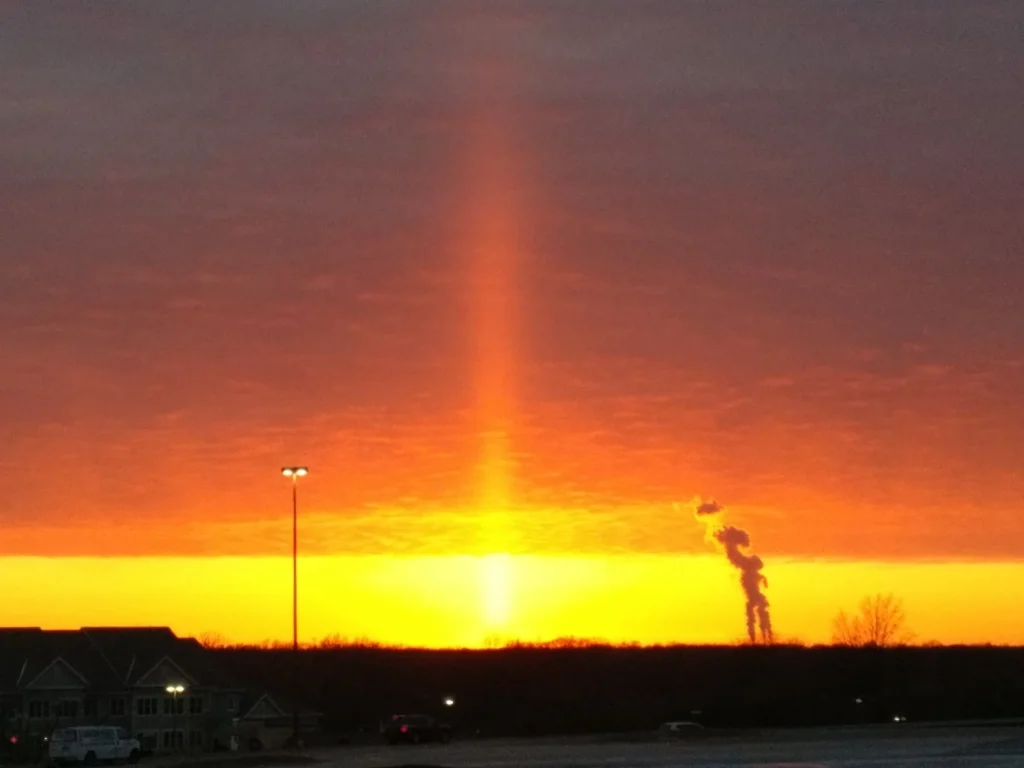
Sunrise on Friday, April 3 is at 06:42 and sunset is at 19:26 providing over 12.5 to 13 hours of daylight. Even after sunset, light from the Sun will dimly illuminate our sky for a little over 1 hour and 30 minutes. This period is called twilight, which ends around 20:58 this week. For those with a sundial, local noon occurs around 13:04 on April 3, 2026.
| Day | Sunrise (CDT) | Sunset (CDT) |
| 03-Apr | 6:42 | 19:26 |
| 04-Apr | 6:41 | 19:27 |
| 05-Apr | 6:39 | 19:28 |
| 06-Apr | 6:38 | 19:29 |
| 07-Apr | 6:36 | 19:30 |
| 08-Apr | 6:35 | 19:31 |
| 09-Apr | 6:33 | 19:32 |
| 10-Apr | 6:32 | 19:33 |
| 11-Apr | 6:30 | 19:34 |
Moon
Moonrise for Friday, April 3, is at 21:26 and moonset occurs at 07:36 the following morning. On April 3, 2026, the Moon will exhibit a waning gibbous phase with 96% disk illumination. By April 11, 2026, the Moon will exhibit a waning crescent phase with 32% disk illumination. Last quarter moon occurs on April 9, 2026, at 23:52.
International Space Station (ISS) Observing
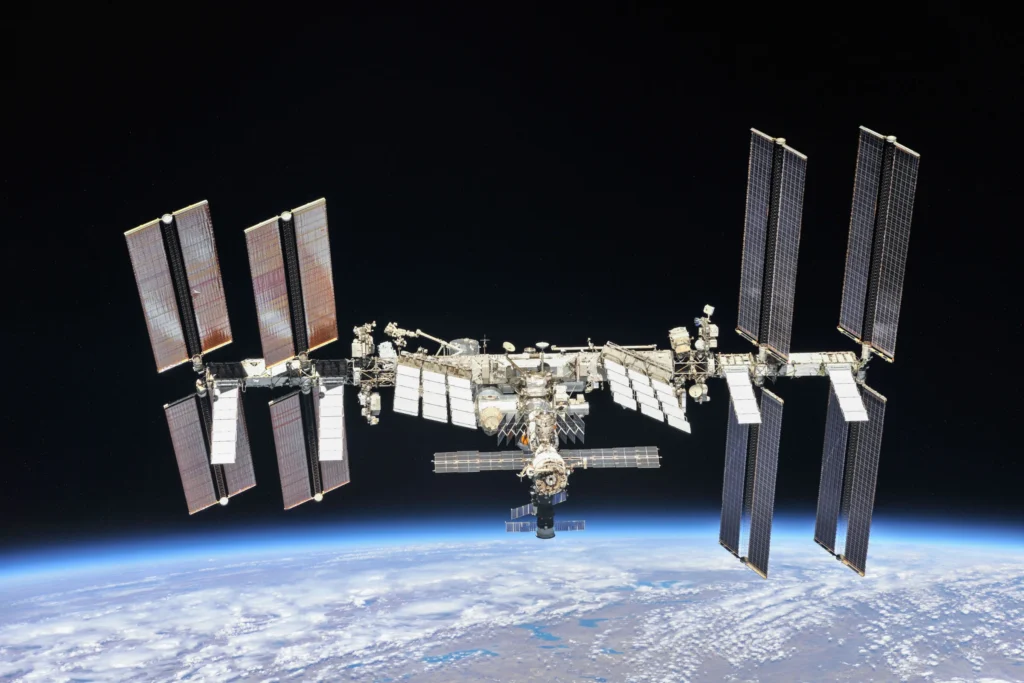
There are no visible passes of ISS from St. Louis for the week of April 3. Instead you can try find the Chinese space station called Tiangong this week. This week Tiangong can be found in evening hours from St. Louis, with the best passes occurring on April 7 and 9. You can find information about these and other satellite pass at https://heavens-above.com. If you are not viewing from the St. Louis area, make sure to change your viewing location for your local times.
Visible Planets
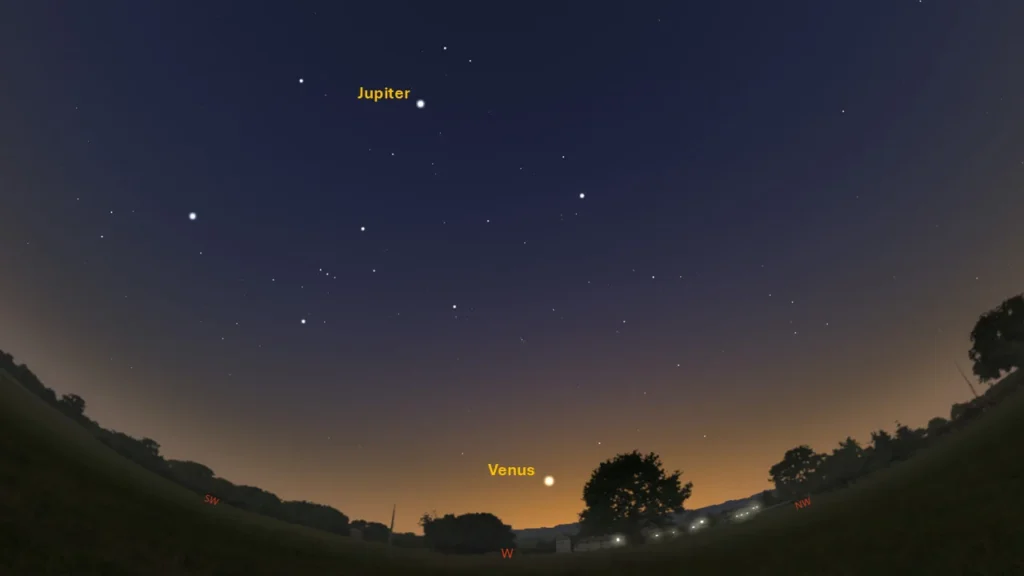
View looking west on April 3,2026, at 20:00. Image created using Stellarium
Two naked eye planets will be visible this week. Jupiter will be found high in the west and Venus low in the west after sunset.
Venus
Venus can now be seen low in the west after sunset. Its current evening apparition will continue until October as it approach inferior conjunction on October 23, 2026.
Jupiter
Jupiter will be visible high in the west about 30 minutes after sunset, Jupiter remains visible until 2 am at which time its low altitude will make it difficult to find for some viewers. Jupiter’s current apparition continues through June and some of July as it heads towards superior conjunction on July 29, 2026.
Uranus
Around 20:30 this week, the planet Uranus can be found in the west. Its current magnitude is 5.8 putting it within naked eye visibility only from dark locations. In reality, most will need to use binoculars to have a chance to spot this distant world. You can find Uranus in the constellation Taurus about 4° south of the Pleiades star cluster. Uranus will be near the stars 13 Tau and 14 Tau.
Our next Star Party will be held on Friday, May 1, 2026.
On the first Friday of each month, the St. Louis Astronomical Society and the Saint Louis Science Center will set up a number of telescopes outdoors and be on hand to answer your questions. Telescope viewing begins once it is dark.
The St. Louis Astronomical Society helps host the monthly Star Parties at the Saint Louis Science Center. In addition to our nighttime viewings, they also help facilitate our daytime event called Solar Sundays. These daytime viewing sessions occur every Sunday through Labor Day. After Labor Day they occur on the 3rd Sunday each month. Visit SLAS’s website linked above to learn about other telescope events SLAS hosts around the St. Louis area.
James S. McDonnell Planetarium
Night Sky Update for April 3, 2026
Subjects