Day Sky Update June 2026
This is the Saint Louis Science Center’s DAY SKY UPDATE for the Month of June 2026.
Information updated monthly or as needed.
Times given as local St. Louis time which is Central Daylight Time (CDT). For definitions of terminology used in the night sky update, click the highlighted text. If relying on times posted in Universal Time (UT), St. Louis is -5 hours when CDT. Additionally, times will be posted in a 24-hour format.
Join us for our next solar telescope viewing each Sunday through Labor Day, held in association with the St. Louis Astronomical Society. These viewing sessions are weather dependent. For details, see the information at the bottom of this page or visit https://www.slsc.org/explore/mcdonnell-planetarium/public-telescope-viewings/
Daytime Astronomy Primer
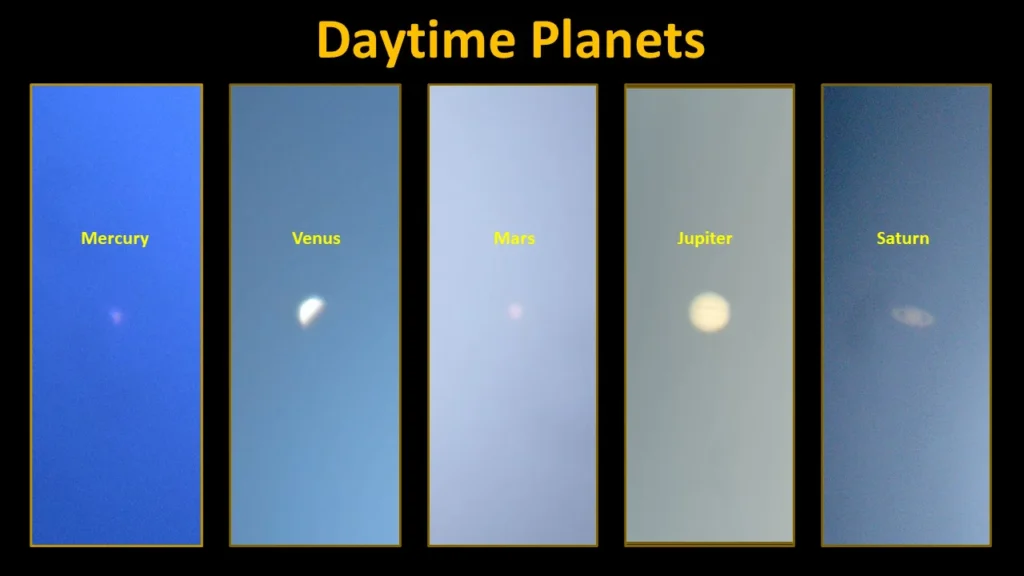
Image shows daytime telescope view of the five naked eye planets. Image credit: Eric Gustafson
For most, astronomy is a hobby that is left to the darkness of night. While most astronomical objects are only visible at night, the day sky can offer a careful observer several astronomical targets along with a multitude of atmospheric phenomena to enjoy. When posted, the DAY SKY UPDATE will explore these possibilities which may include a highlight of the month, cloud observing, sun rise/set times, daytime Moon information, daytime planets and other topics. As always, when viewing during daytime, you must use caution as the Sun is always near.
Aside from solar filters, there are other safety steps that you should consider. Sunscreen, hats and sunglasses are always advisable. Visible light is how we observe the world around us, however, there is light we cannot see such as ultraviolet (UV) and infrared (IR) lights. While both are an issue if you are using an optical system, UV light is an issue through exposure. This can be mitigated by using sunscreen, sunglasses and limiting exposed skin. While sunglasses are not safe instruments to view the Sun with, they do protect your eyes from exposure to ultraviolet light that we are susceptible to during the day.
Observing Highlight
If you have been consuming any form of scientific content or even just watching the news lately, you might have heard about the “super” El Niño that is likely to develop over the next few months. For this month’s highlight, we will explore what El Niño is, what system it is a part of, and what impacts the United States could potentially experience in the next couple of months. So, if you have been curious or unsure of what all this El Niño news is about, hopefully this will help.
ENSO
Let us first clear up the difference between weather and climate, because even though they are related, they are two different things. Weather is the current conditions we experience over a short period of time, like a thunderstorm. Alternatively, climate is the long-term average conditions and patterns of weather, like historical averages. El Niño is considered a climate system because it is a recurring interaction between the ocean and the atmosphere that continuously takes place over the years. The said, scientists do acknowledge that El Niño impacts local weather during its phases.
Before we start getting into the details of El Niño, we first need to look at the bigger picture. El Niño is a part of a larger system that we call ENSO (El Niño – Southern Oscillation). ENSO is the overall climate pattern across the tropical Pacific Ocean involving El Niño and La Niña, which switches back and forth every 3 to 7 years on average. ENSO experiences three phases: El Niño (the warm phase), neutral, and La Niña (the cold phase) which all lead to large scale changes in sea surface temperature, precipitation, atmospheric pressure, and wind patterns all around the globe. The El Niño phase is when sea surface temperatures (SST) transition to becoming above average and the trade winds, which normally blow from east to west (easterlies), become weak and even in some cases start blowing from west to east (westerlies). The La Niña phase is when SST are below average, and the easterlies become strong. The Neutral phase indicates that conditions are at their long-term average and we do not experience El Niño or La Niña at that time.
The phases of El Niño and La Niña tend to last 9 – 12 months but can also last more than a year. The longest La Niña lasted 33 months while the longest El Niño was 18 months. El Niño also tends to occur more often than La Niña. They both tend to develop during the spring months, reaching peak intensity during the late fall to early winter, and then weaken during springtime or early summer.
WHAT IS EL NIÑO
The bare bones definition of what El Niño is, describes the warming of ocean surface temperatures off the coast of Peru and Ecuador along the central and eastern Pacific Ocean. In the neutral phase, there is a constant low pressure over the warm western tropical Pacific, while there is high pressure over the cooler central and eastern tropical Pacific. Air naturally moves from high to low pressure, this makes up the easterlies. These trade winds push warm water from South America all the way to Asia. Cold water from below will come up to replace the displaced warm water in a process referred to as upwelling. The process of upwelling is important for delivery of nutrient rich cold waters.
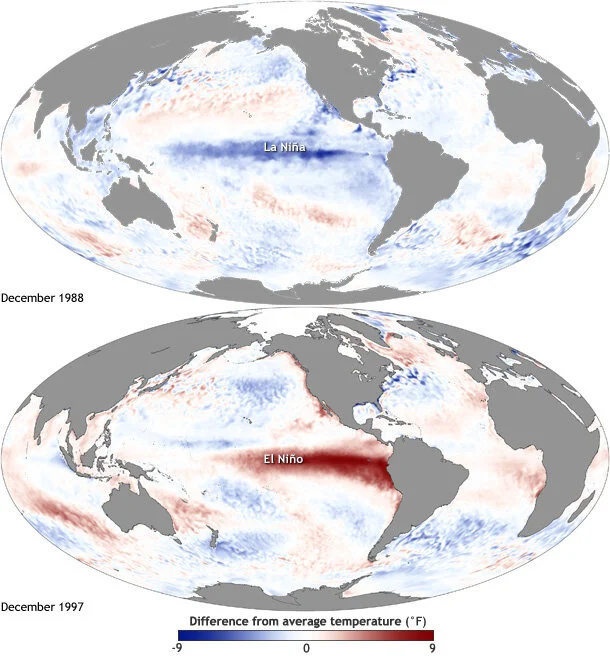
Image showing sea surface temperature difference in the Pacific Ocean during El Niño in 1997. Credit: NOAA
For El Niño conditions to start forming, there needs to be a weakening of the trade winds and a rise in sea surface temperature. Sometimes the low pressure over the western tropical Pacific and the high pressure over the central and eastern tropical Pacific will weaken. This change in pressure differences will start to weaken the trade winds, thus reducing upwelling of cold water. This causes a buildup of warm water in the eastern Pacific. What’s fascinating is that the state of the atmosphere and the ocean depend on each other. As conditions of the ocean change, the atmosphere will respond. The SST in the eastern Pacific will continue to warm, the atmosphere responds by weakening the trade winds, which causes the sea surface temperatures to continue warming. This is known as a positive feedback loop. El Niño is officially declared when SST are 0.5˚C warmer than average for a least three months consecutively.
WHAT ARE THE EFFECTS OF El NIÑO IN THE US
Sea surface temperatures (SST) associated with El Niño can significantly affect the intensity of severe weather events, including tornado outbreaks, snowstorms, severe flooding, and hurricane formation. During the summertime, warmer sea surface temperatures can fuel hurricane formation in the central and eastern Pacific Ocean. On the other hand, El Niño can disrupt the formation of hurricanes in the Atlantic Basin, with a reduction in system intensity, and a 60% reduction in numbered hurricane days. El Niño increases trade winds in the Atlantic, thus increasing strong wind shear which is the change in wind speed or direction with height. Hurricanes rely on little vertical wind shear to develop and strengthen, but when wind shear is high, it can tear storms apart and make development more difficult. Additionally, the warm SST causes an intensification and southward shift in the jet stream influencing daily weather patterns. Seasonally, El Niño tends to have its largest impacts during the wintertime. The northern US will experience warmer than average temperatures and will see less winter storms. The Ohio valley will be milder and drier than normal. The southern US will experience colder temperatures, higher potential for sever weather and increased precipitation which impacts flooding, especially during drought conditions.
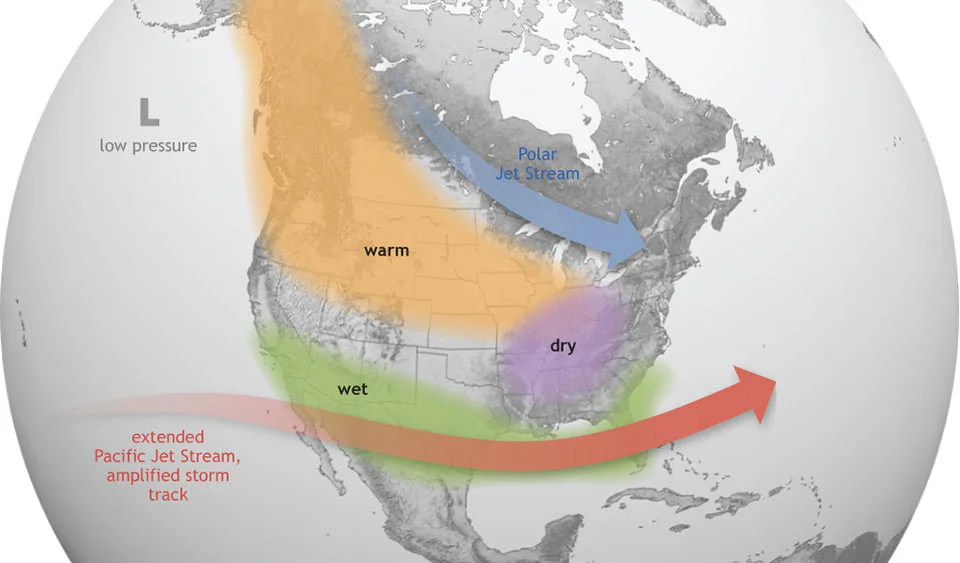
Image showing how El Niño causes the jet stream to move more south and its impacts on temperature and precipitation during the winter in North America. Credit: NOAA
Furthermore, changing ocean temperature and ocean currents can alter the distribution and abundance of marine life off the coast of South America. The changes impact marine life because El Niño disrupts the distribution of nutrient rich cold waters.
Due to the lack of nutrients, there are fewer phytoplankton, which limits food availability for other marine life. This negative impact is not only felt locally but it also affects the food chain globally.
Scientists have been able to identify specific impacts El Niño can bring to the US, but they are not guaranteed to happen during every El Niño event. Also remember, correlation is not causation. In other words, just because it occurs during El Niño does not means it is because of El Niño.
Scientist must estimate and analyze how El Niño contributed to these events, like looking at the amount of water vapor available or the shifting of the jet stream. Depending on the strength of El Niño that year, the influence on these outcomes will vary dramatically.
WHAT IS A SUPPER EL NIÑO
NOAA (National Oceanic and Atmospheric Administration) determines the strength of El Niño by monitoring the Oceanic Niño Index (ONI), which is a three-month average of sea surface temperatures in a specific portion of the Pacific Ocean between 120˚W – 170˚W known as the Niño 3.4 region. Collected data from satellites, buoys, and ships are put into computer models which are used for guidance to make a forecast. Based on these observations of the ONI, NOAA will declare an El Niño as weak, moderate, or strong.
A strong El Niño happens when the ONI is greater or equal to 1.5°C. “Super” El Niño is more of a term used by the media to describe a strong El Niño, with an ONI greater or equal to 2.0˚C. There have only been five strong El Niño events since 1950, with the last one being 2015-2016. A strong El Niño intensifies the already known impacts that we know, like more severe weather and flooding in the south, and even warmer and drier conditions up north that can intensify wildfire risks.
El Niño and La Niña have the potential to make extreme weather events more likely. Being able to predict the cycle and strength of El Niño or La Niña is crucial for protecting life, property, agriculture, energy, transportation, water supply, and even health care.
NOAA’s Climate Prediction Center posts ENSO Diagnostic Discursions on the 2nd Thursday of every month. As of their latest update, ENSO is still in its neutral phase and sea surface temperatures are slightly above average, this constitutes being in an El Niño Watch. There is currently an 82% chance that El Niño will arrive between May and July of this year, so scientists are confident there will be an El Niño this year, but the strength of it is still to be determined.
If you would like to dive deeper into this topic visit
The Sun and the Moon
Sun Information
The month of June sees the Sun reach its northern standstill. When viewed from St. Louis, the Sun’s maximum altitude will shift from 73.5° on June 1, 2026, to 74.8° on June 21, 2026. After the summer solstice, the Sun’s altitude will begin to decrease until it reaches the next standstill in December. On June 30, 2026, the Sun’s maximum altitude will be 74.5°. The next major position of the Sun occurs on June 21, 2026, as the Sun reaches the June solstice.
Summer in the northern hemisphere begins this month when the Sun reaches its northern standstill. This standstill moment occurs at 03:24 on June 21, 2026. This day is called the summer solstice in the northern hemisphere which is when the Sun reaches its maximum altitude for the year.
| June Solstice | June 21, 2026 |
| Sept. Equinox | Sept. 22, 2026 |
| Dec. Solstice | Feb. 21, 2026 |
| March Equinox | March 20, 2027 |
Sunrise and Sunset Times for St. Louis Missouri
The sunrise and sunset times below were calculated by the Earth Systems Research Laboratories for NOAA. These times are calculated using equations for Jean Meeus’s Astronomical Algorithms. The atmosphere complicates these calculations due to the refraction of sunlight as it passes through the atmosphere. For the times listed below, the amount of atmospheric refraction is assumed to be 0.833°. Variations in the atmosphere can change the amount of refraction so the times posted are accurate to within a minute for latitudes between +/- 72°.
| Day | Sunrise (CDT) | Sunset (CDT) |
| 1-June | 5:38 | 20:20 |
| 2-June | 5:38 | 20:20 |
| 3-June | 5:37 | 20:21 |
| 4-June | 5:37 | 20:21 |
| 5-June | 5:37 | 20:22 |
| 6-June | 5:36 | 20:23 |
| 7-June | 5:36 | 20:23 |
| 8-June | 5:36 | 20:24 |
| 9-June | 5:36 | 20:24 |
| 10-June | 5:36 | 20:25 |
| 11-June | 5:36 | 20:25 |
| 12-June | 5:36 | 20:26 |
| 13-June | 5:36 | 20:26 |
| 14-June | 5:36 | 20:27 |
| 15-June | 5:36 | 20:27 |
| 16-June | 5:36 | 20:27 |
| 17-June | 5:36 | 20:28 |
| 18-June | 5:36 | 20:28 |
| 19-June | 5:36 | 20:28 |
| 20-June | 5:36 | 20:28 |
| 21-June | 5:36 | 20:29 |
| 22-June | 5:37 | 20:29 |
| 23-June | 5:37 | 20:29 |
| 24-June | 5:37 | 20:29 |
| 25-June | 5:38 | 20:29 |
| 26-June | 5:38 | 20:29 |
| 27-June | 5:38 | 20:29 |
| 28-June | 5:39 | 20:29 |
| 29-June | 5:39 | 20:29 |
| 30-June | 5:40 | 20:29 |
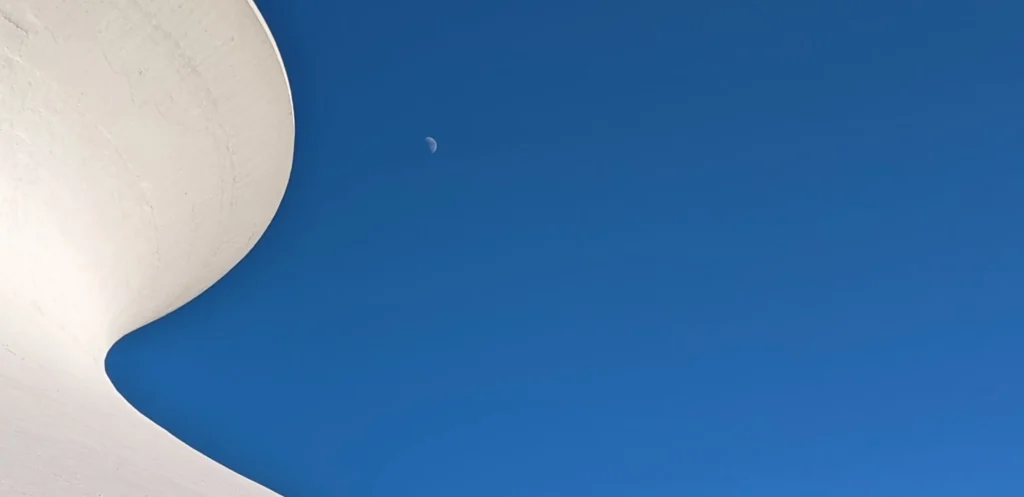
Moon (daytime views)
Last quarter moon occurs on June 8, 2026, and first quarter moon occurs on June 21, 2026. The best daytime views of the Moon are always near the quarter phases. Look for the Moon in the morning at the beginning of June. When we are near first quarter phase, look for the Moon in the afternoon.
The Moon crosses the ecliptic at its ascending node this month on June 7, 2026, and then at its descending node on June 21, 2026. This behavior occurs because the Moon’s orbit around Earth is tilted about 5.1° with respect to Earth’s ecliptic. This nodal cycle of the Moon is called a draconic month which is 27.2 days long. Being aware of these crossing nodes helps observers know if the Moon will appear south or north of the ecliptic.
| Phase | Date | Time (CDT) |
| Full Moon | May 31, 2026 | 03:45 |
| Last Quarter | June 08, 2026 | 05:01 |
| New Moon | June 14, 2026 | 21:54 |
| First Quarter | June 21, 2026 | 16:55 |
| Full Moon | June 29, 2026 | 18:57 |
Solar Sunday is now held every Sunday from 11:00 a.m. until 3:00 p.m. (Weather Dependent). This will continue until Labor day.
Every Sunday through Labor Day, the St. Louis Astronomical Society and the Saint Louis Science Center will set up a number of safe solar telescopes outdoors and be on hand to answer your questions. Telescope viewing begins at 11:00 a.m. weather permitting.
The St. Louis Astronomical Society helps host the monthly Star Parties at the Saint Louis Science Center. In addition to our daytime viewings, they also help facilitate our nighttime Public Telescope Viewing. These nighttime viewing sessions occur on the 1st Friday each month. Visit SLAS’s website linked above to learn about other telescope events SLAS hosts around the St. Louis area.
Subjects