This is the Saint Louis Science Center’s DAY SKY UPDATE for the Month of May 2025.
Information updated monthly or as needed.
Times given as local St. Louis time which is Central Daylight Time (CDT). For definitions of terminology used in the night sky update, click the highlighted text. If relying on times posted in Universal Time (UT), St. Louis is -5 hours when CDT. Additionally, times will be posted in a 24-hour format.
Join us for our next solar telescope viewing, Sunday, May 18, 2025, held in association with the St. Louis Astronomical Society. For details, see the information at the bottom of this page or visit
Daytime Astronomy Primer
For most, astronomy is a hobby that is left to the darkness of night. While most astronomical objects are only visible at night, the day sky can offer a careful observer several astronomical targets along with a multitude of atmospheric phenomena to enjoy. When posted, the DAY SKY UPDATE will explore these possibilities which may include a highlight of the month, cloud observing, sun rise/set times, daytime Moon information, daytime planets and other topics. As always, when viewing during daytime, you must use caution as the Sun is always near.
Aside from solar filters, there are other safety steps that you should consider. Sunscreen, hats and sunglasses are always advisable. Visible light is how we observe the world around us, however, there is light we cannot see. Ultraviolet (UV) and infrared (IR) light are great examples of this. While both are an issue if you are using an optical system, UV light is an issue through exposure. This can be mitigated by using sunscreen, sunglasses and limiting exposed skin. While sunglasses are not safe instruments to view the Sun with, they do protect your eyes from exposure to ultraviolet light that we are susceptible to during the day. If you would like to learn more about UV and its dangers use the buttons below.
Cloud of the Month
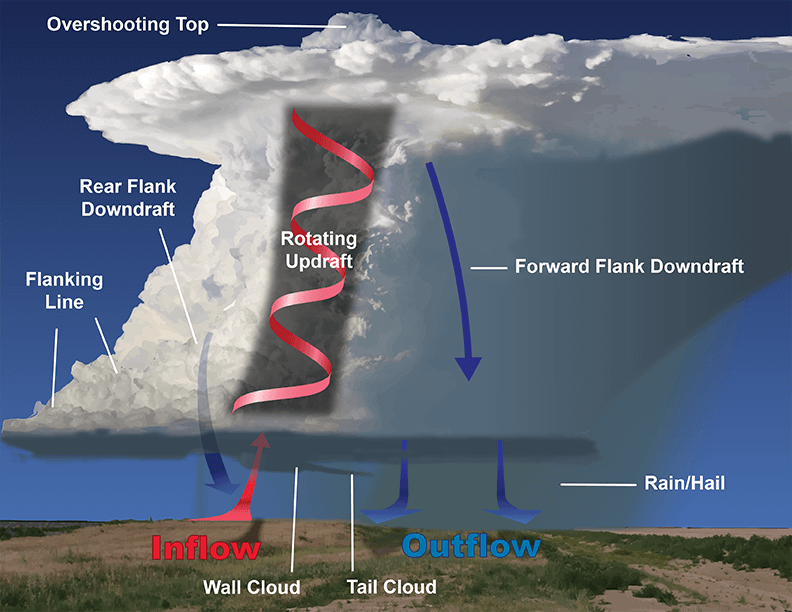
Image showing a cross section of a mature supercell and its main characteristics. Image credit NWS
We are currently in the season of spring, which means we are in severe weather season. On a beautiful spring day, one might look in the sky and see a towering cloud with an anvil stretching out, a supercell. These storms produce most tornadoes, large hail, and straight-line winds.
A supercell is a severe thunderstorm that contains a rotating updraft. This organized internal structure allows the storm to maintain itself for several hours. No two supercells are alike, but they are divided into three types.
Classic supercells: These are the most common type of storms which produce heavy rain, large hail, intense wind, and the majority of tornadoes.
HP (high precipitation) supercells: These storms become dominated by heavy precipitation, very strong downdrafts, and large hail. They tend to form in high moisture environments with weak wind shear (the change in wind’s speed, and/or direction). If tornadoes form in a HP supercell, it can be rain wrapped and make it difficult to see, which can lead to a very dangerous situation, especially during the nighttime.
LP (low precipitation) supercells: These storms produce little rain but are still capable of producing large hail and tornadoes. They are most common and form in drier environments like the Southern and High Plains.
Supercells are different from your average thunderstorm. They have very distinct characteristics that distinguish them from other storms. They are something to look out for, especially when anticipating severe weather. It is important to keep in mind that aside from the rotating updraft, not all of these features will be present or visible in every storm.
The mesocyclone: A rotating column usually on the southwest side of the storm which typically ranges from 3-6 miles in diameter. This rotating updraft is so strong that precipitation cannot fall through it. This produces a rain free area known as the “rain free base” right underneath the updraft.
Wall cloud: A lowering, rotating cloud base where humid, rain cooled air from the downdraft, is drawn into the updraft. It will often appear hanging down from the rain free cloud base on the trailing side of the storm. This can be an indication that a tornado might drop.
Anvil: An elongated cloud that spreads downwind from the initial storm which can extend hundreds of kilometers.
Rear flank downdraft (RFD): Mid-level winds from the southwestern portion of the storm will wrap around the updraft. Precipitation will mix with the dry air and evaporate, causing the air to cool and descend towards the surface.
Forward flank downdraft (FFD): Located on the northeast side of the storm, specifically the rain cooled region. Falling precipitation particles drag air down with them, forming the downdraft. This falling air will not cut off the updraft, allowing the storm to maintain its energy and not dissipate.
Overshooting top: The strong updraft from the storm will carry air parcels past its equilibrium point (the tropopause), causing the upper part of the cloud to rise and bubble up above the anvil.
Supercells, like any other type of storm, require the right atmospheric ingredients to form.
- Very moist air in the lower troposphere. Moisture is crucial for a storm’s development. When warm, moist air rises, it cools and condenses, forming clouds.
- A conditionally unstable environment (humid and warm air at the surface and dry cold air aloft). This develops in the atmosphere when air is heated near the surface while the colder air aloft moves over the dry region. Supercells are most common in the Great Plains, where the moist air mass originates from the Gulf of Mexico, and the dry air mass originates from the mountains and deserts out west.
- Moderate to strong vertical wind shear through the unstable layer. It is important for supercell development for the environmental winds to increase with height within the layer of maximum instability. Narrow strong winds (low-level jet) will often develop above the surface, either by nighttime cooling, or by a strong pressure gradient along a frontal boundary. This low-level jet transports warm moist air northward in the lower atmosphere, and also provides low-level vertical winds shear that supports rotation within the storm.
- A trigger mechanism to initiate lifting. Supercells have a tendency to form where boundary intersections occur such as the intersection of a dry line and warm front, the outflow and a cold front, or an upper-level front and a warm front. Once a single supercell develops, gust front outflows from that initial storm can often trigger new supercells.
Supercells are different from your average thunderstorm, having a strong rotating updraft. Nearly all supercell storms will produce some form of severe weather (large hail, damaging winds, or even tornadoes). It’s important to stay weather aware and listen to your local weather station or radio. If you hear thunder, you are in a high-risk area for lightning strikes. Thunder can often be heard up to 15 miles away, take this sound as a warning sign to take shelter indoors. One can visit the Storm Prediction Center to get forecasts and warnings for all severe weather.
The Sun and the Moon
Sun Information
During May 2025, the Sun will continue its journey towards its northern standstill later this year in June. If you track the position of sunrise or sunset this month you will find these positions are shifting to the north. Maximum altitude will also change each day as the Sun reaches higher altitudes each day closer to the June solstice. For May 2025, the Sun’s maximum altitude will shift from 66.7° on May 1st, to 73.4° on May 31st.
The next major position of the Sun occurs on June 20, 2025, as the Sun reaches the June Solstice. For us in the northern hemisphere, this is the Summer Solstice which signals the start of summer. The world around us will continue to bloom. Sever weather will likely continue this month. Threats of frosts should be behind us this month so if you have not already, it is time to start planting those gardens. If agriculture or gardening is your interest you should check out our GROW exhibit.
Sunrise and Sunset Times for St. Louis Missouri
The sunrise and sunset times below were calculated by the Earth Systems Research Laboratories for NOAA. These times are calculated using equations for Jean Meeus’s Astronomical Algorithms. The atmosphere complicates these calculations due to the refraction of sunlight as it passes through the atmosphere. For the times listed below, the amount of atmospheric refraction is assumed to be 0.833°. Variations in the atmosphere can change the amount of refraction so the times posted are accurate to within a minute for latitudes between +/- 72°. You can learn more about these calculations and where to generate times for areas outside of St. Louis, Missouri by using the buttons below
Moon (daytime views)
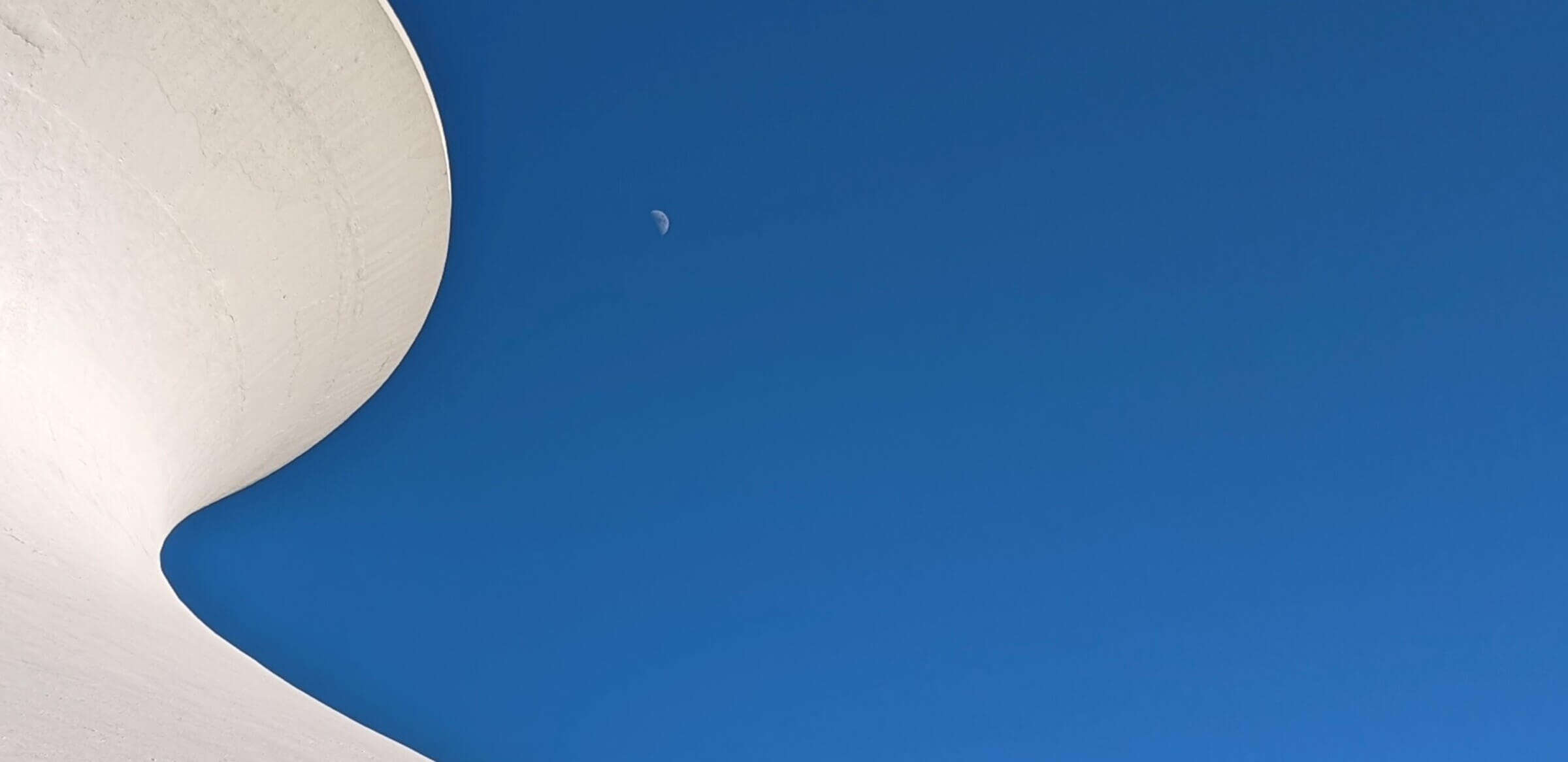
The Moon is one of the best daytime targets. Throughout most of the synodic month, the Moon can be viewed during the day. There are, however, ideal phases during which the Moon is much easier to find and see. There are only two phases of the Moon during which it is not visible in daytime; these are new moon and full moon. During new moon, the Moon is between Earth and the Sun. The side facing us is not reflecting sunlight and will not be visible. The only time we can see the Moon during new moon is when we see its silhouette during a solar eclipse.
During full moon, daytime views are not possible because the Moon is appearing near the anti-solar point in the sky. Because of this position, the Moon rises while the Sun is setting. The closer the moon is to one of these two phases, the more difficult it is to find it in daytime.
The ideal time to look for the Moon during the day is when the Moon is near a quarter phase. During a quarter phase, the contrast between the Moon and the sky will be good making it easier to find. If the Moon is near first quarter, you should look for it in the afternoon. If it is near last quarter, look for it in the morning. The table below will list the main phases of the Moon for the current lunation.
Our next Solar Sunday will be held on Sunday, May 18, 2025, from 11:00 a.m. until 3:00 p.m. (Weather Dependent)
On the third Sunday of each month, the St. Louis Astronomical Society and the Saint Louis Science Center will set up a number of safe solar telescopes outdoors and be on-hand to answer your questions. Telescope viewing begins at 11:00 a.m. Starting Memorial Day, Solar Sunday occurs every Sunday occurring from 11:00 a.m. to 3:00 p.m. weather dependent.
The St. Louis Astronomical Society helps host the monthly Star Parties at the Saint Louis Science Center. In addition to our daytime viewings, they also help facilitate our nighttime Public Telescope Viewing. These nighttime viewing sessions occur on the 1st Friday each month. Visit SLAS’s website linked above to learn about other telescope events SLAS hosts around the St. Louis area.
The Day Sky Update is compiled by McDonnell Planetarium staff.
Subjects